Math Worksheets · Free 13-page pack
Free Comparing Money Amounts Worksheets PDF
This 13-page comparing money amounts pack is designed for grade 2. Its six practice pages ask children to compare two groups of coins using greater than, less than, or equal to relationships. Students total the cents on each side, and the PDF includes an answer key on pages 8-13.
Edited by Tessa Vaughn · Planning & Organization Editor
Free download
Download the 13-page pack
This multi-page pack currently has one print-ready format. Preview the PDF, then print the whole pack or only the page range you need.
Share to Google Classroom ↗No sign-up required · personal/classroom use
Practice this skill on screen30 questions in three levels (easy, medium, hard) with instant feedback. Nothing to install.Get the whole set: 5 packs in one zipMoney worksheet packs. Grades 1–3: coins, bills, comparing amounts and making change. US Letter PDFs with answer keys, 451 KB.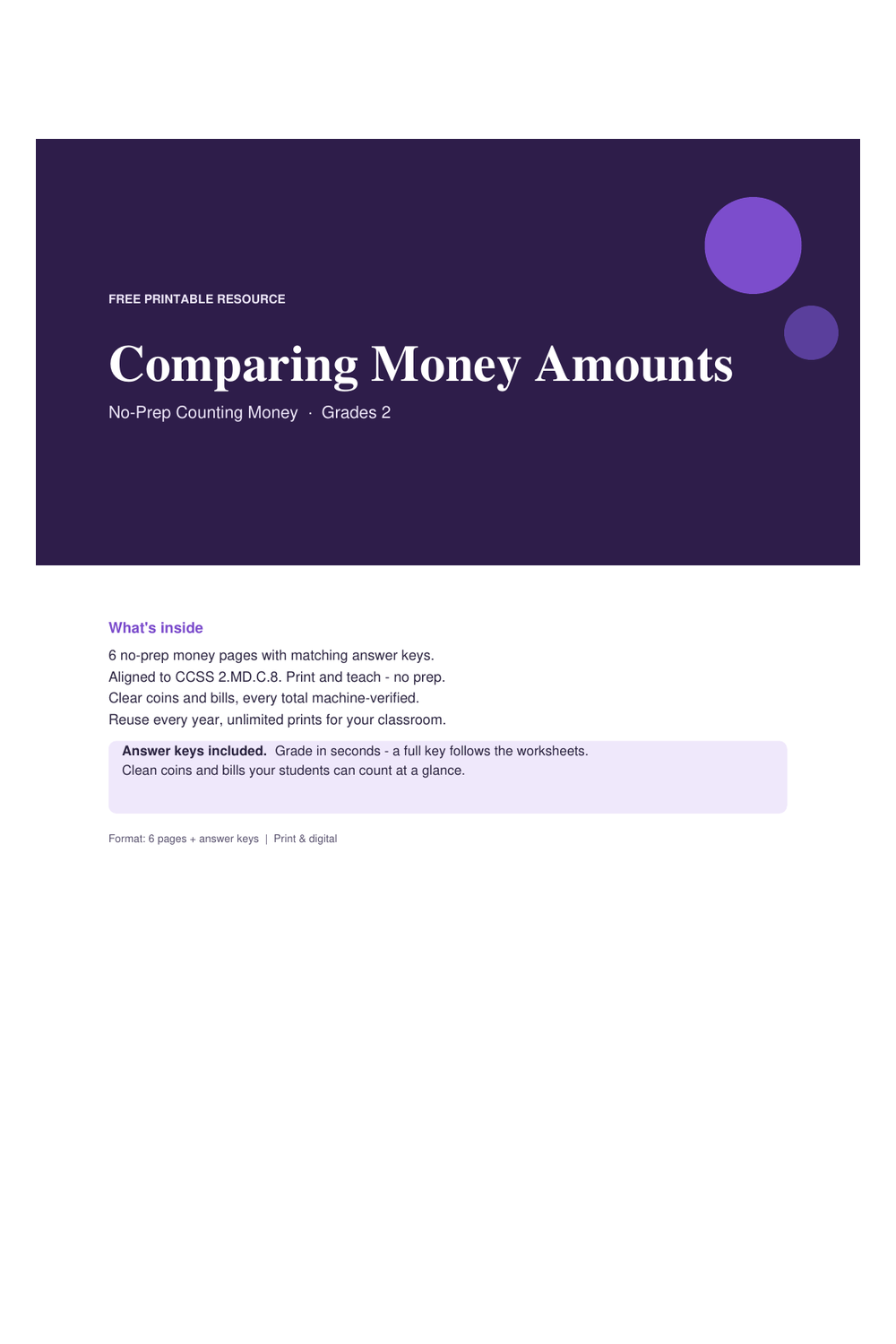
What this printable is for
A cover begins this 13-page US Letter PDF; six sheets ask students to compare pairs of coin collections, and the answer key occupies pages 8-13. Every practice sheet has six numbered comparisons plus Name and Date lines. The coin groups use pennies, nickels, dimes, and quarters. On page 2, one pair is worth 20 cents and 16 cents; page 7 includes a collection of eight quarters.
How to compare two money totals
A coin group is worth the sum of its coin values. Count each group first, then compare the totals; do not decide by looking at how many coins are present. A group with fewer coins can be worth more when it includes a quarter. The symbols > and < point toward the smaller amount, while = means both groups have the same value.
Children can organize the counting by starting with the largest coins and adding smaller values afterward. For instance, three dimes and two nickels make 40 cents: 10 + 10 + 10 + 5 + 5. A quarter, a dime, and a nickel also make 40 cents. Once both totals are known, matching values mean equality even when the coin groups look different.
Worked example 1
Compare 10 cents + 5 cents + 5 cents with 10 cents + 5 cents + 1 cent.
Add the first group to get 20 cents. Add the second group to get 16 cents. Since 20 is greater than 16, choose the greater-than sign.
Answer: 20 cents > 16 cents
Worked example 2
Compare a quarter, a dime, a nickel and a penny with a penny, a nickel, a dime and a quarter.
The first set totals 25 + 10 + 5 + 1 = 41 cents. Reordering the same coin values does not change the sum.
Answer: 41 cents = 41 cents
Worked example 3
Compare 10 + 10 + 10 + 5 cents with 25 + 25 + 25 + 25 + 1 cent + 1 cent.
Three dimes and a nickel make 35 cents. Four quarters and two pennies make 102 cents. The first value is smaller.
Answer: 35 cents < 102 cents
Teaching it step by step
Make coin value cards
Write 1, 5, 10, and 25 on cards and pair each value with its coin name. Before comparing groups, have children sort the values from least to greatest. This separates knowing a coin's value from counting the coins in a pile.
Total each side
Draw a line between the two groups and record a running total under each side. For a group with three quarters, say 25, 50, 75 before adding any dimes or pennies. Compare the completed totals only after both sides are counted.
Choose the symbol
Place two number cards on a table, such as 20 and 16. Ask which amount is larger, then arrange > so its open side faces that amount. Turn the cards around and describe how the same comparison becomes 16 < 20.
Find equal combinations
Build 40 cents once with dimes and nickels, then make the same value with a quarter, dime, and nickel. Ask what stayed equal and what changed. This helps children separate the worth of a group from the number of coins.
Where it fits best
Ways to use it
A coin value check
Ask a child to estimate which group is larger before totaling. Then compare the estimate with the counted values and discuss whether a quarter changed the first impression.
Explain a symbol
Use one completed comparison to have learners explain why the open side points toward the larger total. Their words can clarify whether they understand the relation, not just the shape.
Compare different groups
Invite students to invent two coin combinations with equal value, such as 40 cents in different ways. The task reinforces that a total can stay fixed while the coins change.
Where learners go wrong
A learner says three pennies are worth more than one quarter because 3 coins outnumber 1.
Label the values before comparing counts: three pennies make 3 cents, while one quarter is 25 cents. Ask the learner to compare cents rather than the number of pieces.
A child totals 25 cents + 10 cents + 5 cents as 35 cents by forgetting the nickel.
Touch each coin once while keeping a running total: 25, then 35, then 40. Write the partial sums below the group so no coin is skipped or counted twice.
A student writes 20 cents < 16 cents after pointing the symbol opening toward 16.
Read the symbol aloud as a sentence: 20 is greater than 16. The wide opening faces the greater amount, so the correct relation is 20 cents > 16 cents.
A learner marks 25 cents + 10 cents + 5 cents as greater than 10 cents + 10 cents + 10 cents + 5 cents + 5 cents.
Find both totals before placing a sign. Each group is 40 cents, so the relationship is equality even though one side has three coins and the other has five.
Frequently asked questions
How do you compare money amounts made from coins?
Count the value of each group in cents, then compare the two totals. Keep track of each coin once and include its worth, not just the number of coins. After finding the larger total, place the open side of > or < toward it; use = for matching values.
How to teach children to compare coin values?
Start by sorting pennies, nickels, dimes, and quarters by value. Build two small groups and record each running total aloud. Once the totals are clear, ask the child to choose a comparison symbol and explain which side is larger or whether the values match.
What are examples of comparing money amounts?
A group worth 20 cents is greater than one worth 16 cents, so write 20 cents > 16 cents. Three quarters, two dimes, and a penny total 96 cents, which equals 96 cents. These examples show why children need to total each collection before judging its value.
What is included in this comparing money amounts worksheet pack?
Across 13 pages, six comparison sheets sit between the cover and the answer section on pages 8 through 13. Every student sheet presents six coin-pair decisions with Name and Date blanks. Learners use pennies, nickels, dimes and quarters; the key gives the correct comparison symbol for each item.
Is this comparing money amounts worksheet pack free?
You can download this pack at no cost, with no registration. The file is a US Letter PDF only: it has no A4 or PNG version. Its answer key comes after the six comparison worksheets, on pages 8 through 13.
Keep organizing
You might also like
Free 13-page pack
Counting Coins — Pennies, Nickels & Dimes Worksheets PDF
A 13-page US Letter math pack for grades 1-2. The PDF keeps the student practice and matching answer-key pages together in one file so you can print only the pages you need. The main skill is to combine penny, nickel, and dime values efficiently instead of counting every coin as one unit. The pack references 2.MD.C.8 on the cover. Standards noted for this pack: 2.MD.C.8.
View & download →
Free 13-page pack
Counting Coins with Quarters Worksheets PDF
A 13-page US Letter math pack for grades 2. The PDF keeps the student practice and matching answer-key pages together in one file so you can print only the pages you need. The main skill is to include quarters in mixed-coin totals and use 25-cent benchmarks to count efficiently. The pack references 2.MD.C.8 on the cover. Standards noted for this pack: 2.MD.C.8.
View & download →
Free 13-page pack
Counting Money — Coins & Bills Worksheets PDF
A 13-page US Letter math pack for grades 2-3. The PDF keeps the student practice and matching answer-key pages together in one file so you can print only the pages you need. The main skill is to combine dollar bills and coin values while keeping dollars and cents in the same total. The pack references 2.MD.C.8 on the cover. Standards noted for this pack: 2.MD.C.8.
View & download →