How-to guide · Work & Study
Cornell Notes vs. Outline Method: Which Is Better for Studying?
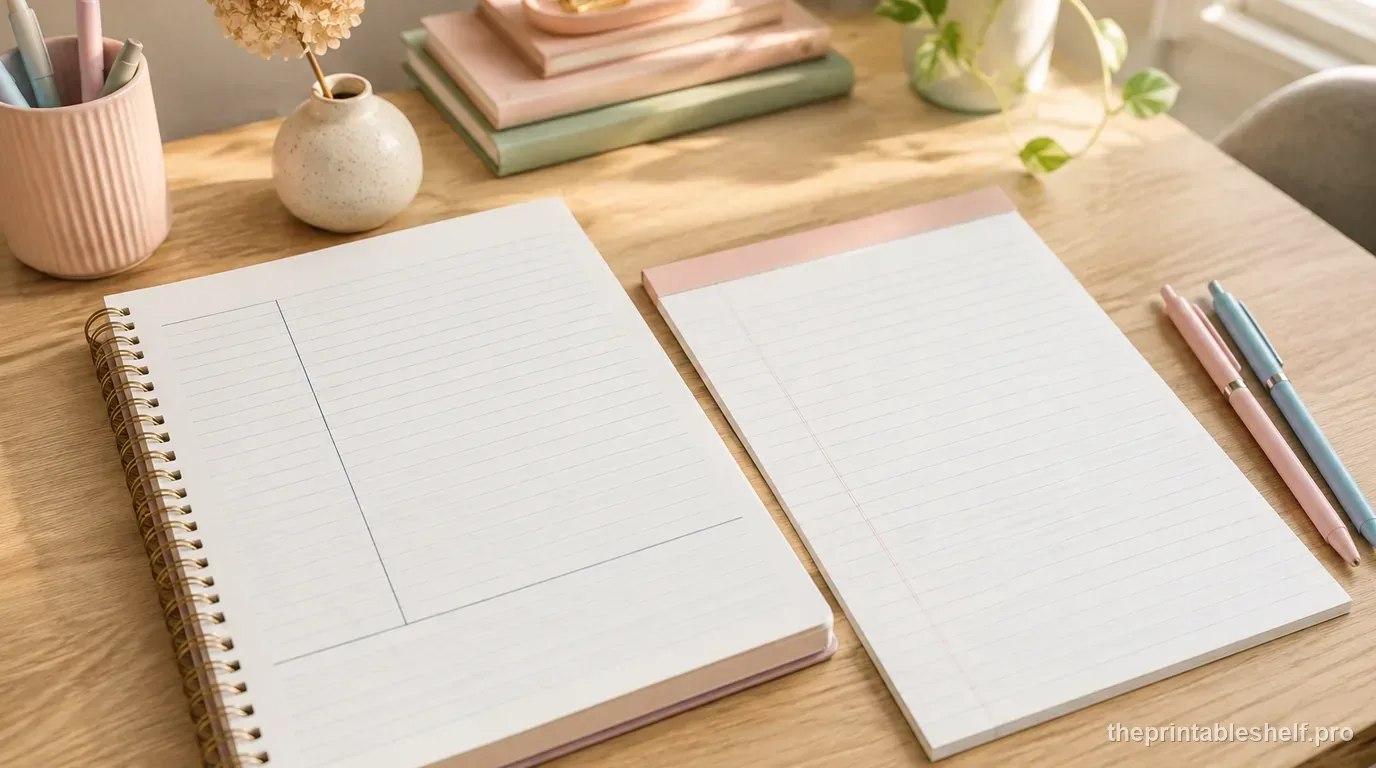
Cornell notes and outline notes solve different problems. The outline method is designed to show hierarchy while you capture information: main topic, subtopic, detail, example. The Cornell system divides a page into a large note area, a cue or question column, and a summary area so the same page can be processed and reviewed after the original lecture or reading.
If you choose between them only by appearance, you miss the useful distinction. Ask whether your immediate problem is capturing a clear structure quickly or turning notes into a study system you can quiz yourself from later.
Cornell notes vs. outline notes at a glance
Cornell University's Learning Strategies Center traces the Cornell system to education professor Walter Pauk and describes a process of recording notes, creating questions or cues, reciting from those cues, reflecting, and reviewing. Barnard College describes outlining as a common method that organizes main ideas and increasingly detailed subtopics through indentation. Those designs produce different strengths.
| Need | Cornell notes | Outline method |
|---|---|---|
| Capture speed | Moderate; page structure is fixed | Fast when the lecture already follows a hierarchy |
| Show hierarchy | Possible inside the notes column, but not the page's main visual feature | Excellent; indentation makes levels visible |
| Built-in self-test | Strong; cue column can become questions | None unless you add questions separately |
| Summary step | Built into the bottom section | Optional |
| Best for later review | Strong when cues and summary are completed | Good for scanning structure; active review must be added |
| Best hybrid use | Outline inside the notes column, then add cues and summary | Use outline for capture and create separate retrieval questions later |
Choose Cornell notes when the page needs to become a study tool
The Cornell layout is most valuable after the initial note-taking. The wide column holds the record of the lecture or reading. The narrower cue column is filled with questions or prompts based on those notes. The summary area forces the note-taker to compress the page into its central idea. Later, the notes can be covered while the learner answers from the cue column.
Cornell's own Learning Strategies Center emphasizes record, question, recite, reflect, and review rather than treating the page as a three-box stationery design. If you never create useful cues, summarize, or review, you are using the shape of Cornell notes without most of the method's study value.
Choose outline notes when the information already has a clear hierarchy
Outline notes are efficient when a professor, textbook, training manual, or presentation is already organized into levels. A main heading becomes the top level, a subtopic is indented beneath it, and supporting examples or details are indented again. The structure is visible without drawing boxes or reserving a separate cue column.
That makes outlining a good capture method for a chapter with clear headings or a lecture that moves predictably from major points to supporting details. It is less helpful when the speaker jumps among related ideas, when relationships are non-hierarchical, or when you want the notes themselves to prompt later self-testing.
The biggest difference is what happens after class
An outline can be complete the moment the lecture ends. That efficiency is useful, but it can invite passive rereading if the learner's study routine is simply scanning the indentation again. Cornell notes deliberately reserve space for post-class processing: turn notes into questions, summarize the page, cover the notes, and attempt to retrieve the answers.
This does not mean an outline cannot support active study. Add questions in the margin, convert headings into prompts, hide subpoints digitally and try to recall them, or make practice questions from the outline. The difference is that those actions are optional additions, while the Cornell format gives them a designated place.
Use a hybrid when you like hierarchy but still want retrieval practice
The two methods are not mutually exclusive. Use an outline inside the large notes column of a Cornell page. During the lecture, capture main ideas and subpoints with indentation. Afterward, write cue questions in the left column and a concise summary at the bottom. This preserves the hierarchy that makes outlining readable while adding a built-in review layer.
The hybrid works especially well for textbook chapters, content-heavy lectures, and exam review. It also prevents a common Cornell problem: filling the notes column with an unstructured stream of sentences simply because the page provides a large rectangle.
Which method fits different situations?
For a textbook chapter with strong headings, outline first. For a lecture that will be tested later and contains definitions, explanations, and examples, Cornell can make later review easier. For a meeting where you mainly need decisions and action items, a simple outline or list may be more efficient. For a course where you already take clean outlines but struggle to remember them, keep the outline structure and add Cornell-style cues afterward.
For math or other problem-solving subjects, neither template should force every line into prose. Leave room for worked examples, diagrams, formulas, or error notes. A note-taking method should adapt to the information instead of making the information conform to a page design.
A short side-by-side test to choose your method
Take one short lecture segment or two textbook pages and make notes both ways. Then close the source. With the outline, cover the details under each heading and try to reconstruct them. With Cornell notes, cover the notes column and answer the cue questions. After a short delay, ask which page made it easier to retrieve the important ideas and which page was realistic to maintain at your normal pace.
Choose based on performance and sustainability, not how polished the page looks. A beautifully ruled Cornell sheet with weak cues is less useful than a plain outline that accurately captures relationships. Likewise, a perfect outline that is never used for retrieval may be less useful for exam preparation than rougher Cornell notes that generate good questions.
Common mistakes with both methods
For Cornell notes, the biggest mistake is postponing the cue and summary sections indefinitely. Add them soon enough that you still understand the context of the notes. Another mistake is writing cue words that are too vague to trigger a meaningful question or explanation.
For outlines, avoid excessive indentation. If every sentence becomes another level, hierarchy stops being informative. Also resist copying a textbook's headings without deciding what belongs under them. In both systems, selective notes are more useful than transcription. Capture the information you need to understand, explain, apply, or retrieve later.
Quick answers
What is the most efficient note-taking method?
There is no single most efficient method; it depends on the material and the goal. Outline notes work well for a lecture with a clear hierarchy, while Cornell notes add a cue column and a summary that support review and self-testing. If you plan to study from your notes later, Cornell usually gives you more to work with.
What are the downsides of the Cornell method?
The page layout takes setup time, the narrow cue column can feel cramped, and the method only pays off if you complete the cues and summary after class. Some fast-moving lectures leave little room to organize. Many students fix this by taking quick notes first and filling in the cue column afterward.
Are Cornell notes better than outline notes?
Not in every situation. Cornell notes are stronger when you want built-in cues, self-testing, and summarization. Outlines are often faster and clearer when the source already has a strong hierarchy.
Can you use the outline method inside Cornell notes?
Yes. A useful hybrid is to outline main points and subpoints in the large notes column, then add cue questions on the left and a page summary at the bottom.
Which note-taking method is better for textbooks?
Outlining is efficient for chapters with clear headings and subheadings. Cornell notes can be better when the same notes will be turned into self-test questions for later study.
Download a matching template
Sources
These sources support the instructional background in this guide. The printable recommendations and usage notes above are The Printable Shelf's editorial guidance.
- Cornell University Learning Strategies Center — The Cornell Note Taking System — Primary institutional explanation of the Cornell method and its origin in Walter Pauk's work.
- Cornell University Learning Strategies Center — The Cornell Note-taking System — Concise description of the record, question, recite, reflect, and review workflow.
- Barnard College — Note-Taking Guide — Current college learning-support overview of outline and Cornell note-taking structures.
Related reading
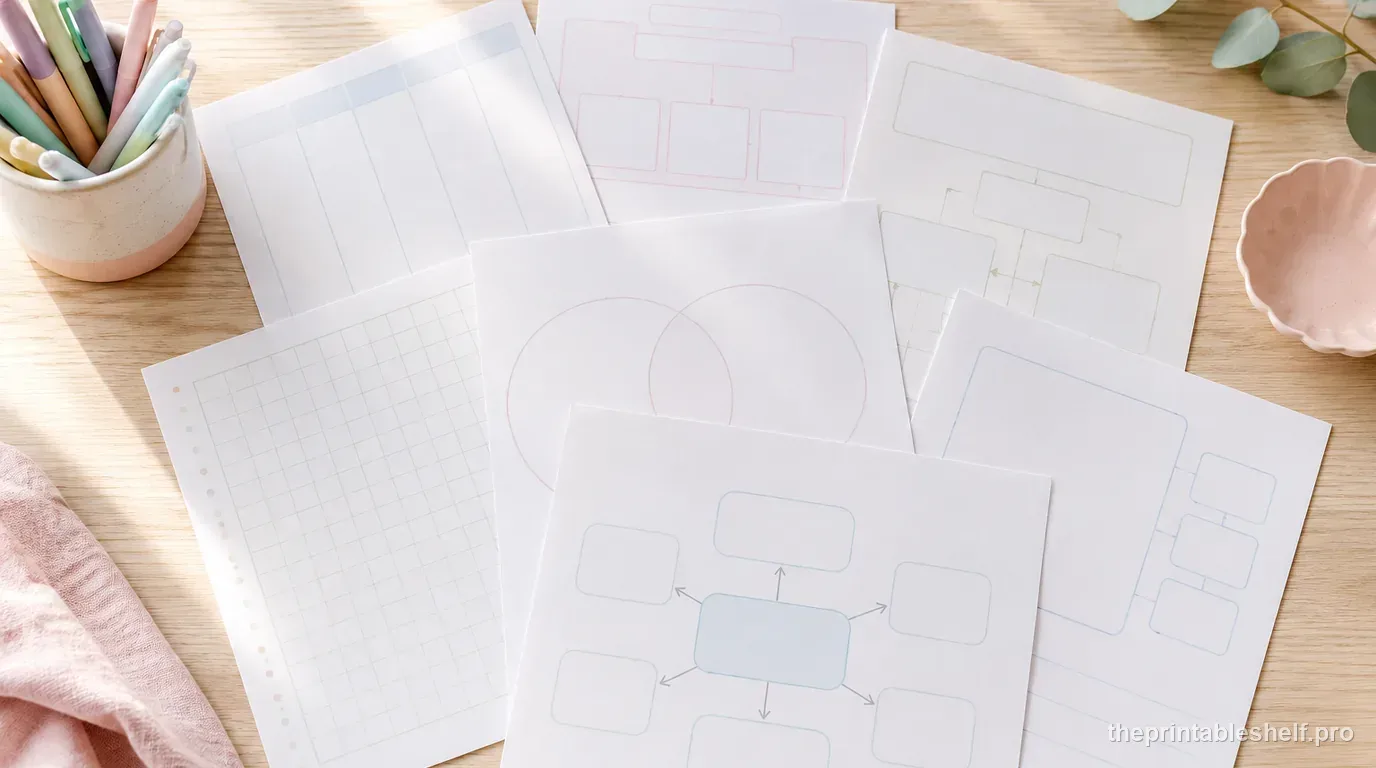
10 Free Graphic Organizers for Reading, Writing, and Studying
Download 10 free graphic organizers for reading, writing, comparison, vocabulary, sequencing, and study. Includes a guide to choosing the right one.
Read guide →
How to Use Graphic Organizers Effectively (Without Turning Them Into Busywork)
Learn how to choose, model, scaffold, and reuse graphic organizers so students think with them instead of simply filling in boxes.
Read guide →
7 Cornell Notes Mistakes That Make the Method Less Useful
Fix seven common Cornell Notes mistakes, from empty cue columns to passive rereading, and turn each page into a practical study tool.
Read guide →