How-to guide · Work & Study
How to Use Context Clues to Figure Out Word Meaning
Context clues are useful because readers often meet unfamiliar words while the text itself contains hints about meaning. But context-clue instruction can become a guessing game when students are told to look for 'a clue word' and choose whatever definition seems possible. Stronger practice treats context as evidence: gather information, make a precise prediction, test it, and confirm when necessary.
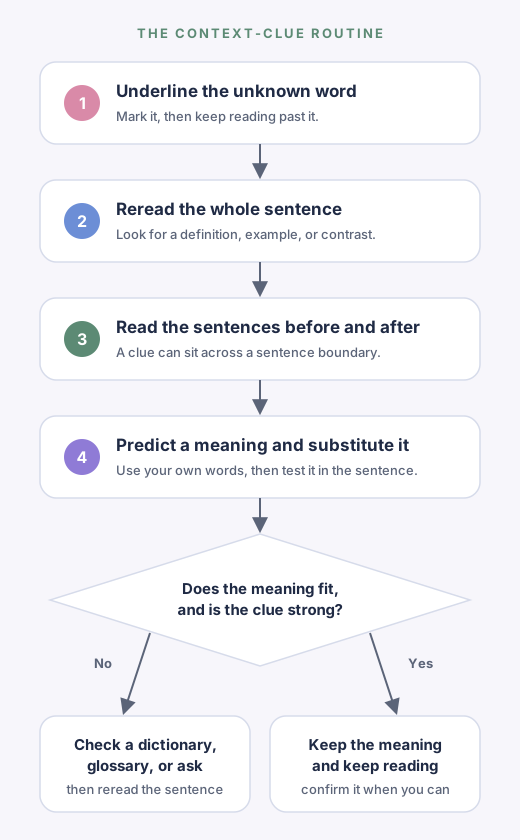
That evidence-based routine matches current IES guidance for grades 4–9. The 2026 REL Southeast resource directs students to underline the unknown word, reread the sentence, examine surrounding sentences, generate a possible definition, check whether it makes sense in context, and consult a dictionary or adult if the context is still not enough. Reading Rockets likewise emphasizes that context can help but is not always informative.
Context clue types with example sentences
A context clue is any hint in the surrounding words or sentences that narrows what an unfamiliar word can mean. Writers give these hints in a few recurring ways. The table shows five of them, each with an example sentence, the unknown word, and the part of the sentence that gives it away.
Word parts such as prefixes and roots, and the grammar of the sentence, can also point toward a meaning. Sources group all of this differently, so lists run from four to seven types. These five are the ones students meet most often in reading passages.
| Clue type | Example sentence | How the clue works |
|---|---|---|
| Definition | The botanist, a scientist who studies plants, spent the summer cataloging wildflowers. | Unknown word: botanist. The phrase between the commas gives the meaning directly. |
| Restatement (synonym) | The speaker was verbose; in other words, she used far more words than she needed. | Unknown word: verbose. The words after “in other words” say the same thing in simpler language. |
| Contrast (antonym) | Unlike her frugal brother, who saved every coin, Mia spent money freely. | Unknown word: frugal. “Unlike” signals that Mia is the opposite of her brother. She spends freely and he saves every coin, so frugal means careful with money. |
| Example | The museum displays artifacts, such as clay pots, stone tools, and ancient coins. | Unknown word: artifacts. The list after “such as” shows what kind of thing the word names: objects made by people long ago. |
| Inference (logic or cause and effect) | Because the road was treacherous, with ice on every curve, the driver slowed to a crawl. | Unknown word: treacherous. No definition appears, but ice on every curve and a driver slowing to a crawl point to something dangerous. |
The context-clue routine in one picture
The flowchart shows the whole routine before the detail. Each step is covered below, followed by a worked example, practice sentences with answers, and the most common mistakes.
Step 1: mark the word and read the whole sentence
Underline the unfamiliar word, but do not stop your eyes there. Read the entire sentence and ask what role the word appears to play. Is it naming something, describing something, showing an action, or modifying another word? Grammar will not give the full definition, but it can eliminate meanings that do not fit the sentence structure.
Look for direct support such as a definition, restatement, example, contrast, appositive phrase, or explanation. Sometimes the author makes the meaning nearly explicit. Other times the sentence only narrows the possibilities. Record what the text actually gives you rather than inventing a synonym too early.
Step 2: expand to the surrounding sentences
If the first sentence is not enough, read the sentence before and after it. A later sentence may give an example, result, contrast, or clarification. A previous sentence may identify the topic or situation that makes one meaning logical. This is why a one-sentence worksheet can be weaker than real reading practice: many useful context clues live across sentence boundaries.
The 2026 IES routine explicitly separates the sentence step from the surrounding-sentence step. That separation is useful for teaching because it makes students search progressively rather than jump immediately to a dictionary or random guess. It also helps them recognize whether the author has supplied enough information.
Know the common clue types without turning them into a scavenger hunt
Common context clues include definitions, restatements or synonyms, examples, contrasts or antonyms, and logical information supplied by the surrounding sentence or passage. Word parts and grammar can provide additional evidence about meaning, but they are better treated as word-analysis and syntactic supports rather than as context clues themselves. Reading Rockets describes common context-clue categories and recommends direct modeling for students who need support.
However, the purpose is not to label every clue. A student can correctly say 'contrast clue' and still infer the wrong meaning. Return to the harder question: what does this clue tell me about the unfamiliar word? Use the label only when it helps explain the reasoning.
Step 3: propose a precise meaning and substitute it
Write a short definition in your own words. Make it specific enough to test. 'Bad' or 'good' may capture tone but not meaning. Then substitute that meaning into the sentence, adjusting the wording or inflection when necessary so it fits the original grammar. The sentence should still make sense, and the proposed meaning should fit the surrounding discussion rather than only one isolated phrase.
Substitution is especially helpful with multiple-meaning words. A dictionary may list several valid senses, but context identifies which sense the author is using. If your substitute works grammatically but produces an idea that conflicts with the next sentence, revise it.
Step 4: know when context is too weak
Not every passage contains a usable clue. Reading Rockets gives examples in which many different meanings could fit the same context and cautions readers that some contexts provide little help. Strong reading behavior includes recognizing uncertainty rather than becoming overconfident in a guess.
If the sentence and surrounding text do not narrow the meaning enough, consult a dictionary, glossary, teacher, or another reliable source. Then return to the original sentence and check how the confirmed meaning works in context. Reference use is not failure; it is the correct next step when evidence is insufficient.
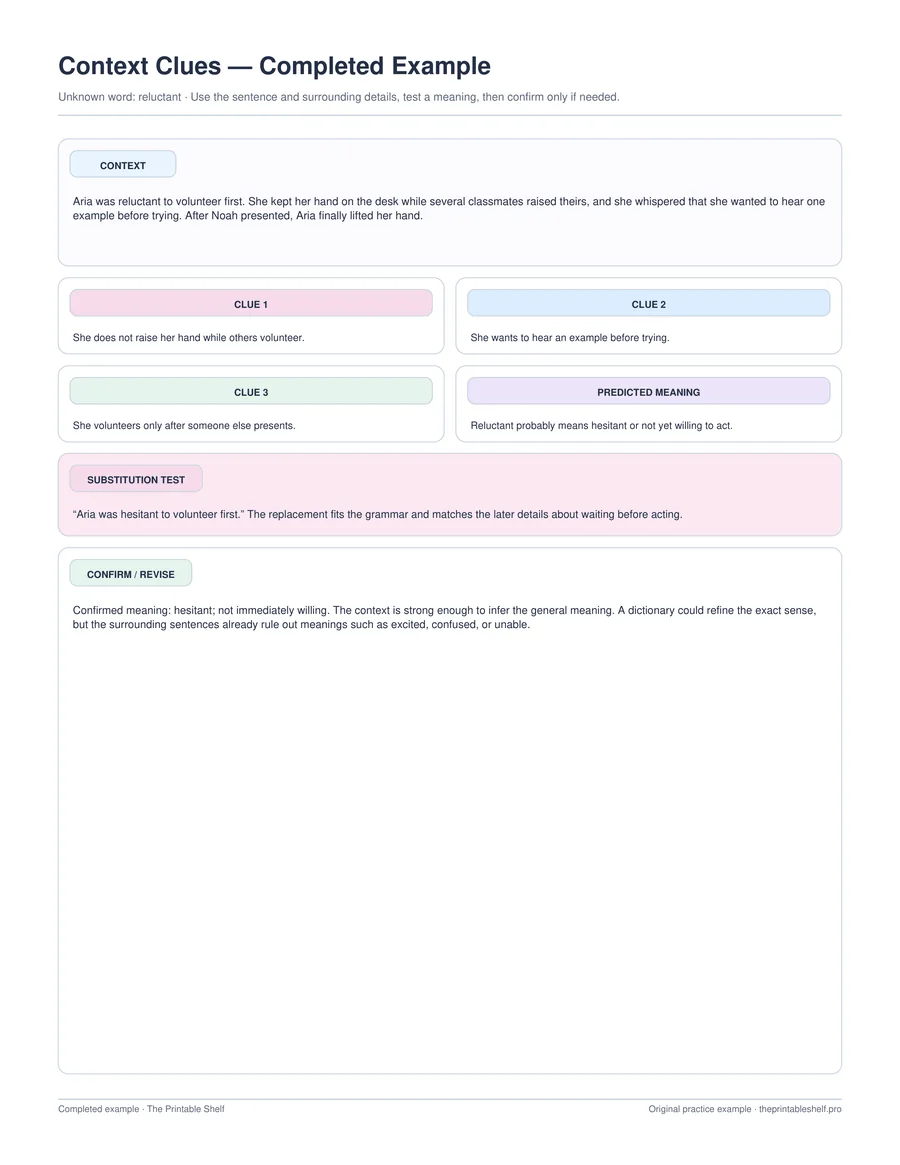
Worked example: infer, test, and confirm
Suppose a passage says: 'The trail became precarious after the rain. Loose stones slid under our boots, and we moved slowly near the steep edge.' The unknown word is precarious. The first clue is the condition after rain; the following sentence adds loose stones, slow movement, and a steep edge. Those details suggest something unsafe or unstable rather than merely wet.
A predicted meaning might be 'dangerous because it is unstable.' Substitute it: 'The trail became dangerous because it was unstable after the rain.' That fits both the sentence and the following evidence. A dictionary can then confirm the precise sense. The reasoning matters more than memorizing this one word because the same routine transfers to new vocabulary.
Practice sentences with answers
Cover the last two columns, read each sentence, and predict the meaning of the word in the second column from the clues alone. Then check your prediction. The last row is different on purpose: some sentences give no usable clue, and the right move is to look the word up.
| Sentence | Unknown word | Meaning | Clue that gives it away |
|---|---|---|---|
| After the long hike, the campers were ravenous and ate three helpings of stew. | ravenous | very hungry | Inference: after a long hike they ate three helpings. |
| My grandmother is gregarious: she loves parties and talks with everyone she meets. | gregarious | friendly and fond of company | The colon introduces a restatement: loves parties, talks with everyone. |
| Desert plants are hardy, able to survive months without rain. | hardy | tough enough to survive harsh conditions | The phrase after the comma defines it. |
| The twins looked identical, but their personalities were disparate: one was shy and the other was bold. | disparate | very different from each other | Contrast: shy versus bold, signaled by “but.” |
| The detective was scrutinizing the footprints, studying every curve and line. | scrutinizing | examining very closely | “Studying every curve and line” restates it. |
| Maya was reluctant to jump, so she stood at the edge of the pool for ten minutes. | reluctant | unwilling or hesitant | Inference: she stayed at the edge for ten minutes instead of jumping. |
| Maya picked up the sextant and left. | sextant | Cannot tell from this sentence | Nothing in the sentence narrows the meaning. This is the moment to check a dictionary or ask. |
Common context-clue mistakes and repairs
Mistake one is choosing the nearest familiar word as the clue. Read the whole sentence. Mistake two is guessing from prior knowledge without text evidence. Record the phrase that narrows the meaning. Mistake three is treating every context as decisive. Mark uncertainty and confirm. Mistake four is copying a dictionary definition without checking which sense fits.
Mistake five is ignoring morphology and grammar when they are useful. A recognizable root or affix can combine with sentence context to strengthen an inference. Mistake six is practicing only artificial sentences designed around obvious clues. Move into authentic paragraphs where clues may be partial, distributed, or occasionally insufficient.
Fade the organizer as the routine becomes automatic
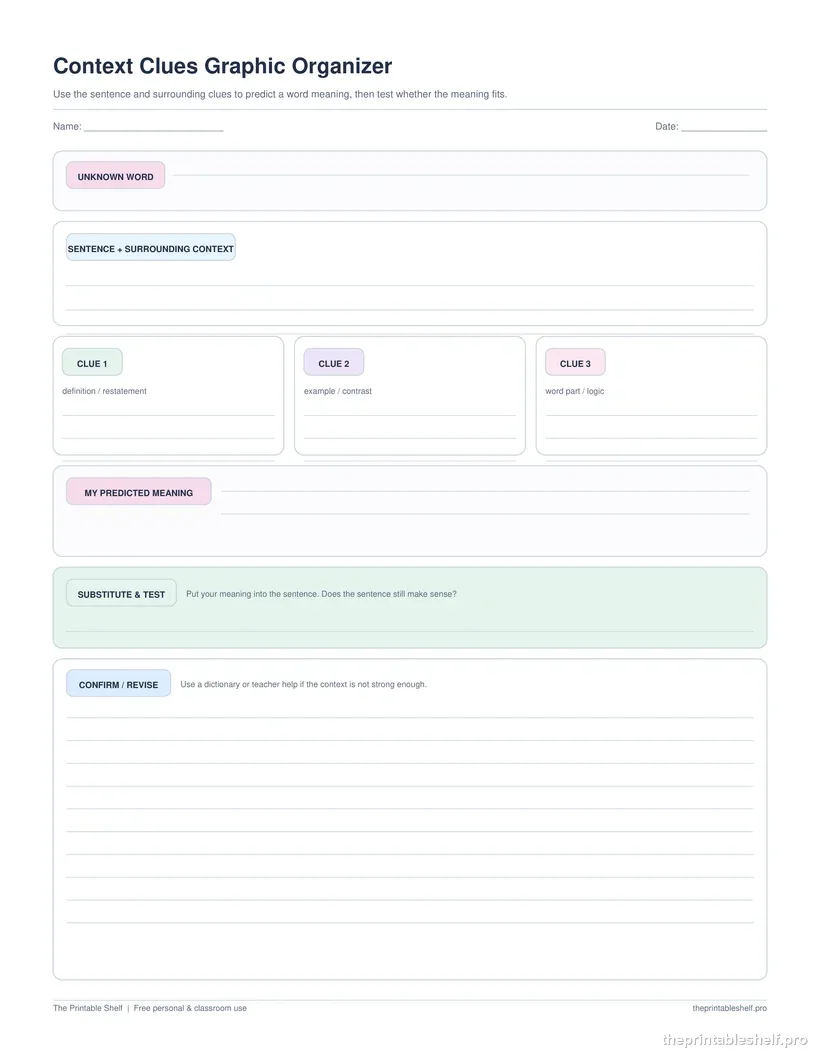
The printable separates the unknown word, context, possible clues, predicted meaning, substitution test, and confirmation. Use that full sequence when teaching the strategy explicitly. Model your thinking aloud, including a case where the context is too weak and you choose to consult a dictionary.
Once learners internalize the steps, shorten the process. A margin annotation such as 'clues → predicted meaning → check' may be enough. Independent reading requires quick decisions about whether context is helpful, not a completed worksheet for every unfamiliar word. As fluency grows, ask learners to explain the clue only for difficult or uncertain words. That selective explanation keeps the strategy efficient while preserving the habit of testing meaning against evidence.
Free download
Choose your file size
Print at 100% / Actual Size for the cleanest margins. Pick the paper size your printer normally uses.
Share to Google Classroom ↗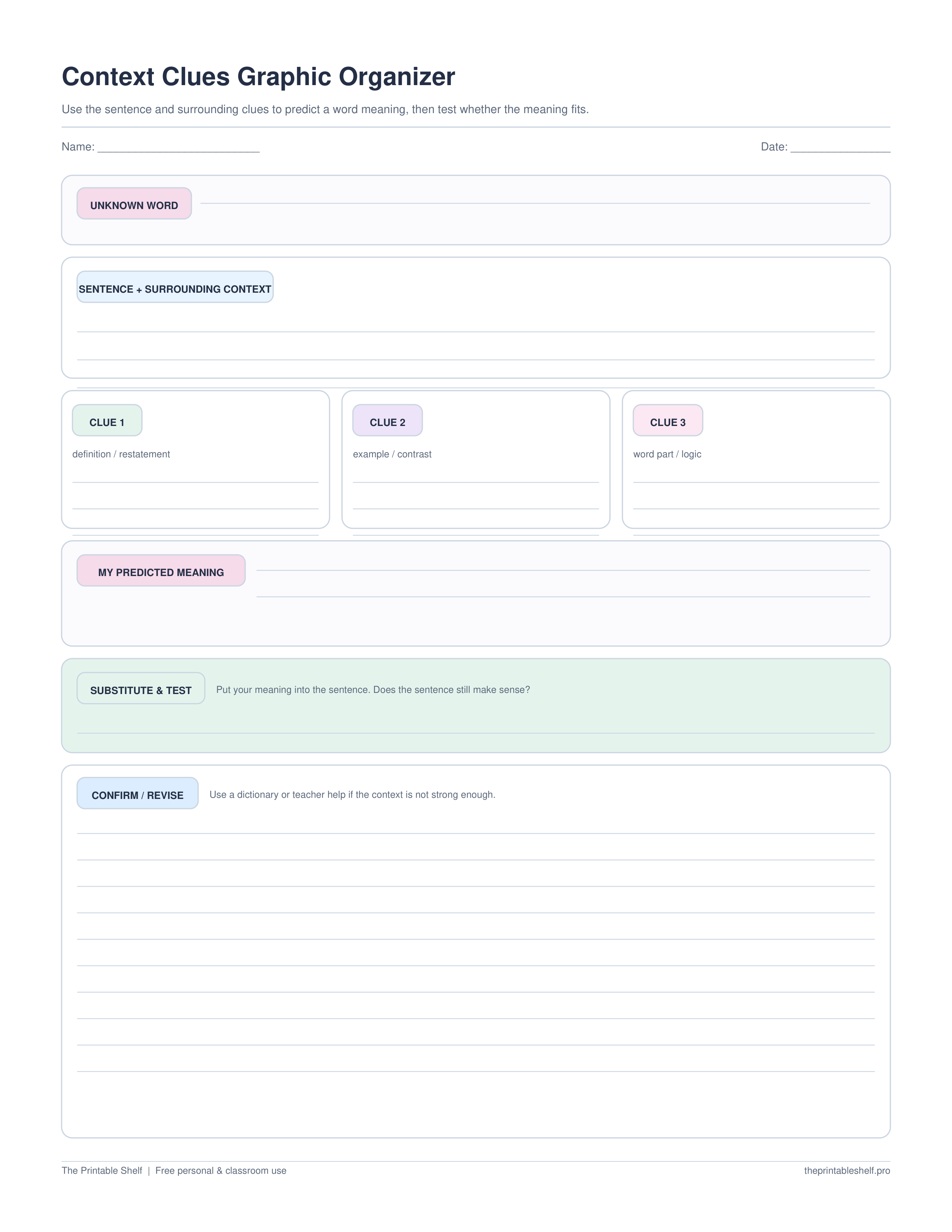
No sign-up required · personal/classroom use
Questions people ask
What are the main types of context clues?
Common context clues include definitions or restatements, examples, contrasts or antonyms, synonyms, and logical clues from surrounding sentences. Word parts and grammar can also help determine meaning, but they are supporting word-analysis or syntactic clues rather than context clues in the narrow sense.
What should I do if context clues do not help?
Use a dictionary, glossary, teacher, or reliable reference, then return to the passage to confirm how that meaning fits the sentence.
Why substitute the predicted meaning into the sentence?
Substitution tests whether the proposed meaning fits both the sentence's logic and grammar instead of remaining an untested guess.
What is an example of a context clue?
In the sentence “The botanist, a scientist who studies plants, spent the summer cataloging wildflowers,” the phrase between the commas is a context clue. It defines the unfamiliar word botanist without a dictionary.
Matching templates
Free Context Clues Graphic Organizer Printable →
This free context clues organizer guides readers through an unknown word, the sentence and surrounding sentences, three possible clues, a predicted meaning, a substitution test, and a final confirmation or revision step. It makes the evidence for the word meaning visible instead of rewarding a quick guess.
Free Printable Frayer Model Vocabulary Template →
This free Frayer Model template helps learners understand a word or concept through four lenses: definition, characteristics, examples, and non-examples. The format is useful for vocabulary in reading, science, social studies, and math because it makes the boundaries of a concept visible. Download Letter, A4, or PNG.
Free Inference Graphic Organizer →
This free inference graphic organizer makes the reasoning path visible: record a text clue, add relevant background knowledge, state the inference, and check why the conclusion fits. Two evidence-to-inference rows let learners practice more than once without turning the page into a long written response.
Sources & further reading
These sources support the instructional background in this guide. The printable recommendations and usage notes above are The Printable Shelf's editorial guidance.
- IES / REL Southeast — Steps for Using Context Clues to Determine Word Meanings — 2026 context-clue sequence: underline the unknown word, reread the sentence, examine surrounding sentences, generate and check a definition, and consult a reference if needed.
- Reading Rockets — Using Context Clues to Understand Word Meanings — Describes common context-clue types and explicit instruction for using surrounding words and sentences to infer meaning.
- Reading Rockets — Vocabulary: Instructional Guidelines and Classroom Examples — Explains context clues, cautions that not all contexts are helpful, and situates contextual analysis within vocabulary instruction.
Other guides you may like
How to Make Inferences From Text Without Guessing
Learn how to make inferences from text using clues, relevant background knowledge, evidence checks, and a simple worked example for reading practice.
Read guide →
How to Use a Frayer Model for Vocabulary and Concepts
Learn how to use a Frayer Model with definitions, characteristics, examples, and non-examples, plus worked examples and common fixes.
Read guide →
Free Reading Comprehension Graphic Organizers by Reading Skill
Free reading comprehension graphic organizers for story elements, main idea, sequence, cause and effect, comparison, vocabulary, and prior knowledge.
Read guide →