Math Worksheets · Free 13-page pack
Free Making Change — Word Problems Worksheets PDF
This 13-page making change word-problem pack is for grades 2-3. Its six practice pages each present six snack purchases paid for with $1.00, asking students to find the change from prices between 19 cents and 86 cents. The answer key is included on pages 8-13.
Edited by Tessa Vaughn · Planning & Organization Editor
Free download
Download the 13-page pack
This multi-page pack currently has one print-ready format. Preview the PDF, then print the whole pack or only the page range you need.
Share to Google Classroom ↗No sign-up required · personal/classroom use
Practice this skill on screen30 questions in three levels (easy, medium, hard) with instant feedback. Nothing to install.Get the whole set: 5 packs in one zipMoney worksheet packs. Grades 1–3: coins, bills, comparing amounts and making change. US Letter PDFs with answer keys, 451 KB.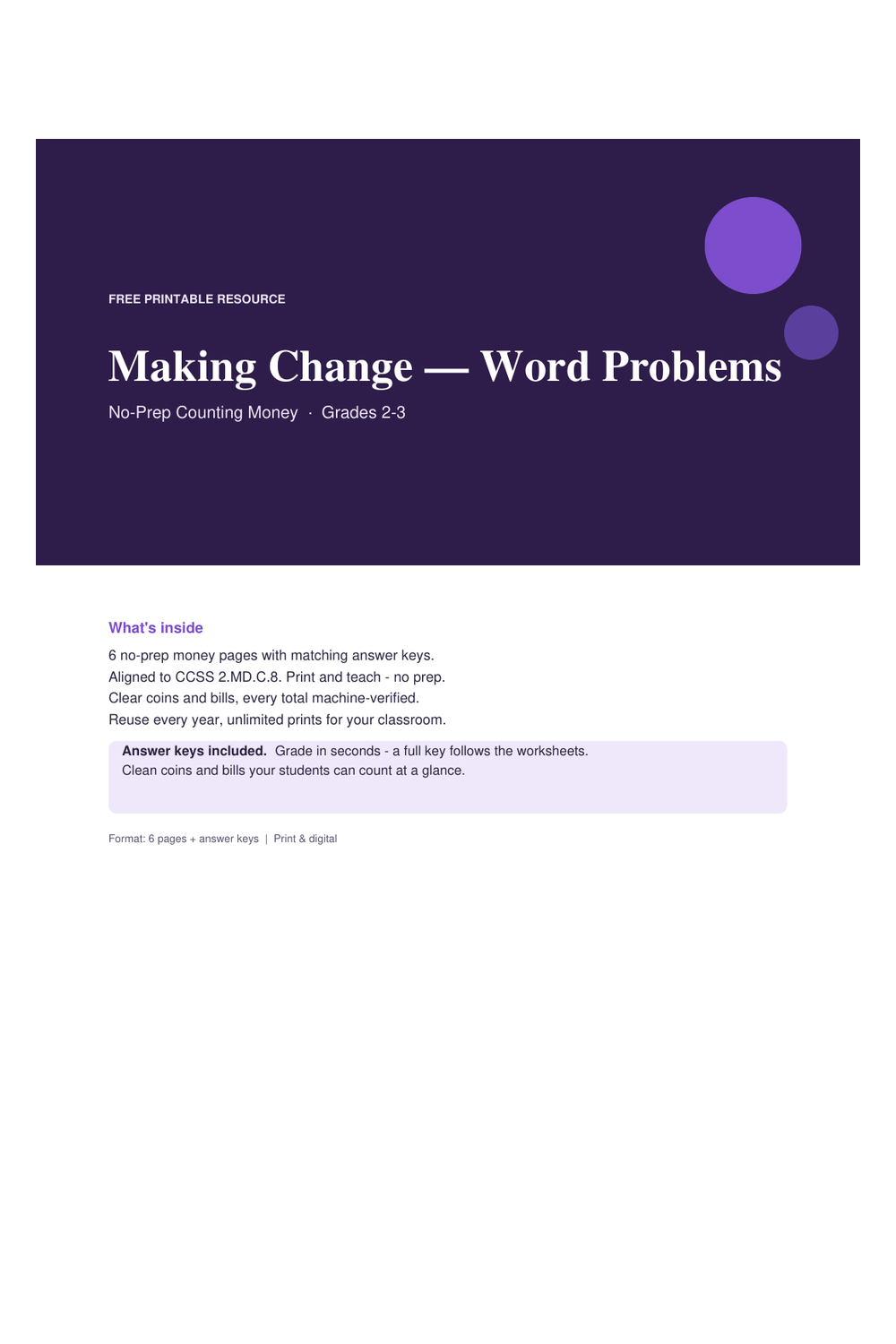
About this printable
A single dollar is the payment in each of the six snack stories on every practice sheet. Students write the difference on a Change line; Name and Date blanks are provided. This US Letter file runs 13 pages, with six practice pages and an answer key on pages 8-13. Page 2 uses prices from 28 to 72 cents, while page 7 includes amounts from 23 to 82 cents. The remaining practice sheets keep that question pattern.
How to find change from one dollar
Change is the amount returned after subtracting the purchase price from the amount paid. If an item costs 57 cents and the customer gives one dollar, subtract 57 cents from 100 cents. The difference is 43 cents. Children can check the result by adding the price and change; those two amounts should bring them back to the dollar paid.
Counting up can make the subtraction easier to picture. From 57 cents, count 3 cents to 60, then 40 cents to 100; the jumps add to 43 cents. This method treats change as the distance between price and payment. For prices near a dollar, the gap is small; recording each jump helps keep the total exact.
Worked example 1
A snack costs $0.57. The customer pays $1.00. How much change?
Count from 57 cents to 60 cents: 3 cents. Count from 60 cents to 100 cents: 40 cents. Add the jumps, 3 cents + 40 cents.
Answer: $0.43
Worked example 2
A snack costs $0.82. The customer pays $1.00. How much change?
Count up 8 cents from 82 cents to 90 cents, then 10 cents to 100 cents. Combine the two jumps.
Answer: $0.18
Worked example 3
A snack costs $0.19. The customer pays $1.00. How much change?
Subtract 19 cents from 100 cents, or count up 1 cent to 20 cents and 80 cents to 100 cents. The jumps total 81 cents.
Answer: $0.81
How to teach it with this pack
Count up to a dollar
Write the price, such as 57 cents, and make a number line ending at 100. Jump first to the next ten, then to 100. Add the jump sizes to find the change and discuss why the destination is the amount paid.
Subtract in cents
Rewrite $1.00 as 100 cents. For a 57-cent price, calculate 100 - 57. Use place value or an open number line to show the difference, then record the answer in dollars-and-cents notation. using cents as whole numbers.
Check by adding back
Take a price and proposed change, then add them. For $0.82 and $0.18, the sum is $1.00. Ask children to explain what the sum represents: the amount paid before change was returned.
Compare two strategies
Solve one purchase by subtraction and another by counting up. Ask which method was easier for that particular price. For a price close to 100 cents, a short count-up gap may be especially clear. for each price.
Best uses for this template
Ideas for using this page
Practice the one-dollar gap
Choose a price near a dollar and estimate whether the change should be small or large before calculating. Compare the estimate with the exact cents afterward.
Read a money story
Have children underline the price and circle the amount paid in each problem. This helps them identify the two amounts needed to find the difference.
Explain a change amount
Ask a learner to show how price plus change returns to one dollar. The check connects subtraction to addition and makes an answer easier to check.
Mistakes to watch for
A child finds $1.00 - $0.57 as $0.57 by copying the price into the blank.
Represent the dollar as 100 cents, then find the difference between 100 and 57. Check by adding the proposed 43 cents to 57 cents; together they make 100.
A learner says the change from 82 cents is 28 cents after reversing the digits in 82.
Use a count-up line: 82 to 90 is 8 cents, and 90 to 100 is 10 cents. The jumps total 18 cents, which added to 82 cents reaches one dollar.
A learner calculates 100 - 57 = 53 cents by borrowing without reducing the tens digit.
Trade one dollar for 10 dimes, then trade one dime for 10 cents. Subtract 7 from 10 and 5 from the 9 dimes left: 43 cents. Check because 57 cents plus 43 cents equals one dollar.
A child writes 18 as $18.00 for the change from an 82-cent snack.
The result is cents, less than one dollar. Write eighteen cents as $0.18 and check that $0.82 plus $0.18 equals $1.00.
Quick answers
How do you calculate change from a dollar?
Treat one dollar as 100 cents and subtract the price in cents. Another method is to count from the price up to 100, recording each jump. Check the answer by adding the price and change; the sum should equal the dollar given.
How to teach making change to a child?
Use a number line marked in cents with 100 as the payment point. Start at the price and count up, perhaps reaching the next ten before jumping to 100. Add the jumps and compare the result with subtraction from 100 cents.
What is an example of making change from $1.00?
If the price is $0.82, count 8 cents to reach 90 cents and another 10 cents to reach a dollar. The change is $0.18. Check the result by adding $0.82 and $0.18 to get $1.00.
What is included in this making change word problems worksheet pack?
The 13-page packet has a cover, six student sheets with six short purchase stories apiece, and the answer key on pages 8-13. Each customer pays one dollar and has a blank for the change. The worksheet also has Name and Date fields above its problems.
Is this making change word problems worksheet pack free?
Yes, there is no charge and no sign-up step. The download is a US Letter PDF; A4 and PNG files are not part of it. Check the back section, pages 8-13, for the answer key to all six practice pages.
Keep organizing
You might also like
Free 13-page pack
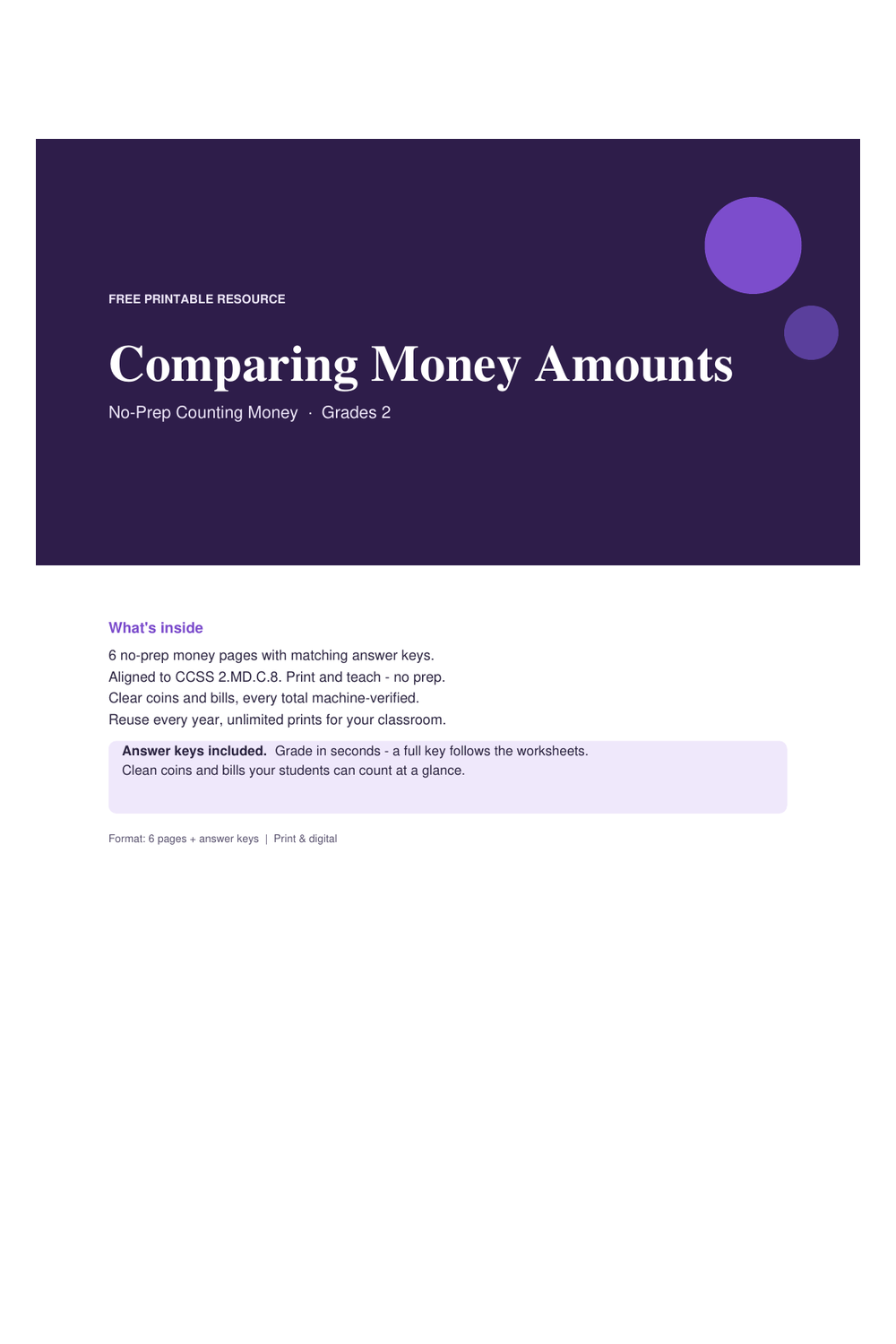
Comparing Money Amounts Worksheets PDF
A 13-page US Letter math pack for grades 2. The PDF keeps the student practice and matching answer-key pages together in one file so you can print only the pages you need. The main skill is to compare money amounts by value rather than by the number of coins or bills shown. The pack references 2.MD.C.8 on the cover. Standards noted for this pack: 2.MD.C.8.
View & download →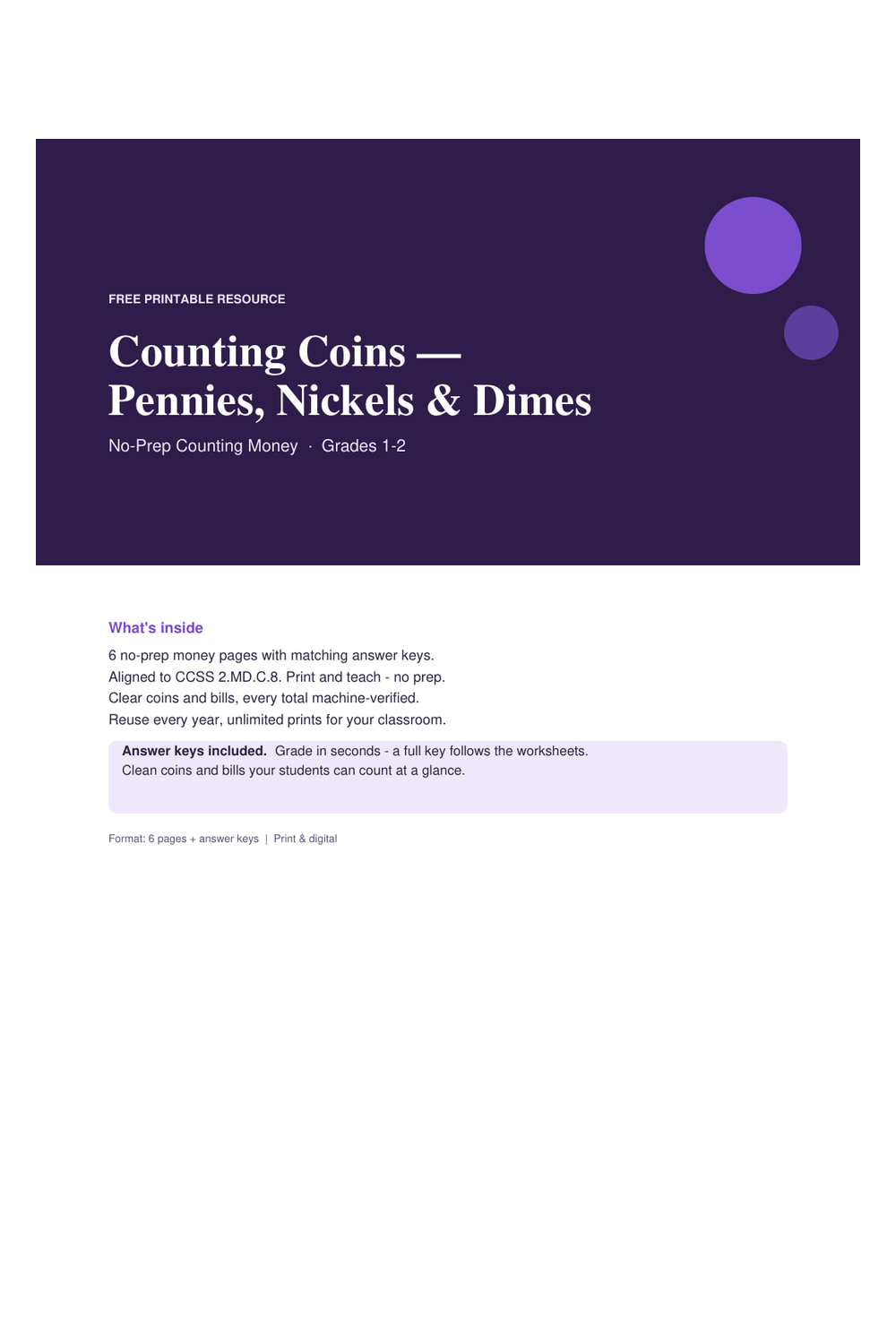
Free 13-page pack
Counting Coins — Pennies, Nickels & Dimes Worksheets PDF
A 13-page US Letter math pack for grades 1-2. The PDF keeps the student practice and matching answer-key pages together in one file so you can print only the pages you need. The main skill is to combine penny, nickel, and dime values efficiently instead of counting every coin as one unit. The pack references 2.MD.C.8 on the cover. Standards noted for this pack: 2.MD.C.8.
View & download →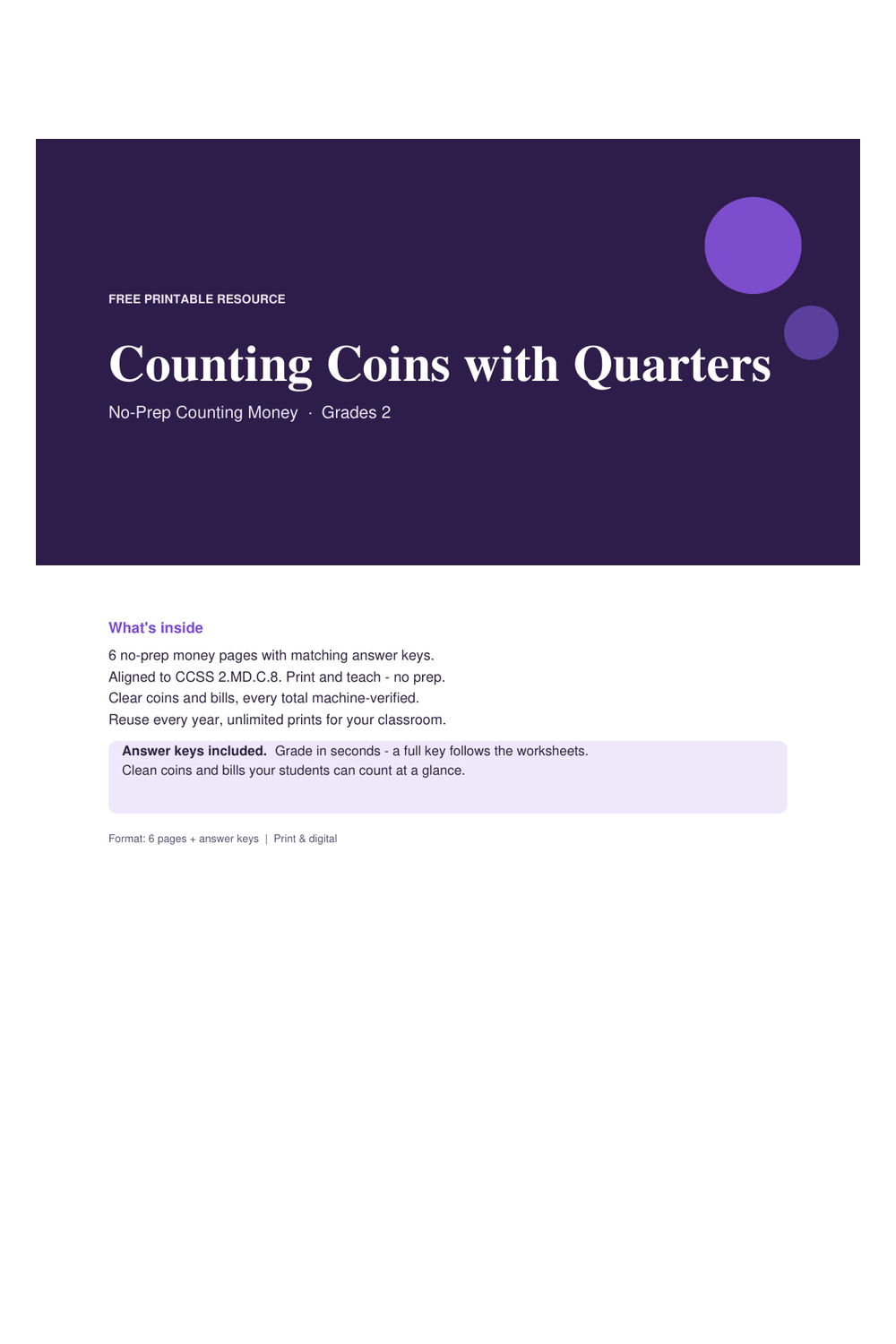
Free 13-page pack
Counting Coins with Quarters Worksheets PDF
A 13-page US Letter math pack for grades 2. The PDF keeps the student practice and matching answer-key pages together in one file so you can print only the pages you need. The main skill is to include quarters in mixed-coin totals and use 25-cent benchmarks to count efficiently. The pack references 2.MD.C.8 on the cover. Standards noted for this pack: 2.MD.C.8.
View & download →