How-to guide · Work & Study
Frayer Model Examples and Non-Examples: How to Choose Ones That Actually Teach the Concept
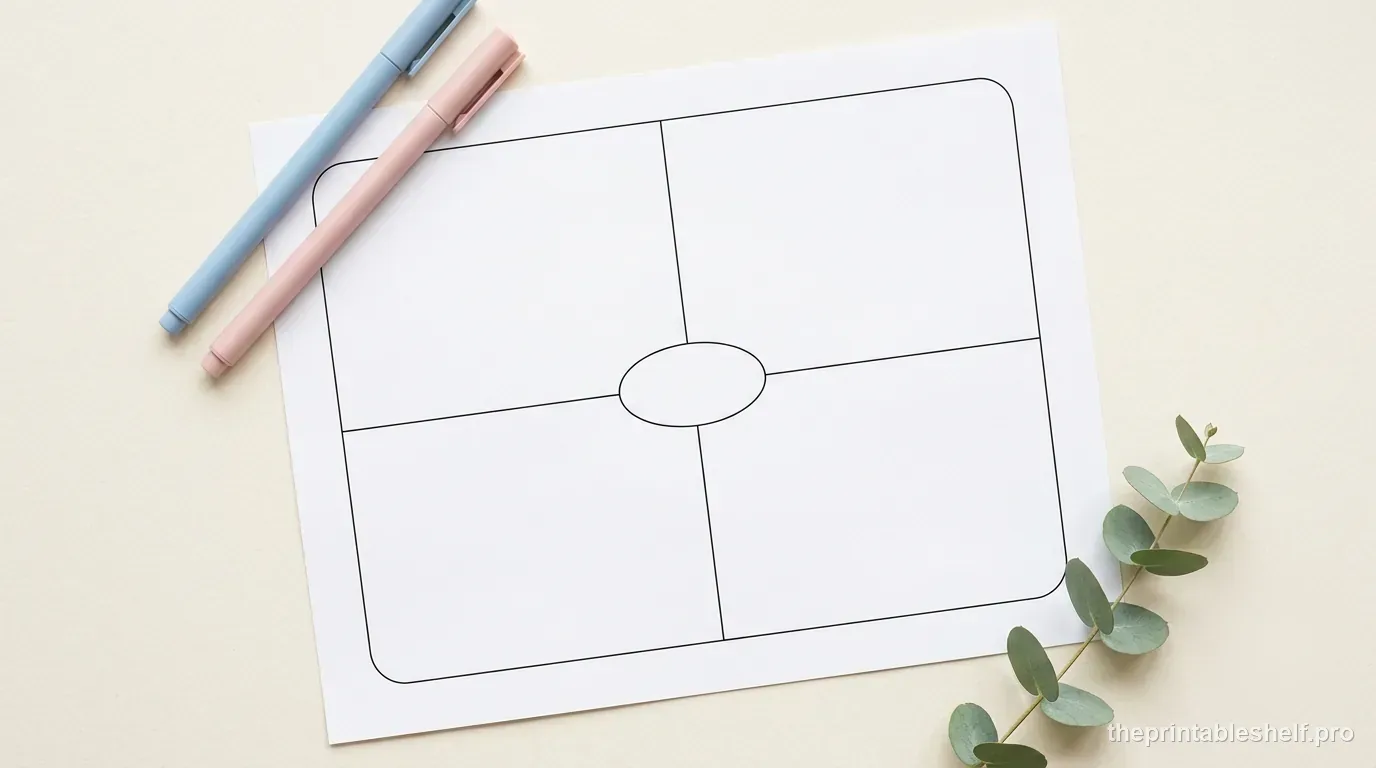
The examples and non-examples boxes are often the most valuable part of a Frayer Model and the easiest part to fill badly. Students may list random items that are obviously unrelated to the target word, or choose examples because they look familiar without checking the concept's defining characteristics. Both approaches produce a completed worksheet without much conceptual work.
A stronger Frayer Model treats each example as a classification decision. The student should be able to point to the features that make an item qualify and identify the feature that disqualifies a near-miss. This guide focuses on that boundary work, with examples from mathematics, science, social studies, and language arts.
Start with defining characteristics before brainstorming examples
Do not begin by filling the examples box. First establish what must be true for something to count as the concept. For a triangle, exactly three straight sides and a closed shape are defining characteristics. Color, size, and orientation are not. For historical fiction, the text is set in the past and blends a historical setting or events with fictional elements. The details vary by subject, but the same question applies: Which features determine category membership?
This order matters because otherwise students tend to reason from memory: I have seen this word near that object, so it must be an example. A characteristics list gives them a test. IRIS's Frayer Model guidance similarly emphasizes explicit modeling, conceptual characteristics, examples, and non-examples rather than treating the page as a dictionary-definition worksheet.
Move from obvious examples toward less obvious cases
A useful examples box can do more than collect obvious instances. One effective progression is to move from a prototype to a less obvious example and then, when it adds value, an edge case that forces students to rely on the characteristics instead of appearance. The point is not to fill a three-item quota or trick learners; it is to make the category more flexible and precise.
For the concept mammal, dog is a prototype, whale is a less visually obvious example, and bat can challenge a learner who associates mammals only with animals that walk on four legs. The examples reveal which characteristics are essential and which are merely common.
| Example type | Purpose | Mammal example |
|---|---|---|
| Prototype | Anchor the concept with a clear, familiar instance | Dog |
| Less obvious example | Break a shallow surface rule | Whale |
| Edge case | Force attention to defining characteristics | Bat |
Choose non-examples that are close enough to be informative
A random non-example often teaches almost nothing. If the target concept is triangle, toaster is technically a non-example, but no student is likely to confuse the two. A square is more useful because it shares several features with a triangle: it is a closed polygon made of straight segments, but it has four sides instead of three. That single failed condition makes the boundary visible.
Call these near-miss non-examples. The closer the candidate is to qualifying, the more clearly students must identify the decisive characteristic. This is why examples and non-examples work as a pair: the strongest non-examples are close enough to the concept to force boundary reasoning rather than obvious rejection.
Ask students to justify the classification, not just list items
After a student writes an item, ask for a short because statement. Square is a non-example of triangle because it has four sides. A day trip is a non-example of human migration because it is temporary rather than a permanent or semi-permanent move. A simile is a useful near-miss for metaphor because it marks the comparison explicitly—often with words such as like or as—whereas a metaphor makes the comparison without that explicit simile marker.
These brief explanations expose misconceptions immediately. A student may put whale under non-examples of mammal because it lives in water. The explanation reveals that the learner is using habitat as a defining rule. That gives the teacher something specific to correct instead of simply marking the box wrong.
Worked example 1: mathematics — quadrilateral
For quadrilateral, begin with the defining rule: a closed polygon with four straight sides. Rectangle and trapezoid are clear examples. A concave dart-shaped quadrilateral is a useful less-obvious example because students may incorrectly assume every quadrilateral has to look box-like. A triangle is a near-miss non-example because it is closed and polygonal but has only three sides. A pentagon is another because it has five.
Avoid using circle as the only non-example. It is useful as one contrast because it has no straight sides, but it is too far from the boundary to expose whether students understand the number-of-sides condition. Pair an obvious contrast with a near miss.
Worked example 2: science — physical change
For physical change, characteristics might include a change in form, size, or state without creating a new substance. Melting ice and cutting paper are examples. Dissolving sugar in water can become a productive discussion example depending on the level and definition being used because the sugar can be recovered and no new substance is formed. Burning paper is a strong non-example because new substances form during combustion.
This example also shows why teachers should verify subject definitions before building the Frayer Model. A vocabulary organizer should clarify disciplinary meaning, not replace accurate content instruction. If a concept has important exceptions or depends on grade-level conventions, make those limits explicit rather than forcing every example into a simplistic rule.
Worked example 3: social studies — migration
For human migration, useful characteristics may include movement from one place or region to another that changes a person's usual residence for an extended or permanent period. A family relocating from one state to another is an example. People forced to relocate their usual residence because of conflict can be another. Commuting to work each morning is a near-miss non-example because movement occurs, but usual residence does not change. A weekend vacation is another because it is temporary travel rather than migration.
IRIS provides a similar content-area example in which temporary cross-border travel and commuting are contrasted with actual human migration. The value of those non-examples is that they share the visible feature of movement while failing the more important residence-and-duration characteristics.
Worked example 4: language arts — metaphor
For metaphor, define the target at the level students are expected to use: a figurative expression that identifies or describes one thing in terms of another without explicitly framing the relationship as a simile. Time is a thief is an example. The classroom was a zoo is another. The classroom was like a zoo is a near-miss non-example because it explicitly signals a simile comparison; like and as are common simile markers, but they are not the only possible wording. The classroom was noisy is a literal statement, so it is also a non-example for a different reason.
Using two types of non-example is useful here. One is structurally close but belongs to a neighboring category; the other lacks figurative comparison altogether. Students learn not only what metaphor is, but how it differs from a concept they are likely to confuse with it.
Do not confuse a non-example with an antonym
For some everyday words, an antonym may work as a non-example, but the categories are not interchangeable. The opposite of transparent is opaque, so opaque can help contrast the concept. But many academic concepts do not have a meaningful single opposite. The non-example of prime number is not simply an antonym; composite numbers and 1 fail the defining conditions in different ways.
If a Frayer variant replaces non-examples with antonyms, make sure that change fits the type of vocabulary being taught. For technical and conceptual terms, examples versus near-miss non-examples usually reveal category boundaries more clearly than a synonym-antonym exercise.
Let students argue about borderline cases
A good Frayer discussion does not always need instant agreement. Put one borderline candidate on the board and ask students to classify it using the characteristics. Their task is to cite the rule, not vote based on intuition. If the class discovers that the characteristics are incomplete, revise the list. That revision is evidence of learning, not a failed worksheet.
The University of Minnesota's Frayer guidance describes a similar process: gather candidate examples, identify shared characteristics, verify them through reading or research, and distinguish essential from nonessential characteristics before finalizing the organizer. This makes the model a reasoning routine rather than a four-box form.
Common mistakes in the examples and non-examples boxes
Mistake one is choosing unrelated non-examples. Replace an uninformative item with a near miss that clarifies the boundary. Mistake two is using surface appearance as the rule. Return to the characteristics and classify from those. Mistake three is accepting examples with no explanation. Ask for a brief because statement. Mistake four is packing the boxes with so many items that students never discuss any of them. A small set of thoughtful candidates can teach more than a crowded list of copied words.
Mistake five is completing every quadrant in one sitting before students have enough knowledge. IRIS notes that the model does not have to be finished in one lesson. You can establish a preliminary definition, collect examples during reading or instruction, and return later to refine characteristics and non-examples once the concept is better understood.
A quick quality test for a completed Frayer Model
Cover the definition and look only at the characteristics, examples, and non-examples. Could another student infer the concept's boundary? Do the examples vary enough to prevent a shallow stereotype? Do the non-examples include plausible confusions rather than only random unrelated objects? Can the student explain why a borderline item belongs or does not belong?
If the answer is yes, the page is doing more than storing a definition. It is making the learner classify, compare, and revise. That is the information gain that a Frayer Model can provide over a standard vocabulary list.
Questions people ask
What is an example of a Frayer Model?
For the word "mammal," the definition box says a warm-blooded animal that feeds its young milk. Characteristics include fur or hair and live birth. Examples are dolphins and bats, and non-examples are sharks and lizards. The non-examples show where the concept ends, which is the part that makes the Frayer Model more useful than a plain definition box.
What are the disadvantages of using a Frayer Model?
It can turn into box-filling if students copy a dictionary definition or list weak non-examples, and it takes longer than a quick vocabulary check. It also suits concrete concepts better than abstract ones. Keep it for a few key terms, ask students to explain why each non-example does not belong, and compare their boxes in pairs.
How can I tell whether a Frayer non-example is useful?
Choose an item that looks plausible but fails one important defining characteristic. A near-miss usually teaches more than an unrelated item because the student has to explain the exact boundary.
Can an antonym be used as a Frayer Model non-example?
Sometimes, especially for everyday descriptive words, but a non-example is not the same thing as an antonym. For academic concepts, choose items that fail the defining conditions rather than forcing an opposite word.
How many examples and non-examples should students include?
There is no universal required number. Use enough well-chosen items to test the concept across clear and less obvious cases, and include a near-miss non-example when it helps clarify the boundary. Justification matters more than filling every space.
Matching templates
Free Printable Frayer Model Vocabulary Template →
This free Frayer Model template helps learners understand a word or concept through four lenses: definition, characteristics, examples, and non-examples. The format is useful for vocabulary in reading, science, social studies, and math because it makes the boundaries of a concept visible. Download Letter, A4, or PNG.
Free Compare and Contrast Graphic Organizer →
This free compare and contrast organizer separates details that belong only to Topic A, only to Topic B, and to both. A conclusion box then asks the learner to state the most important comparison. It works for texts, concepts, people, events, or choices and downloads in Letter, A4, or PNG.
Sources & further reading
These sources support the instructional background in this guide. The printable recommendations and usage notes above are The Printable Shelf's editorial guidance.
- IRIS Center — Building Vocabulary and Conceptual Knowledge Using the Frayer Model — Detailed teacher guidance on modeling the Frayer Model, using characteristics, examples and non-examples, content-area examples, guided practice, and staged completion.
- University of Minnesota — Frayer Model — Teacher-preparation and instructional steps emphasizing critical versus non-critical characteristics and classification of examples and non-examples.
- The Teacher Toolkit — Frayer Model — Overview of common Frayer elements, classroom uses, variations, and printable template options.
Other guides you may like

How to Use a Frayer Model for Vocabulary and Concepts
Learn how to use a Frayer Model with definitions, characteristics, examples, and non-examples, plus worked examples and common fixes.
Read guide →
10 Free Graphic Organizers for Reading, Writing, and Studying
Download 10 free graphic organizers for reading, writing, comparison, vocabulary, sequencing, and study. Includes a guide to choosing the right one.
Read guide →
How to Use Graphic Organizers Effectively (Without Turning Them Into Busywork)
Learn how to choose, model, scaffold, and reuse graphic organizers so students think with them instead of simply filling in boxes.
Read guide →