How-to guide · Work & Study
How to Compare and Contrast Two Texts Without Just Making a List
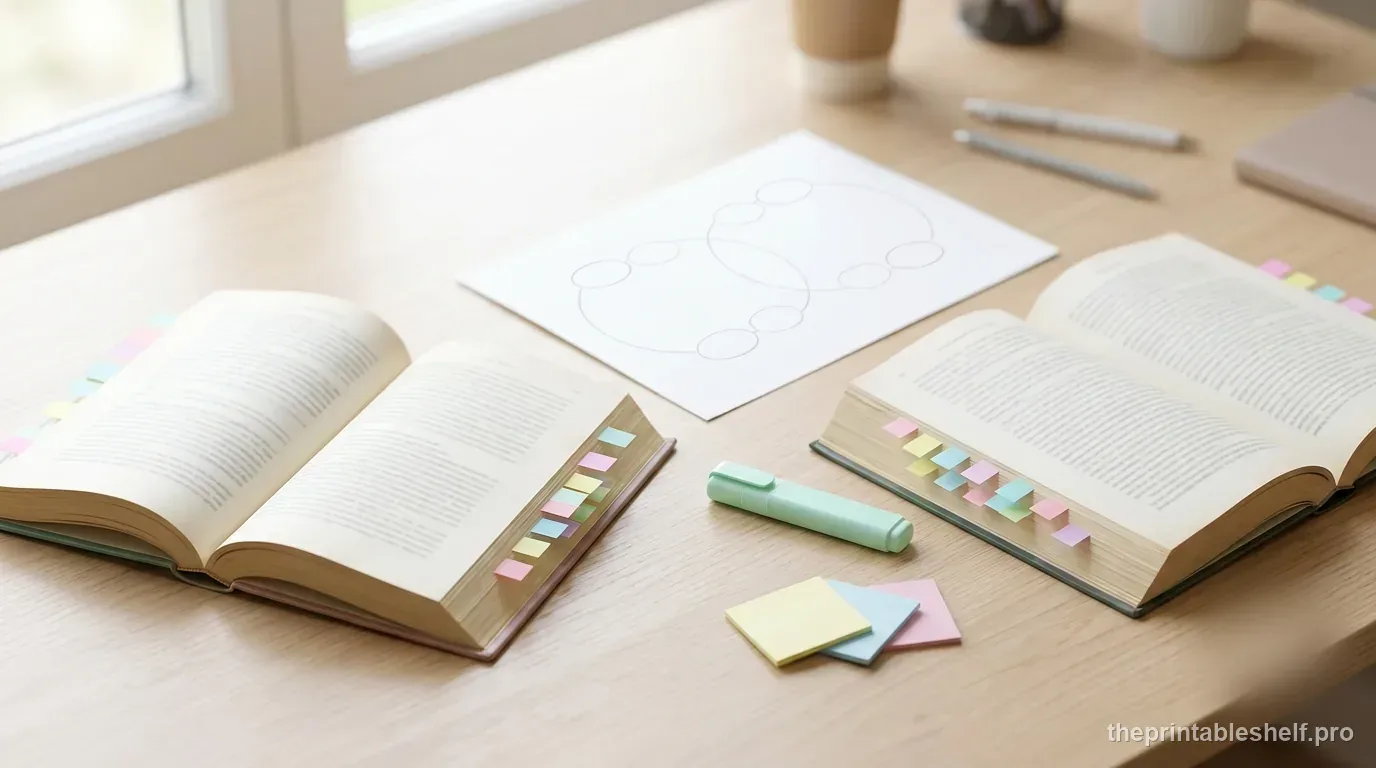
Compare and contrast work becomes weak when students collect unrelated facts: Text A has a dog, Text B is six pages long, both have pictures. Technically, those statements may be true, but they do not build a meaningful comparison. Strong comparison begins with a shared criterion—character response, central idea, evidence, setting, author's approach, text structure, or treatment of the same topic—and asks how both texts handle that same feature.
Reading Rockets recommends explicit modeling of compare-contrast text structure and demonstrates the use of a Venn diagram while a teacher thinks aloud about similarities and differences. ReadWriteThink similarly pairs Venn diagrams or comparison charts with a think-aloud before students move toward written comparison. The key instructional move is consistency: compare like with like, support both sides with evidence, and turn the organizer into an explanation rather than stopping at a list.
Start with a comparison question, not two piles of facts
Before reading closely, write the comparison question in a form that requires the same lens on both texts. How do the two authors explain why bees are important? How do both characters respond to losing something valuable? How does each text organize information about severe weather? A focused question tells the reader what evidence to collect and prevents the organizer from becoming a storage bin for anything noticeable.
If the assignment gives only Compare these texts, choose a small set of criteria that matter to the learning goal. For literature, useful criteria include character motivation, conflict, setting, point of view, or theme development. For informational text, consider central idea, evidence, text structure, examples, vocabulary, or how the author explains the same topic. Do not compare every possible feature on one page.
Use the same criteria on both sides
A fair comparison is symmetrical. If you record the main character's motivation for Text A, record the main character's motivation for Text B before deciding whether they are similar or different. If you analyze evidence quality in one informational article, use the same evidence question on the other. Otherwise the comparison becomes two mini-summaries that happen to sit beside each other.
A simple planning table can keep the criteria aligned before anything goes into a Venn diagram. This is especially helpful when the texts differ in length, genre, or complexity. The organizer should reveal a pattern across matched evidence, not create the pattern by comparing unrelated categories.
| Criterion | Text A | Text B | What the comparison shows |
|---|---|---|---|
| Central idea / theme | State in your own words | State in your own words | Shared message, different emphasis, or different conclusion |
| Evidence / key events | Best supporting detail | Best supporting detail | How each text develops its point |
| Structure | Sequence, cause/effect, narrative arc, etc. | Identify the same feature | Whether organization changes clarity or emphasis |
| Author / character approach | Relevant choice or response | Matched choice or response | Meaningful similarity or contrast |
| Language / tone | One representative example | One representative example | How wording shapes the reader's impression |
Read Text A and Text B with the same evidence prompts
On the first read, understand each text. On the comparison pass, use identical prompts. What is the central point? Which detail best supports it? What causes the key change? How does the author organize the explanation? What does the main character do when the conflict becomes harder? Reusing the same prompts makes later similarities and differences more defensible.
For short texts, annotate with matching symbols: C for central idea, E for evidence, S for structure, or a star for a turning point. For longer texts, keep a two-column evidence sheet before transferring only the strongest observations to the final organizer. The extra step can save time because the Venn diagram stays readable instead of becoming a dense transcription of both texts.
Put only true shared features in the overlap
The center of a Venn diagram should contain features that apply to both texts under the same criterion. Both are about oceans is often too broad to be useful. Both explain that warming water can disrupt marine ecosystems is more precise if both texts actually make that point. The overlap should help the reader say something meaningful about the relationship between the texts.
A good test is to complete the sentence Both texts __, but __. If the shared phrase is so generic that almost any text on the topic would fit, refine it. If the phrase depends on evidence from only one text, move it back to the correct outer circle. Accuracy matters more than filling the middle section.
Use differences that answer the same question
A useful contrast is not simply one fact that appears only in Text A and another unrelated fact that appears only in Text B. It is a difference in how both texts answer the same question. Text A explains wildfire spread mainly through weather conditions, while Text B emphasizes vegetation and land management. Both statements address explanatory focus, so the contrast can support a conclusion.
This matched-criterion rule is especially important with fiction. One character may respond to fear by avoiding a problem while another seeks help; that is a meaningful contrast in response to conflict. Saying one character has a brother while the other story takes place in winter is not a comparison, even though both details are unique.
Venn diagram or compare-and-contrast organizer?
Use a Venn diagram when the main job is sorting shared and unique traits and the entries can stay short. Its spatial overlap makes patterns visible quickly. Use a box-based compare-and-contrast organizer when the learner needs complete sentences, quotations, page references, multiple pieces of evidence, or a conclusion about significance. The second format sacrifices some visual simplicity for writing space.
A strong workflow is often Venn first, writing organizer second. Brainstorm and test the categories in the circles, then move only the strongest comparisons into a more detailed page. This prevents the Venn diagram from becoming cramped while preserving its value as a visual sorting tool.
Worked example: compare two short texts about urban trees
Imagine Text A is a city-news article explaining a new street-tree program. Its central focus is heat reduction and shade in neighborhoods with few mature trees. It cites surface-temperature measurements and describes where new trees will be planted. Text B is a science explainer about urban trees more broadly. It discusses shade too, but also covers stormwater, habitat, air quality, and the limits of tree planting when maintenance is poor.
A weak comparison says both are about trees; Text A is about a city; Text B mentions birds. A stronger set of matched notes says both explain environmental benefits of urban trees. Text A develops the idea through a local program and temperature evidence, while Text B uses several ecosystem functions and cautions that benefits depend on species choice and maintenance. The similarity is the role of trees; the contrast is how each author develops and scopes the explanation.
A useful conclusion could then say: Both texts present urban trees as infrastructure rather than decoration, but the city article narrows the argument to immediate heat relief while the science explainer presents a broader set of benefits and constraints. That sentence could not be written from two unrelated fact lists.
Turn organizer notes into a comparison paragraph
Do not copy the left circle, then the right circle, then the overlap in that order. Build the paragraph around one comparison claim. Start with the relationship: Both texts show __, but they differ in __. Add evidence from Text A, then matched evidence from Text B, and explain what the difference or similarity reveals. Repeat with a second criterion only if it strengthens the response.
For a longer essay, each body paragraph can use one criterion. Paragraph one might compare central ideas, paragraph two evidence, and paragraph three structure or tone. This organization is clearer than writing an entire paragraph about Text A followed by an entire paragraph about Text B and asking the reader to perform the comparison mentally.
Comparing fiction and nonfiction requires a shared lens
Two texts do not have to share a genre, but the criterion must still make sense for both. A story about a drought and an informational article about water shortages could be compared through causes, consequences, human responses, or information each text helps the reader understand. Point of view and evidence work differently across genres, so do not force identical terminology where it does not fit.
Instead, use a broader question such as How does each text help the reader understand the consequences of drought? The fiction may build understanding through a character's choices and lived experience; the article may use data and explanation. The contrast becomes meaningful because both approaches serve the same comprehension question.
Common compare-and-contrast mistakes and quick fixes
Mistake one is comparing unrelated details. Fix it by naming the criterion above both columns. Mistake two is putting generic topic statements in the Venn overlap. Make the shared feature specific enough to require evidence from both texts. Mistake three is summarizing each text separately without explaining the relationship; add a sentence beginning Both, unlike, while, similarly, or however and then explain why the pattern matters.
Mistake four is collecting too many categories. Choose only the criteria that best answer the assignment. Mistake five is treating signal words as the reasoning itself. Words such as similarly and in contrast organize a response, but they do not create a meaningful comparison. The evidence must be matched before the transition word can do useful work.
Questions people ask
How do you compare two texts step by step?
Read each text and note its main idea and key evidence on separate sides of an organizer. Then choose the points that both texts address, such as topic, author's purpose, or evidence used, and note one similarity and one difference for each. Finish by writing what the comparison shows that neither text shows alone.
How do you compare two texts side by side?
Use a two-column organizer or a Venn diagram, and keep the same categories in both columns. For example, record the main idea, the evidence, and the author's point of view for Text A and Text B. Lining up the same categories makes real similarities and differences visible instead of a list of unrelated notes.
What is the best graphic organizer for comparing two texts?
Use a Venn diagram for short shared and unique traits. Use a compare-and-contrast chart when you need longer evidence, matched criteria, quotations, or a written conclusion.
What should students compare between two texts?
Choose the same meaningful criteria for both texts, such as central idea, theme, character response, evidence, text structure, author's approach, setting, or treatment of the same topic.
How do you turn a Venn diagram into a paragraph?
Choose one strong pattern from the diagram, state the similarity or difference as a claim, provide matched evidence from both texts, and explain what the comparison shows. Do not simply copy each circle in order.
Matching templates
Free Printable Venn Diagram Template →
This free Venn diagram template gives you two large overlapping circles for comparing two topics. Put traits unique to each topic in the outer sections and shared traits in the overlap. It works for reading, science, social studies, decision-making, and study review, with Letter, A4, and PNG downloads.
Free Compare and Contrast Graphic Organizer →
This free compare and contrast organizer separates details that belong only to Topic A, only to Topic B, and to both. A conclusion box then asks the learner to state the most important comparison. It works for texts, concepts, people, events, or choices and downloads in Letter, A4, or PNG.
Sources & further reading
These sources support the instructional background in this guide. The printable recommendations and usage notes above are The Printable Shelf's editorial guidance.
- Reading Rockets — Compare, Contrast, Comprehend — Describes explicit modeling, think-alouds, signal features, Venn diagrams, guided practice, and independent use of compare-contrast structure.
- ReadWriteThink — Examining Plot Conflict through a Comparison/Contrast Essay — Models comparison through think-aloud and uses either a two-circle Venn diagram or compare-and-contrast chart before writing.
- Reading Rockets — Teaching Text Structure — Provides broader instructional context for recognizing and using compare-contrast and other text structures during comprehension.
Other guides you may like
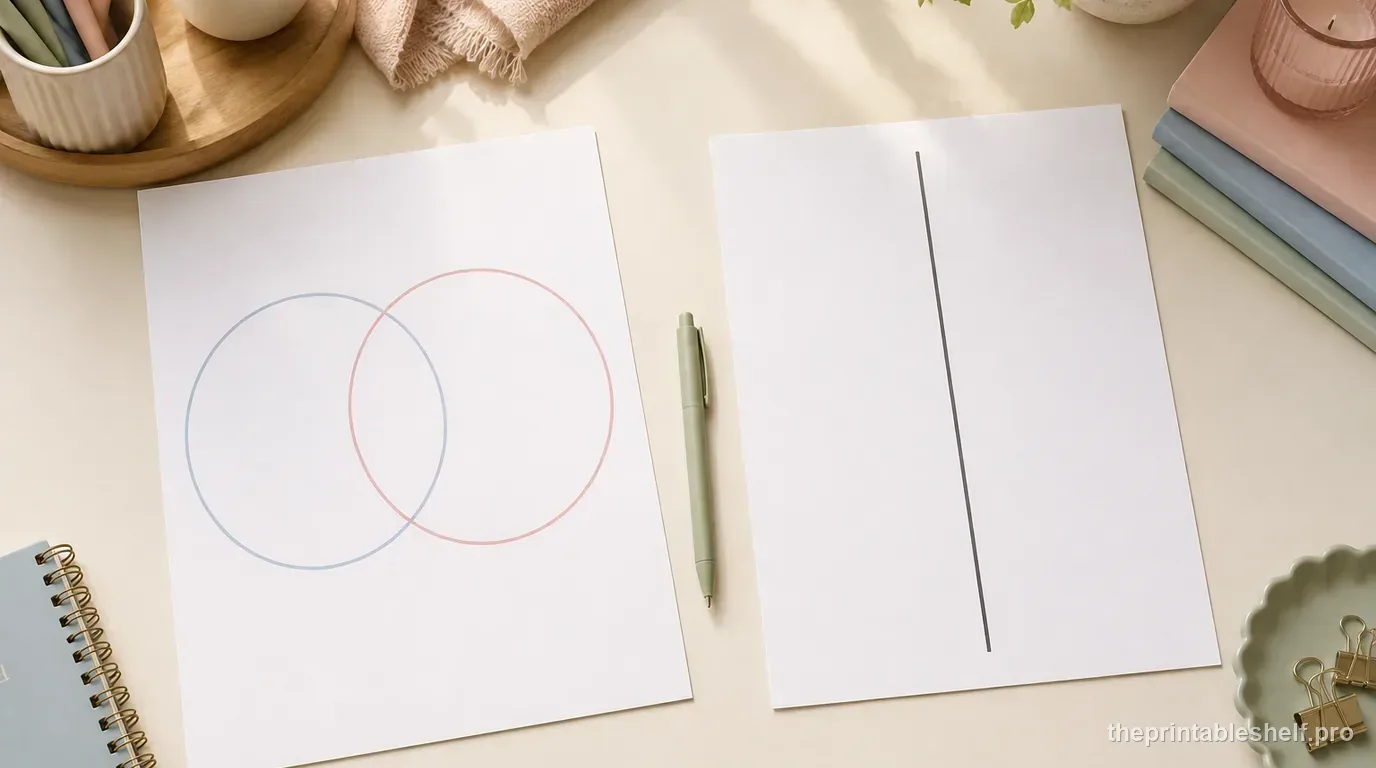
Venn Diagram vs. T-Chart: Which One Should You Use?
Compare Venn diagrams and T-charts, see when each organizer works best, and use a simple decision rule for reading, writing, and classroom tasks.
Read guide →
Free Reading Comprehension Graphic Organizers by Reading Skill
Free reading comprehension graphic organizers for story elements, main idea, sequence, cause and effect, comparison, vocabulary, and prior knowledge.
Read guide →
How to Use Graphic Organizers Effectively (Without Turning Them Into Busywork)
Learn how to choose, model, scaffold, and reuse graphic organizers so students think with them instead of simply filling in boxes.
Read guide →