How-to guide · Work & Study
How to Write Claim, Evidence, Reasoning (CER)
Claim-Evidence-Reasoning, usually shortened to CER, is a scaffold for scientific explanations. It separates three jobs that students often blend together: state the conclusion, identify the information that supports it, and explain why that information counts as support. NSTA describes CER as a framework for helping students construct scientific explanations, while NGSS practices emphasize explanations supported by evidence and scientific reasoning.
CER is useful because a response can be factually accurate but still incomplete. A student may choose the correct claim and copy the right data yet never explain the relationship between them. The reasoning section makes that missing logic visible. The routine below treats CER as a thinking structure rather than a rigid paragraph template so it can scale from a short elementary explanation to more complex middle- and high-school work.
CER at a glance: what each part does and what a weak version looks like
CER stands for claim, evidence, reasoning. The table shows what each part answers and the most common way a draft goes wrong, so a teacher or a student can check a response quickly. The sections after it cover each part in detail, with sentence starters, worked examples, and a before-and-after revision.
| Part | The question it answers | A strong version | A weak version |
|---|---|---|---|
| Claim | What is your answer to the question? | One clear sentence that answers the question and says what was compared. | Repeats the question, lists the materials, or gives no definite answer. |
| Evidence | What did you observe, measure, or read? | Specific observations or data, with units and the conditions that were kept the same. | An opinion, a guess, every result from the lab, or an explanation sitting in the evidence box. |
| Reasoning | Why does the evidence support the claim? | Names the science idea that links the data to the claim and keeps the conclusion to what was tested. | Repeats the data, or says “this proves my claim” without saying why. |
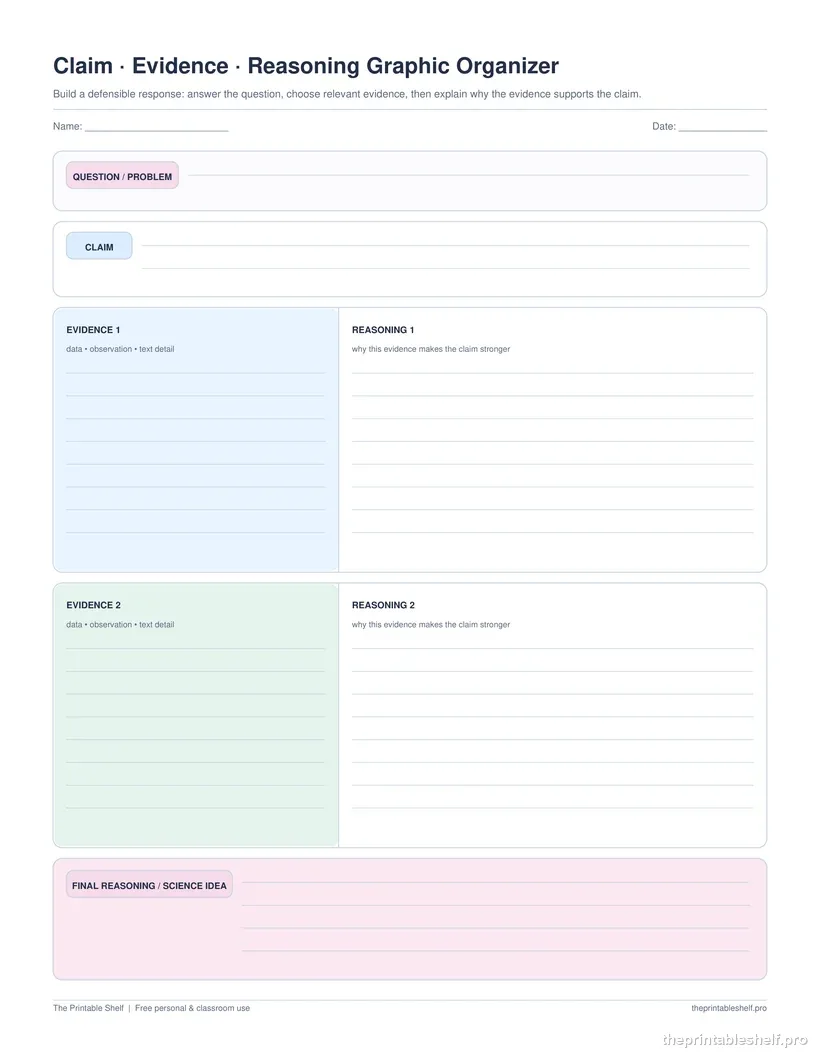
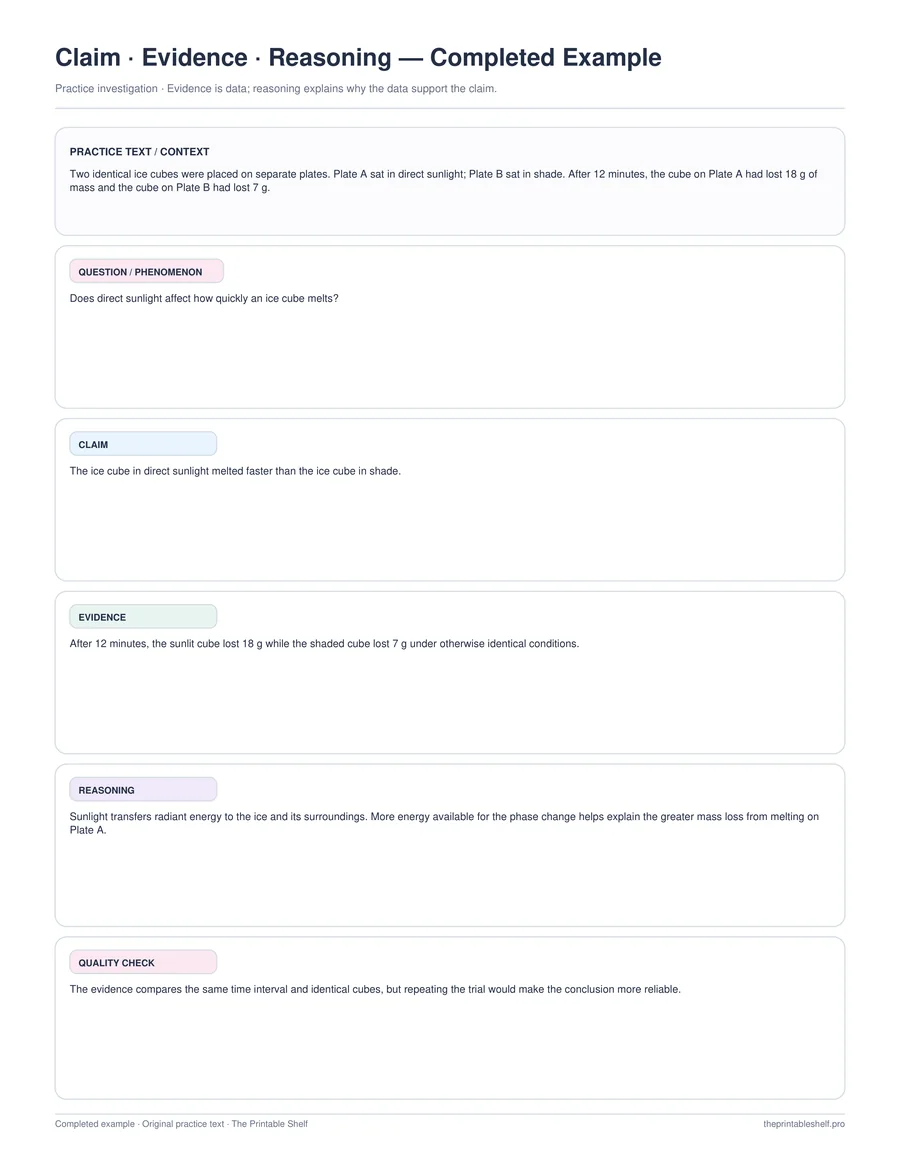
Free download
Choose your file size
Print at 100% / Actual Size for the cleanest margins. Pick the paper size your printer normally uses.
Share to Google Classroom ↗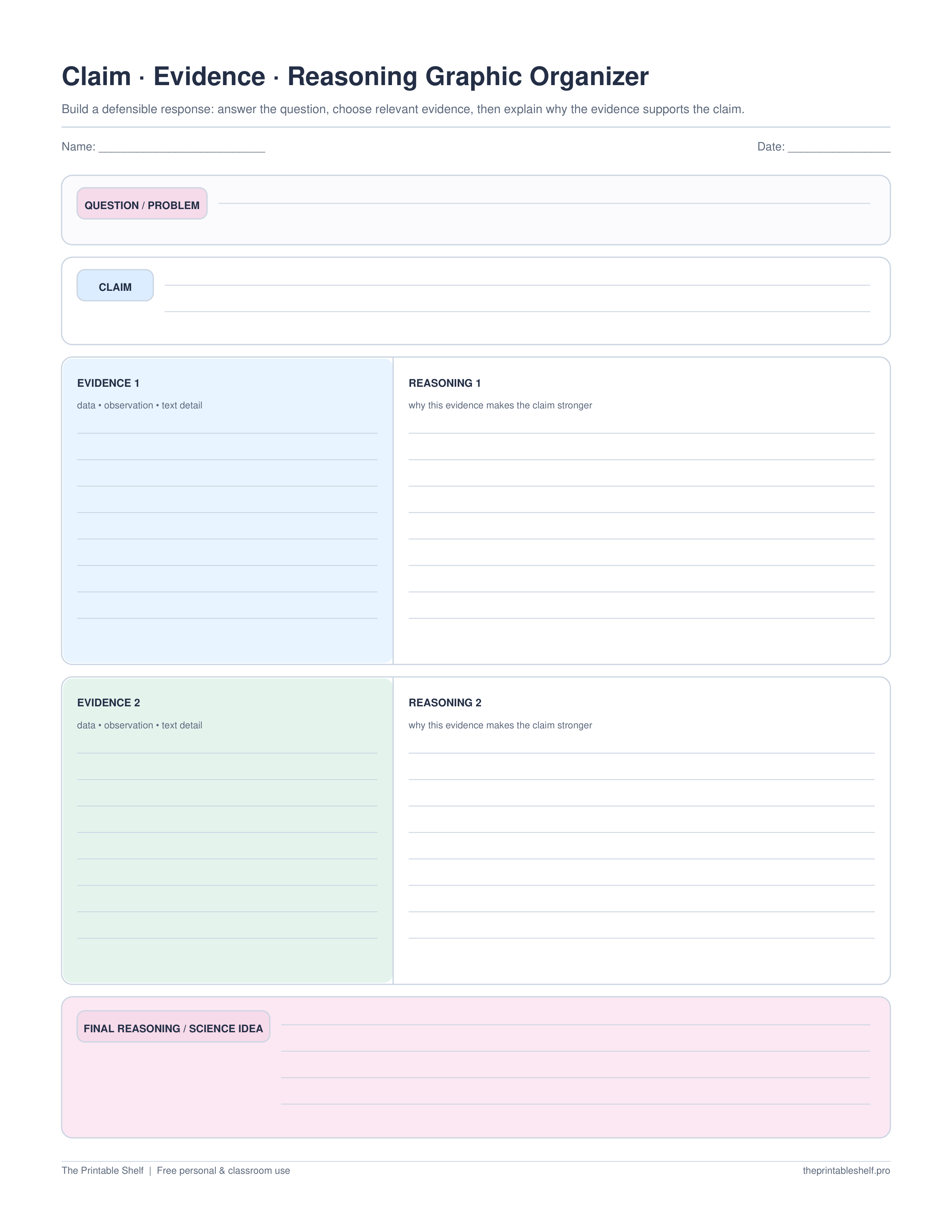
No sign-up required · personal/classroom use
Understand the three jobs before filling the boxes
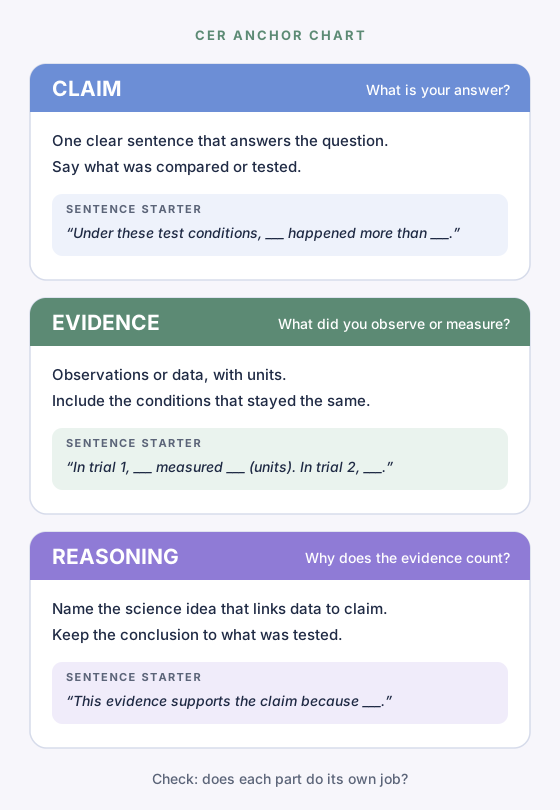
The claim answers the question or states the conclusion. Evidence is the relevant information used to support that conclusion, such as observations, measurements, patterns, results, or source-based facts allowed by the task. Reasoning is the justification that explains why the evidence supports the claim through scientific ideas, principles, mechanisms, or relationships.
These categories are connected but not interchangeable. 'The plant near the lamp grew taller' may be evidence if it reports an observation. 'The lamp caused more growth' is a claim about the relationship. Reasoning would have to explain why the measured pattern supports that conclusion and address whether the investigation actually controlled other important conditions. Labeling the jobs separately makes those distinctions easier to inspect.
Step 1: make the claim answer the question—not the whole worksheet
A claim should be clear enough to evaluate. If the question asks which material is the best insulator in an investigation, the claim identifies the material supported by the results. It does not need to repeat every measurement or explain the mechanism yet. When the question asks for a relationship, the claim should state that relationship at the level the evidence can support.
Treat the claim as revisable. Scientific explanations are not stronger because a student refuses to change an early answer. If the data do not support the first conclusion, update the claim. This makes CER consistent with evidence-based reasoning rather than turning the claim box into a guess that must later be defended at all costs.
Step 2: choose evidence that is relevant, appropriate, and sufficient
Evidence should bear directly on the claim. In an investigation, that may mean measurements, repeated observations, comparison groups, or a pattern across trials. In a source-based science task, it may come from a graph, model, text, or data table. Preserve units and conditions when they change the meaning of the result. A number without context is not automatically useful evidence.
Do not list every observation because it was collected. Ask which results discriminate among possible claims. NGSS materials repeatedly emphasize valid and reliable evidence and, at higher grades, multiple sources or lines of evidence when appropriate. Sufficiency depends on the task: a tightly scoped classroom question may sometimes be answered with one strong observation, but repeated observations are stronger when variability matters, and broader explanations may require several independent supports.
Step 3: make the reasoning explain why the evidence counts
Reasoning is usually the hardest part because it cannot be copied directly from the data table. It identifies the scientific idea that makes the evidence meaningful. If an investigation shows ice melting faster on one surface, the reasoning needs the relevant thermal-energy relationship; repeating the melting times is still evidence, not reasoning. NSTA's CER guidance similarly distinguishes data from the justification that links data to a claim.
A useful prompt is: 'What science idea explains why this result supports my conclusion?' Another is: 'If a reader accepted the evidence but did not yet accept the claim, what relationship would I need to explain?' Those questions move students away from empty phrases such as 'This proves my claim' and toward an actual explanatory bridge.
Sentence starters you can copy for each part
Many students know what a claim is and still freeze at the first word. These starters give them a way in. Use them for the first few responses, then ask students to set the starter aside and write in their own words. Otherwise every paper in the class begins with the same phrase.
| Part | Starters |
|---|---|
| Claim | “Under these test conditions, ___ happened more than ___.” / “The answer to the question is ___.” / “The results suggest that ___ affects ___.” |
| Evidence | “In trial 1, ___ measured ___ (units), and in trial 2 it measured ___.” / “The data table shows ___.” / “I observed ___ while ___ stayed the same.” |
| Reasoning | “This evidence supports the claim because ___.” / “The relationship between ___ and ___ explains why ___.” / “If the claim were not true, we would expect to see ___ instead.” |
| Limits | “This investigation does not show ___, because we only tested ___.” |
Worked CER example: compare two paper-towel samples
Suppose a class tests how much water equal-sized pieces of two unlabeled paper-towel samples absorb, using the same water amount, contact time, draining method, and measurement procedure for both samples. Across three matched trials, Sample B absorbs more water each time. Claim: under the tested conditions, Sample B absorbed more water than Sample A. Evidence: the recorded amount for B is higher in all three matched trials, and the average for B is also higher. Those are observations from the investigation rather than opinions about which brand seems better.
Reasoning: using equal-sized samples while holding the water amount, contact time, draining method, and measurement procedure consistent makes the absorption results more comparable, and the repeated pattern across matched trials supports the conclusion that B performed better on this measured property under those conditions. Notice the limits. The CER does not justify a broader claim that B is 'the best paper towel' overall, because the investigation did not test cost, strength, different liquids, or every competing product. Good reasoning also keeps the conclusion proportional to what was tested.
A second worked CER example: explain a dissolving result
Use a classroom investigation with the same mass of sugar and water, but two water temperatures. In this illustrative data set, the sugar dissolves in 24 seconds at 50°C and 78 seconds at 20°C, with both cups left unstirred. Claim: the sugar dissolved faster in the warmer water under these test conditions. Evidence: the recorded dissolving time was 24 seconds in the 50°C water and 78 seconds in the 20°C water. Reasoning: warmer water has greater average molecular kinetic energy, so water molecules move faster and interact with the sugar more rapidly; that scientific idea explains why the measured time was shorter. The evidence supports this comparison, but one trial does not establish the exact result for every sugar grain, water volume, or classroom setup.
Compare this with the paper-towel example: the claim answers the investigation question, the evidence reports measured results with their conditions, and the reasoning supplies the scientific relationship that connects those results to the claim. The topic changes; the three jobs do not.
Fix a weak CER: a before-and-after example
Question: which melts an ice cube faster, a metal pan or a wooden board? In this illustrative test, two ice cubes of the same size start on surfaces that have been sitting in the same room at about 22°C (72°F). The cube on the metal pan melts completely in 6 minutes. The cube on the wooden board takes 14 minutes.
Before reading the revision, look for three problems in the first draft. The claim describes the setup without answering the question. The evidence box holds an explanation instead of a measurement. The reasoning repeats the result and adds the word “proves.” Then compare each cell with the revised column.
| Part | First draft | Revised |
|---|---|---|
| Claim | Metal and wood are different materials, and I put ice on both. | An ice cube melted faster on the metal pan than on the wooden board. |
| Evidence | Metal conducts heat well. | The cube on the metal pan melted completely in 6 minutes. The cube on the wooden board took 14 minutes. Both cubes were the same size, and both surfaces started at room temperature, about 22°C. |
| Reasoning | This proves metal is better because the ice melted. | Metal conducts thermal energy much better than wood, so heat moves from the pan into the ice faster. Faster heat transfer fits the shorter melting time. With one trial per surface, this supports the comparison but does not say how other metals or woods would behave. |
CER outside science: English and social studies
CER works in any class where an answer needs support. In English, the evidence is a detail or quotation from the text, and the reasoning explains what that detail shows about the idea in the claim. In social studies, the evidence is a fact from a source, and the reasoning links it to the historical idea. The organizer's last box is labeled for a science idea, but students can use it for the text-based or historical idea instead.
The table answers two questions. English: is Charlotte a loyal friend to Wilbur in Charlotte's Web? Social studies: why did colonists dump tea into Boston Harbor in 1773?
| Part | English (Charlotte's Web) | Social studies (Boston Tea Party) |
|---|---|---|
| Claim | Charlotte is a loyal friend to Wilbur. | Colonists destroyed the tea to protest being taxed by a Parliament that did not include their representatives. |
| Evidence | Charlotte weaves the words “Some Pig,” “Terrific,” “Radiant,” and “Humble” into her web so the Zuckermans will decide to keep Wilbur alive. | On December 16, 1773, colonists boarded three ships and dumped 342 chests of East India Company tea into Boston Harbor. The Tea Act of 1773 had made that tea cheaper, but the tax on tea was still in place. |
| Reasoning | Charlotte keeps working to protect Wilbur even though he cannot repay her. Loyalty shows in what a friend does when it costs something, so this evidence supports the claim. | Buying the cheaper tea would have meant paying the tax, which many colonists saw as accepting Parliament's right to tax them without their consent. Destroying the tea rejected both the tax and that right. |
Claim, evidence, commentary (CEC) and CERER: how they relate to CER
Some English and social studies classes teach claim, evidence, commentary (CEC) instead of CER. The structure is the same: the claim answers the question, the evidence is the quotation or fact, and the commentary does the job the reasoning does in science by explaining how and why that evidence supports the claim. Commentary is where the analysis lives, so a sentence that only repeats the quotation in other words is not commentary yet.
CERER is the same routine with two supports: claim, evidence, reasoning, evidence, reasoning. It matches the two evidence-reasoning rows on the organizer, and you can write it as one paragraph. Whichever label your teacher uses, check each part with the same question: does this sentence do its own job, or is it repeating another part? In the organizer's last box, write the science idea, or in English or social studies write the idea the commentary is building toward.
Use a quick three-part CER check before turning it in
Score each part 0, 1, or 2: 0 means missing or unsupported, 1 means present but incomplete, and 2 means clear and supported. Claim: does it answer the actual question at a scope the investigation can support? Evidence: does it include relevant observations or data, with units or conditions when those matter? Reasoning: does it explain the scientific idea that links the evidence to the claim instead of repeating the result? A response with a low score in one part shows what to revise; it does not need extra evidence merely to reach a fixed sentence count.
For a first elementary practice, a teacher may accept one clear observation and an oral or sentence-stem explanation. In later grades, the same check can require repeated measurements, attention to variability, a mechanism, or a limit on the conclusion. Match the expected evidence and reasoning to the question and available data rather than applying one rubric as a universal standard.
Use two evidence-reasoning pairs when they add different support
The printable provides room for two pairs because many explanations benefit from more than one support. Pair one might describe the main quantitative pattern; pair two might identify a repeated observation, comparison, or second data source. Each reasoning box should explain the significance of that particular evidence instead of copying one generic sentence twice.
If the second piece adds nothing, do not force it. A requirement such as 'always use two pieces of evidence' can lead students to duplicate weak information. Conversely, a complex claim may need more than the worksheet provides. The organizer is a planning surface, not a rule about how much evidence science permits.
Revise CER when the evidence is mixed or contradicts the claim
Real data are not always perfectly tidy. If one trial differs from the others, note it instead of silently discarding it. Check for measurement error, procedure differences, variability, or another explanation that the task allows you to investigate. The presence of an exception does not automatically destroy a claim, but the reasoning should not pretend contradictory evidence does not exist.
A stronger revision may narrow the claim: 'Sample B absorbed more water in two of three trials' is more accurate than a sweeping conclusion when the pattern is inconsistent. At advanced levels, students can discuss reliability, uncertainty, and competing explanations. The core habit stays the same: the claim and reasoning should respond to the evidence actually available.
Common CER mistakes and targeted fixes
Mistake one is writing a claim that simply repeats the question. Make a definite answer. Mistake two is putting an explanation in the evidence box. Ask whether the sentence reports what was observed or measured; if not, it may belong in reasoning. Mistake three is using every datum. Select information that directly bears on the claim. Mistake four is treating correlation as automatic causation when the investigation does not justify it.
Mistake five is repeating evidence in the reasoning section. Add the scientific principle or mechanism that explains the connection. Mistake six is keeping a claim that the results do not support. Revise it. Mistake seven is writing a conclusion broader than the study. Match the wording to the variables, samples, conditions, and evidence that were actually examined.
Turn the organizer into a scientific explanation, not a labeled list
After planning, combine claim, evidence, and reasoning into connected prose. A short response may use one paragraph; a longer explanation may revisit the reasoning after several pieces of evidence. The reader should still be able to identify the three functions, but the final writing does not need to announce 'Claim:' and 'Evidence:' unless the teacher or assessment specifically requests those labels.
For younger learners, oral CER or color coding can make the distinctions visible before extended writing. For older students, add source evaluation, uncertainty, alternative explanations, and more demanding reasoning. The NGSS progression increases expectations for evidence and scientific reasoning across grade bands, so the scaffold should become more sophisticated as students gain knowledge rather than remain a fixed fill-in-the-blank routine.
Quick answers
What does CER stand for in science?
CER stands for Claim, Evidence, and Reasoning. The claim answers the question, evidence supplies relevant observations or data, and reasoning explains why the evidence supports the claim using appropriate scientific ideas.
What is the difference between evidence and reasoning in CER?
Evidence is the information that supports the claim, such as measurements or observations. Reasoning is the justification that connects that information to the conclusion through a scientific principle, mechanism, pattern, or relationship.
How many pieces of evidence should a CER have?
Use enough appropriate and relevant evidence for the claim and task. The printable provides two evidence-reasoning pairs for practice, but a simple explanation may need less and a complex explanation may require more.
How do you start a CER response?
Start with the question or phenomenon you're explaining, then write a claim that answers it directly in one sentence, before listing any evidence. Writing the claim before the evidence keeps what follows focused on supporting that specific answer instead of listing everything the investigation produced.
How long should a CER response be?
There is no fixed length. A short classroom task may be one paragraph with a claim, one evidence-reasoning pair, and a closing sentence; a fuller lab report may need multiple pairs and a longer reasoning section. Length should track how much evidence the task actually provides and how complex the claim is, not a word-count target.
What goes in the conclusion of a CER?
A CER conclusion restates the claim in light of the evidence and reasoning already given, rather than introducing new data. It should also state the limits of what the evidence actually supports, so the conclusion does not claim more than the investigation tested.
What is claim, evidence, commentary and how is it different from CER?
Claim, evidence, commentary (CEC) is the same three-part routine used in many English and social studies classes. The claim answers the question, the evidence is a quotation or fact, and the commentary explains how that evidence supports the claim, which is the job reasoning does in a science CER. The labels differ, but the check is the same: each part must do its own job.
Download a matching template
Free Claim Evidence Reasoning (CER) Graphic Organizer PDF →
This free Claim-Evidence-Reasoning (CER) graphic organizer separates a scientific explanation into a claim that answers the question, evidence that supports the claim, and reasoning that explains why the evidence counts. Two evidence-reasoning pairs make the connection visible instead of letting evidence stand alone as a list of data.
Free Text Evidence Graphic Organizer →
This free text evidence graphic organizer helps learners move beyond quote collecting. Start with the question and a focused claim, record two relevant pieces of textual evidence, then explain how each detail supports the claim. A final evidence check prompts the learner to judge relevance and sufficiency before drafting a response.
Free Paragraph Writing Graphic Organizer →
This paragraph writing organizer helps writers build one focused paragraph around a topic sentence, three supporting ideas, and a closing sentence. Each support section also prompts for explanation or evidence so the paragraph does more than list three facts. Use it for informational, opinion, response, or general academic paragraphs before drafting on lined paper.
Sources
These sources support the instructional background in this guide. The printable recommendations and usage notes above are The Printable Shelf's editorial guidance.
- National Science Teaching Association — Helping Students Write Scientific Explanations — Describes the claim-evidence-reasoning framework as a structure for helping students construct scientific explanations.
- National Science Teaching Association — Data Literacy 101 — Discusses CER as a structure for making sense of scientific information and highlights students' difficulty connecting data to explanations.
- Next Generation Science Standards — Constructing Explanations and Designing Solutions — NGSS practice materials emphasize constructing and revising explanations based on evidence and applying scientific reasoning to link evidence and conclusions.
- What Works Clearinghouse — Teaching Secondary Students to Write Effectively — Evidence-based writing guidance supports explicit strategy instruction using model, practice, and reflection cycles that can be applied to scientific explanation writing.
Related reading
How to Use Text Evidence in a Reading Response
Learn how to choose, cite, and explain text evidence in a reading response without quote dumping, with a worked example and free evidence organizer.
Read guide →
Free Writing Graphic Organizers: Which One to Use and When
Use free writing graphic organizers to plan ideas, structure paragraphs, compare evidence, sequence steps, and organize explanations before drafting.
Read guide →
How to Use Graphic Organizers Effectively (Without Turning Them Into Busywork)
Learn how to choose, model, scaffold, and reuse graphic organizers so students think with them instead of simply filling in boxes.
Read guide →