How-to guide · Work & Study
Free Writing Graphic Organizers: Which One to Use and When
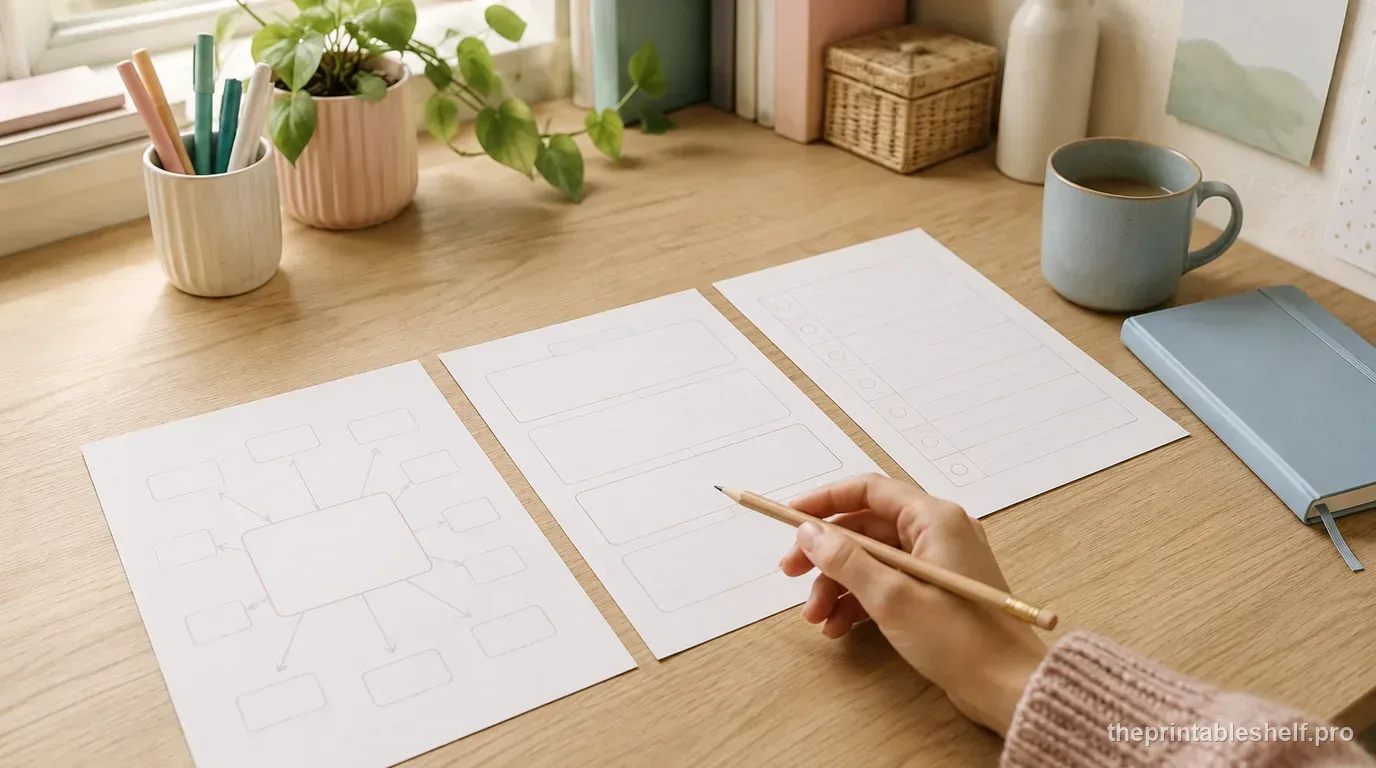
A writing organizer should make one part of drafting easier. It might help a writer find supporting points, put events in order, separate two sides of a comparison, or turn research notes into usable material. Problems start when the organizer becomes a rigid form that every piece of writing has to imitate. Good prewriting keeps the writer focused on meaning while making the structure visible enough to manage.
The free printables in this guide cover different stages of writing. Some are true prewriting planners. Others are information-gathering tools that make the later draft stronger. The key is to pick the page that solves the writer's current problem, then move out of the organizer once it has done that job.
Start with the kind of writing, then choose the organizer
Ask what the finished writing needs to do. An explanation may need causes and results. A procedure needs ordered steps. A comparison needs parallel features and a meaningful conclusion. A short opinion or informational paragraph often needs one clear focus plus several supporting points. A narrative may need a sequence for events but a story map for the larger problem-and-resolution arc.
This keeps the organizer subordinate to the writing goal. The same student can use different organizers in the same week because a science explanation and a character comparison demand different relationships between ideas. Reading Rockets notes that graphic organizers can break writing into manageable steps and make the organization of ideas more visible; the practical question is which visual structure matches the draft you want to create.
Use Four-Square when the writer needs a central idea and supporting points
The Four-Square organizer is useful when a student can name the topic but does not yet have a plan for developing it. On our printable, put the main claim, topic sentence, or controlling idea in the opening area, then use the support sections for reasons, examples, facts, or subtopics that develop the same focus. Before drafting, check whether every support actually belongs under that central idea.
Do not force the final piece to have exactly four paragraphs because the planning page has four regions. The organizer is a thinking scaffold, not a required essay shape. Combine related points, drop a weak square, or expand one idea into several sentences when the evidence demands it.
Use a sequence organizer for procedures and chronological writing
Sequence is the right structure when changing the order would change the meaning. That includes how-to writing, recounting a historical process, explaining a life cycle, or planning a narrative scene whose events depend on one another. Write one meaningful action or stage in each box and use transition language only after the logic of the order is clear.
A sequence sheet is less useful when the ideas are simply a list of equal reasons. “First, second, third” can make unrelated points look chronological when they are not. In that case, Four-Square or a comparison structure usually produces a more honest plan.
Use cause and effect when the draft must explain why something happened
Cause-and-effect writing becomes weak when a writer lists events without establishing or supporting the relationship between them. A cause-and-effect organizer makes each pair visible so the writer can test the logic: because this condition or action occurred, this result followed. For more complex topics, several causes may contribute to one outcome, or one cause may produce several effects.
Before turning the organizer into prose, ask what evidence supports each arrow. This is especially important in science, history, and informational writing, where chronological order by itself does not establish causation. The planner should help the writer distinguish “happened before” from “helped cause.”
Use comparison organizers when the writing needs parallel evidence
For a short brainstorm, a Venn diagram quickly separates unique and shared traits. It is useful when the writer is still discovering the comparison. For a fuller paragraph or essay plan, the box-based compare-and-contrast organizer gives more room to explain the same feature on both sides and decide why a similarity or difference matters.
Whichever format you choose, compare like with like. If one side discusses cost, the other side should address cost too. If one paragraph is about a character's motivation, collect evidence about both characters' motivations. Parallel categories make the final writing analytical instead of two separate descriptions placed next to each other.
Use note-taking and vocabulary organizers before prewriting
Sometimes the real writing problem is not organization yet; it is that the writer does not have usable material. Cornell notes can capture information during reading or instruction and turn key points into cue questions. A Frayer model helps a writer understand an important term through definition, characteristics, examples, and non-examples. A KWL chart can expose what the writer still needs to research.
Treat these sheets as an input stage. After the notes are complete, select only the information that serves the writing purpose. Copying an entire note page into a draft usually produces a report-shaped list rather than a focused explanation.
Model the organizer, then gradually remove the scaffold
A blank page with labeled boxes is not self-explanatory to every writer. Fill in part of an organizer together using a familiar topic. Think aloud about why an idea belongs in one section and not another, then let the student complete the remaining sections. With repeated use, reduce the prompts or let the writer choose which organizer fits the assignment.
The long-term goal is not dependence on a worksheet. It is for the writer to internalize questions such as: What is my focus? Which ideas support it? What is the relationship between these points? What order will make sense to a reader? The organizer is successful when those questions begin to happen without the paper.
Turn the organizer into a draft without copying box by box
Before drafting, circle or mark the strongest ideas and decide what can be dropped. Then write a sentence that states the focus of the piece without looking for a preprinted sentence starter. Move through the organizer by relationship, not by box number. Add transitions only where the reader needs help seeing how one idea connects to the next.
After the first draft, put the organizer aside and revise the writing as writing. A paragraph may need a different order once complete sentences reveal the logic. New ideas may appear. Weak points may disappear. Prewriting should give the writer a launch ramp, not a cage.
Frequently asked questions
Which graphic organizer is best for paragraph writing?
For a paragraph built around one main point with supporting details, Four-Square is a practical starting structure. For a comparison paragraph, use a Venn or compare-and-contrast organizer instead.
Can a student use more than one organizer for the same writing assignment?
Yes. A writer might collect research in Cornell notes, compare sources in a Venn diagram, and then use Four-Square to plan the final response. Each organizer should solve a different problem.
When should students stop using graphic organizers for writing?
Reduce the scaffold when a student can independently identify the focus, relationships, order, and supporting evidence needed for the task. The goal is flexible planning, not permanent dependence on a template.
Printables for this topic
Free Four-Square Writing Organizer Printable →
This free four-square writing organizer helps plan a focused paragraph before drafting. One box holds the opening or topic sentence, three boxes collect supporting reasons, facts, or details, and a final strip is reserved for the closing sentence. Download it in Letter, A4, or PNG format.
Free Sequence of Events Graphic Organizer →
This sequence of events organizer gives you five ordered steps labeled First, Next, Then, After That, and Finally, plus a final reflection on what changed. Use it to retell a story, track historical events, explain a process, or plan a procedure. Download the printable in Letter, A4, or PNG.
Free Cause and Effect Graphic Organizer →
Use this cause and effect graphic organizer to connect why something happened with what happened as a result. The page includes a focus event plus three clearly paired cause-and-effect rows, making it useful for reading, science, history, and process analysis. Download it in Letter, A4, or PNG format.
Free Printable Venn Diagram Template →
This free Venn diagram template gives you two large overlapping circles for comparing two topics. Put traits unique to each topic in the outer sections and shared traits in the overlap. It works for reading, science, social studies, decision-making, and study review, with Letter, A4, and PNG downloads.
Free Compare and Contrast Graphic Organizer →
This free compare and contrast organizer separates details that belong only to Topic A, only to Topic B, and to both. A conclusion box then asks the learner to state the most important comparison. It works for texts, concepts, people, events, or choices and downloads in Letter, A4, or PNG.
Free Printable Cornell Notes Template →
This free Cornell notes template divides one page into a cue column, a larger notes area, and a summary section. Take notes on the right, add questions or key terms on the left afterward, then summarize the page in your own words after class. Download it in Letter, A4, or PNG format.
References
These sources support the instructional background in this guide. The printable recommendations and usage notes above are The Printable Shelf's editorial guidance.
- Reading Rockets — Graphic Organizers to Help Kids With Writing — Overview of visual organizers as tools for breaking writing into manageable steps.
- Reading Rockets — Reading and Scaffolding Expository Texts — Examples of matching organizer structures to comparison, cause-effect, problem-solution, and other text relationships.
- IES — Using Graphic Organizers in Writing — Classroom example showing a graphic organizer used as a plan that students convert into writing.
Keep reading
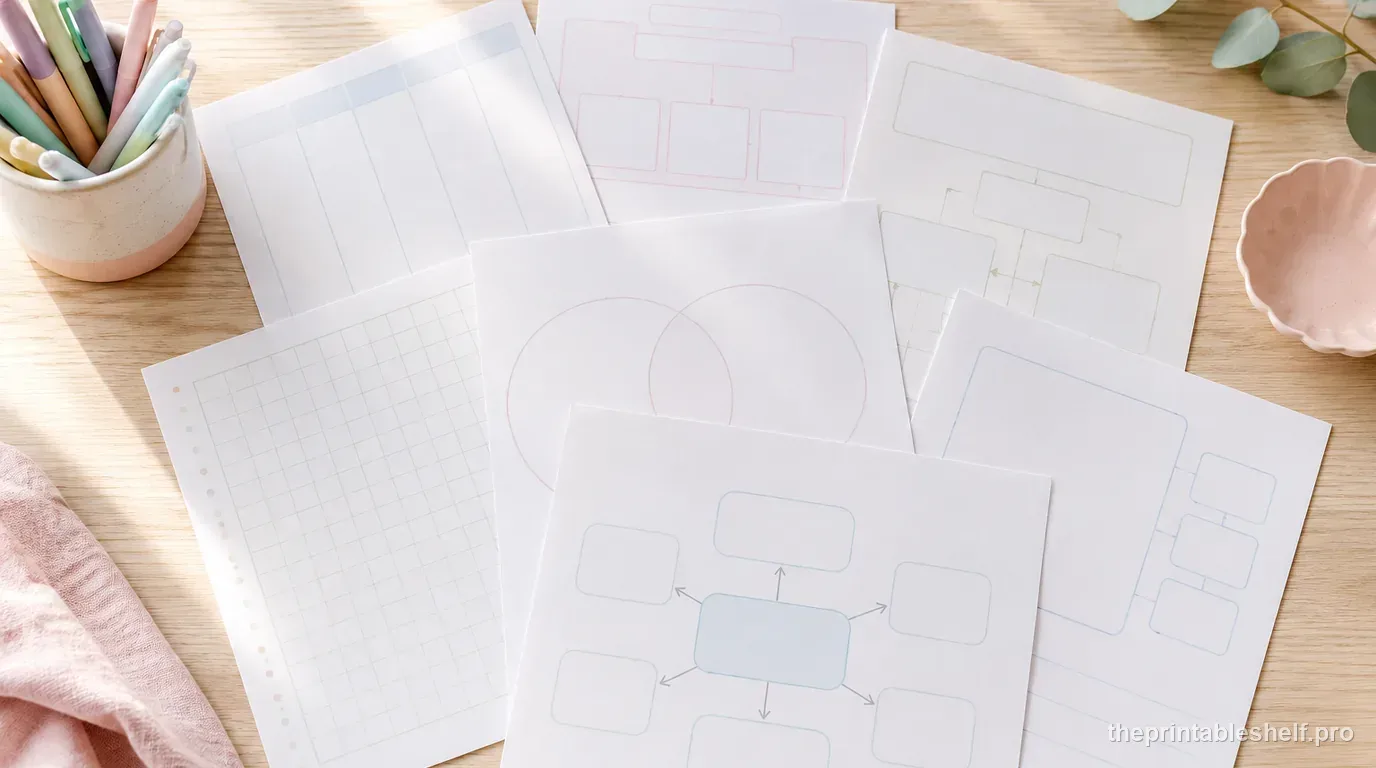
10 Free Graphic Organizers for Reading, Writing, and Studying
Download 10 free graphic organizers for reading, writing, comparison, vocabulary, sequencing, and study. Includes a guide to choosing the right one.
Read guide →
Free Reading Comprehension Graphic Organizers by Reading Skill
Free reading comprehension graphic organizers for story elements, main idea, sequence, cause and effect, comparison, vocabulary, and prior knowledge.
Read guide →
How to Use Graphic Organizers Effectively (Without Turning Them Into Busywork)
Learn how to choose, model, scaffold, and reuse graphic organizers so students think with them instead of simply filling in boxes.
Read guide →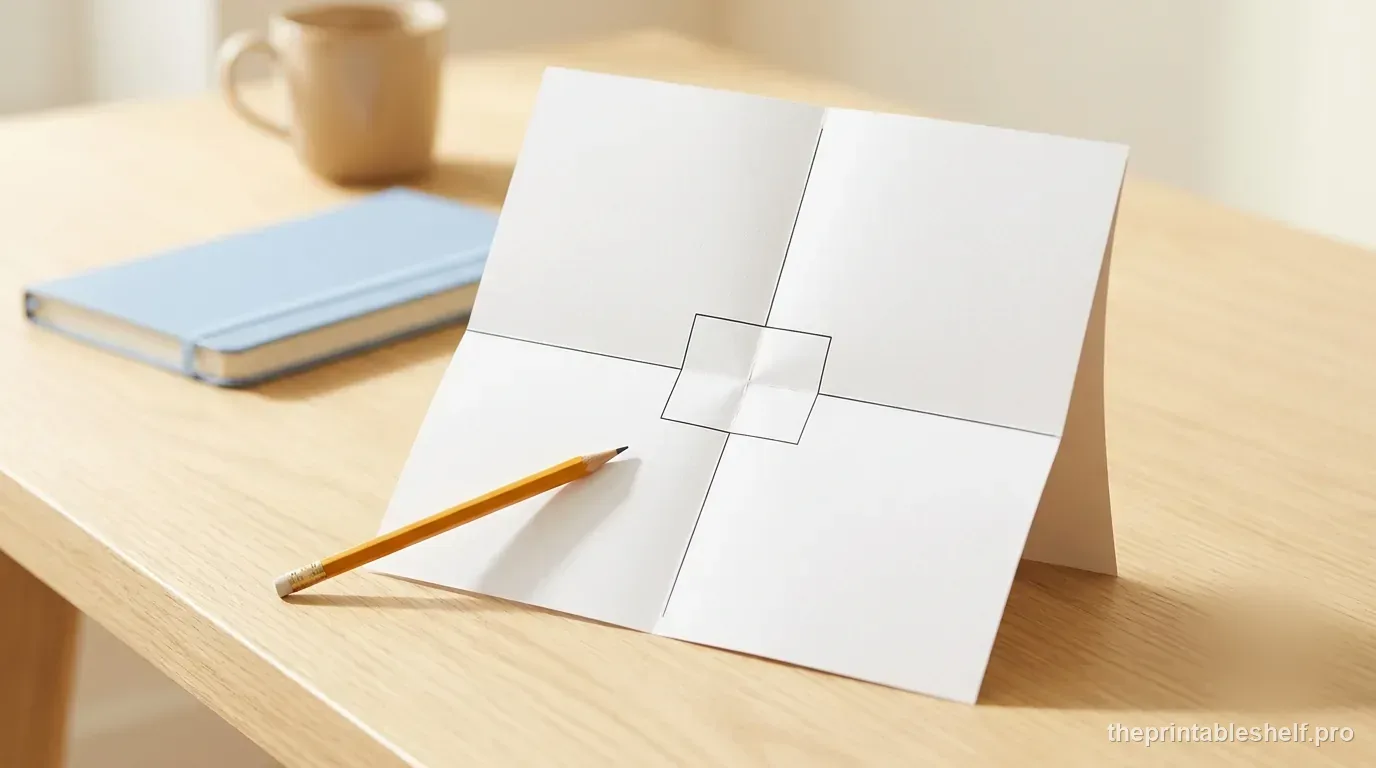
How to Use the Four-Square Writing Method to Plan a Paragraph
Learn how to use the four-square writing method to plan a focused paragraph, choose strong supports, and turn the organizer into a draft.
Read guide →