Math Worksheets · Free 13-page pack
Free Adding Fractions — Like Denominators Worksheets PDF
This grade 4 pack has six practice pages for adding fractions with the same denominator, plus an answer key, in a 13-page PDF. Learners combine equal-sized parts by adding the top numbers while keeping the size of each part unchanged. Problems use denominators from 3 to 10, including sums such as 8/10 + 1/10.
Edited by Tessa Vaughn · Planning & Organization Editor
Free download
Download the 13-page pack
This multi-page pack currently has one print-ready format. Preview the PDF, then print the whole pack or only the page range you need.
Share to Google Classroom ↗No sign-up required · personal/classroom use
Practice this skill on screen30 questions in three levels (easy, medium, hard) with instant feedback. Nothing to install.Get the whole set: 8 packs in one zipFractions worksheet packs. Grades 1–5: identify, compare, add, subtract and simplify fractions. US Letter PDFs with answer keys, 509 KB.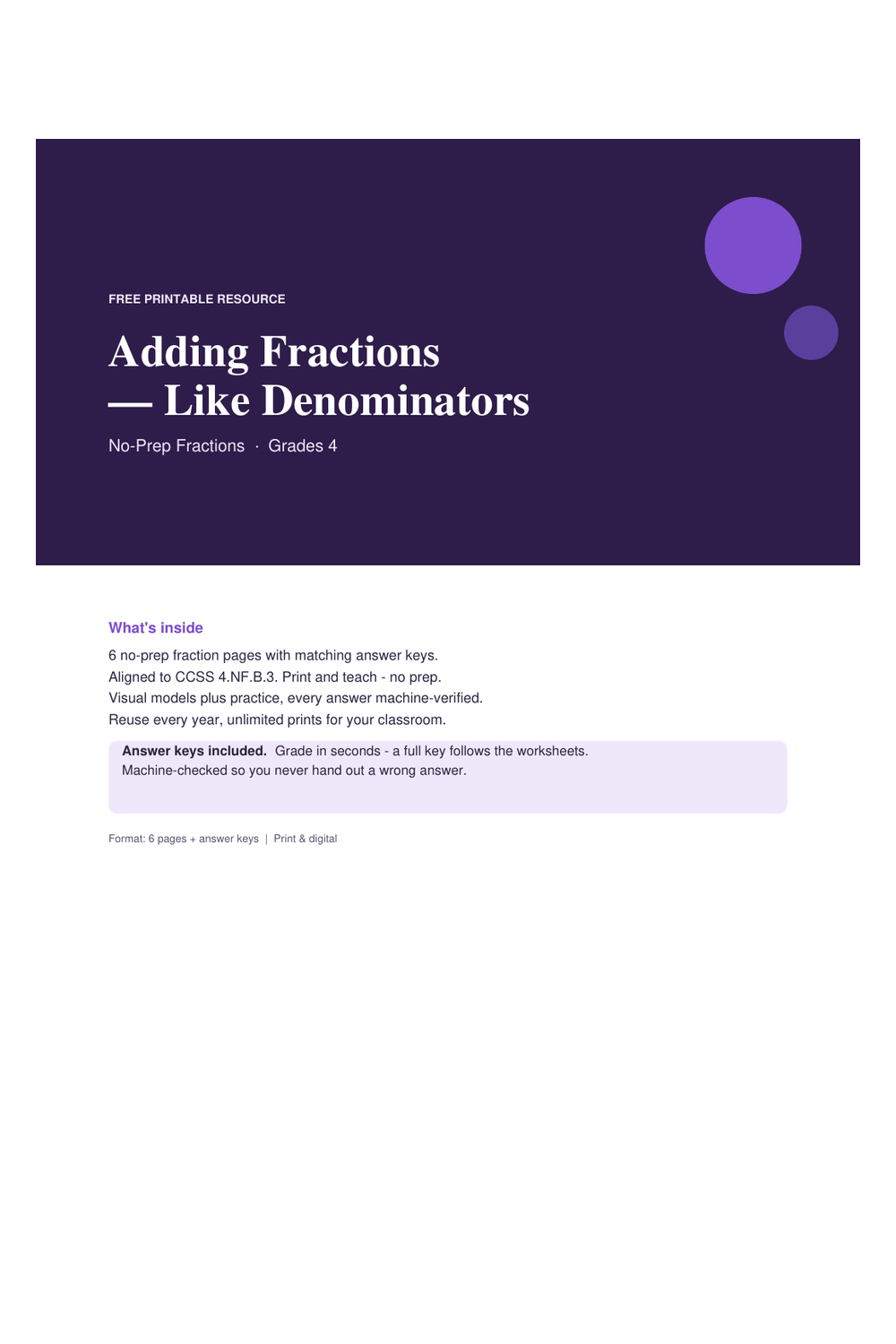
What you get in this download
This 13-page PDF pairs six addition practice pages with a cover; the answer key is on pages 8-13. Worksheets 2, 3, and 7 each contain 10 problems. A Name/Date line appears on each. Denominators are the same within a problem and range from 3 to 10, as in 8/10 + 1/10. Remaining worksheets give students further like-denominator sums.
Adding equal-sized fraction parts
A denominator tells how many equal pieces make one whole. When two fractions have the same denominator, their pieces are the same size, so addition means counting those pieces together. Add the numerators and keep the denominator. For example, fourths stay fourths when combined. If the new numerator equals the denominator, the pieces make one whole; if it is smaller, the result is still a proper fraction.
Children can picture two collections of same-sized tiles being joined. The denominator names the tile size, while the numerator counts how many tiles are present. Encourage a child to say, “three tenths plus four tenths is seven tenths,” before writing the equation. This helps connect the operation to the quantity. The shortcut works here because the units match; unlike-sized parts would need a different strategy before they could be combined directly.
Worked example 1
Find 1/4 + 2/4.
Both fractions count fourths. Combine 1 piece and 2 pieces, keeping the fourth-size unit: 1 + 2 = 3.
Answer: 3/4
Worked example 2
Find 8/10 + 1/10.
The parts are tenths, so add their counts: 8 + 1 = 9. Nine tenths is less than ten tenths, so it remains a fraction of one whole.
Answer: 9/10
Worked example 3
Find 2/5 + 2/5.
Count four fifth-size parts altogether: 2 + 2 = 4. The size of each part stays fifths because both starting fractions use fifths.
Answer: 4/5
How to teach this skill
Build matching pieces
Draw one strip divided into five equal boxes. Shade two, then shade two more in a second strip of the same size. Ask how many fifths are shaded altogether. Have the child write 2/5 + 2/5 = 4/5 and point to the unchanged fifth-size boxes as the reason the denominator stays five.
Name the unit aloud
Before calculating, ask the learner to read each fraction as a number of tenths, thirds, or another named part. For 1/3 + 1/3, say “one third and one third.” This language keeps attention on equal unit sizes, rather than treating the two digits as unrelated numbers.
Check for one whole
Use a paper strip split into the denominator's number of equal spaces. After the child combines the counts, compare the numerator with that total number of spaces. With 1/3 + 1/3, two of three spaces are filled; the strip shows why the sum is 2/3 rather than a whole.
Connect drawing to equation
Start with a simple shaded-part sketch, then write the matching addition sentence beneath it. For 6/10 + 3/10, the drawing can show nine of ten equal parts covered. Ask the child to identify what the denominator describes before recording 9/10, so each symbol has a clear referent.
Works well for
Classroom and home ideas
A first look at fraction sums
Use one or two questions to see whether a learner understands that equal denominators represent equal-size pieces. Ask for a spoken explanation as well as the answer.
Independent written practice
Assign a practice page for a short individual session. The repeated equation format lets a student concentrate on joining like-sized parts and writing a fraction sum.
Review with the answer key
After the work, compare a few responses with their corresponding answers. When a numerator is off, revisit the count of pieces rather than simply copying the result.
What usually goes wrong
Answering 9 for 6/10 + 3/10 and omitting the tenths unit.
Have the child say the count and its unit: six tenths plus three tenths is nine tenths. Then write 9/10. The denominator names the fractional unit, so giving only 9 loses the size of the amount.
Adding the denominators as well, so 6/10 + 3/10 becomes 9/20.
Point to the same-size tenths in both addends. Joining them changes how many tenths there are, not the size of a tenth; nine pieces are 9/10.
Keeping only one addend, such as answering 2/5 for 2/5 + 2/5.
Have the child make two groups of two fifths with marks or counters, then count every mark. Four fifth-size parts are present, so the numerator must include both groups.
Calling 8/10 + 1/10 equal to 10/10 after counting one extra tenth incorrectly.
Track each piece once: eight tenths followed by one more makes nine tenths. Count the marks aloud or point to them individually; the total is still one less than a full ten tenths.
Questions people ask
How do you add fractions with like denominators?
First check that both denominators match, so the fractions name equal-size parts. Add the numerators to count all those parts, and keep the common denominator. For instance, 1/3 + 1/3 is 2/3 because two thirds are being counted. A drawing divided into thirds can help a child see why the unit does not change.
How to teach adding fractions with like denominators to grade 4 students?
Begin with a strip or set of equal boxes divided into the denominator's number of parts. Shade the first fraction, then add the second set of shaded pieces. Let the learner count the combined pieces and describe their size before writing an equation. That routine links the written method to the amount represented.
What are some fun activities for adding fractions with like denominators?
Use paper strips with a child divided into equal sections and ask them to shade two collections, such as two fifths and one fifth. They can join the strips, count the shaded sections, and write the matching sum. Keep the denominator unchanged in each pair so the activity stays focused on adding like-sized parts.
What is included in this adding fractions like denominators worksheet pack?
This 13-page file pairs six addition sheets with their solutions. The answer key is on pages 8-13. Worksheets 2, 3, and 7 each have 10 addition problems and a Name/Date line. Denominators run from thirds through tenths, and the key lists each sum.
Is this adding fractions like denominators worksheet pack free?
Yes. There is no fee and no sign-up. The download is a US Letter PDF only, with no A4 or PNG option. Its answer key, on pages 8-13, is included with six addition worksheets. You can print only the sheets needed.
Keep organizing
You might also like
Free 13-page pack
Comparing Fractions Worksheets PDF
A 13-page US Letter math pack for grades 3-4. The PDF keeps the student practice and matching answer-key pages together in one file so you can print only the pages you need. The main skill is to compare fraction size using models, benchmarks, or common-sized parts instead of comparing numerators alone. The pack references 4.NF.A.2 on the cover. Standards noted for this pack: 4.NF.A.2.
View & download →
Free 13-page pack
Equivalent Fractions Worksheets PDF
A 13-page US Letter math pack for grades 3-4. The PDF keeps the student practice and matching answer-key pages together in one file so you can print only the pages you need. The main skill is to recognize when different numerator-denominator pairs represent the same quantity. The pack references 4.NF.A.1 on the cover. Standards noted for this pack: 4.NF.A.1.
View & download →
Free 13-page pack
Fractions on a Number Line Worksheets PDF
A 13-page US Letter math pack for grades 3. The PDF keeps the student practice and matching answer-key pages together in one file so you can print only the pages you need. The main skill is to treat a fraction as a number located a measured distance from zero, not only as a shaded shape. The pack references 3.NF.A.2 on the cover. Standards noted for this pack: 3.NF.A.2.
View & download →