Math Worksheets · Free 13-page pack
Free Fractions on a Number Line Worksheets PDF
Made for grade 3, this 13-page pack offers six practice pages about locating fractions between 0 and 1, plus an answer key. Each practice page asks students to name eight marked points on number lines. The key includes values such as 5/6, 7/8, and 2/3, connecting fractions with positions and distance.
Edited by Tessa Vaughn · Planning & Organization Editor
Free download
Download the 13-page pack
This multi-page pack currently has one print-ready format. Preview the PDF, then print the whole pack or only the page range you need.
Share to Google Classroom ↗No sign-up required · personal/classroom use
Practice this skill on screen30 questions in three levels (easy, medium, hard) with instant feedback. Nothing to install.Get the whole set: 8 packs in one zipFractions worksheet packs. Grades 1–5: identify, compare, add, subtract and simplify fractions. US Letter PDFs with answer keys, 509 KB.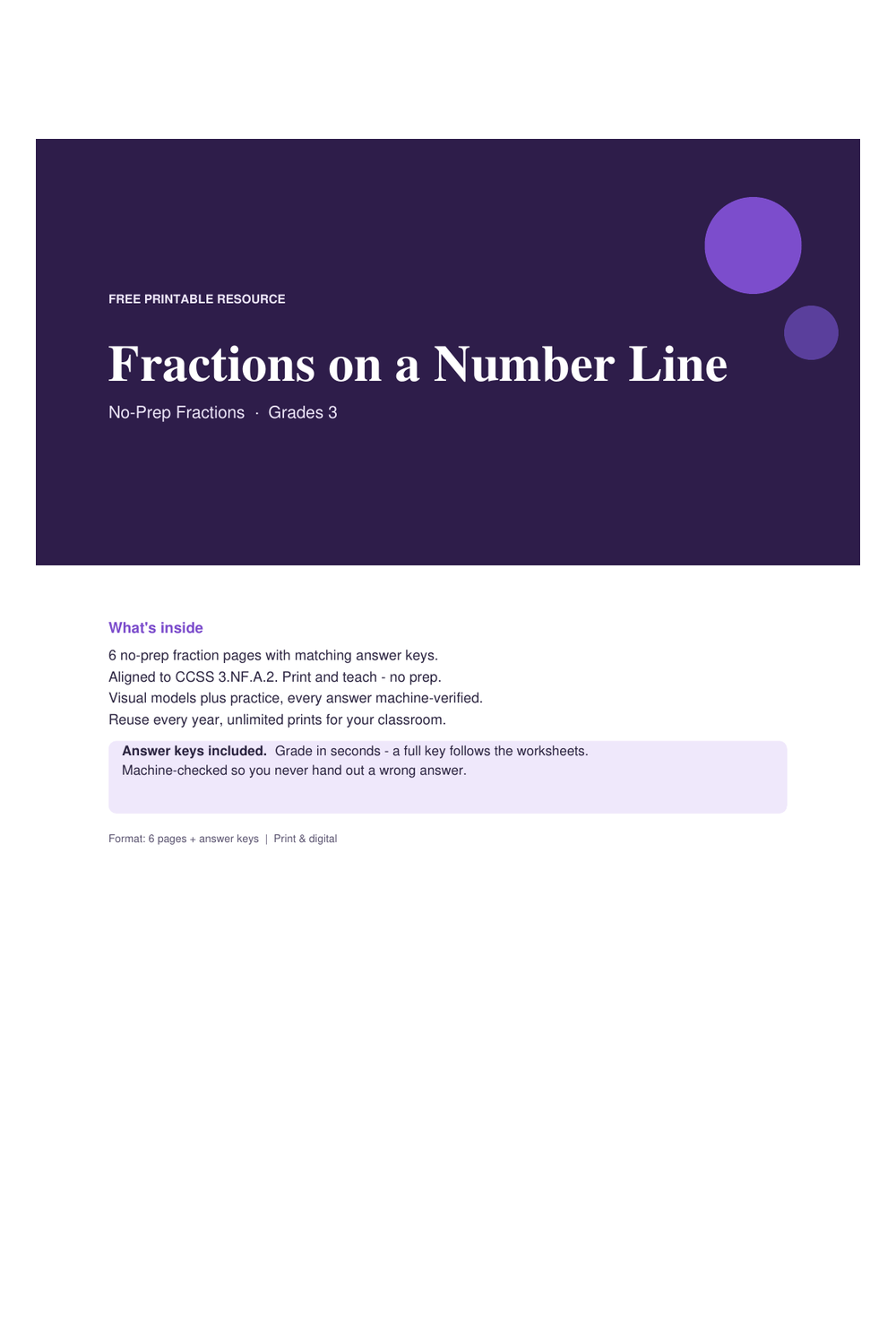
What this page helps with
The number-line PDF has 13 pages. A cover comes first, then six number-line practice pages; the answer key is on pages 8-13. Students write a Name/Date on each worksheet. Pages 2, 3, and 7 ask them to name 8 points between labeled endpoints 0 and 1. Answers include 1/3, 5/6, 7/8, and 2/3. Later practice pages use the same point-naming task.
Fractions mark distances from zero
A number line treats a fraction as a number with a location, not just as part of a pictured shape. The interval from zero to one is one whole. To locate a fraction, divide that interval into the number of equal steps named by the denominator, then count the numerator's steps from zero. The denominator sets the step size; the numerator tells how far along the line to travel.
For example, thirds split the unit interval into three equal jumps. Two jumps land at 2/3. Each jump is the same length, so the point is measured from zero rather than guessed by its appearance. A good check is to notice that a proper fraction lies between zero and one, and that a larger numerator with the same denominator means moving farther right.
Worked example 1
Where is 1/3 on a number line from 0 to 1?
Divide the full interval into 3 equal steps. Starting at zero, count one step to the right; that location is the first third.
Answer: 1/3
Worked example 2
Which point is 5/6 of the way from 0 to 1?
Split the unit into six equal intervals, then count five intervals from zero. The location is one sixth before 1.
Answer: 5/6
Worked example 3
Locate 7/8 between 0 and 1.
Make eight equal steps across the whole interval. Count seven steps from zero; the point sits one equal step to the left of 1.
Answer: 7/8
A teaching routine for this pack
Mark the unit interval
Draw a straight segment and label its endpoints zero and one. Explain that the entire distance represents one whole. Before placing a fraction, ask what denominator-sized pieces would divide that exact interval evenly. The endpoint labels give the learner a stable scale for all the positions that follow.
Count equal jumps
For a fraction such as 2/3, partition the segment into three equal spaces and count two jumps from zero. Emphasize that the marks create spaces, not points to count. This prevents counting zero as the first third and landing one interval too far right.
Compare positions
Place two fractions with a shared denominator on one line, such as 1/8 and 5/8. Since the step size is identical, the point reached after five steps lies farther right. Ask learners to connect “farther right” with “greater” and explain the role of the numerator.
Estimate before partitioning
Ask whether a fraction should fall near zero, the middle, or one before drawing every tick. A value such as 5/6 should be close to one because only one sixth remains. The estimate gives the child a way to catch an uneven partition or a point placed outside the unit interval.
Good matches for this page
Three ways to use it
Connect fraction and magnitude
Number line work lets a learner see a fraction as a number with an order and distance from zero. Ask where a known benchmark would sit.
Practice reading marked points
The point-naming format gives students practice translating a location into a fraction. Have them describe the interval count and the number of jumps. Ask for a spoken label before writing.
Check fraction estimates
Before checking an exact point, ask whether it should lie nearer zero or one. A misplaced estimate can reveal confusion about numerator or denominator. Revisit the unit interval when a point falls outside it.
Common mistakes to avoid
Counting the zero endpoint as the first step and placing 1/3 at the second tick.
The endpoints are locations, while the spaces between them are intervals. Start at zero, move across one equal interval, and label the landing point 1/3.
Dividing the line into five spaces for 3/5 but counting only two spaces from zero.
The denominator creates five equal intervals; the numerator tells how many to travel. Count three intervals from zero and check that the point is beyond one half but before one.
Putting 7/8 to the left of 1/2 because 8 is a large denominator.
A large denominator means smaller steps, not a smaller value by itself. Seven of eight steps go almost all the way to one, so 7/8 lies to the right of one half.
Marking 5/6 beyond 1 because six ticks are counted after the endpoint.
The complete distance from zero to one contains six intervals. Five intervals end at 5/6, and the sixth reaches one. Keep the counting within the labeled unit length.
Common questions
How do you show fractions on a number line?
Mark zero and one to define a whole interval. Divide that distance into equal spaces based on the denominator, then count the numerator's number of spaces from zero. For 2/3, split the interval into three equal lengths and move two lengths right. The landing point names the fraction.
How to teach fractions on a number line to grade 3 students?
Start with a line from zero to one and let children label the whole distance. Make equal partitions together, then hop from zero while counting the spaces aloud. Ask whether the final point is near zero, the middle, or one. A prediction helps students notice when partitions are uneven or a count is off.
What is an easy way to locate fractions on a number line?
Use the denominator to decide how many equal intervals fit between zero and one. Use the numerator as the number of intervals to travel. For 5/6, create six equal spaces and move five of them from zero. The point should be close to one, which is a useful reasonableness check.
What is included in this fractions on a number line worksheet pack?
A 13-page file supplies six student sheets after its cover and a key on pages 8-13. Practice worksheets 2, 3, and 7 each ask learners to name 8 points; the line endpoints are 0 and 1, and a Name/Date line is present. The answer key gives 1/3, 5/6, 7/8, and 2/3.
Is this fractions on a number line worksheet pack free?
Yes. There is no cost and no sign-up form. This pack is supplied as a US Letter PDF, without an A4 or PNG copy. Its number-line exercises and answer key share one file; the key occupies pages 8-13. Print as needed.
Keep organizing
You might also like
Free 13-page pack
Adding Fractions — Like Denominators Worksheets PDF
A 13-page US Letter math pack for grades 4. The PDF keeps the student practice and matching answer-key pages together in one file so you can print only the pages you need. The main skill is to combine like-sized fractional parts by adding numerators and keeping the common denominator. The pack references 4.NF.B.3 on the cover. Standards noted for this pack: 4.NF.B.3.
View & download →
Free 13-page pack
Comparing Fractions Worksheets PDF
A 13-page US Letter math pack for grades 3-4. The PDF keeps the student practice and matching answer-key pages together in one file so you can print only the pages you need. The main skill is to compare fraction size using models, benchmarks, or common-sized parts instead of comparing numerators alone. The pack references 4.NF.A.2 on the cover. Standards noted for this pack: 4.NF.A.2.
View & download →
Free 13-page pack
Equivalent Fractions Worksheets PDF
A 13-page US Letter math pack for grades 3-4. The PDF keeps the student practice and matching answer-key pages together in one file so you can print only the pages you need. The main skill is to recognize when different numerator-denominator pairs represent the same quantity. The pack references 4.NF.A.1 on the cover. Standards noted for this pack: 4.NF.A.1.
View & download →