Math Worksheets · Free 13-page pack
Free Equivalent Fractions Worksheets PDF
This grades 3-4 resource is a 13-page PDF with six practice pages and an answer key for finding equivalent fractions. Students complete a missing numerator or denominator while keeping the fraction's value unchanged. Problems include 4/6 = 16/□ and 1/2 = □/8.
Edited by Tessa Vaughn · Planning & Organization Editor
Free download
Download the 13-page pack
This multi-page pack currently has one print-ready format. Preview the PDF, then print the whole pack or only the page range you need.
Share to Google Classroom ↗No sign-up required · personal/classroom use
Practice this skill on screen30 questions in three levels (easy, medium, hard) with instant feedback. Nothing to install.Get the whole set: 8 packs in one zipFractions worksheet packs. Grades 1–5: identify, compare, add, subtract and simplify fractions. US Letter PDFs with answer keys, 509 KB.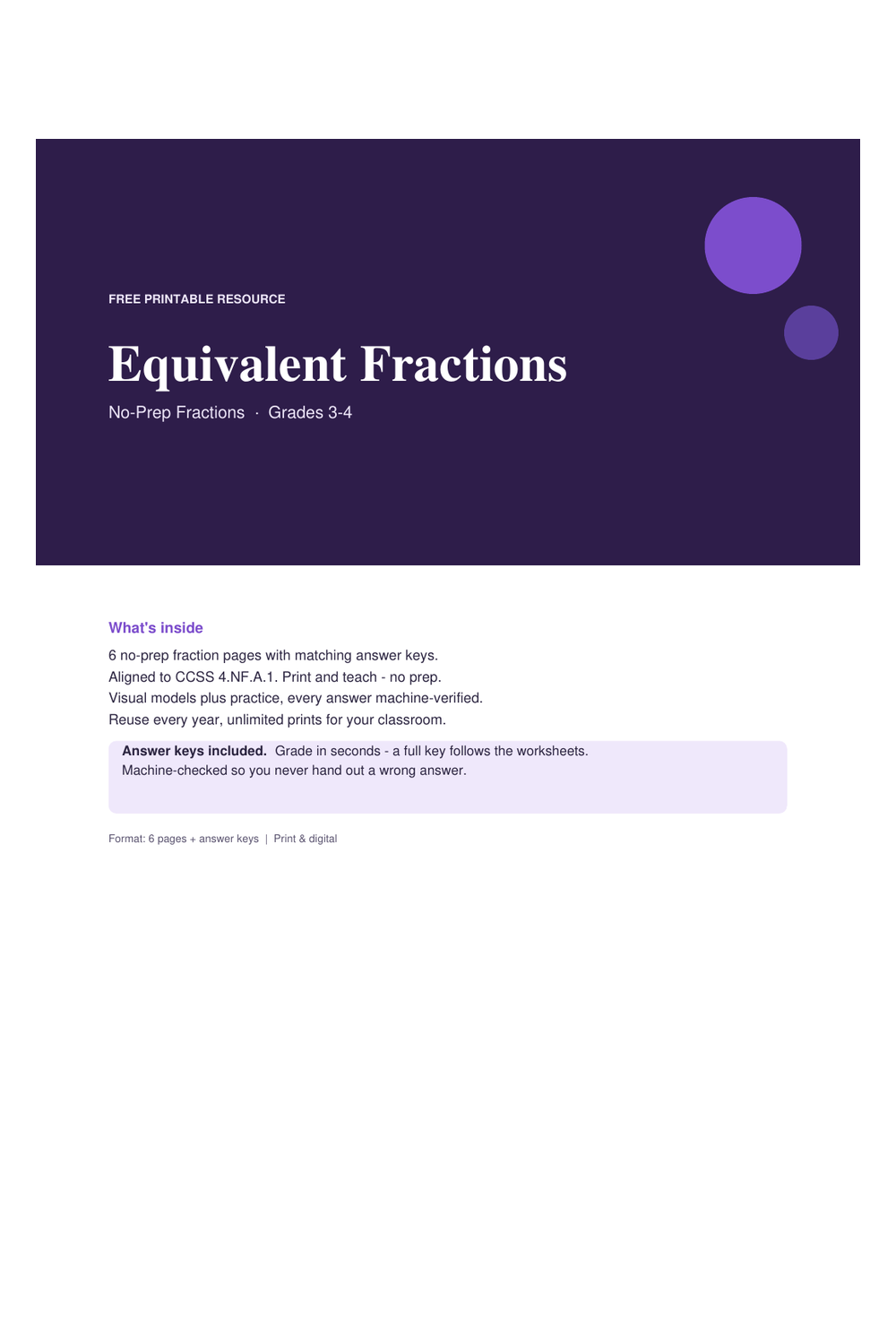
What is on the page
Teachers get a 13-page PDF with a cover, six missing-number practice pages, and matching solutions. The answer key spans pages 8-13. On pages 2, 3, and 7, pupils complete 10 equations per page, with a Name/Date line. Each equation leaves either the numerator or denominator blank; the numbers range from 2 to 24. Page 2 includes 4/6 = □/24. The remaining practice pages continue this task.
Keeping a fraction's value the same
Equivalent fractions name the same portion of a whole even though their numerator and denominator can differ. Multiplying both by the same nonzero number makes more, smaller equal parts without changing the total amount. Dividing both by a shared factor describes the same amount with fewer, larger parts. The key is to apply the same change to the top and bottom; changing only one alters the value.
A child can imagine one half of a strip, then split every existing part in two. The shaded amount is now two fourths, but its length has not moved. For a missing-number equation, ask what happened to the denominator and apply that same factor to the numerator. This paired change keeps the relationship balanced and gives a way to check whether the proposed fraction covers the same amount.
Worked example 1
Complete 1/2 = □/8.
The denominator changed from 2 to 8 by multiplying by 4. Multiply the numerator by 4 as well: 1 × 4 = 4.
Answer: 1/2 = 4/8
Worked example 2
Complete 4/6 = □/24.
The denominator 6 becomes 24 by multiplying by 4. Use that same factor for the numerator: 4 × 4 = 16.
Answer: 4/6 = 16/24
Worked example 3
Complete 3/4 = 12/□.
The numerator is multiplied by 4 to make 12. Multiply the denominator by 4 too: 4 × 4 = 16.
Answer: 3/4 = 12/16
A teaching routine for this pack
Split every part again
Draw a bar, divide it into two equal sections, and shade one. Now divide each half into two equal pieces without changing the shaded length. Count two shaded pieces out of four. The child can see that 1/2 and 2/4 describe the same span, though the partitions are finer.
Track the scale factor
Write a small multiplication beside each denominator change. If 3 becomes 12, label it ×4, then ask what 5 would become under the same scale. This keeps both parts of the fraction connected. Have the learner check by reversing the operation or comparing the original amount.
Use paired number lines
Mark zero and one at matching positions on two number lines. Divide one line into halves and the other into fourths. The marks for one half and two fourths line up. Matching positions provide a visual test when the numbers in an equation look quite different.
Check both directions
After filling a blank, ask whether the same multiplier links both numerator and denominator. For 1/2 = 4/8, each original number was multiplied by four. Then ask whether the new fraction names the same portion on a drawing or number line.
Good matches for this page
Three ways to use it
Fill a missing fraction part
Use an equation with one blank to see whether a learner applies a matching change to numerator and denominator. Ask for the factor, not only the answer.
Prepare for fraction comparison
Equivalent forms can help students compare values later. Have them describe why a renamed fraction still covers the same portion before moving to a comparison task.
Explain a surprising equality
When students see different numerals on both sides of an equation, a strip model can show why the two fractions can still be equal. Ask them to trace the unchanged shaded length.
Common mistakes to avoid
Multiplying only the denominator and writing 1/2 = 1/8.
The numerator and denominator must change by the same factor. If halves become eighths by multiplying by four, one shaded half becomes four shaded eighths, so the matching fraction is 4/8.
Adding 4 to both parts and claiming 1/2 = 5/6.
Equivalent fractions come from multiplying or dividing both terms by the same factor, not adding the same amount. Draw both fractions over equal wholes to see that 1/2 and 5/6 cover different lengths.
Writing 4/6 = 24/30 after multiplying the numerator by 6 but the denominator by 5.
Find one scale factor and use it twice. Since 4 becomes 24 by multiplying by 6, the denominator must also be multiplied by 6, giving 36 and the equivalent fraction 24/36.
Changing 3/4 to 6/16 by doubling only the numerator and quadrupling the denominator.
Compare the multiplier used on each term. Both terms need the same factor; doubling 3/4 gives 6/8. To reach a denominator of 16, multiply both terms by 4 and get 12/16.
Common questions
How do you find equivalent fractions?
Multiply or divide the numerator and denominator by the same nonzero number. This changes how many pieces the whole is divided into and how many are counted, but preserves the amount. For example, doubling both parts of 1/2 gives 2/4. A drawing with matching shaded lengths can confirm the new fraction.
How to teach equivalent fractions with a visual model?
Draw one whole as a bar and shade a simple fraction such as one half. Split each existing section into smaller equal pieces, keeping the shaded boundary in place. Count the newly shaded pieces and all the pieces. The unchanged shaded length helps explain why a different pair of numbers can name the same value.
Which equivalent fractions problems could a student try?
Complete 1/2 = □/8, 4/6 = □/24, and 3/4 = 12/□. Ask students to identify the factor that links a known numerator or denominator to its partner, then apply that factor to the other part. Finish by checking each equation with a bar or by reversing the multiplication.
What is included in this equivalent fractions worksheet pack?
A 13-page PDF includes a cover and six student sheets. The answer key is in the back section, pages 8-13. On sheets numbered 2, 3, and 7, students complete 10 equations each, with a Name/Date line. Every equation has one blank in the numerator or denominator, and the numbers range from 2 to 24.
Is this equivalent fractions worksheet pack free?
Yes, there is no charge and no account needed. You receive a US Letter PDF only, with no A4 or PNG edition. The answer key is in the final group, numbered pages 8-13. It is part of this 13-page file, not a separate download.
Keep organizing
You might also like
Free 13-page pack
Adding Fractions — Like Denominators Worksheets PDF
A 13-page US Letter math pack for grades 4. The PDF keeps the student practice and matching answer-key pages together in one file so you can print only the pages you need. The main skill is to combine like-sized fractional parts by adding numerators and keeping the common denominator. The pack references 4.NF.B.3 on the cover. Standards noted for this pack: 4.NF.B.3.
View & download →
Free 13-page pack
Comparing Fractions Worksheets PDF
A 13-page US Letter math pack for grades 3-4. The PDF keeps the student practice and matching answer-key pages together in one file so you can print only the pages you need. The main skill is to compare fraction size using models, benchmarks, or common-sized parts instead of comparing numerators alone. The pack references 4.NF.A.2 on the cover. Standards noted for this pack: 4.NF.A.2.
View & download →
Free 13-page pack
Fractions on a Number Line Worksheets PDF
A 13-page US Letter math pack for grades 3. The PDF keeps the student practice and matching answer-key pages together in one file so you can print only the pages you need. The main skill is to treat a fraction as a number located a measured distance from zero, not only as a shaded shape. The pack references 3.NF.A.2 on the cover. Standards noted for this pack: 3.NF.A.2.
View & download →