Math Worksheets · Free 13-page pack
Free Comparing Numbers — 2-Digit Worksheets PDF
Grades 1-2 learners compare two-digit numbers in this 13-page PDF. Six practice sheets present 15 pairs apiece, asking students to decide which number is greater or whether they match. Problems include 42 and 45, as well as equal pairs such as 72 and 72. The answer key shows the comparison symbol for each pair.
Edited by Tessa Vaughn · Planning & Organization Editor
Free download
Download the 13-page pack
This multi-page pack currently has one print-ready format. Preview the PDF, then print the whole pack or only the page range you need.
Share to Google Classroom ↗No sign-up required · personal/classroom use
Practice this skill on screen30 questions in three levels (easy, medium, hard) with instant feedback. Nothing to install.Get the whole set: 9 packs in one zipPlace value and rounding worksheet packs. Grades 1–4: compare, order, expanded form and rounding. US Letter PDFs with answer keys, 384 KB.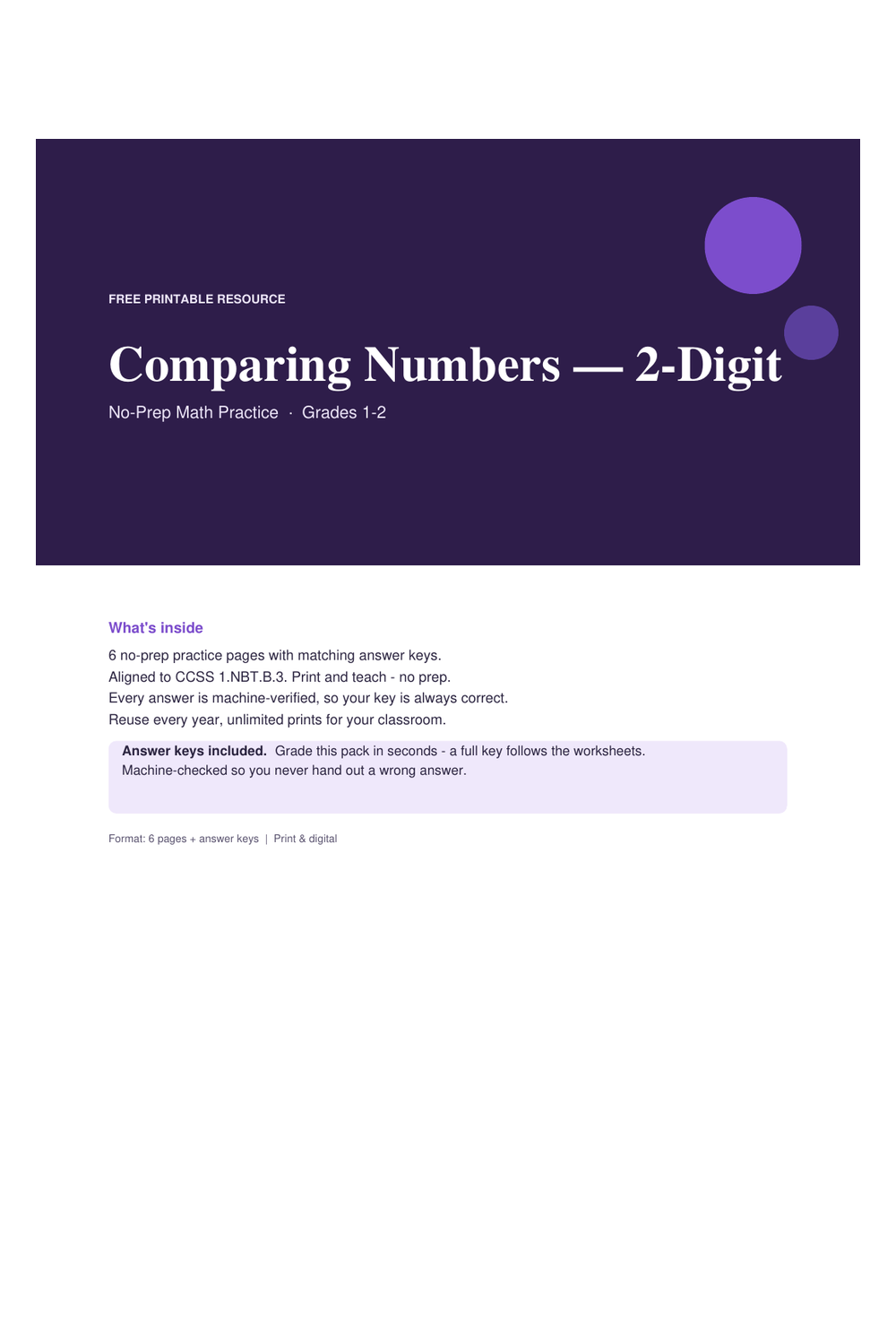
What you get in this download
The download runs to 13 pages in US Letter size. It starts with a cover, then gives six numbered sheets for students, and closes with their comparison key. Practice pages 2, 3, and 7 each contain 15 pairs of two-digit values; the other practice pages use that same layout. Pairs shown include 12 and 97, 72 and 72, and 85 and 86. Name and Date lines appear on each sheet. An answer key is provided.
Compare tens before ones
A two-digit number is made of tens and ones. Compare the tens first because each ten is worth more than any single one. When one number has more tens, it is greater, whatever the ones digits are. If the tens match, compare the ones to decide. If both places match, the numbers are equal. The symbols < and > point toward the smaller number; = means the values match.
Take 42 and 45. Both numbers have four tens, so the tens do not settle the comparison. Compare the ones: two is less than five, so 42 is less than 45. For 94 and 50, compare nine tens with five tens and stop there. Children can build each number with tens sticks and single counters, then connect the larger quantity to the open side of the symbol.
Worked example 1
42 __ 45
Both numbers have 4 tens. Compare the ones: 2 is less than 5, so the left number is smaller. Point the symbol's open side toward 45.
Answer: 42 < 45
Worked example 2
94 __ 50
Compare tens first: 9 tens is greater than 5 tens. The ones do not need to decide this pair.
Answer: 94 > 50
Worked example 3
72 __ 72
The tens digits match and the ones digits match too. Neither number is greater, so use the equal sign.
Answer: 72 = 72
A teaching routine for this pack
Make tens and ones
Build 42 and 45 with four tens sticks each, then add two or five single counters. Ask what stayed the same and what changed. Let the learner compare the loose counters before drawing the symbol. This physical view explains why the tens can be equal while the ones decide the relationship.
Use an open number line
Mark 42 and 45 on a short number line and ask which point lies farther to the right. Then connect that order to 42 < 45. Keep the numbers close enough that students focus on comparing quantities, and remind them that the symbol opens toward the greater value.
Sort equal and unequal pairs
Write pairs such as 72 and 72 beside pairs such as 94 and 50. Have students first say equal or different, then name the place that decides. For matching pairs, check both tens and ones before choosing the equal sign rather than assuming every question needs a greater-than symbol.
Read the sign aloud
After selecting a sign for 53 and 80, read the full statement as “53 is less than 80.” This turns the symbol into a sentence about the numbers. Ask the learner to trace the narrow point toward the smaller value and explain which tens helped decide the comparison.
Good matches for this page
Three ways to use it
Explain a close pair
Choose pairs with the same tens, such as 42 and 45, so students must look at the ones. Ask them to name the first place that settles the comparison before writing a sign.
Find matching values
Mix in equal pairs such as 72 and 72. Students can verify both digits and explain why neither side is greater, reinforcing the meaning of the equality symbol.
Read a comparison aloud
Have learners turn each written statement into a spoken sentence. Listening for “less than,” “greater than,” or “is equal to” can reveal when a symbol has been reversed.
Common mistakes to avoid
Choosing 42 > 45 because 5 in 45 looks larger than 2 without comparing the tens first.
Compare the tens: both have four. Then compare the ones, where 2 is less than 5. Write 42 < 45 and read it aloud as forty-two is less than forty-five.
Writing 72 < 72 because the worksheet asks for a symbol even though both values match.
Check both places. Each number has seven tens and two ones, so their values are the same. Use = and say that 72 is equal to 72.
Turning the open side toward 42 in 42 < 45, so the symbol points at the smaller value.
Read the statement as “42 is less than 45.” The symbol's narrow point faces the smaller number and its open side faces the greater one. Use the spoken sentence to verify the direction.
Comparing 94 and 50 by looking only at 4 ones and 0 ones.
The tens decide first: 94 has nine tens while 50 has five. Since nine tens is greater, 94 > 50 regardless of the ones digits.
Common questions
How do you compare two-digit numbers?
Check the tens digits first. If one number has more tens, it is greater. When the tens are equal, compare the ones; matching tens and ones mean the numbers are equal. For example, 42 and 45 each have four tens, so compare two ones with five ones and write 42 < 45.
How can I teach comparing numbers with the greater-than and less-than signs?
Build each number with tens sticks and loose counters, then compare the quantities. For 94 and 50, nine tens is already more than five tens. For a close pair like 42 and 45, the tens match and the ones decide. After choosing a sign, have the child read the statement aloud.
How should a student compare two-digit numbers to find the greater value?
Read the whole comparison as a sentence, such as “42 is less than 45.” The symbol's pointed end faces the smaller number, while its open side faces the greater number. You can also place both values on a number line and check that the greater quantity is farther right.
What is included in this comparing numbers 2-digit worksheet pack?
Students work through six sheets of comparisons, with 15 numbered pairs on every sheet. Examples include 42 and 45, 94 and 50, and the matching pair 72 and 72. A cover precedes the practice; solutions using <, >, or = close the 13-page PDF on pages 8-13. Name and Date lines are printed for student use.
Is this comparing numbers 2-digit worksheet pack free?
Yes. The download is free, and no account or registration is needed. Only a US Letter PDF is identified for this pack; no A4 or PNG copy is listed. The file has 13 pages, with the comparison answer key in its closing section, pages 8 to 13.
Keep organizing
You might also like
Free 13-page pack
Comparing Numbers — 3-Digit Worksheets PDF
A 13-page US Letter math pack for grades 2-3. The PDF keeps the student practice and matching answer-key pages together in one file so you can print only the pages you need. The main skill is to compare hundreds, then tens, then ones so the first unequal place determines the relationship. The pack references 2.NBT.A.4 on the cover. Standards noted for this pack: 2.NBT.A.4.
View & download →
Free 13-page pack
Expanded Form — 2-Digit Numbers Worksheets PDF
A 13-page US Letter math pack for grades 1-2. The PDF keeps the student practice and matching answer-key pages together in one file so you can print only the pages you need. The main skill is to read each 2-digit number as tens and ones before rewriting it in expanded form. The pack references 2.NBT.A.3 on the cover. Standards noted for this pack: 2.NBT.A.3.
View & download →
Free 13-page pack
Expanded Form — 3-Digit Numbers Worksheets PDF
A 13-page US Letter math pack for grades 2-3. The PDF keeps the student practice and matching answer-key pages together in one file so you can print only the pages you need. The main skill is to connect hundreds, tens, and ones so expanded notation reflects place value rather than digit order alone. The pack references 2.NBT.A.3 on the cover. Standards noted for this pack: 2.NBT.A.3.
View & download →