Math Worksheets · Free 13-page pack
Free Expanded Form — 2-Digit Numbers Worksheets PDF
This 13-page expanded form pack is for grades 1-2. Across six practice sheets, children write each of 12 two-digit numbers as tens and ones. Examples include 28 and 60, where a zero ones digit leaves a single tens term. The answer key shows the place-value sums for the practice problems.
Edited by Tessa Vaughn · Planning & Organization Editor
Free download
Download the 13-page pack
This multi-page pack currently has one print-ready format. Preview the PDF, then print the whole pack or only the page range you need.
Share to Google Classroom ↗No sign-up required · personal/classroom use
Practice this skill on screen30 questions in three levels (easy, medium, hard) with instant feedback. Nothing to install.Get the whole set: 9 packs in one zipPlace value and rounding worksheet packs. Grades 1–4: compare, order, expanded form and rounding. US Letter PDFs with answer keys, 384 KB.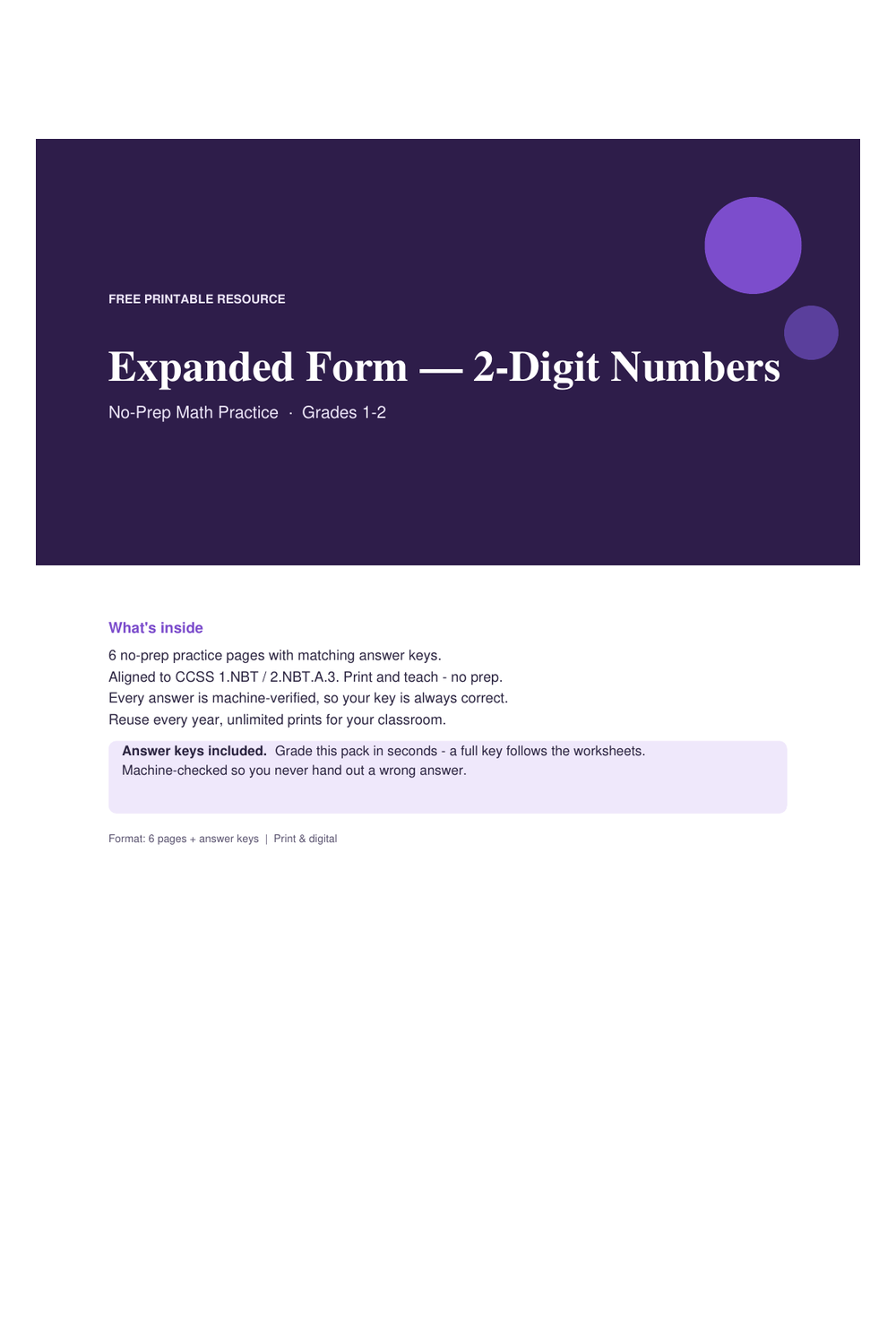
What this printable is for
This download is a 13-page US Letter PDF with a cover followed by six student sheets and their solutions. Practice pages 2, 3, and 7 each give 12 two-digit values with a blank for expanded notation; remaining practice pages use the same task style. The examples shown span 12 to 97 and include 60. Name and Date lines appear on each practice sheet. The answer key expresses a value as tens plus ones, leaving out a zero ones term.
Break a number into tens and ones
Expanded form names the value of each digit rather than repeating the digits as written. In a two-digit number, the left digit counts tens and the right digit counts ones. So 28 means two tens and eight ones, or 20 + 8. The parts add back to the original number. This is a way to show place value, not simply to place a plus sign between the digits.
A zero in the ones place contributes no ones, so 60 is written as 60 rather than 60 + 0 in the provided answer style. Children can make a number with tens rods and unit cubes, then say how much each group is worth. The model helps distinguish the digit 6 from its value of six tens, or 60.
Worked example 1
28 in expanded form
The 2 is in the tens place, so its value is 20. The 8 is in the ones place, so its value is 8. Add the parts.
Answer: 20 + 8
Worked example 2
69 in expanded form
Six tens have a value of 60. Nine ones have a value of 9. Write the two place values as an addition expression.
Answer: 60 + 9
Worked example 3
60 in expanded form
The 6 represents six tens, worth 60. The ones digit is zero, so it contributes no additional term in this answer format.
Answer: 60
How to teach it with this pack
Build with tens rods
Give the learner two tens rods and eight unit cubes to model 28. Ask for the value of the rods as a group before writing 20 + 8. Keep the digit, the number of rods, and their combined value distinct in the discussion.
Trade a number card
Show 69 on a place-value mat with tens and ones columns. Place six tens counters and nine ones counters, then label the groups by value: 60 and 9. Have the child combine the labels with a plus sign to form the expanded expression.
Notice an empty ones place
Represent 60 with six tens rods and no unit cubes. Ask what value the empty ones column adds; it adds zero, so the provided key writes 60 alone. This prevents children from treating the zero as a missing tens digit or adding an unnecessary nonzero part.
Put the parts back together
After writing 20 + 8 for 28, have the learner combine the values mentally or with blocks to return to 28. This reverse check confirms that the expanded parts preserve the original amount and that 2 was interpreted as two tens, not two ones.
Best uses for this template
Ideas for using this page
Explain a digit's value
Ask students to describe what each digit contributes in a two-digit number. A tens rod model makes the difference between the digit 6 and its value of 60 concrete.
Review zero in a place
Use 60 to discuss why the ones place adds no extra value. Students can write the form shown in the answer key and explain what the zero tells them.
Connect form and quantity
Have a learner build a number, write its expanded form, then recombine the parts. The three representations should describe one quantity in matching place-value language.
Mistakes to watch for
Writing 2 + 8 for 28 because the digits are copied without their place values.
Ask what the 2 counts: it is two tens, worth 20. The 8 counts eight ones. Write 20 + 8 and combine the parts to check that they make 28.
Writing 90 + 6 for 69 because the digit values were assigned to opposite places.
Put 6 in the tens place and 9 in the ones place. Six tens are worth 60, while nine ones are worth 9. Write 60 + 9, then add the parts to verify 69.
Writing 600 + 9 for 69 by giving the 6 a hundreds value.
The 6 in 69 sits in the tens place, so it is worth 60, not 600. Say the place names aloud: tens, then ones. Then write 60 + 9 and check that 60 + 9 is 69.
Writing 20 + 8 but combining it as 208 instead of 28.
The plus sign means add the values, not place the terms side by side. Two tens and eight ones total 28. Build two rods and eight cubes, then count the whole amount.
Quick answers
How do you write a two-digit number in expanded form?
Name the value of each digit. The tens digit tells how many groups of ten, while the ones digit gives the remaining units. For 28, two tens are worth 20 and eight ones are worth 8, so write 20 + 8. Add the parts to check that they return to the original number.
How can I teach expanded form for two-digit numbers?
Use tens rods and unit cubes. Build 69 with six rods and nine cubes, then name the groups as 60 and 9 before writing 60 + 9. Ask the child to explain the value of each place, rather than just naming the printed digits.
How does expanded form show the value of a two-digit number?
Think of a number as a collection of place-value amounts. In 60, the 6 stands for six tens, which equals 60; the zero shows there are no ones to add. The answer style in this pack therefore writes 60 by itself, while numbers with nonzero ones have two addends.
What is included in this expanded form 2-digit numbers worksheet pack?
The six student sheets each show 12 two-digit values for children to rewrite as tens and ones. Examples include 28, 69, and 60. The cover and practice are followed by the answer key in this 13-page PDF; solutions are on pages 8 to 13. Name and Date lines appear on the practice sheets.
Is this expanded form 2-digit numbers worksheet pack free?
Yes. This resource is free and needs no registration. The pack is identified as a US Letter PDF only, without an A4 or PNG option. It contains 13 pages in all, and its answer key appears on the last six pages, 8 through 13.
Keep organizing
You might also like
Free 13-page pack
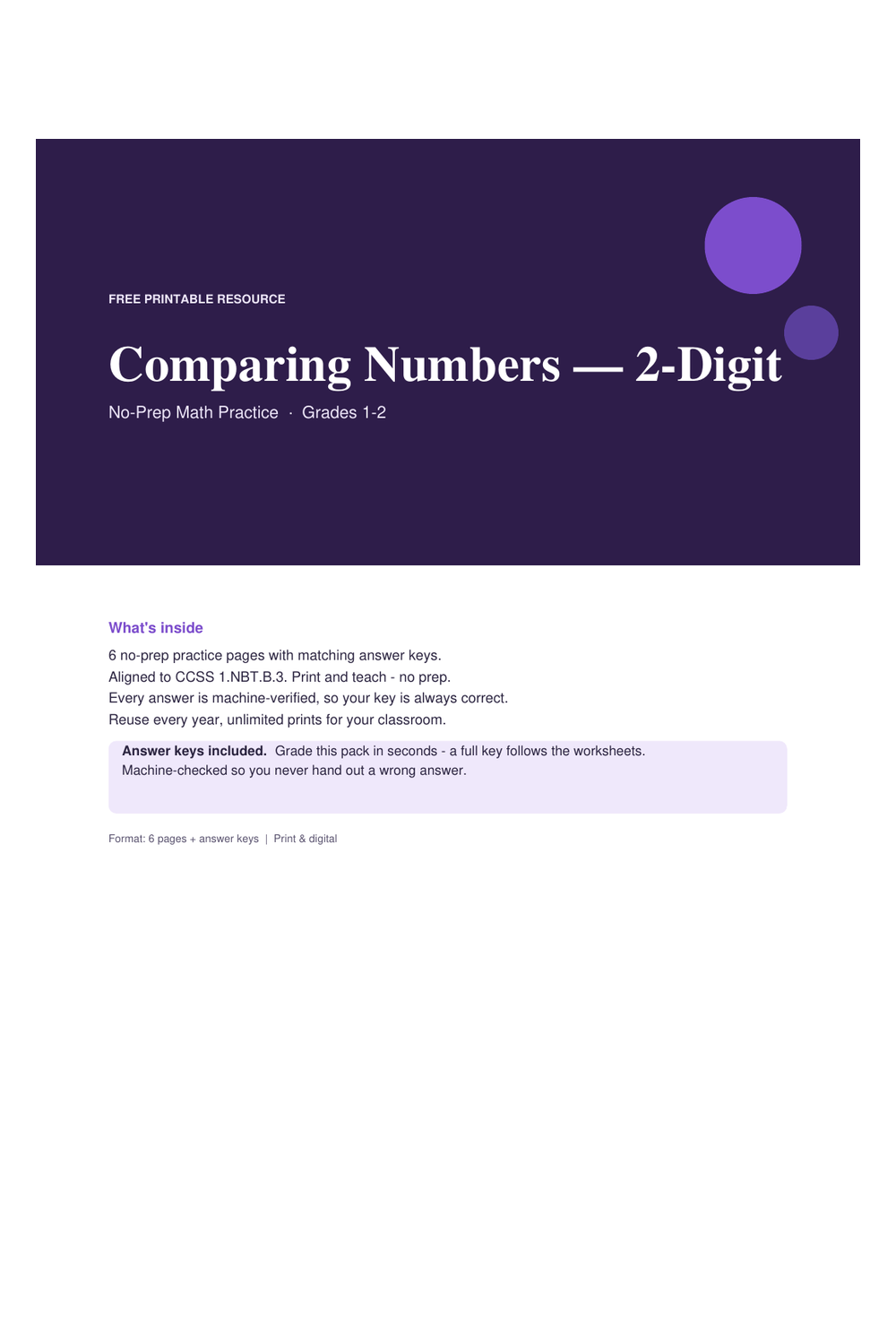
Comparing Numbers — 2-Digit Worksheets PDF
A 13-page US Letter math pack for grades 1-2. The PDF keeps the student practice and matching answer-key pages together in one file so you can print only the pages you need. The main skill is to compare tens first and use ones only when the tens digits match. The pack references 1.NBT.B.3 on the cover. Standards noted for this pack: 1.NBT.B.3.
View & download →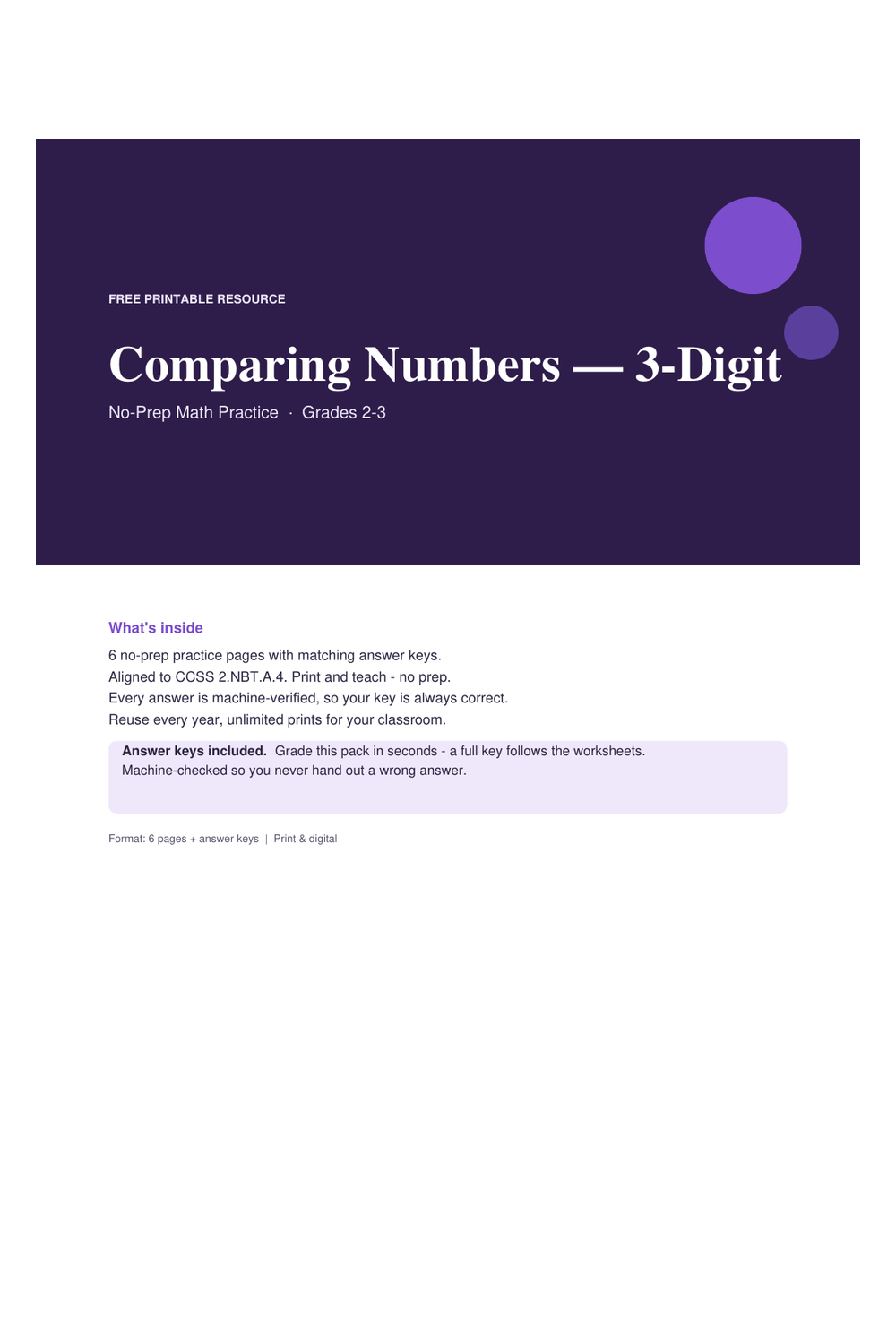
Free 13-page pack
Comparing Numbers — 3-Digit Worksheets PDF
A 13-page US Letter math pack for grades 2-3. The PDF keeps the student practice and matching answer-key pages together in one file so you can print only the pages you need. The main skill is to compare hundreds, then tens, then ones so the first unequal place determines the relationship. The pack references 2.NBT.A.4 on the cover. Standards noted for this pack: 2.NBT.A.4.
View & download →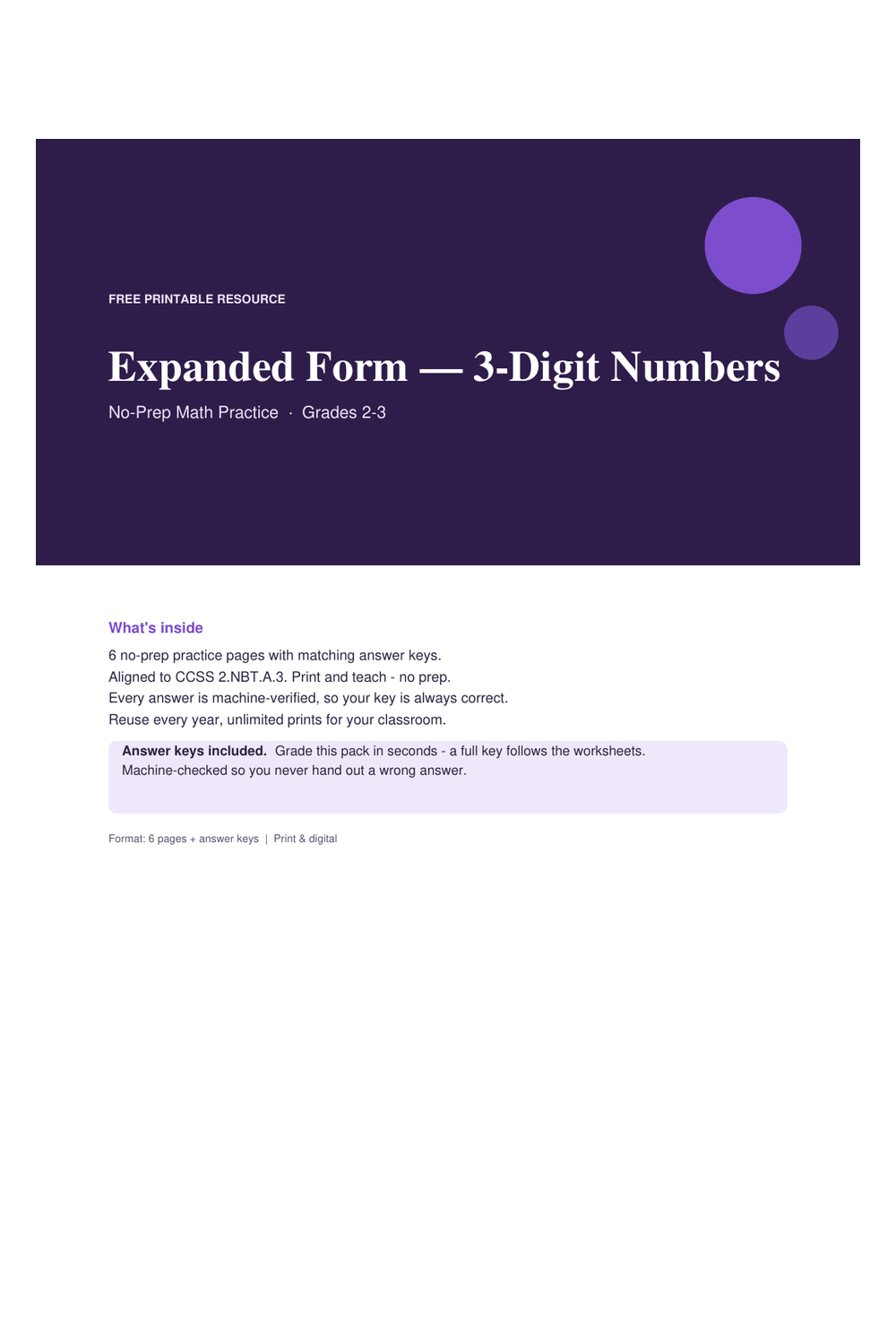
Free 13-page pack
Expanded Form — 3-Digit Numbers Worksheets PDF
A 13-page US Letter math pack for grades 2-3. The PDF keeps the student practice and matching answer-key pages together in one file so you can print only the pages you need. The main skill is to connect hundreds, tens, and ones so expanded notation reflects place value rather than digit order alone. The pack references 2.NBT.A.3 on the cover. Standards noted for this pack: 2.NBT.A.3.
View & download →