Math Worksheets · Free 13-page pack
Free Expanded Form — 3-Digit Numbers Worksheets PDF
Grades 2-3 students can use this 13-page pack to write three-digit numbers in expanded form. Each of six practice sheets asks for 12 place-value decompositions, including values such as 404, 807, and 907 with a zero place. The answer key models hundreds, tens, and ones as addends, omitting zero-value parts.
Edited by Tessa Vaughn · Planning & Organization Editor
Free download
Download the 13-page pack
This multi-page pack currently has one print-ready format. Preview the PDF, then print the whole pack or only the page range you need.
Share to Google Classroom ↗No sign-up required · personal/classroom use
Practice this skill on screen30 questions in three levels (easy, medium, hard) with instant feedback. Nothing to install.Get the whole set: 9 packs in one zipPlace value and rounding worksheet packs. Grades 1–4: compare, order, expanded form and rounding. US Letter PDFs with answer keys, 384 KB.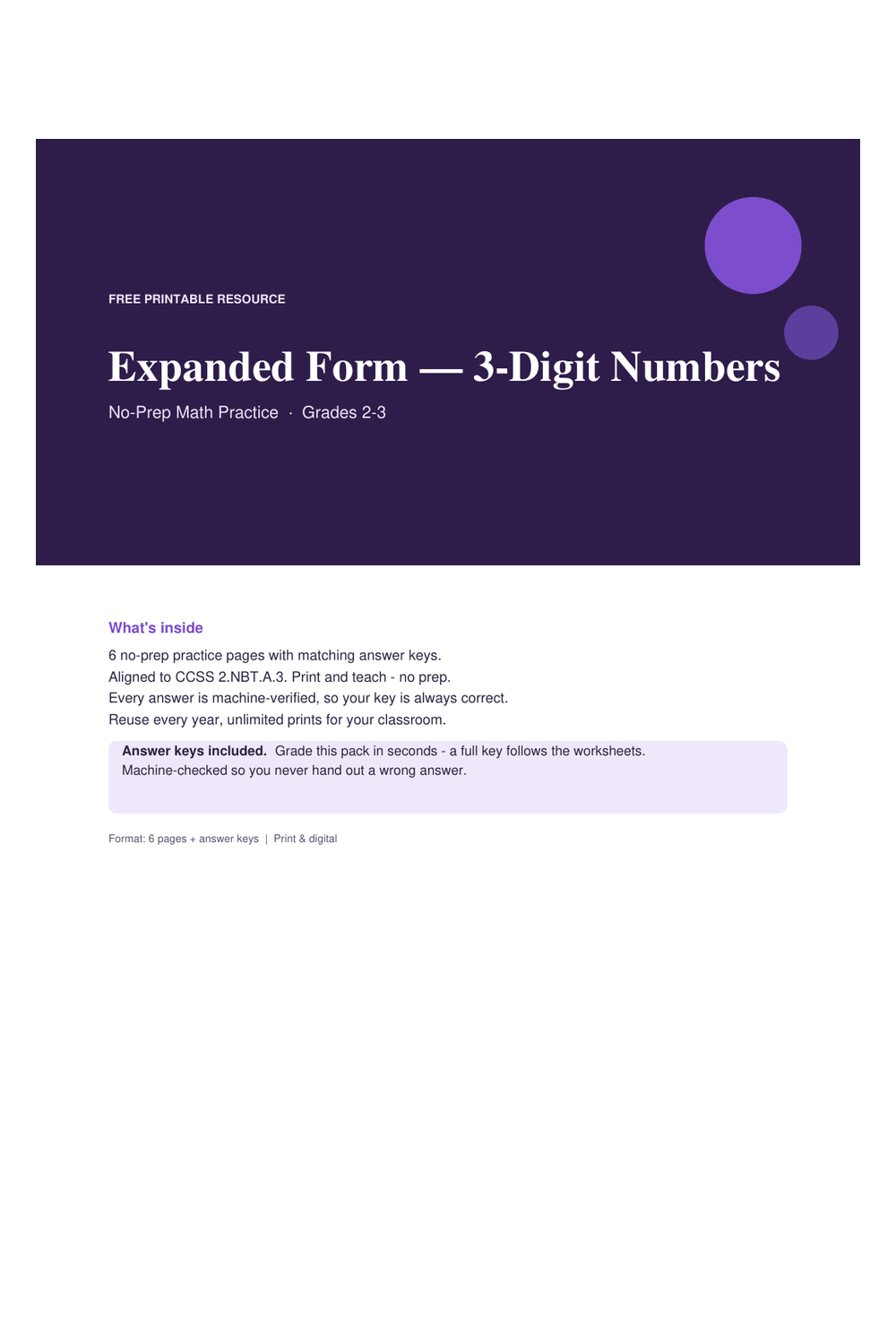
What is on the page
For grades 2-3, the 13-page US Letter file begins with a cover and includes six sheets asking for place-value decompositions. Practice pages 2, 3, and 7 each have 12 three-digit numerals with room to expand them; additional practice pages follow the same format. Examples include 404, 807, and 907, where one place has a zero, as well as 993. Each practice sheet carries Name and Date lines. Answers are included at the end.
Give every place its full value
A three-digit number can be separated into hundreds, tens, and ones. Each digit's value depends on its place: in 367, the 3 means 300, the 6 means 60, and the 7 means 7. Expanded form adds those amounts as 300 + 60 + 7. The sum remains 367. Naming the values helps children understand why the same digit can mean different amounts in different positions.
When a place contains zero, it contributes no addend. In 404, the 4 in the hundreds place is 400, the tens digit contributes nothing, and the final 4 is four ones, so the form is 400 + 4. The zero still marks an empty tens place and keeps the other digits in the correct positions. Place-value blocks or a chart can make that role visible.
Worked example 1
404 in expanded form
The first 4 is in the hundreds place and is worth 400. There are no tens to add. The last 4 is four ones.
Answer: 400 + 4
Worked example 2
266 in expanded form
Read by place: 2 hundreds are 200, 6 tens are 60, and 6 ones are 6. Write each value as an addend.
Answer: 200 + 60 + 6
Worked example 3
907 in expanded form
Nine hundreds are worth 900. The zero shows no tens, so it contributes no term. Seven ones are worth 7.
Answer: 900 + 7
Teaching it step by step
Fill a place-value chart
Write 404 in a hundreds, tens, and ones chart. Ask the learner to read each column's value: four hundred, zero tens, and four ones. Translate only the nonzero amounts into 400 + 4, while explaining that the zero keeps the four ones in the ones place.
Model with base-ten blocks
Build 266 from two hundred flats, six ten rods, and six unit cubes. Label each group by its total value, then arrange the labels as 200 + 60 + 6. Have the student combine them again to verify that they make 266.
Compare 404 and 440
Place both numbers in a chart and compare their tens positions. In 404 the tens digit is zero; in 440 it is four, worth 40. This contrast helps students see that a digit's location determines its value and that zero is a place holder.
Recompose the addends
After expanding 907 as 900 + 7, ask the learner to make the number again. Start with nine hundreds, add no tens, and finish with seven ones. Rebuilding the numeral checks that no tens were invented and that the final digit stayed in the ones place.
Where it fits best
Ways to use it
Make place value visible
Use blocks or a chart when a child lists digits instead of their values. Naming hundreds, tens, and ones supports accurate expanded notation for three-place numbers.
Talk through zero places
Discuss examples such as 404 and 907 to show that zero contributes no addend while preserving the position of neighboring digits in the written numeral.
Check a decomposition
Have students add their expanded terms back together. If the total differs from the original numeral, review which digit value was misread and rebuild that place with blocks.
Where learners go wrong
Writing 4 + 0 + 4 for 404 instead of giving the hundreds digit a value of 400.
Use a place-value chart: the left 4 counts hundreds, so it is worth 400; the middle zero contributes nothing; the last 4 is four ones. Write 400 + 4.
Writing 900 + 70 for 907 by moving the 7 into the tens place.
Keep each digit in its original column. In 907, 9 is hundreds, 0 is tens, and 7 is ones. There are no tens to add, so the expanded form is 900 + 7.
Leaving out the 60 when expanding 266 because the tens digit is read as just 6.
Six in the tens place means six groups of ten, or 60. Include all three values: 200 + 60 + 6. Combine the addends to confirm they total 266.
Writing 400 + 4 as 4004 instead of adding the two place values.
The plus sign means combine quantities. Four hundred and four ones make 404, not a four-digit numeral. Use blocks or a quick sum to check the value represented.
Frequently asked questions
How do you write a three-digit number in expanded form?
Separate the hundreds, tens, and ones by their values, then add those amounts. For 266, two hundreds equal 200, six tens equal 60, and six ones equal 6, so write 200 + 60 + 6. Recombine the addends to make sure they equal the starting number.
How can I teach expanded form with hundreds, tens, and ones?
Place a number in a hundreds-tens-ones chart or build it with base-ten blocks. For 404, show four hundreds, no tens, and four ones. Name the values as 400, zero, and 4, then write 400 + 4. Ask what the zero tells us about the empty tens place.
What does a zero mean in three-digit expanded form?
Read each digit in its column and write only the nonzero place values as addends. In 907, nine hundreds contribute 900, the zero tens contribute nothing, and seven ones contribute 7. The result is 900 + 7; the zero still holds the tens position in the original number.
What is included in this expanded form 3-digit numbers worksheet pack?
Children work with 12 numerals on each of six practice sheets and write their hundreds, tens, and ones values. Examples include 404, 266, and 907. Name and Date lines are present, and solutions appear in the answer section at the end of the 13-page PDF, on pages 8-13.
Is this expanded form 3-digit numbers worksheet pack free?
Yes. No payment or registration is required to get this pack. Its format is US Letter PDF; there is no A4 or PNG edition listed. The answer key is part of the 13-page file and occupies pages 8-13, after the six practice sheets.
Keep organizing
You might also like
Free 13-page pack
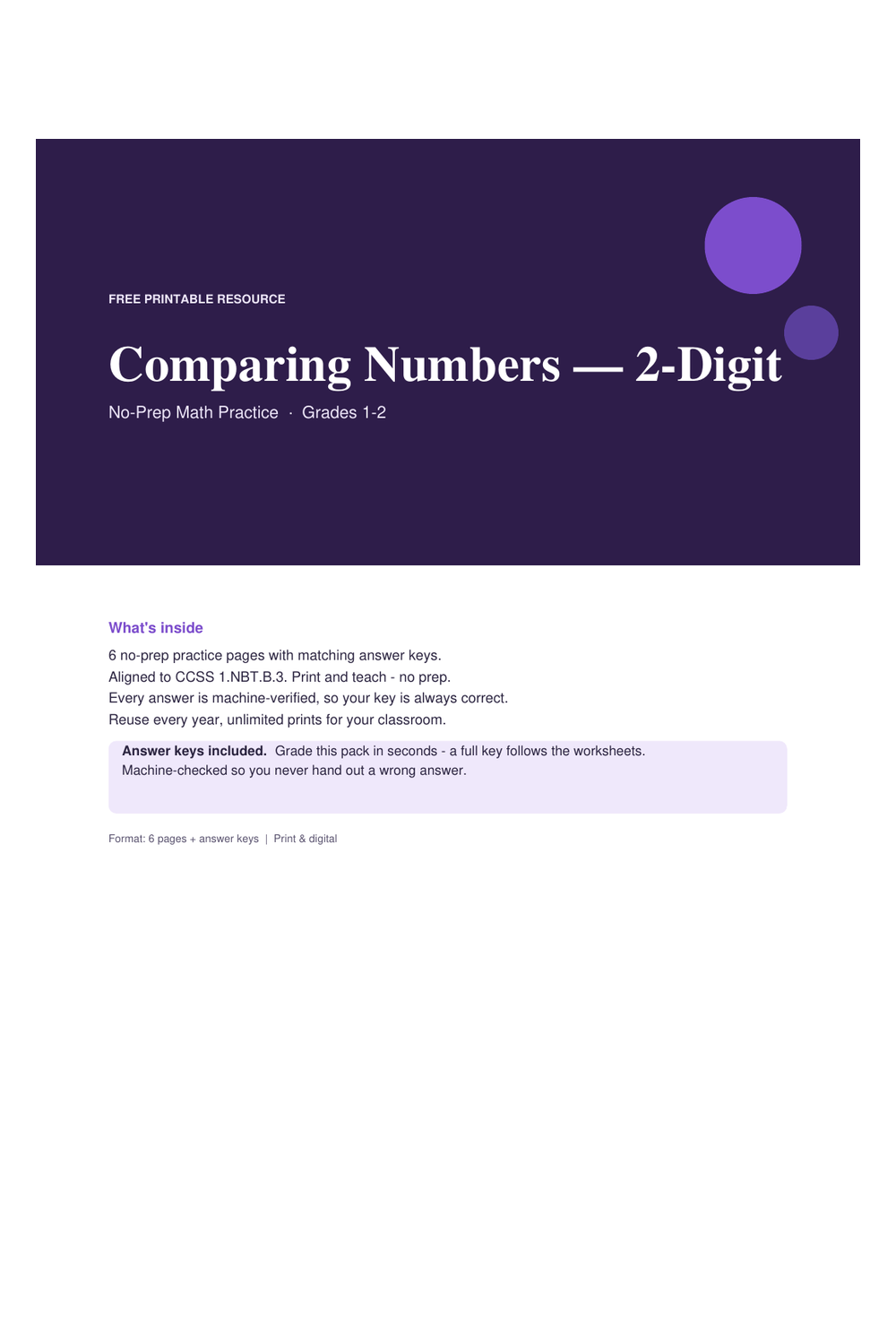
Comparing Numbers — 2-Digit Worksheets PDF
A 13-page US Letter math pack for grades 1-2. The PDF keeps the student practice and matching answer-key pages together in one file so you can print only the pages you need. The main skill is to compare tens first and use ones only when the tens digits match. The pack references 1.NBT.B.3 on the cover. Standards noted for this pack: 1.NBT.B.3.
View & download →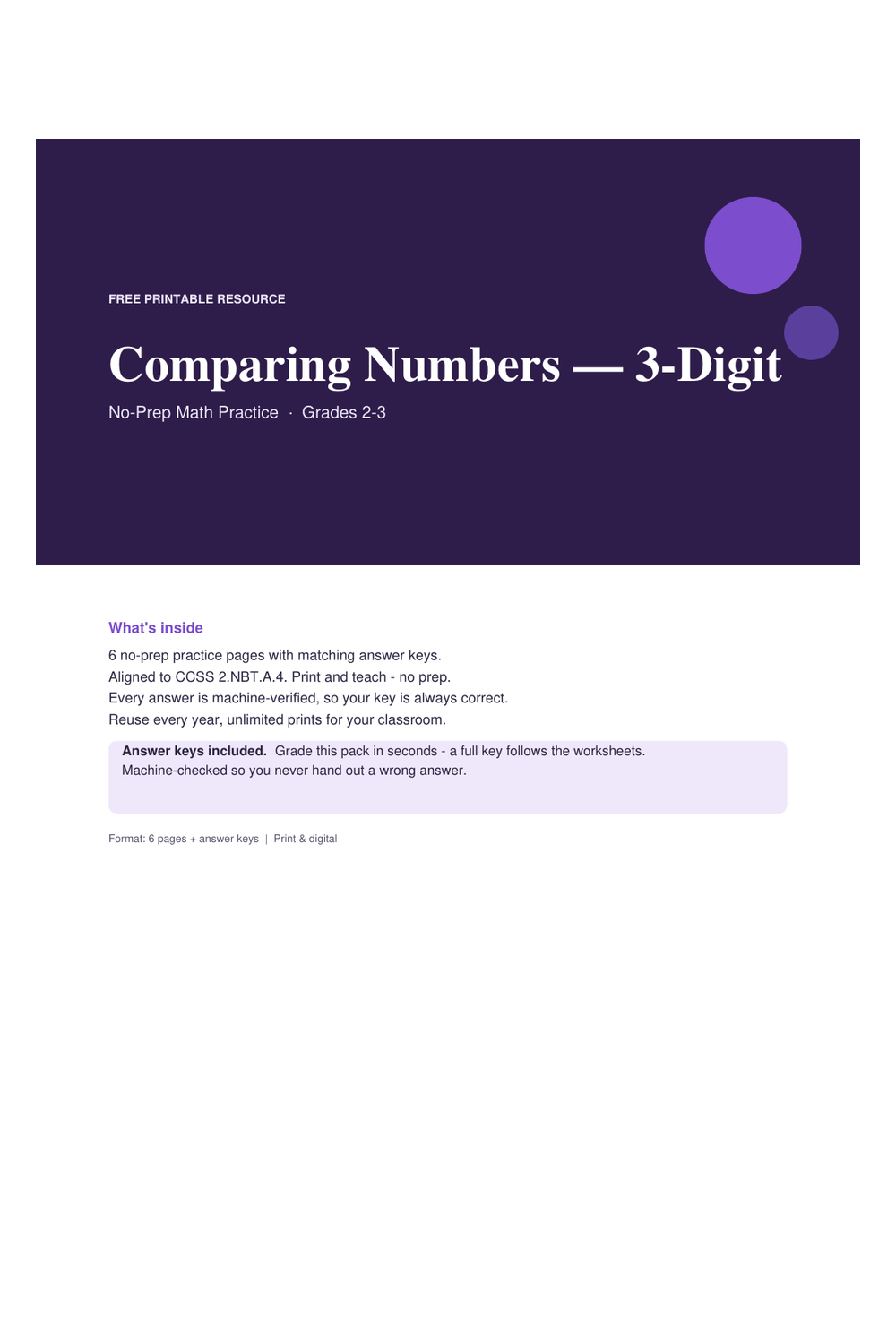
Free 13-page pack
Comparing Numbers — 3-Digit Worksheets PDF
A 13-page US Letter math pack for grades 2-3. The PDF keeps the student practice and matching answer-key pages together in one file so you can print only the pages you need. The main skill is to compare hundreds, then tens, then ones so the first unequal place determines the relationship. The pack references 2.NBT.A.4 on the cover. Standards noted for this pack: 2.NBT.A.4.
View & download →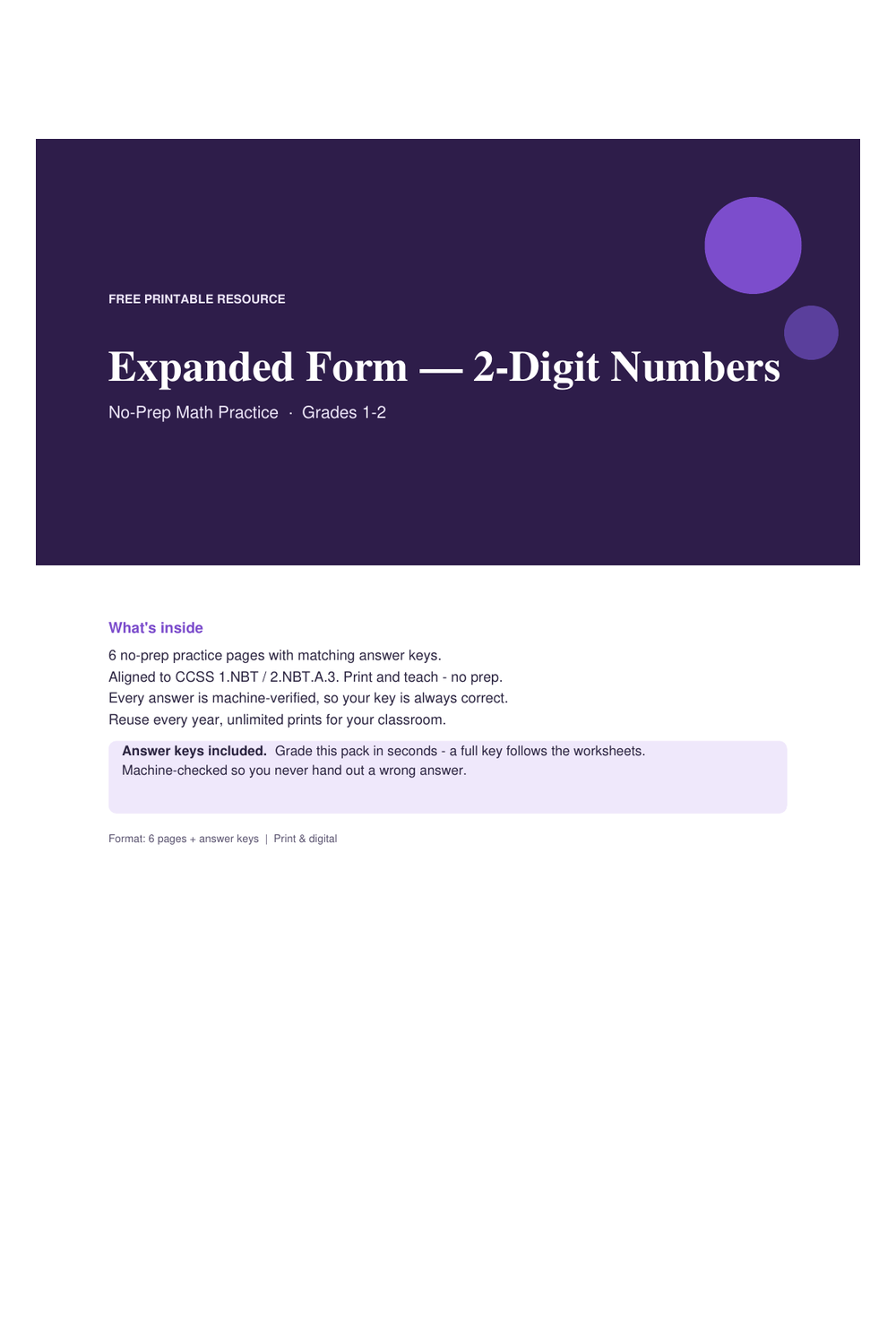
Free 13-page pack
Expanded Form — 2-Digit Numbers Worksheets PDF
A 13-page US Letter math pack for grades 1-2. The PDF keeps the student practice and matching answer-key pages together in one file so you can print only the pages you need. The main skill is to read each 2-digit number as tens and ones before rewriting it in expanded form. The pack references 2.NBT.A.3 on the cover. Standards noted for this pack: 2.NBT.A.3.
View & download →