Math Worksheets · Free 13-page pack
Free Expanded Form — 4-Digit Numbers Worksheets PDF
This 13-page expanded form worksheet pack gives grades 3-4 practice breaking four-digit numbers into thousands, hundreds, tens, and ones. Each practice page has 12 numerals to expand, including numbers with zero-valued places such as 9004 and 6070. Six paired answer key pages let an adult check each response against its place value parts.
Edited by Tessa Vaughn · Planning & Organization Editor
Free download
Download the 13-page pack
This multi-page pack currently has one print-ready format. Preview the PDF, then print the whole pack or only the page range you need.
Share to Google Classroom ↗No sign-up required · personal/classroom use
Practice this skill on screen30 questions in three levels (easy, medium, hard) with instant feedback. Nothing to install.Get the whole set: 9 packs in one zipPlace value and rounding worksheet packs. Grades 1–4: compare, order, expanded form and rounding. US Letter PDFs with answer keys, 384 KB.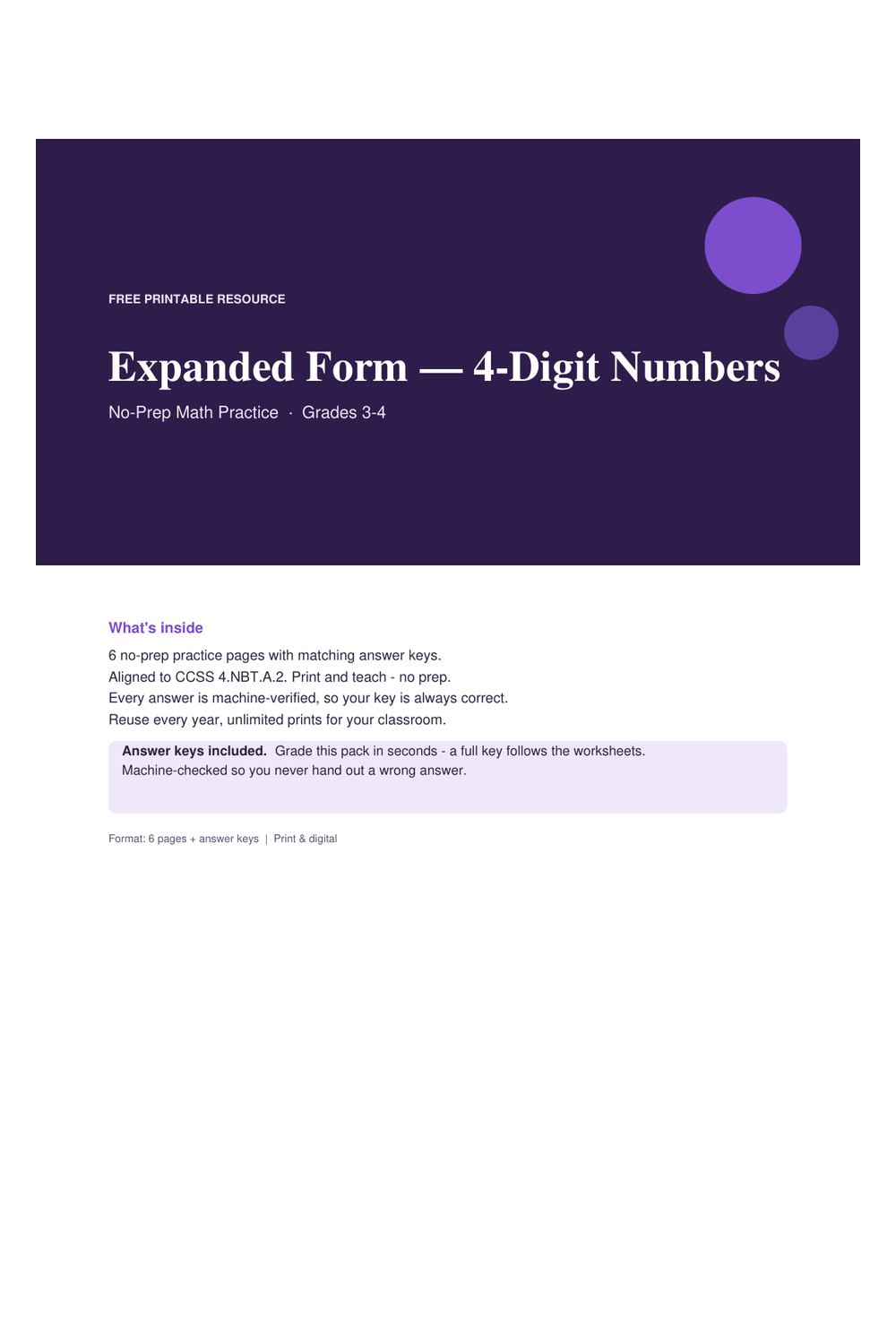
About this printable
This 13-page US Letter collection serves grades 3-4, pairing six student sheets with their answer key. Practice pages 2, 3 and 7 each have 12 four-digit numerals to expand; Name and Date blanks and an equals sign appear on each. The examples include 3617, which uses every place, and 9004, where two positions add nothing. Remaining student sheets extend the same work. The key section is pages 8-13 and shows the sums.
How four-digit place values make a sum
A four-digit numeral records thousands, hundreds, tens, and ones from left to right. Expanded form writes the value held in each place as an addition sentence. For 3617, the 3 means 3,000, the 6 means 600, the 1 means 10, and the 7 means 7. The numeral is a compact label; the sum makes each place's contribution visible.
A zero means that place contributes no amount, so it is left out of the sum. In 9004, the 9 is nine thousands and the 4 is four ones; there are no hundreds or tens to add. Children can say each digit's place name before writing its value, then add the parts to check that they rebuild the starting number.
Worked example 1
Write 3617 in expanded form.
Read each position from left to right: 3 thousands, 6 hundreds, 1 ten, and 7 ones. Write each place value as a sum.
Answer: 3,000 + 600 + 10 + 7
Worked example 2
Write 9004 in expanded form.
The 9 is in the thousands place and the 4 is in the ones place. The hundreds and tens have value zero, so omit those addends.
Answer: 9,000 + 4
Worked example 3
Write 6070 in expanded form.
The 6 stands for 6,000 and the 7 stands for 70. The hundreds and ones digits are zero, so they add no terms.
Answer: 6,000 + 70
A teaching routine for this pack
Build a place value chart
Draw four columns labeled thousands, hundreds, tens, and ones. Place the digits of a number such as 6386 in the columns, then name each amount aloud. Have the child transfer those amounts into an addition sentence. The chart keeps the digit's position connected to its value before the child writes the expanded form.
Trade blocks for amounts
Use base-ten blocks or quick sketches: a thousand cube, hundred flats, ten rods, and single units. Represent one worksheet numeral, then list the value of each group. For 9004, nine thousand units and four ones are present; the empty hundreds and tens spaces help explain why no corresponding addends appear.
Mark the empty places
When a numeral contains zero, ask the learner to point to that place before writing. Compare 9004 and 6070, naming which columns contain an amount and which do not. This pause makes the missing addends a place-value decision rather than a forgotten step, and the child can verify the sum by recomposing it.
Check by recomposing
After an expanded form is written, add its terms or rebuild the number in a place value chart. For 7000 + 200 + 30 + 6, read the chart back as 7236. If the result differs from the original numeral, inspect the place names first; a digit may have been assigned the wrong value.
Good matches for this page
Three ways to use it
A place-value warm-up
Choose one numeral from a page and ask students to name its four place values before they start the independent set. The routine prepares them to interpret each digit by position.
A quick conference prompt
Ask a learner to explain why 9004 has two addends while 3617 has four. Their explanation can show whether they understand zero-valued places, beyond simply copying a pattern.
A recomposition check
Use a completed response as a reverse question: read the addends aloud and ask which numeral they compose. This links expanded form to reading and building multi-digit numbers.
Common mistakes to avoid
Writing 3617 as 3 + 6 + 1 + 7 treats digits as amounts.
Name the position of each digit first: 3 thousands, 6 hundreds, 1 ten, and 7 ones. Then write 3,000 + 600 + 10 + 7 and add the terms to confirm they equal 3617.
Writing 9004 as 9,000 + 4,000 gives the ones digit a thousands value.
Point to each digit's column in 9004. The 4 sits in the ones place, so it contributes 4. Read the finished sum back as nine thousand four, not nine thousand four thousand.
Adding 600 + 70 for 6070 assigns the 7 to the hundreds place.
Use a chart to locate 6 in thousands and 7 in tens. Their values are 6,000 and 70; the hundreds and ones are zero. Recompose 6,000 + 70 to check that it returns 6070.
Leaving out the 10 when expanding 3617 changes its value to 3607.
Touch each chart column as you read the number. The 1 is in the tens column and contributes 10, even though its digit is small. Include 10, then add all four place values to recover 3617.
Common questions
How do you write a four-digit number in expanded form?
Read the number from left to right and say the value of each digit by its position. For 4545, those amounts are 4,000, 500, 40, and 5. Join the amounts with plus signs, then add them to make sure the sum returns to 4545. A zero-valued position contributes no addend.
How to teach expanded form with a place value chart?
Label four columns thousands, hundreds, tens, and ones. Put one digit in each column, then have the child state the amount represented there. Write those amounts as an addition sentence and compare the sum with the original numeral. With 6070, the chart makes clear that only thousands and tens contribute.
What check can show whether an expanded form is correct?
Add the written amounts and compare the total with the numeral you started with. Another check is to put each amount back into a thousands, hundreds, tens, and ones chart. For example, 7,000, 200, 30, and 6 rebuild 7236. If a digit lands in another place, review that amount.
What is included in this expanded form 4-digit numbers worksheet pack?
This grades 3-4 US Letter file has 13 pages. The three cited practice sheets, numbered 2, 3 and 7, each provide 12 blanks for writing four-digit numerals as place-value sums. Name and Date fields appear there. Examples include 9004 and 6070, where zero places add no terms. The answer key occupies pages 8-13.
Is this expanded form 4-digit numbers worksheet pack free?
Yes, there is no charge and no sign-up step. You receive one US Letter PDF; this pack has no A4 or PNG file. Its 13 pages include an answer key on pages 8-13. The worksheets are for grades 3-4 and ask students to express each four-digit numeral as a sum of place values.
Keep organizing
You might also like
Free 13-page pack
Comparing Numbers — 2-Digit Worksheets PDF
A 13-page US Letter math pack for grades 1-2. The PDF keeps the student practice and matching answer-key pages together in one file so you can print only the pages you need. The main skill is to compare tens first and use ones only when the tens digits match. The pack references 1.NBT.B.3 on the cover. Standards noted for this pack: 1.NBT.B.3.
View & download →
Free 13-page pack
Comparing Numbers — 3-Digit Worksheets PDF
A 13-page US Letter math pack for grades 2-3. The PDF keeps the student practice and matching answer-key pages together in one file so you can print only the pages you need. The main skill is to compare hundreds, then tens, then ones so the first unequal place determines the relationship. The pack references 2.NBT.A.4 on the cover. Standards noted for this pack: 2.NBT.A.4.
View & download →
Free 13-page pack
Expanded Form — 2-Digit Numbers Worksheets PDF
A 13-page US Letter math pack for grades 1-2. The PDF keeps the student practice and matching answer-key pages together in one file so you can print only the pages you need. The main skill is to read each 2-digit number as tens and ones before rewriting it in expanded form. The pack references 2.NBT.A.3 on the cover. Standards noted for this pack: 2.NBT.A.3.
View & download →