Math Worksheets · Free 13-page pack
Free Identify Fractions — Halves, Thirds & Fourths Worksheets PDF
For grades 1-2, this 13-page PDF has six practice pages for naming shaded halves, thirds, and fourths, plus an answer key. Each practice page contains six “What fraction is shaded?” questions and a Name/Date line. The key shows examples including 1/2, 2/3, 1/4, and 3/4.
Edited by Tessa Vaughn · Planning & Organization Editor
Free download
Download the 13-page pack
This multi-page pack currently has one print-ready format. Preview the PDF, then print the whole pack or only the page range you need.
Share to Google Classroom ↗No sign-up required · personal/classroom use
Practice this skill on screen30 questions in three levels (easy, medium, hard) with instant feedback. Nothing to install.Get the whole set: 8 packs in one zipFractions worksheet packs. Grades 1–5: identify, compare, add, subtract and simplify fractions. US Letter PDFs with answer keys, 509 KB.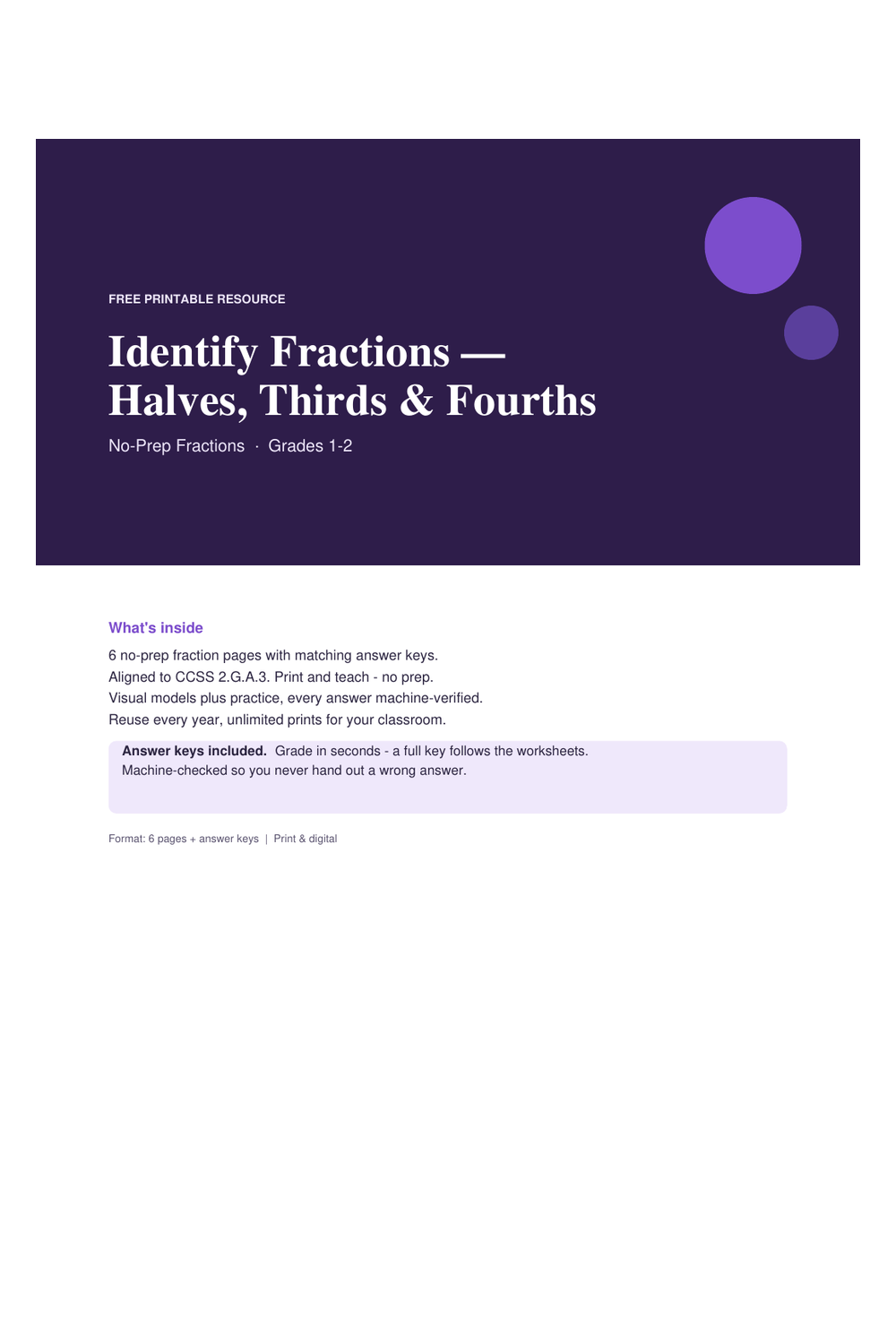
What is on the page
A cover starts this 13-page PDF, followed by six practice pages. The answer key is in the last six sheets, pages 8-13. Practice pages 2, 3, and 7 each ask students to name 6 shaded fractions and provide a Name and Date line. The title names halves, thirds, and fourths; key answers include 1/2, 2/4, 2/3, 1/3, and 3/4.
Naming equal parts in a whole
A fraction describes equal parts of one whole. The denominator tells how many equal parts make the whole, and the numerator tells how many of those parts are being considered. In a shaded shape, count all the equal parts first, then count the shaded parts. The pieces must be equal in size for the fraction name to describe a fair share.
For halves, the whole is split into two equal shares; for thirds, into three; for fourths, into four. A child can say “two of four equal parts are shaded” and then write 2/4. The number below names the total equal shares, while the number above counts the selected shares. Even if a drawing has two shaded pieces, the denominator depends on all the equal parts in the whole.
Worked example 1
A shape is divided into 2 equal parts and 1 is shaded. Name the shaded fraction.
Count the equal shares in the whole for the denominator: 2. Count the shaded shares for the numerator: 1.
Answer: 1/2
Worked example 2
A shape has 4 equal parts and 2 are shaded. What fraction is shaded?
There are 4 equal parts altogether and 2 shaded parts. Put the shaded count over the total count.
Answer: 2/4
Worked example 3
Three of 4 equal sections are shaded. Write the fraction.
The whole is partitioned into 4 equal sections, and 3 are selected. Use 3 as the numerator and 4 as the denominator.
Answer: 3/4
How to teach this skill
Check equal shares first
Before naming any shaded region, ask whether the whole has been split into equal parts. If the shares are unequal, the fraction label does not describe equal fractional units. For a valid halves example, both regions should cover the same area, even if the dividing line is not centered visually.
Count total, then shaded
Have the learner point to every part once to find the denominator, then point only to shaded parts for the numerator. Say “shaded over total” as a temporary verbal cue. For two shaded pieces out of four equal shares, record 2/4 and explain both counts.
Keep the whole in sight
Fold a paper square into two, three, or four equal regions, then shade a chosen number of regions. Unfold and count all parts before the shaded ones. Folding offers a tangible way to discuss equal sharing while keeping the whole in view.
Keep the whole in view
Ask what object or shape counts as one whole before counting parts. If a child says 1/3 because one piece is shaded, ask how many equal pieces make the entire shape. This prevents the numerator from being mistaken for the full fraction name.
Works well for
Classroom and home ideas
Introduce fraction vocabulary
Use a prompt to practice saying halves, thirds, or fourths and connecting the spoken name to a written fraction. Ask what each number counts. Name the whole first. Name the whole first.
Notice counting strategies
Observe whether a learner counts every equal part before focusing on the shaded area. The order helps show how they decide on numerator and denominator.
Talk through a picture
A child can explain a shaded answer by pointing to the whole, the total shares, and the chosen shares. This helps them explain how they read the picture.
What usually goes wrong
Writing 2/2 when two of four equal regions are shaded.
Count every equal region in the whole before recording the denominator. There are four parts total and two shaded, so the fraction is 2/4.
Writing 1/4 when one of three equal regions is shaded.
The numerator is one shaded share, but the denominator must count all three equal shares. The correct name is 1/3, not 1/4.
Calling one shaded piece 1/2 even though the whole has four equal parts.
Ask how many equal pieces make the full shape. With four total and one shaded, the name is 1/4. The denominator describes the partition of the whole, not the shaded count.
Naming 2/3 when two shaded regions are unequal and the whole is not split fairly.
Fractions count equal shares. First check whether each of the three parts is the same size. If not, the picture does not show two thirds as equal fractional units; discuss the unequal partition before naming it.
Questions people ask
How do you identify halves, thirds and fourths in a shaded shape?
First count the equal parts that make the whole; that count is the denominator. Then count how many of those parts are shaded; that is the numerator. If two of four equal regions are shaded, the picture shows 2/4. Check that the regions are equal before assigning a fraction name.
How to teach identifying fractions to young students?
Use a paper shape divided into equal shares and ask children to point to the whole before counting parts. Have them count all shares, then the shaded ones, and say the fraction aloud. Folding paper into halves or fourths can make equal sharing concrete before students write numerator over denominator.
What is an easy way to identify fractions in a shaded picture?
Ask two separate questions about the drawing: “How many equal parts are there altogether?” and “How many are shaded?” The total number of parts becomes the denominator; the shaded count becomes the numerator. Saying both answers before writing reduces the chance of swapping the two counts.
What is included in this identify fractions halves, thirds and fourths worksheet pack?
This 13-page file pairs a cover with six student sheets; answers are collected in the final section, pages 8-13. Worksheets 2, 3, and 7 ask children to name 6 shaded amounts, with a Name/Date line on each. The key gives 1/2, 2/4, 2/3, 1/3, and 3/4.
Is this identify fractions halves, thirds and fourths worksheet pack free?
Yes. Download access is free, with no registration. The file is US Letter PDF only; it has no A4 or PNG counterpart. Check the answer key on pages 8-13 after the six picture worksheets. Use them during practice or review.
Keep organizing
You might also like
Free 13-page pack
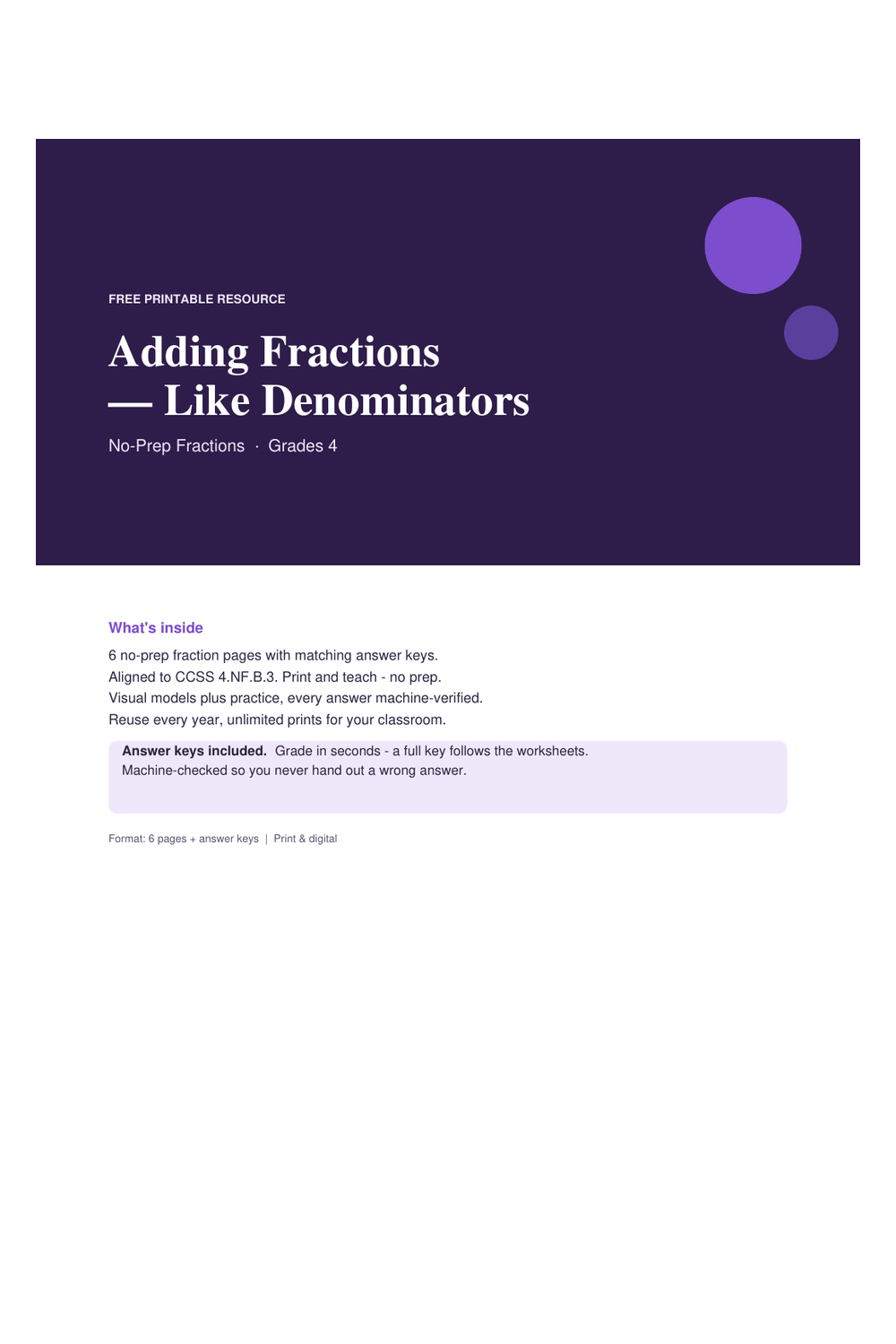
Adding Fractions — Like Denominators Worksheets PDF
A 13-page US Letter math pack for grades 4. The PDF keeps the student practice and matching answer-key pages together in one file so you can print only the pages you need. The main skill is to combine like-sized fractional parts by adding numerators and keeping the common denominator. The pack references 4.NF.B.3 on the cover. Standards noted for this pack: 4.NF.B.3.
View & download →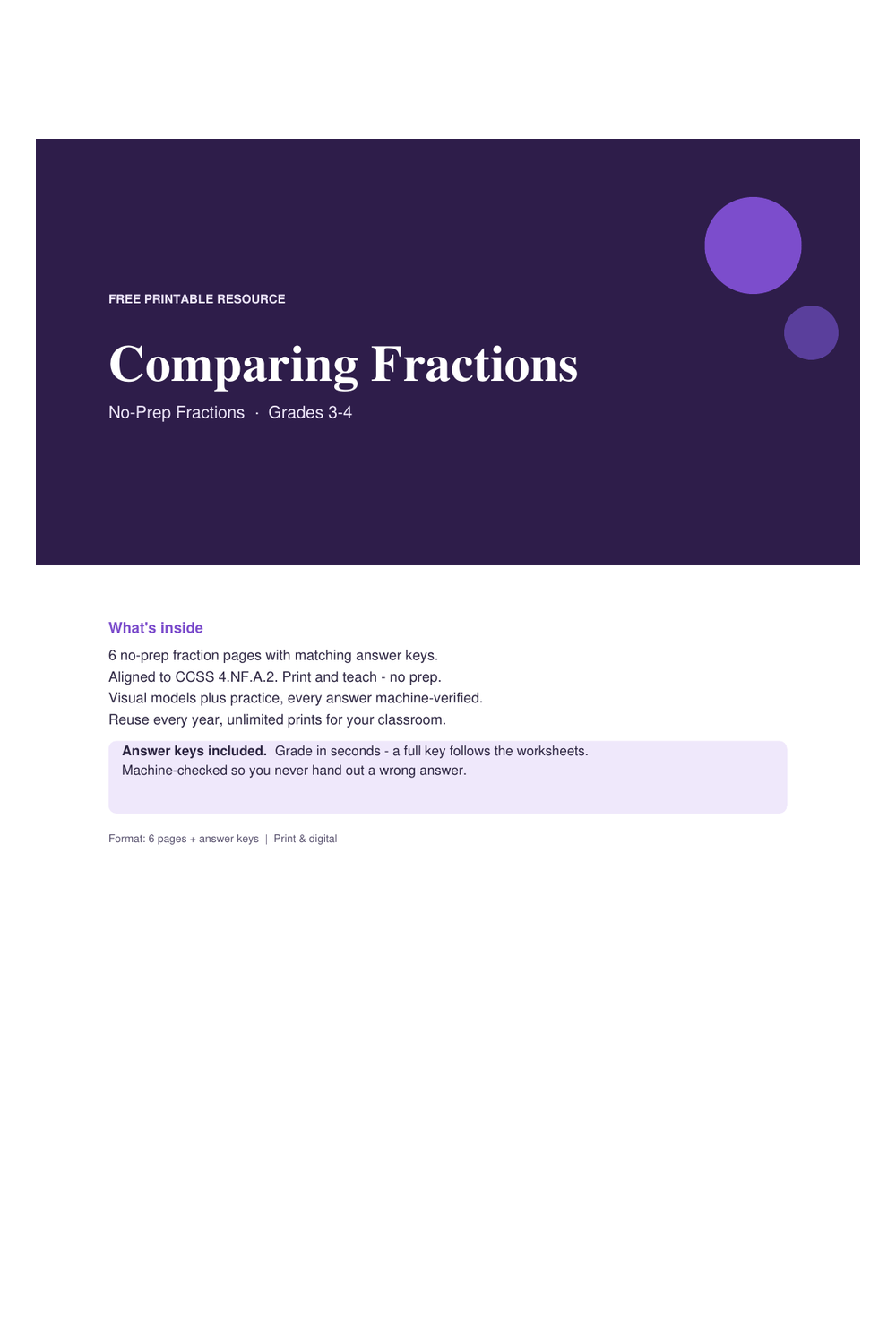
Free 13-page pack
Comparing Fractions Worksheets PDF
A 13-page US Letter math pack for grades 3-4. The PDF keeps the student practice and matching answer-key pages together in one file so you can print only the pages you need. The main skill is to compare fraction size using models, benchmarks, or common-sized parts instead of comparing numerators alone. The pack references 4.NF.A.2 on the cover. Standards noted for this pack: 4.NF.A.2.
View & download →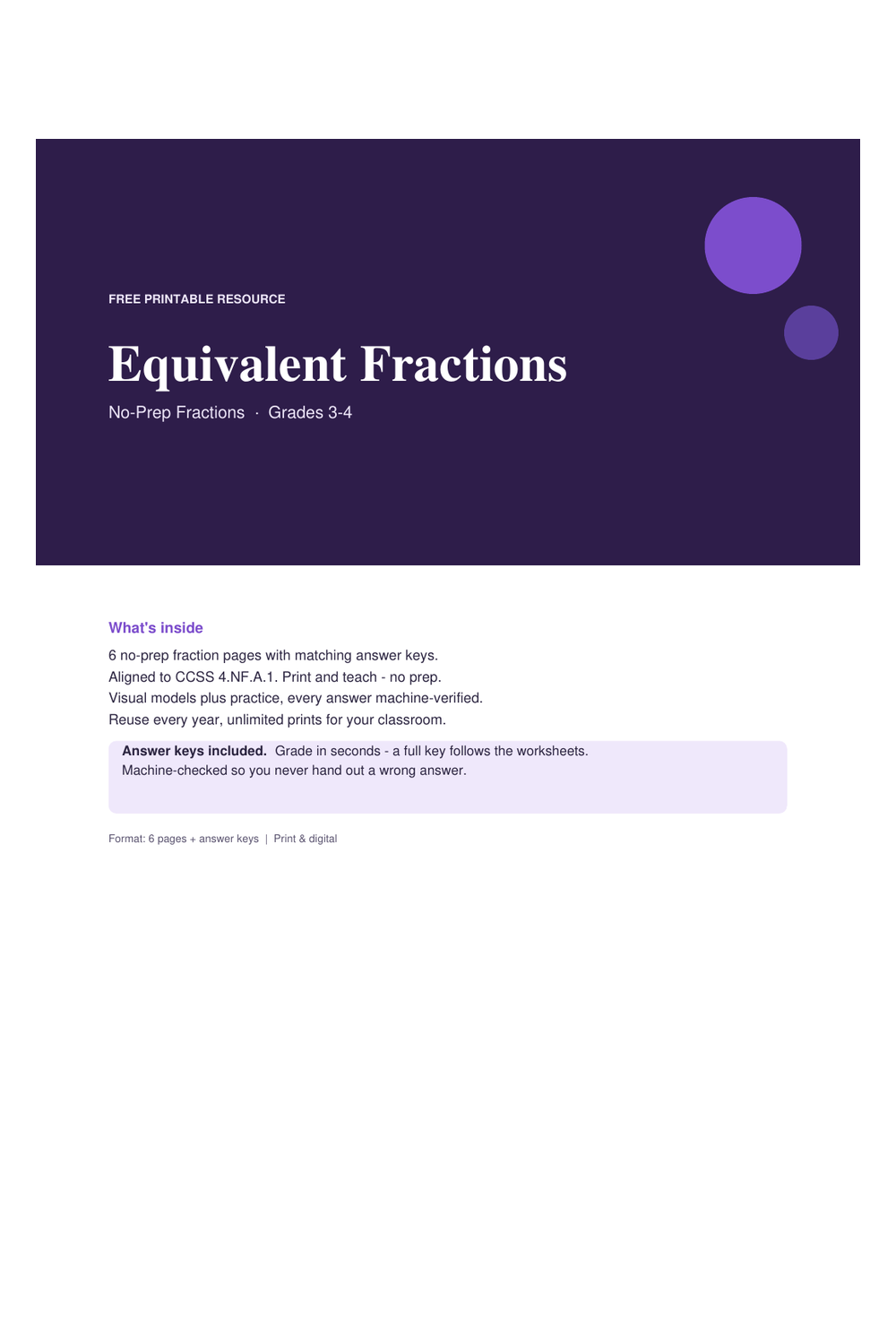
Free 13-page pack
Equivalent Fractions Worksheets PDF
A 13-page US Letter math pack for grades 3-4. The PDF keeps the student practice and matching answer-key pages together in one file so you can print only the pages you need. The main skill is to recognize when different numerator-denominator pairs represent the same quantity. The pack references 4.NF.A.1 on the cover. Standards noted for this pack: 4.NF.A.1.
View & download →