Math Worksheets · Free 13-page pack
Free Identify Fractions — Up to Eighths Worksheets PDF
This grades 2-3 pack contains six practice pages for identifying shaded fractions through eighths, along with an answer key in a 13-page PDF. Students count the equal parts in a whole and the selected parts. Each practice page asks six shaded-fraction questions per page; key answers include 1/8, 6/8, and 4/5.
Edited by Tessa Vaughn · Planning & Organization Editor
Free download
Download the 13-page pack
This multi-page pack currently has one print-ready format. Preview the PDF, then print the whole pack or only the page range you need.
Share to Google Classroom ↗No sign-up required · personal/classroom use
Practice this skill on screen30 questions in three levels (easy, medium, hard) with instant feedback. Nothing to install.Get the whole set: 8 packs in one zipFractions worksheet packs. Grades 1–5: identify, compare, add, subtract and simplify fractions. US Letter PDFs with answer keys, 509 KB.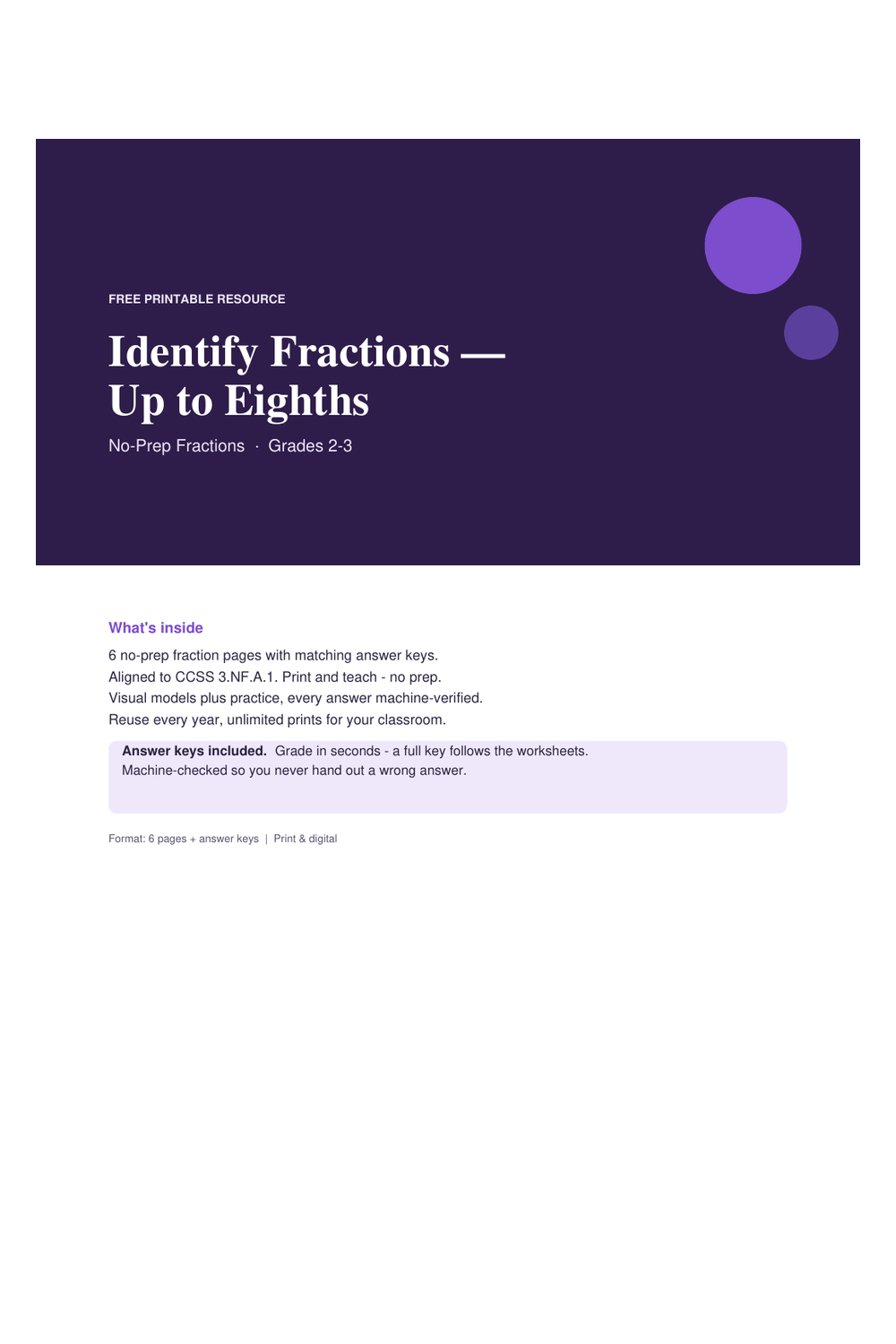
About this printable
This 13-page pack begins with a cover and has six practice sheets; its answer key spans pages 8-13. Students name 6 shaded fractions on sheets 2, 3, and 7. A Name/Date line appears on each page. The title covers fraction names through eighths. Answers include 1/8, 6/8, 4/5, and 2/4. The other practice pages keep these shaded-part prompts.
Counting parts to name a fraction
A fraction names some equal shares of a whole. The denominator is the total number of equal shares, and the numerator counts the shares selected or shaded. When the whole is divided into eight equal regions, each single region is one eighth. If several are shaded, count them for the numerator while keeping eight as the denominator, provided all eight shares are equal.
The same way of thinking works across different partitions: establish the whole, count all its equal parts, then count the chosen parts. A picture with four shaded sections does not automatically show fourths; there may be eight total sections, making the amount four eighths. Children can trace each part with a finger and say the total and shaded counts separately before writing the fraction.
Worked example 1
A whole is split into 8 equal parts; 1 is shaded. Name it.
The full partition has 8 equal parts, so write 8 below. One part is shaded, so write 1 above.
Answer: 1/8
Worked example 2
Six of eight equal parts are shaded. What fraction is shaded?
Count six shaded shares for the numerator. The whole still has eight equal shares, so use 8 as the denominator.
Answer: 6/8
Worked example 3
Four of five equal parts are shaded. Write the fraction.
The five equal pieces form the whole, and four are shaded. Place 4 over 5 to show selected parts over total equal parts.
Answer: 4/5
How to teach this skill
Make an eighths strip
Draw a long rectangle divided into eight equal boxes. Shade one box, then several more in another example. Each box is one eighth because eight equal boxes fill the strip. Ask learners to distinguish the one-box example from the total count of eight boxes.
Use a two-pass count
On any partitioned picture, make one pass to count all equal parts and a second pass to count shaded parts. Record the total below the line and the shaded count above it. This sequence remains useful when the picture has many regions and the counts are easy to mix up.
Compare partition sizes
Show strips divided into four and eight equal pieces, each with one piece shaded. Ask which fraction name matches each strip. Although both have one shaded region, their denominators differ because the wholes were partitioned into different numbers of equal parts.
Say the fraction in words
After writing a fraction such as 6/8, have the child say “six eighths” and point to six shaded regions among eight total. The verbal phrase helps connect the denominator to the kind of unit and the numerator to how many of those units are present.
Works well for
Classroom and home ideas
Practice larger partitions
Use the shaded prompts to build careful counting across wholes divided into several equal regions. Ask students to name both counts before answering. Include the unit name when they read the fraction.
Check fraction notation
Listen for whether a learner says the denominator as the name of each unit, such as eighths, and records the shaded count in the numerator position.
Compare two shaded pictures
Ask students to explain why pictures with the same number shaded can represent different fractions when the totals differ. Have them count every section in both wholes.
What usually goes wrong
Writing 1/7 for one shaded piece when the whole has 8 equal regions.
Count every equal region that completes the whole. Eight pieces make the denominator, even though only one is shaded, so the answer is 1/8.
Calling six shaded parts out of eight 6/6 because six regions are colored.
The denominator counts all equal shares, not only the colored ones. The whole has eight parts and six are selected, so write 6/8.
Writing 4/8 when four of five equal regions are shaded.
Look at the full partition before naming the unit. There are five total equal regions, so four shaded regions represent 4/5, not 4/8.
Reversing 1/8 to 8/1 for one shaded region among eight.
Say “one shaded part out of eight equal parts.” The selected count is the numerator, and the total count is the denominator, giving 1/8.
Questions people ask
How do you identify fractions up to eighths?
Count the equal pieces that make the entire shape to find the denominator, then count the shaded pieces for the numerator. If a whole has eight equal pieces and one is shaded, the fraction is 1/8. A finger count across every region helps keep the total separate from the selected amount.
How to teach identifying fractions with many equal parts?
Have students first trace the outline of the whole, then count every equal share before considering the shading. A second count of shaded parts gives the numerator. For partitions with up to eight regions, grouping or touching each part once helps prevent skipped or repeated counts.
What fraction identification examples extend up to eighths?
Consider a whole with one of eight parts shaded, six of eight shaded, or four of five shaded. The answers are 1/8, 6/8, and 4/5. The last example reminds learners to count the actual total parts rather than assume every picture is divided into eighths.
What is included in this identify fractions up to eighths worksheet pack?
After a cover and six shaded-fraction pages, answers are collected at the back, pages 8-13. Each of worksheets 2, 3, and 7 asks for 6 shaded-fraction names and has a Name/Date line. The answer key gives 1/8, 6/8, 4/5, and 2/4.
Is this identify fractions up to eighths worksheet pack free?
Yes, this material is free, and no sign-up is requested. Only a US Letter PDF is supplied, so there is no A4 or PNG version. Page numbers 8-13 identify the answer key, which accompanies all six shaded-part sheets. Print when ready.
Keep organizing
You might also like
Free 13-page pack
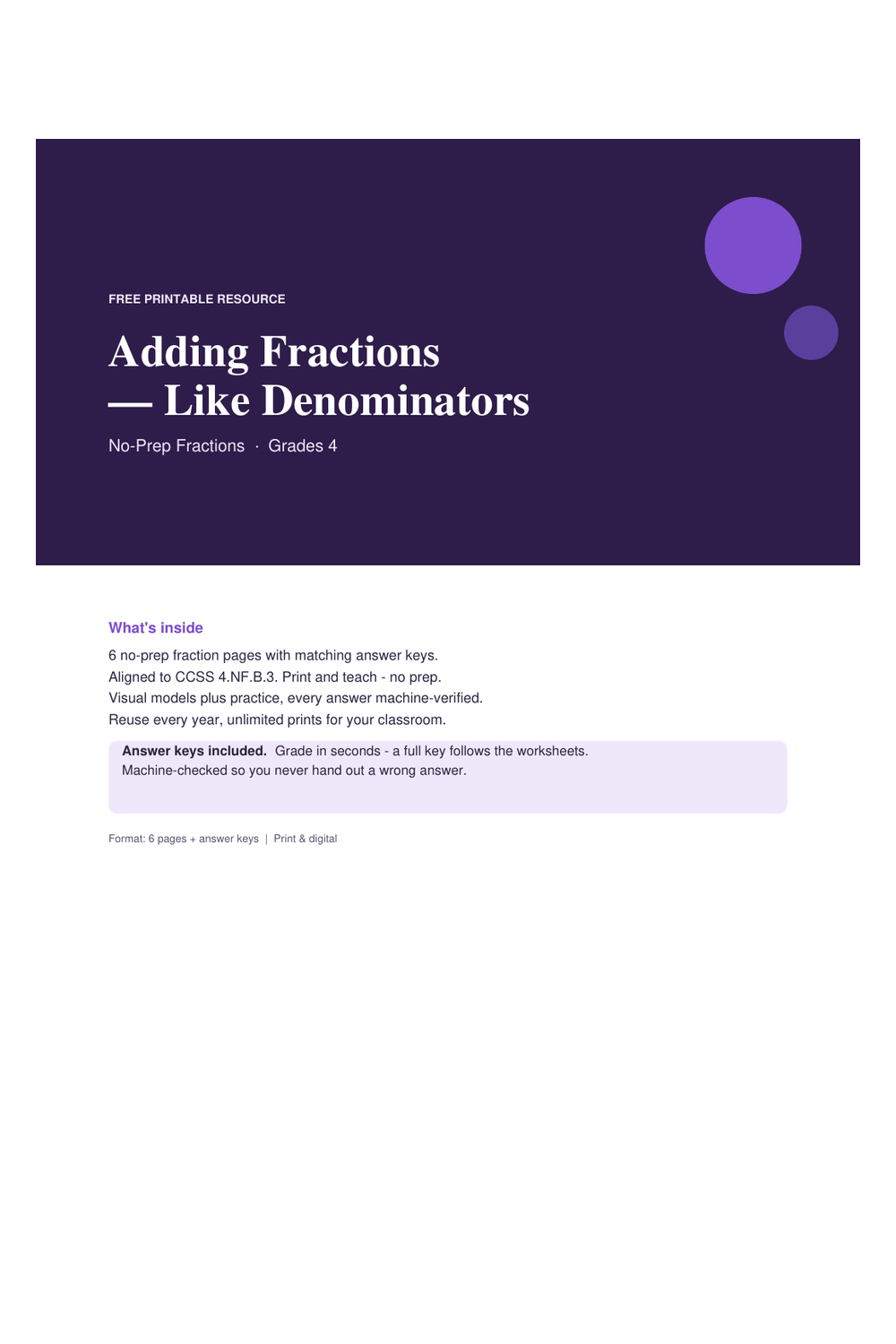
Adding Fractions — Like Denominators Worksheets PDF
A 13-page US Letter math pack for grades 4. The PDF keeps the student practice and matching answer-key pages together in one file so you can print only the pages you need. The main skill is to combine like-sized fractional parts by adding numerators and keeping the common denominator. The pack references 4.NF.B.3 on the cover. Standards noted for this pack: 4.NF.B.3.
View & download →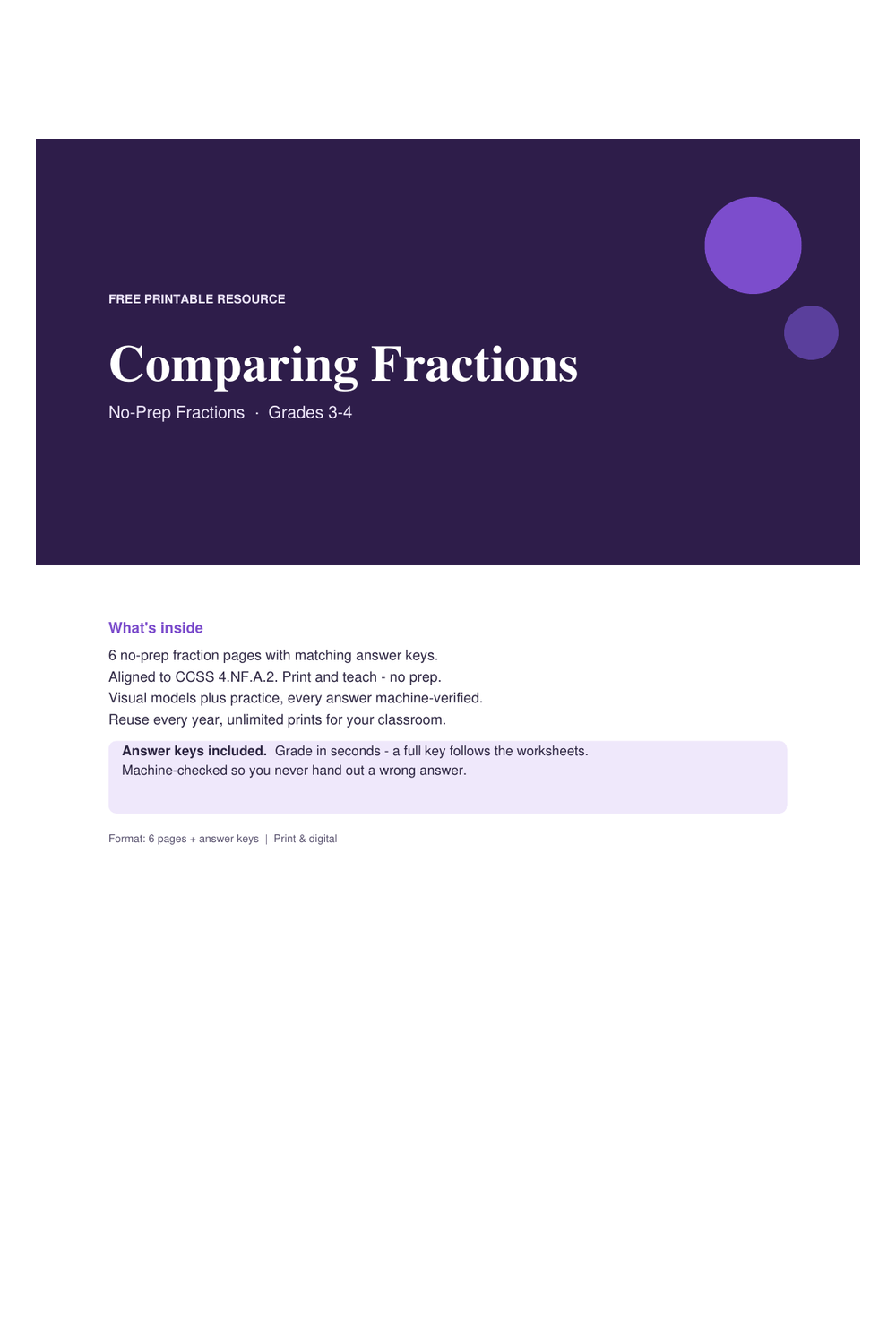
Free 13-page pack
Comparing Fractions Worksheets PDF
A 13-page US Letter math pack for grades 3-4. The PDF keeps the student practice and matching answer-key pages together in one file so you can print only the pages you need. The main skill is to compare fraction size using models, benchmarks, or common-sized parts instead of comparing numerators alone. The pack references 4.NF.A.2 on the cover. Standards noted for this pack: 4.NF.A.2.
View & download →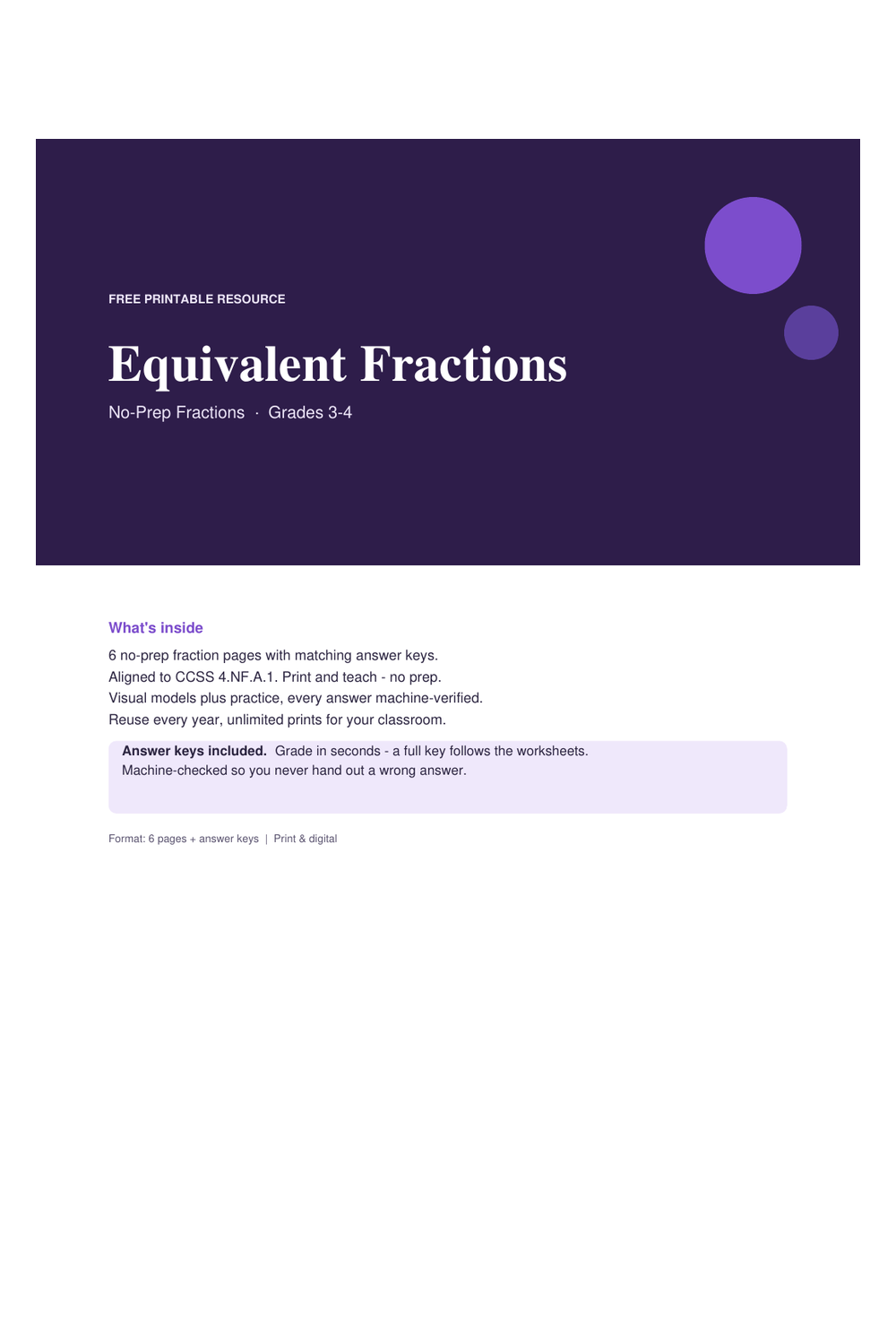
Free 13-page pack
Equivalent Fractions Worksheets PDF
A 13-page US Letter math pack for grades 3-4. The PDF keeps the student practice and matching answer-key pages together in one file so you can print only the pages you need. The main skill is to recognize when different numerator-denominator pairs represent the same quantity. The pack references 4.NF.A.1 on the cover. Standards noted for this pack: 4.NF.A.1.
View & download →