Math Worksheets · Free 41-page pack
Free Math Fact Fluency — Addition & Subtraction to 20 Worksheets PDF
This 41-page math fact fluency pack serves K-2 students who are practicing addition and subtraction within 20. Its 20 practice pages move through addition to 10 and 20, subtraction within 10 and 20, and mixed facts. Each page has 40 problems, and the PDF includes a matching answer key.
Edited by Tessa Vaughn · Planning & Organization Editor
Free download
Download the 41-page pack
This multi-page pack currently has one print-ready format. Preview the PDF, then print the whole pack or only the page range you need.
Share to Google Classroom ↗No sign-up required · personal/classroom use
Practice this skill on screen30 questions in three levels (easy, medium, hard) with instant feedback. Nothing to install.Get the whole set: 7 packs in one zipAddition and subtraction worksheet packs. Grades K–3: fact fluency, regrouping and word problems. US Letter PDFs with answer keys, 287 KB.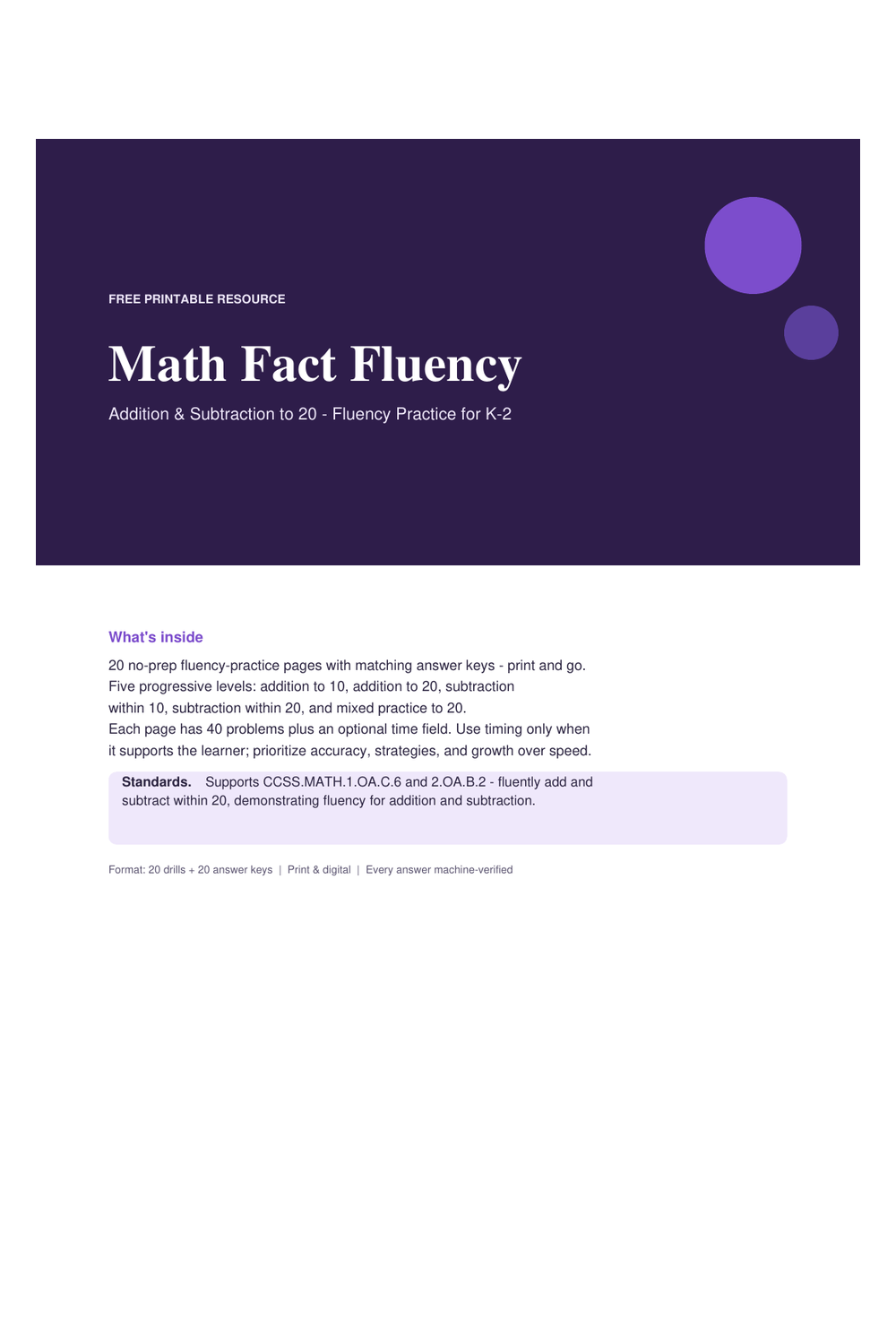
About this printable
The 41-page PDF has a cover, 20 practice pages, and 20 matching answer key pages. Each practice page has 40 addition or subtraction equations and Name, Date, optional Time, and Correct fields. Pages 2 and 3 focus on addition within 10; page 7 includes sums up to 20, and page 41 key lists mixed addition and subtraction facts. The other practice pages cover the remaining levels listed on the cover. An answer key follows every drill.
How addition and subtraction facts connect
Addition combines two amounts, while subtraction tells how much remains or how far apart two amounts are. The same three numbers can make a fact family: if 8 and 5 make 13, then 13 minus 8 and 13 minus 5 undo that addition. Children can use a known fact to solve a less familiar one, rather than treating every equation as a brand-new puzzle.
For sums within 20, children can make ten, then add what is left. In 8 + 7, move 2 from the 7 to the 8 to make 10, with 5 still to add; the total is 15. Subtraction can reverse this thinking: 15 - 8 asks what joins 8 to make 15. Fingers, counters, or a number line can make each change clear before a child records the equation.
Worked example 1
14 + 3 = ?
Start at 14 and count on three: 15, 16, 17. Or split 3 into 1 and 2 to reach 15, then 17.
Answer: 17
Worked example 2
9 + 9 = ?
Double 9 is 18. A near double also works: 9 + 10 is 19, so take away 1.
Answer: 18
Worked example 3
18 - 16 = ?
Ask how many steps take 16 up to 18: 17, then 18. The difference is two.
Answer: 2
Teaching it step by step
Build a ten first
Put 8 counters in one row and 7 in another. Move 2 counters beside the 8 to complete a group of ten; count the 5 left over to reach 15. Ask the child to explain why moving counters does not change the total.
Walk a number line
For 14 + 3, place a marker on 14 and take three forward jumps. For 18 - 16, compare the two positions and count the two spaces between them. Keep the jump direction tied to the operation sign.
Link a fact family
Write 8, 5, and 13 on separate cards. Have the learner arrange them into 8 + 5 = 13, 5 + 8 = 13, 13 - 8 = 5, and 13 - 5 = 8. Point out which number is the whole in each equation.
Sort by operation
Use two columns labeled addition and subtraction. Read a mixed equation aloud and let the child choose a column before solving. For 7 - 7, discuss why taking away the whole starting amount leaves zero. Check the sign aloud first.
Where it fits best
Ways to use it
A quick warm-up
Choose a few facts from the addition-to-10 pages before introducing larger sums. Invite children to name a strategy, such as doubles or making ten, after they solve.
A small-group comparison
Pair one addition page with a mixed page and listen for which facts children retrieve quickly. Use their explanations to decide whether to revisit a number line or a fact family.
A review folder
Keep completed drills with their matching keys for later discussion. Children can correct an equation and describe the step that changed their first answer. during a later math conversation.
Where learners go wrong
A child writes 14 + 3 = 16 after counting 14 as the first jump.
Start on 14 without counting it as a move. Say one more at 15, two more at 16, and three more at 17 while moving a counter or marker.
A learner answers 18 - 16 with 34 after adding the two numbers.
Ask whether the question joins amounts or finds what remains. Model 18 objects with 16 covered, then count the two uncovered objects to show why subtraction gives 2.
A student says 9 + 9 is 19 by using the 9 + 10 fact unchanged.
Write 9 + 10 = 19, then circle the extra one. Since the second addend is 9, remove one from 19; the double is 18.
A child changes 7 - 7 into 7 + 7 and records 14.
Use seven counters and physically remove all seven. Count what remains, then connect the empty set to zero and reread the minus sign in the original equation.
Frequently asked questions
How do you build addition and subtraction fact fluency within 20?
Invite children to solve in more than one way, then ask which method felt easiest. A learner might use doubles for 9 + 9 and a number line for 18 - 16. Short conversations about strategy help adults hear whether an answer came from a useful relationship or a guess.
How to teach addition and subtraction facts to a child?
Begin with objects the child can move, then sketch a number line or a ten frame, and finally write the equation. Switch between joining and taking away so the operation symbol has meaning. Let children explain one step before expecting them to work through a longer set independently.
What are some examples of addition and subtraction facts within 20?
Examples include 14 + 3 = 17, 9 + 9 = 18, and 18 - 16 = 2. Ask children to check subtraction by adding the difference back: 16 + 2 returns to 18. These facts also appear among the kinds of sums and differences used in the pack.
What is included in this math fact fluency addition and subtraction to 20 worksheet pack?
The PDF has 41 pages: a cover, 20 practice pages with 40 problems apiece, and 20 matching answer key pages. The drills address addition to 10 and 20, subtraction within 10 and 20, and mixed operations. Each practice page has Name and Date fields, plus optional timing and a correct-count field.
Is this math fact fluency addition and subtraction to 20 worksheet pack free?
Yes, the pack is free and needs no sign-up. It is a US Letter PDF only, with no A4 or PNG version. Its 20 drills each have an answer key in the 41-page file and cover addition and subtraction within 20.
Keep organizing
You might also like
Free 49-page pack
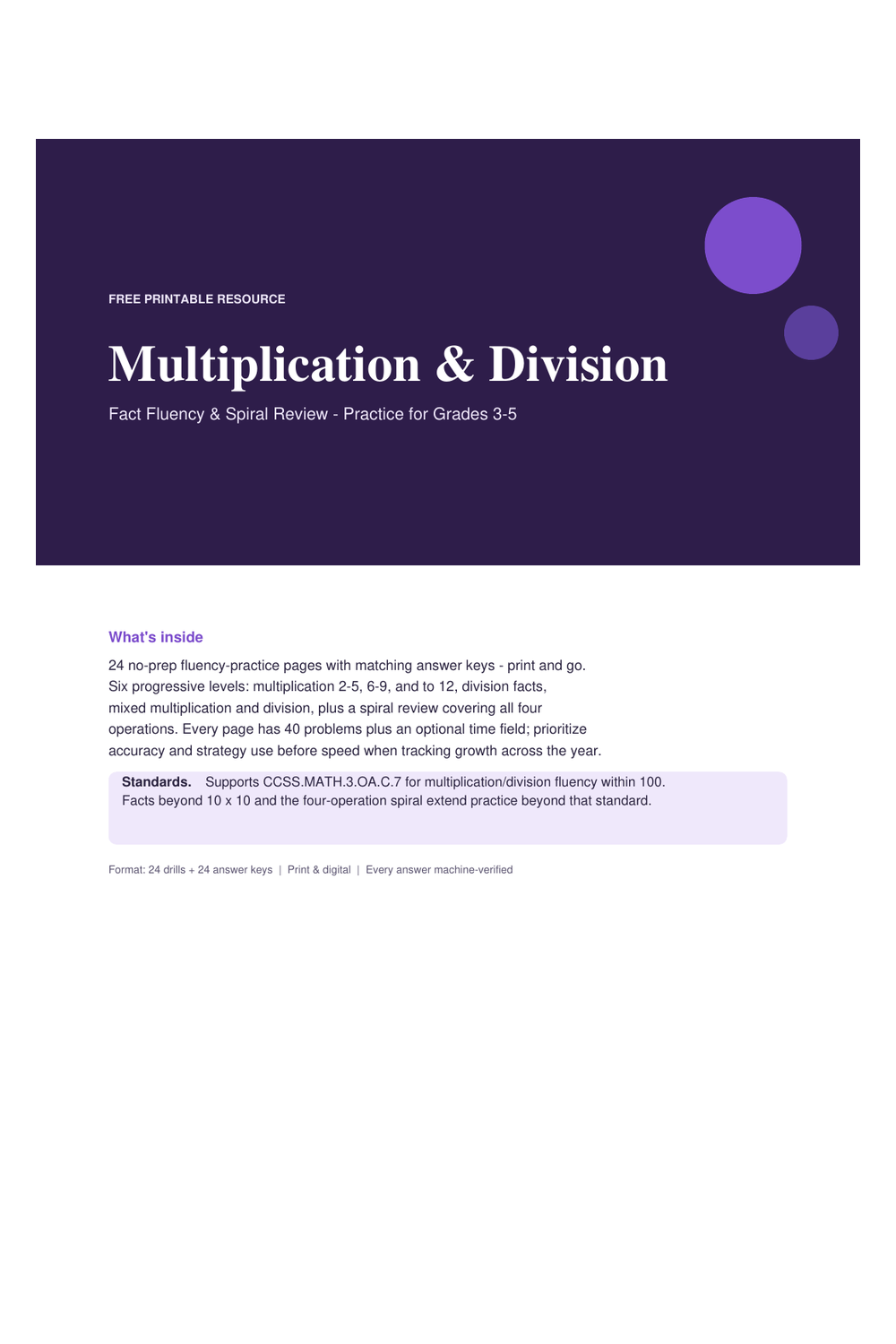
Multiplication & Division Fluency Worksheets PDF
A 49-page US Letter math pack for grades 3-5. The PDF keeps the student practice and matching answer-key pages together in one file so you can print only the pages you need. The main skill is to build multiplication and division fact recall across progressive levels, then mix operations in spiral review. The pack references 3.OA.C.7 on the cover. Standards noted for this pack: 3.OA.C.7.
View & download →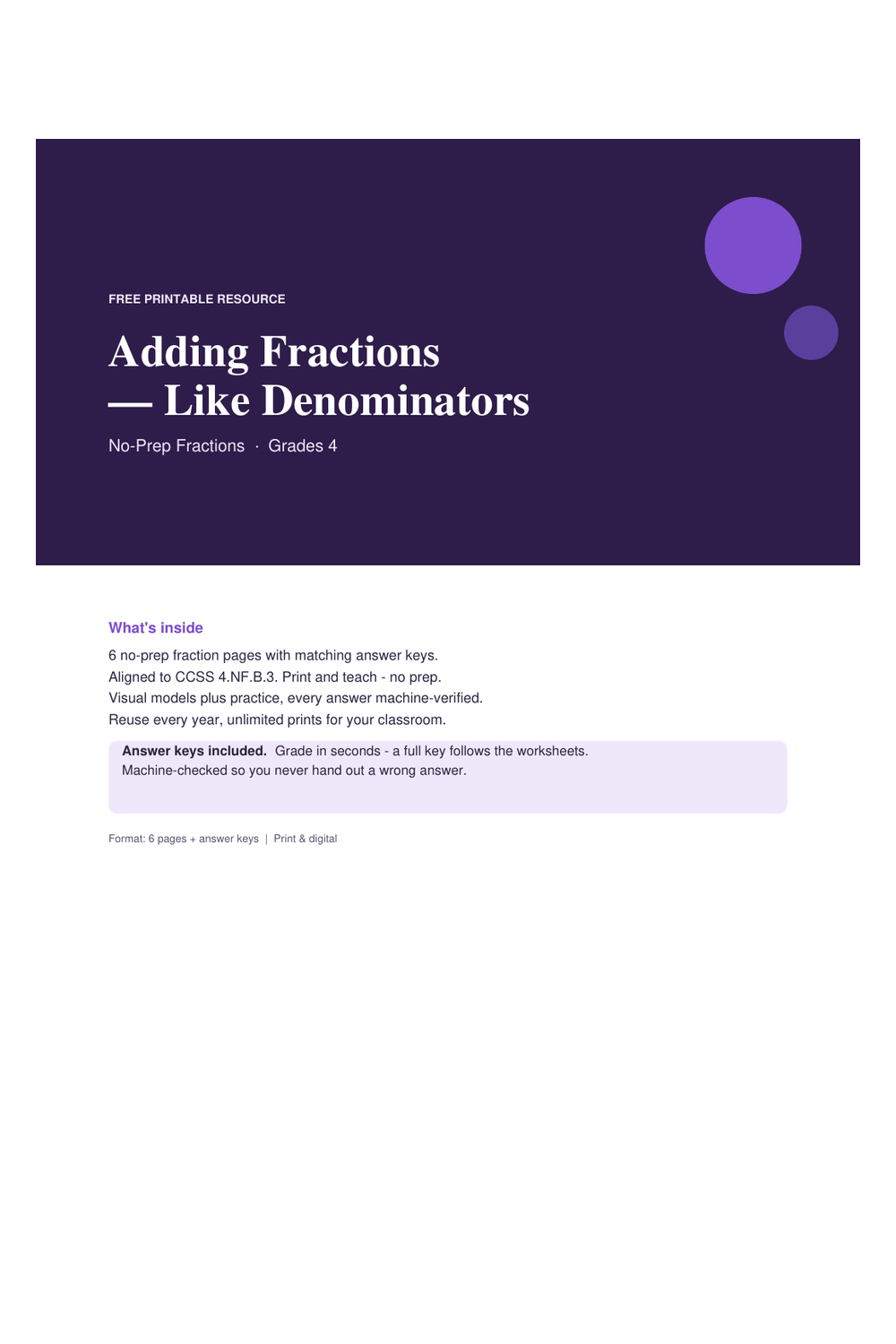
Free 13-page pack
Adding Fractions — Like Denominators Worksheets PDF
A 13-page US Letter math pack for grades 4. The PDF keeps the student practice and matching answer-key pages together in one file so you can print only the pages you need. The main skill is to combine like-sized fractional parts by adding numerators and keeping the common denominator. The pack references 4.NF.B.3 on the cover. Standards noted for this pack: 4.NF.B.3.
View & download →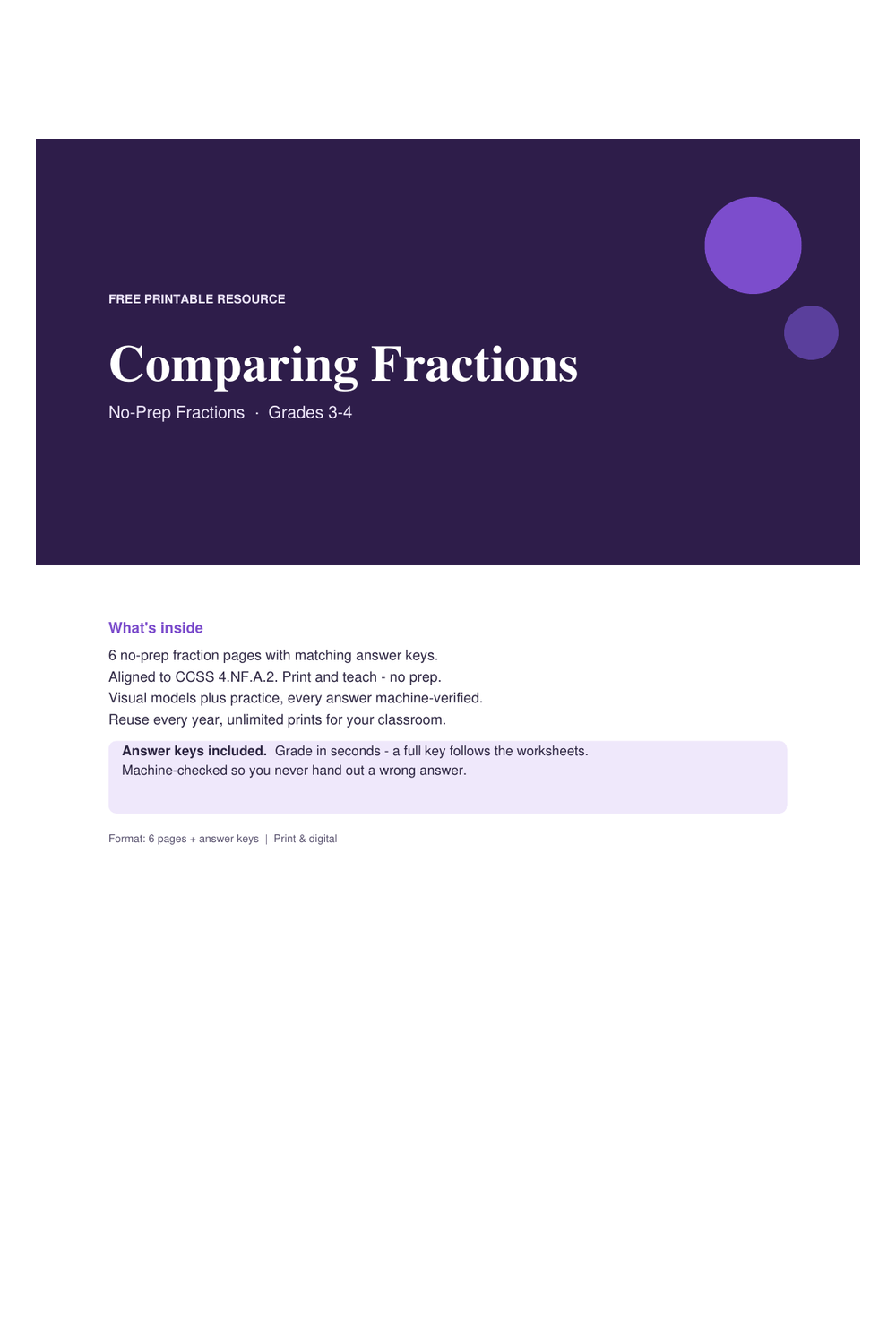
Free 13-page pack
Comparing Fractions Worksheets PDF
A 13-page US Letter math pack for grades 3-4. The PDF keeps the student practice and matching answer-key pages together in one file so you can print only the pages you need. The main skill is to compare fraction size using models, benchmarks, or common-sized parts instead of comparing numerators alone. The pack references 4.NF.A.2 on the cover. Standards noted for this pack: 4.NF.A.2.
View & download →