Math Worksheets · Free 49-page pack
Free Multiplication & Division Fluency Worksheets PDF
This 49-page multiplication and division fluency pack is for grades 3-5. Across 24 practice pages, students work on multiplication facts from 2-5, 6-9, and through 12, division facts, mixed multiplication and division, and four-operation review. Every drill contains 40 problems, with an answer key included.
Edited by Tessa Vaughn · Planning & Organization Editor
Free download
Download the 49-page pack
This multi-page pack currently has one print-ready format. Preview the PDF, then print the whole pack or only the page range you need.
Share to Google Classroom ↗No sign-up required · personal/classroom use
Practice this skill on screen30 questions in three levels (easy, medium, hard) with instant feedback. Nothing to install.Get the whole set: 6 packs in one zipMultiplication and skip counting worksheet packs. Grades K–5: skip counting, multi-digit multiplication and fact fluency. US Letter PDFs with answer keys, 436 KB.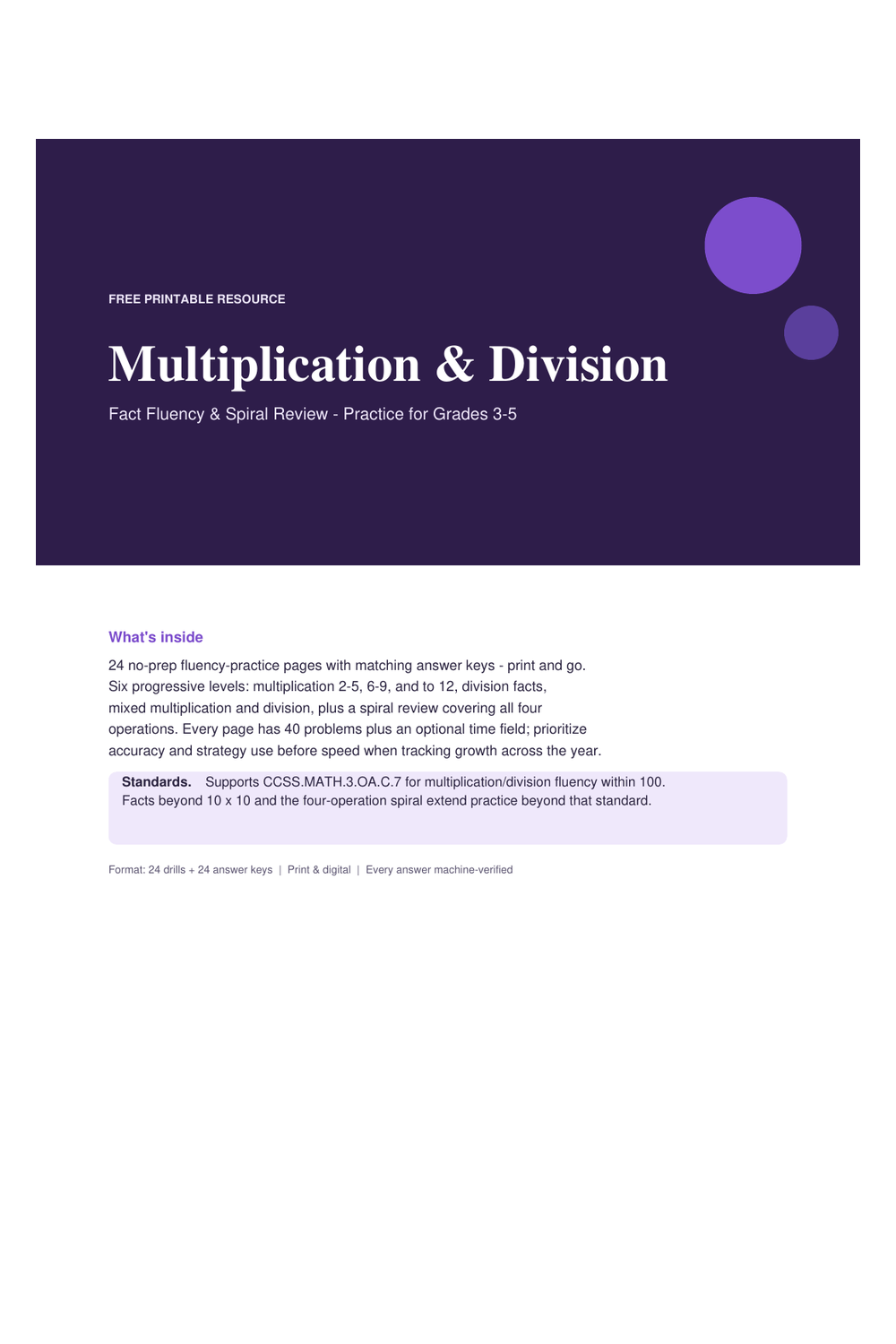
What this page helps with
The 49-page file contains a cover, 24 practice pages, and 24 corresponding answer key pages. Forty problems appear on each practice sheet; Name and Date lines come with optional Time and Correct fields. Pages 2 and 3 use multiplication facts with factors 2-5; page 7 uses factors 6-9, including products with 10, 11, and 12. The page 49 key covers addition, subtraction, multiplication, and division. The other practice pages follow the levels named on the cover.
How multiplication and division are related
Multiplication counts equal groups efficiently. In 4 x 6, there are four groups of six, so repeated addition gives 6 + 6 + 6 + 6. The order of the factors can switch without changing the product: four groups of six have the same total as six groups of four. A child who understands groups can connect a fact to objects or an array instead of relying on a chant alone.
Division reverses multiplication by splitting a total into equal groups or finding how many groups fit. For 55 divided by 11, ask which number multiplied by 11 makes 55; five groups do. This inverse relationship offers a check: multiply the quotient by the divisor and see whether the original total returns. Mixed review also asks children to notice the operation sign before choosing a strategy.
Worked example 1
9 x 12 = ?
Break 12 into 10 and 2. Compute 9 x 10 = 90 and 9 x 2 = 18, then combine 90 and 18.
Answer: 108
Worked example 2
7 x 12 = ?
Use 7 x 10 = 70 and 7 x 2 = 14. Add the partial products: 70 + 14.
Answer: 84
Worked example 3
55 divided by 11 = ?
Think of the matching multiplication fact. Five groups of 11 make 55, since 11 + 11 + 11 + 11 + 11 = 55.
Answer: 5
A teaching routine for this pack
Make equal groups
Place 12 counters in four equal groups. Count four at a time to see 4 x 3, then rearrange into three groups of four. Discuss why the total remains 12 even though the grouping changes.
Sketch an array
Draw nine rows with twelve dots in each row for 9 x 12. Split each row into ten dots and two dots; total the two smaller arrays as 90 and 18. This connects a larger fact to easier products.
Turn products around
Write 6 x 8 = 48 and ask for two division facts that use the same numbers. Guide the child to 48 divided by 6 = 8 and 48 divided by 8 = 6. Keep the whole and the group size clear as the numbers move.
Name the operation
In mixed review, cover the numbers and point to the sign first. Ask whether the problem joins, removes, makes equal groups, or shares equally. Then uncover the values and choose a model that matches that action.
Good matches for this page
Three ways to use it
A fact strategy check
Use one drill after a lesson and ask children to explain a product they solved by breaking a factor apart. Their reasoning can show whether partial products make sense to them.
Division warm-up
Before a division page, name a few multiplication facts that could help. For a quotient with 11, children can search for the related 11-times fact and verify it by multiplying back.
Mixed-operation review
A four-operation page gives children practice noticing the sign before calculating. Have them mark each operation first, then compare selected responses with the included key.
Common mistakes to avoid
A student calculates 9 x 12 as 9 x 10 + 2, giving 92.
The two remaining groups of nine are 9 x 2, not just 2. Draw two rows of nine dots, count 18, and combine that with the 90 from nine tens.
A learner answers 55 divided by 11 = 44 after subtracting 11 once.
One subtraction finds what remains after one group, not the number of groups. Keep subtracting 11 from 55 and count the steps, or ask how many elevens make 55; there are five.
A child writes 7 x 12 = 712 by placing the factors side by side.
Multiplication asks for equal groups, not concatenated digits. Build seven groups of twelve or split twelve into ten and two; the partial products 70 and 14 combine to 84.
A student reads 18 - 2 as 18 + 2 and records 20 during mixed review.
Pause at the operation symbol before using a fact. Model 18 counters and remove two; recount the 16 remaining. Ask the child to say take away before solving another subtraction item.
Common questions
How do you teach multiplication and division fact fluency?
Build products with equal groups or arrays, and connect each product to division facts that undo it. When a fact is difficult, split a factor into tens and ones, calculate two smaller products, and combine them. Ask learners to explain how their multiplication check confirms a quotient.
What is an easy way to practice multiplication and division facts?
Choose one known multiplication fact and make its two related division equations. For example, 6 x 8 = 48 leads to 48 divided by 6 = 8 and 48 divided by 8 = 6. Children can use counters or a quick array sketch to verify the family before moving to written facts.
Can you give me examples of multiplication and division problems?
The pack includes kinds of facts such as 9 x 12 and 55 divided by 11; their answers are 108 and 5. To check the quotient, multiply 5 by 11 to return to 55. Another example is 7 x 12, which can be broken into 7 x 10 plus 7 x 2.
What is included in this multiplication and division fluency worksheet pack?
There are 49 pages: a cover, 24 practice pages with 40 problems each, and 24 matching answer key pages. The levels include multiplication facts, division, mixed multiplication and division, and a final four-operation review. Name and Date fields appear on practice pages alongside optional Time and Correct fields.
Is this multiplication and division fluency worksheet pack free?
This pack is free to download and requires no registration. The only format is a US Letter PDF; alternate A4 and PNG files are not offered. Matching answer keys for all 24 drills appear in the 49-page document, covering facts through 12, division, and mixed review.
Keep organizing
You might also like
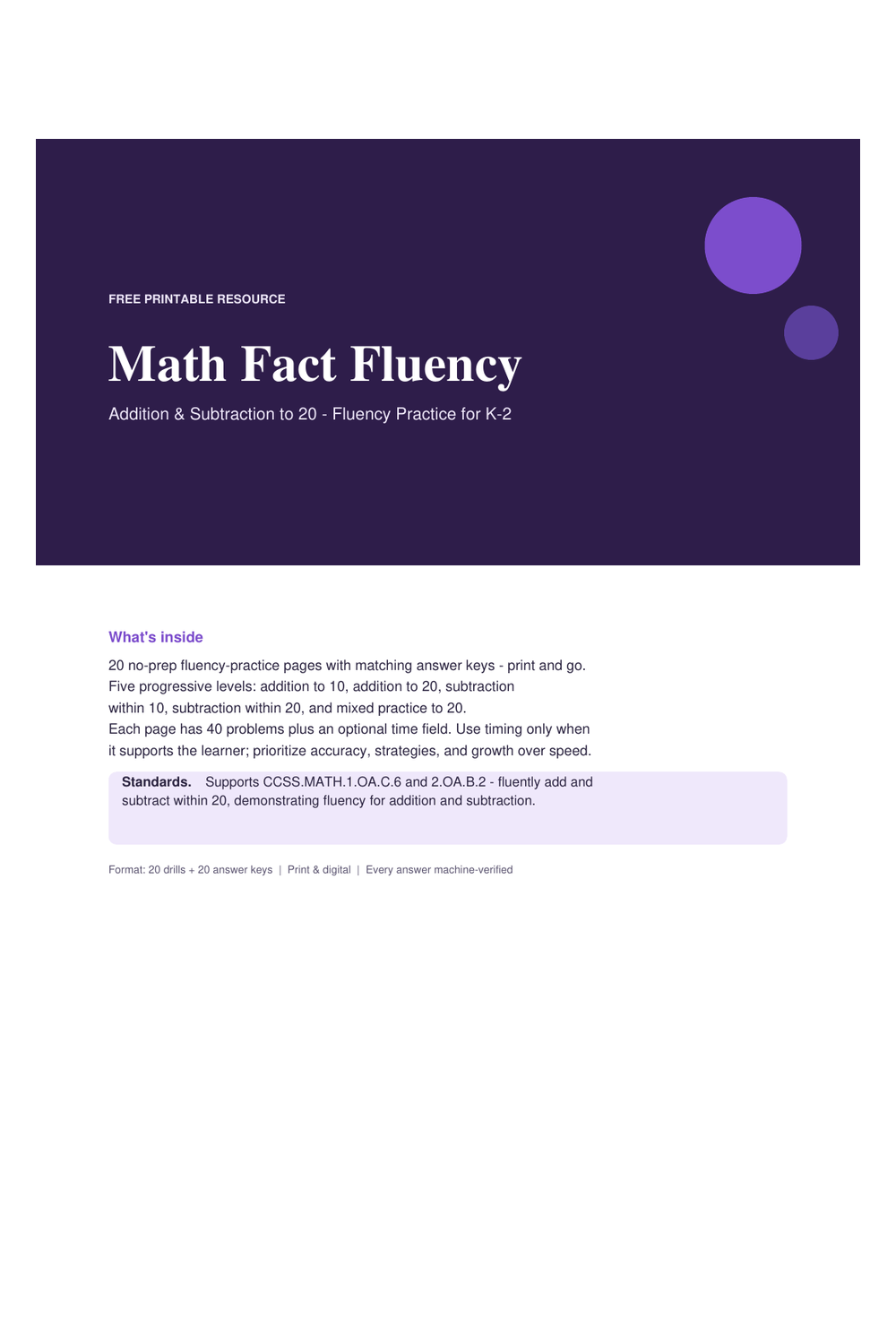
Free 41-page pack
Math Fact Fluency — Addition & Subtraction to 20 Worksheets PDF
A 41-page US Letter math pack for grades K-2. The PDF keeps the student practice and matching answer-key pages together in one file so you can print only the pages you need. The main skill is to build accurate addition and subtraction recall through short repeated sets before emphasizing speed. The pack references 1.OA.C.6, 2.OA.B.2 on the cover. Standards noted for this pack: 1.OA.C.6, 2.OA.B.2.
View & download →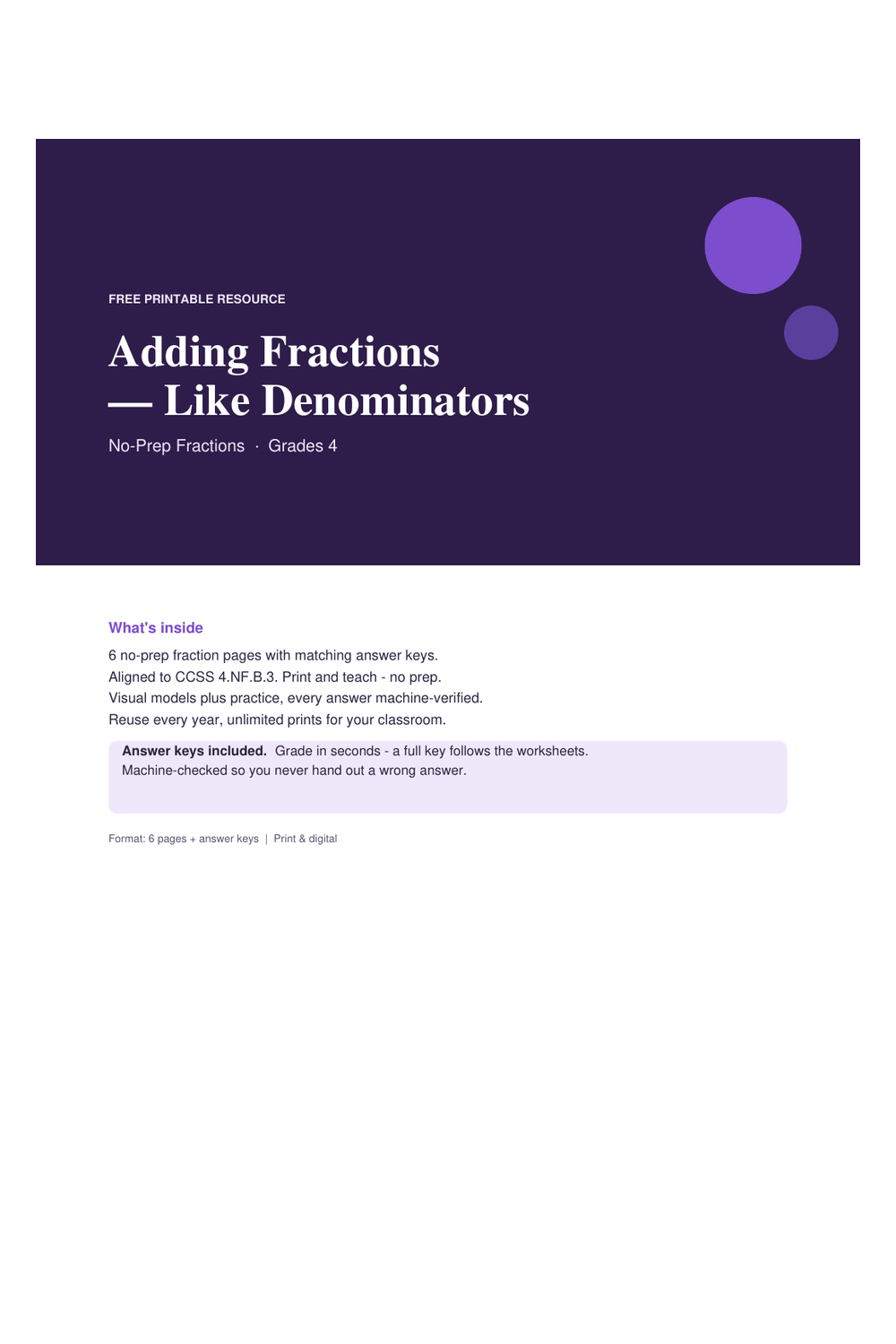
Free 13-page pack
Adding Fractions — Like Denominators Worksheets PDF
A 13-page US Letter math pack for grades 4. The PDF keeps the student practice and matching answer-key pages together in one file so you can print only the pages you need. The main skill is to combine like-sized fractional parts by adding numerators and keeping the common denominator. The pack references 4.NF.B.3 on the cover. Standards noted for this pack: 4.NF.B.3.
View & download →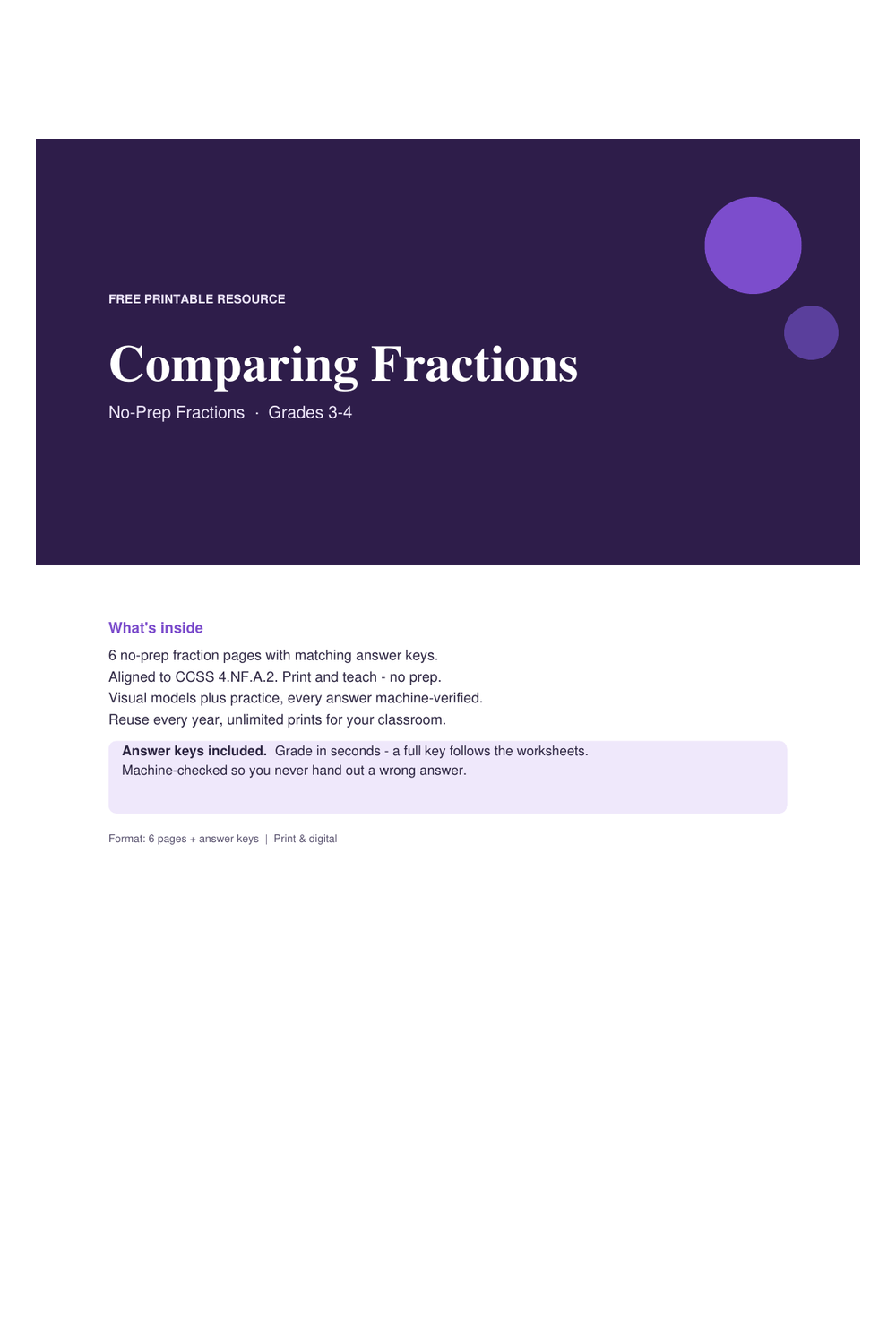
Free 13-page pack
Comparing Fractions Worksheets PDF
A 13-page US Letter math pack for grades 3-4. The PDF keeps the student practice and matching answer-key pages together in one file so you can print only the pages you need. The main skill is to compare fraction size using models, benchmarks, or common-sized parts instead of comparing numerators alone. The pack references 4.NF.A.2 on the cover. Standards noted for this pack: 4.NF.A.2.
View & download →