Math Worksheets · Free 13-page pack
Free Rounding to the Nearest 10 Worksheets PDF
This 13-page rounding pack serves grades 2 to 3 and focuses only on the nearest ten. Children compare a two-digit number with the tens on either side, including midpoint cases such as 25 and 45. Six practice sheets are paired with an answer key for checking the work.
Edited by Tessa Vaughn · Planning & Organization Editor
Free download
Download the 13-page pack
This multi-page pack currently has one print-ready format. Preview the PDF, then print the whole pack or only the page range you need.
Share to Google Classroom ↗No sign-up required · personal/classroom use
Practice this skill on screen30 questions in three levels (easy, medium, hard) with instant feedback. Nothing to install.Get the whole set: 9 packs in one zipPlace value and rounding worksheet packs. Grades 1–4: compare, order, expanded form and rounding. US Letter PDFs with answer keys, 384 KB.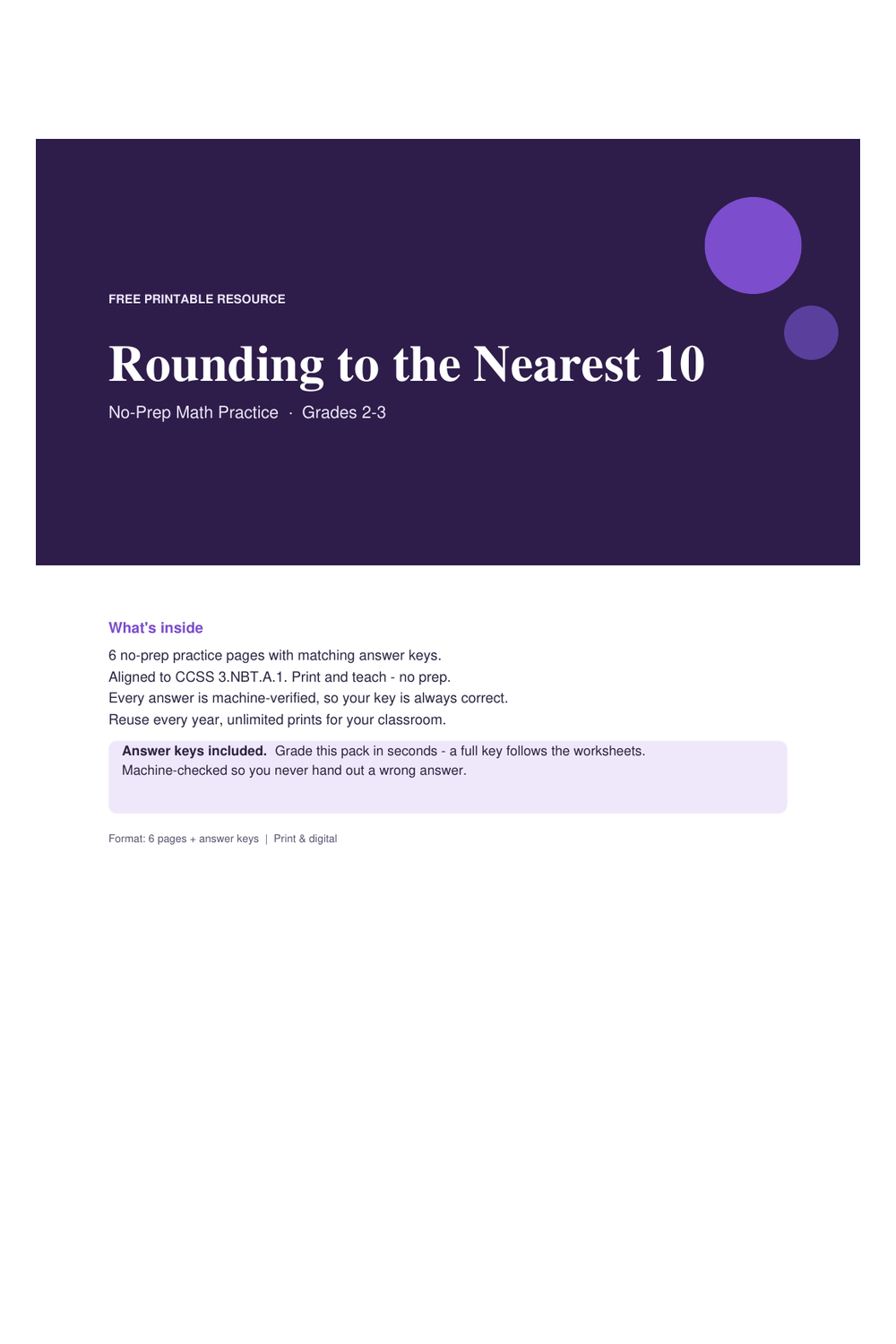
About this printable
Inside this 13-page US Letter file, learners round two-digit values to a ten across six practice pages. Practice pages 2, 3, and 7 hold 15 questions each, ranging from 11 to 98 and including midpoint values 45 and 95. Other practice pages continue with the same target. Students write their Name and Date on each page. The answer key is on pages 8 to 13.
Finding the closer ten
Every whole number sits between two tens, except a number already ending in zero. To round to the nearest ten, compare the ones digit with 5: digits 0 through 4 are closer to the lower ten, while 5 through 9 are at the midpoint or closer to the upper ten. A number line makes the reason visible: 46 is one step from 50 and six from 40, so 50 is nearer.
Tens can also be pictured as stops on a path. A number such as 63 has passed the halfway mark between 60 and 70, so it belongs with 70; 32 has not passed halfway from 30 to 40, so it belongs with 30. Numbers ending in 5 land exactly between stops. Under the usual school convention, those ties go up. The rounded value is an estimate, not an exact replacement for the original number.
Worked example 1
Round 25 to the nearest 10.
25 is halfway between 20 and 30. At a tie, choose the higher ten.
Answer: 30
Worked example 2
Round 46 to the nearest 10.
46 lies between 40 and 50. It is 6 from 40 and 4 from 50, so 50 is closer.
Answer: 50
Worked example 3
Round 95 to the nearest 10.
95 is exactly between 90 and 100. Apply the tie rule and select the higher ten.
Answer: 100
Teaching it step by step
Build a tens track
Draw a path labeled 20, 30, and 40, then add small marks for the numbers between them. Let the learner point to 25 and 32. The path shows that one is halfway while the other is still nearer 30.
Use a bead string
On a bead string grouped in tens, find the nearest group boundary for a number such as 46. Count the gap to 40 and 50. The physical spacing supports comparison before introducing the ones-digit shortcut.
Make midpoint pairs
Offer pairs like 25 and 26. Ask which tens each number sits between and whether either is exactly halfway. This keeps the tie convention distinct from the simple case where a number is plainly nearer one endpoint.
Say the estimate aloud
Before recording a rounded answer, have the child say, “46 is closer to 50 than 40.” Then write 50. The sentence links the decision to distance and gives adults a quick way to hear whether the learner is comparing the correct neighboring tens.
Where it fits best
Ways to use it
A short number talk
Display 45 and invite two possible answers, 40 and 50. Ask learners to show its location and explain the tie convention before they write anything.
Practice with tens landmarks
Use the questions after building a tens track. Children can point to both bordering landmarks, compare their distance from the given number, and then record the estimate on the worksheet.
Review place-value language
Ask students to identify the two tens around each selected value. This gives practice connecting a two-digit number with its neighbors and explaining why one landmark is the better estimate.
Where learners go wrong
Rounding 45 down to 40 because it has not reached 50.
45 is exactly halfway between 40 and 50, not closer to 40. Use the class tie convention: halfway values round to the greater ten, so 45 becomes 50.
Rounding 67 down to 60 because the tens digit stays the same.
67 is between 60 and 70, but it is three away from 70 and seven from 60. The nearest ten is 70. Compare distance or check whether the ones digit is at least 5.
Rounding 16 to 10 after noticing the 1 in the tens place.
16 is between 10 and 20 and is 6 above 10. It is closer to 20, so the rounded result is 20. Locate both tens before deciding.
Rounding 88 to 80 after comparing it with 80 and 100 instead of 80 and 90.
For the nearest ten, compare 88 with 80 and 90. It is eight from 80 and two from 90, so it rounds to 90. Use the adjacent tens, not the next hundred.
Frequently asked questions
How do you round to the closest ten?
Find the ten just below the number and the next ten above it. Compare how far the number is from each. If it is exactly halfway, use the usual school convention of rounding up. For example, 46 is nearer 50, while 25 is a midpoint and rounds to 30.
Can a tens number line teach rounding?
Draw a line with tens labeled at its ends and a halfway mark between them. Let the child place a value and compare the gaps to the endpoints. Use a number ending in 5 to discuss the classroom tie convention separately from cases that lie closer to one ten.
Which check shows whether rounding to 10 is sensible?
Have the learner identify the two tens that bracket a value, then select the landmark that needs fewer steps to reach. For 46, the gaps are six to 40 and four to 50, so the rounded estimate is 50. This quick distance check works for other values too.
What is included in this rounding to the nearest 10 worksheet pack?
The download holds 13 US Letter pages, with six student sheets and a matching answer key. Practice pages 2, 3, and 7 ask 15 questions apiece; all round two-digit numbers to a ten, from 11 through 98. Each worksheet has Name and Date spaces. Solutions occupy PDF pages 8 to 13.
Is this rounding to the nearest 10 worksheet pack free?
Yes, there is no fee and you can access it without registration. The file supplied here is formatted for US Letter paper and comes only as PDF, not as A4 or PNG. Its answer key sits in the closing section, on PDF pages 8 to 13.
Keep organizing
You might also like
Free 13-page pack
Comparing Numbers — 2-Digit Worksheets PDF
A 13-page US Letter math pack for grades 1-2. The PDF keeps the student practice and matching answer-key pages together in one file so you can print only the pages you need. The main skill is to compare tens first and use ones only when the tens digits match. The pack references 1.NBT.B.3 on the cover. Standards noted for this pack: 1.NBT.B.3.
View & download →
Free 13-page pack
Comparing Numbers — 3-Digit Worksheets PDF
A 13-page US Letter math pack for grades 2-3. The PDF keeps the student practice and matching answer-key pages together in one file so you can print only the pages you need. The main skill is to compare hundreds, then tens, then ones so the first unequal place determines the relationship. The pack references 2.NBT.A.4 on the cover. Standards noted for this pack: 2.NBT.A.4.
View & download →
Free 13-page pack
Expanded Form — 2-Digit Numbers Worksheets PDF
A 13-page US Letter math pack for grades 1-2. The PDF keeps the student practice and matching answer-key pages together in one file so you can print only the pages you need. The main skill is to read each 2-digit number as tens and ones before rewriting it in expanded form. The pack references 2.NBT.A.3 on the cover. Standards noted for this pack: 2.NBT.A.3.
View & download →