Math Worksheets · Free 13-page pack
Free Rounding to the Nearest 100 Worksheets PDF
For grades 3 to 4, this 13-page pack develops rounding three-digit numbers to the nearest hundred. Students locate neighboring hundreds and judge whether the number is below or above the midpoint, with examples including 499 and 995. Six practice pages come with a matching answer key.
Edited by Tessa Vaughn · Planning & Organization Editor
Free download
Download the 13-page pack
This multi-page pack currently has one print-ready format. Preview the PDF, then print the whole pack or only the page range you need.
Share to Google Classroom ↗No sign-up required · personal/classroom use
Practice this skill on screen30 questions in three levels (easy, medium, hard) with instant feedback. Nothing to install.Get the whole set: 9 packs in one zipPlace value and rounding worksheet packs. Grades 1–4: compare, order, expanded form and rounding. US Letter PDFs with answer keys, 384 KB.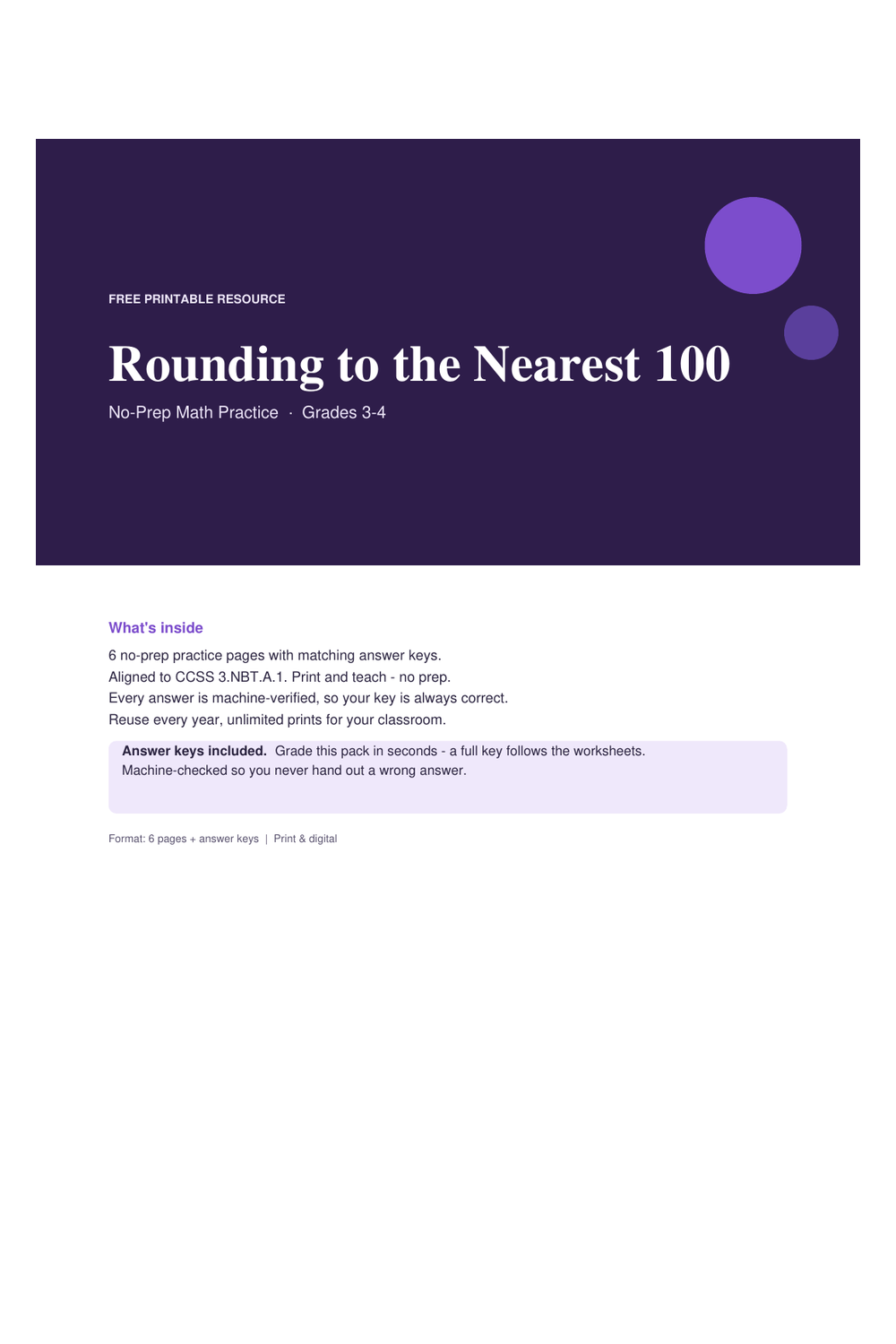
What is on the page
The cover and 12 following pages make this a 13-page US Letter PDF. Six sheets ask students to round three-digit numbers to the nearest hundred; six provide the answer key. Practice pages 2, 3, and 7 each pose 15 prompts, including 219, 650, and 995. Remaining practice pages keep that target. Name and Date lines are provided for students. Answers are on pages 8 to 13.
Locating the nearest hundred
To round to a hundred, identify the hundreds immediately below and above the number. The halfway point is 50 above the lower hundred. Numbers less than halfway round down; numbers at or beyond halfway round up. For 483, the hundreds around it are 400 and 500; the upper landmark is only 17 away, compared with 83 to the lower one, so choose 500. Thinking in distances helps children understand why the tens and ones together matter.
A hundred chart can show the same decision as a vertical move between rows of hundreds. Numbers near the top of a hundred range lean toward the next landmark, while values near the beginning stay with the previous one. An exact midpoint, such as 650, is equally distant from 600 and 700; the usual school convention sends it to 700. Keep the full number in view, especially when it is close to a boundary like 499 or 995.
Worked example 1
Round 499 to the nearest 100.
The neighboring hundreds are 400 and 500. 499 is just 1 below 500, so it is much closer to 500.
Answer: 500
Worked example 2
Round 650 to the nearest 100.
650 is exactly halfway between 600 and 700. Apply the tie convention and choose the greater hundred.
Answer: 700
Worked example 3
Round 995 to the nearest 100.
995 is between 900 and 1,000, only 5 below 1,000. Choose the nearer hundred.
Answer: 1,000
Teaching it step by step
Bridge two hundreds
Draw a number line from 400 to 500 and mark 450 in the center. Place 483 on the line and ask which landmark it approaches. Repeat with a number below the center so students compare both sides of the midpoint.
Read a hundreds chart
Use a hundreds chart with successive hundreds visible. Locate a value such as 219 within the 200s, then compare its position with the halfway mark at 250. The chart helps connect the hundred it belongs to with the nearer rounded landmark.
Test boundary numbers
Compare 499 with 401. Both are in the 400s, but their distances from 500 differ greatly. Ask learners to explain why one rounds upward and the other downward rather than relying only on the hundreds digit.
Discuss the exact half
Mark 650 between 600 and 700. Let the learner state that the distances match, then apply the class convention for ties. Separate this convention from the distance reasoning used for values such as 649 or 651.
Where it fits best
Ways to use it
Estimate a three-digit amount
Use a prompt from the pack to ask whether the nearest hundred is above or below the original value. Learners can support their estimate by naming both surrounding hundreds.
Explore the halfway boundary
Pair values on either side of 450, such as 449 and 451. Ask children to predict the nearest hundred before checking their positions on a line.
Check number sense
After students round a few values, ask whether the answer should be 400, 500, or another hundred. The answer key helps an adult check the result after the learner explains the estimate.
Where learners go wrong
Rounding 483 to 400 because its hundreds digit is 4.
Compare 483 with the surrounding hundreds. It is 83 from 400 but only 17 from 500, so 500 is nearer. The hundreds digit alone cannot show which landmark is closer.
Rounding 650 down to 600 because it is still written in the 600s.
650 is the exact halfway point from 600 to 700. Under the usual classroom convention, a midpoint rounds up to 700. Show both equal distances before using the convention.
Rounding 499 to 400 because it is less than 500.
Being below 500 does not make 400 nearer. 499 is one away from 500 and 99 away from 400, so it rounds to 500. Compare distances, not just which side of 500 the number occupies.
Rounding 995 to 900 because its hundreds digit is 9.
The neighboring hundreds are 900 and 1,000. Since 995 is five below 1,000 and much farther from 900, the nearest hundred is 1,000. Check the next landmark when rounding near the end of a range.
Frequently asked questions
How can you round a three-digit value to the nearest hundred?
Find the hundreds on either side and locate their midpoint, which is 50 above the lower hundred. If the number is below that midpoint, choose the lower hundred; at or above it, choose the higher one. Thus, 483 rounds to 500, while 219 rounds to 200.
What can a hundreds chart show about rounding?
Label two consecutive hundreds and mark the value halfway between them. Let the learner place a three-digit number on this segment and explain which side it favors. Use the exact middle value separately to introduce the classroom convention for ties.
Which estimate is closer when rounding to 100?
Name the two adjacent hundreds, then compare the number’s distance from each endpoint. For 499, it is one away from 500 and ninety-nine from 400, so 500 is the sensible estimate. Check that the result is a multiple of one hundred.
What is included in this rounding to the nearest 100 worksheet pack?
There are 13 pages in this US Letter file: a cover, six exercises, and six matching answer sheets. On practice pages 2, 3, and 7, students round 15 numbers to a hundred per page. The values include 105 to 995, with near and exact midpoints. Name and Date lines appear for students.
Is this rounding to the nearest 100 worksheet pack free?
Yes, the resource costs nothing and access needs no sign-up. You receive a PDF for US Letter paper; A4 pages and PNG images are not offered in this pack. Check student work against its answer key, printed on the final six sheets, numbered 8 to 13.
Keep organizing
You might also like
Free 13-page pack
Comparing Numbers — 2-Digit Worksheets PDF
A 13-page US Letter math pack for grades 1-2. The PDF keeps the student practice and matching answer-key pages together in one file so you can print only the pages you need. The main skill is to compare tens first and use ones only when the tens digits match. The pack references 1.NBT.B.3 on the cover. Standards noted for this pack: 1.NBT.B.3.
View & download →
Free 13-page pack
Comparing Numbers — 3-Digit Worksheets PDF
A 13-page US Letter math pack for grades 2-3. The PDF keeps the student practice and matching answer-key pages together in one file so you can print only the pages you need. The main skill is to compare hundreds, then tens, then ones so the first unequal place determines the relationship. The pack references 2.NBT.A.4 on the cover. Standards noted for this pack: 2.NBT.A.4.
View & download →
Free 13-page pack
Expanded Form — 2-Digit Numbers Worksheets PDF
A 13-page US Letter math pack for grades 1-2. The PDF keeps the student practice and matching answer-key pages together in one file so you can print only the pages you need. The main skill is to read each 2-digit number as tens and ones before rewriting it in expanded form. The pack references 2.NBT.A.3 on the cover. Standards noted for this pack: 2.NBT.A.3.
View & download →