Math Worksheets · Free 13-page pack
Free Simplifying Fractions to Lowest Terms Worksheets PDF
Grades 4-5 learners can use six lowest-terms worksheets in this 13-page fraction simplification PDF. It includes an answer key. Students reduce each fraction without changing its value; problems include 18/21 and 21/24, where a common factor divides both terms.
Edited by Tessa Vaughn · Planning & Organization Editor
Free download
Download the 13-page pack
This multi-page pack currently has one print-ready format. Preview the PDF, then print the whole pack or only the page range you need.
Share to Google Classroom ↗No sign-up required · personal/classroom use
Practice this skill on screen30 questions in three levels (easy, medium, hard) with instant feedback. Nothing to install.Get the whole set: 8 packs in one zipFractions worksheet packs. Grades 1–5: identify, compare, add, subtract and simplify fractions. US Letter PDFs with answer keys, 509 KB.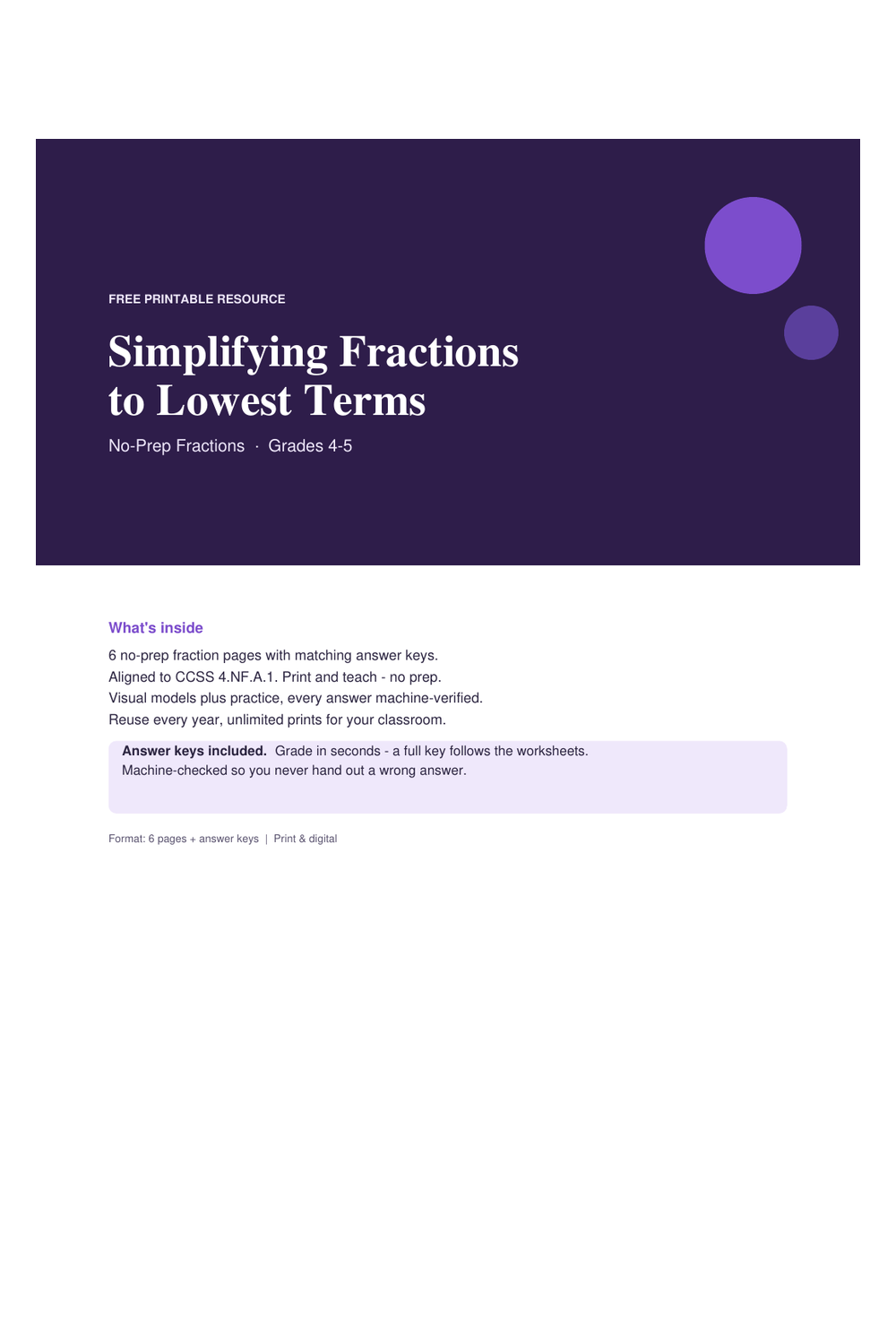
What this printable is for
The simplifying fractions pack is 13 pages long. It starts with a cover and six practice pages; its key fills pages 8-13. On pages 2, 3, and 7, students reduce 12 fractions per page and have a Name/Date line. Terms range from 2 to 32; problems include 18/21, 12/28, and 21/24. Students simplify each fraction to lowest terms on the remaining practice pages.
Reducing without changing the amount
To simplify a fraction, divide its numerator and denominator by the same common factor. This creates a fraction with fewer, larger-sized parts but keeps the same value. Continue until no whole number greater than one divides both terms evenly; then the fraction is in lowest terms. Dividing only one term would change the relationship and produce a different amount.
Children can look for a shared factor, such as 3 in 18/21. Dividing both terms by 3 gives 6/7. The fraction is reduced because 6 and 7 share no factor beyond one. It can help to check by multiplying 6/7's numerator and denominator by 3 to return to 18/21, showing that the original and reduced forms represent the same quantity.
Worked example 1
Simplify 18/21.
Both terms divide evenly by 3. Divide the numerator and denominator by 3: 18 ÷ 3 = 6 and 21 ÷ 3 = 7.
Answer: 6/7
Worked example 2
Write 21/24 in lowest terms.
Divide both terms by 3 to get 7/8. Seven and eight have no common factor greater than 1, so this is lowest terms.
Answer: 7/8
Worked example 3
Simplify 16/28.
A common factor is 4. Divide each term by 4: 16 ÷ 4 = 4 and 28 ÷ 4 = 7; these share no larger common factor.
Answer: 4/7
How to teach it with this pack
Find a shared divisor
List factors for the numerator and denominator, then identify one they share. For 16/28, both are divisible by 4. This deliberate search helps students see that reduction acts on the pair together, rather than changing whichever number looks convenient.
Divide top and bottom
Write the same division beside each term. In 18/21, show 18 ÷ 3 and 21 ÷ 3, then record 6/7. Ask the learner why both divisions use three; applying one shared factor is what preserves the fraction's value.
Check for lowest terms
After one reduction, ask whether the new numerator and denominator still share a factor greater than one. For 6/9, both divide by 3 to make 2/3. Since 2 and 3 have no common factor beyond one, the process stops there.
Reverse the reduction
Multiply the reduced numerator and denominator by the factor used earlier. From 6/7, multiplying both terms by 3 returns 18/21. This reverse check confirms that the two forms remain equivalent and helps catch a one-sided division error.
Best uses for this template
Ideas for using this page
Practice factor reasoning
A reduction exercise can show whether students can find a divisor shared by both terms. Ask them to name the divisor before writing the new fraction.
Write a simpler equivalent form
Use a reduced fraction when a problem asks for lowest terms. Students can explain why the new pair is smaller while the represented amount stays fixed.
Spot a stopping point
Ask learners to justify that no common factor remains. Checking factors makes “lowest terms” a mathematical condition, not a guess based on appearance. Invite them to name the final pair's shared divisors.
Mistakes to watch for
Dividing only 18 in 18/21 and writing 6/21.
Use the same divisor on both terms. Since 18 and 21 divide by 3, calculate 18 ÷ 3 and 21 ÷ 3 together to get 6/7 without changing the value.
Subtracting 3 from both terms of 16/28 and claiming 13/25 is reduced form.
Simplifying uses a common division factor, not subtraction. Divide both 16 and 28 by 4 to get 4/7; the shared operation keeps the fraction equivalent.
Stopping at 6/9 and calling it lowest terms although both terms still divide by 3.
Test the new pair for another common factor. Dividing 6 and 9 by 3 gives 2/3, and those terms have no common factor larger than one.
Dividing 18/21 by 7 and writing 18/3 because 21 is divisible by 7.
A factor must divide both terms evenly. Seven does not divide 18 evenly, but 3 divides 18 and 21, producing 6/7.
Quick answers
How do you simplify fractions to lowest terms?
Find a common factor of the numerator and denominator, then divide both by that same factor. Keep reducing while a shared factor greater than one remains. For 18/21, divide both terms by 3 to get 6/7. Since 6 and 7 share no larger factor, the fraction is in lowest terms.
How to teach simplifying fractions with factor lists?
Write the factors of the numerator and denominator in two short lists and find a number that appears in both. Divide both terms by that number, then repeat if another shared factor remains. This approach clarifies why both fraction parts change together and helps students avoid changing only one term.
How can a learner check if a fraction is in lowest terms?
Look for a whole number greater than one that divides both terms evenly. For 21/24, both divide by 3, giving 7/8, and 7 and 8 have no shared factor beyond one. If no shared divisor remains, the fraction is in lowest terms.
What is included in this simplifying fractions to lowest terms worksheet pack?
The download totals 13 pages: six reduction worksheets, a cover, and a solutions section on pages 8-13 called the answer key. Worksheets 2, 3, and 7 each show 12 equations and a Name/Date line. Problems include 18/21, 12/28, and 21/24, with reduced forms supplied in the key.
Is this simplifying fractions to lowest terms worksheet pack free?
Yes. There is no payment or registration. The supplied format is US Letter PDF only, with neither A4 nor PNG included. For reduced results, consult the answer key on pages 8-13 in the same file as the six exercises. Print when useful.
Keep organizing
You might also like
Free 13-page pack
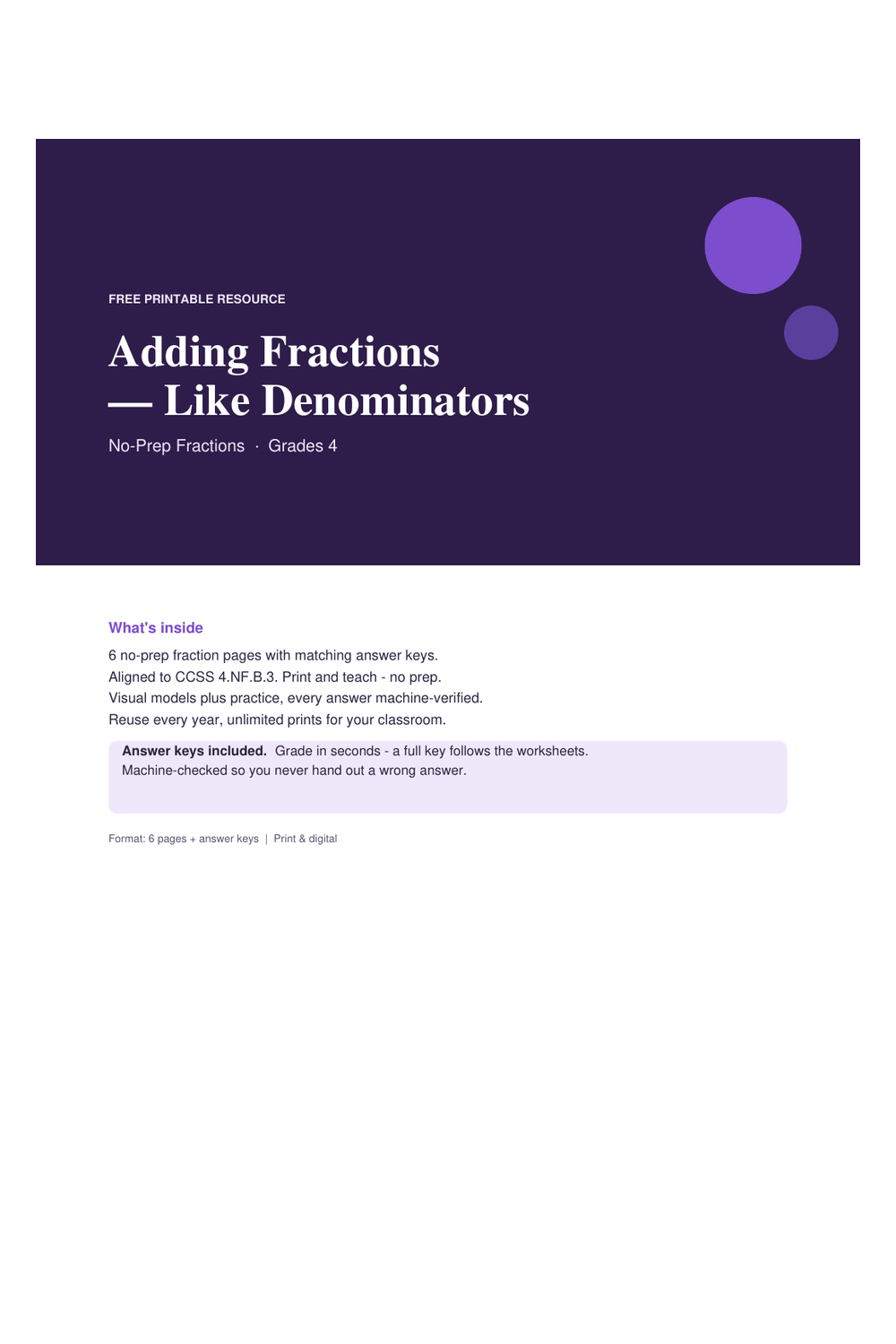
Adding Fractions — Like Denominators Worksheets PDF
A 13-page US Letter math pack for grades 4. The PDF keeps the student practice and matching answer-key pages together in one file so you can print only the pages you need. The main skill is to combine like-sized fractional parts by adding numerators and keeping the common denominator. The pack references 4.NF.B.3 on the cover. Standards noted for this pack: 4.NF.B.3.
View & download →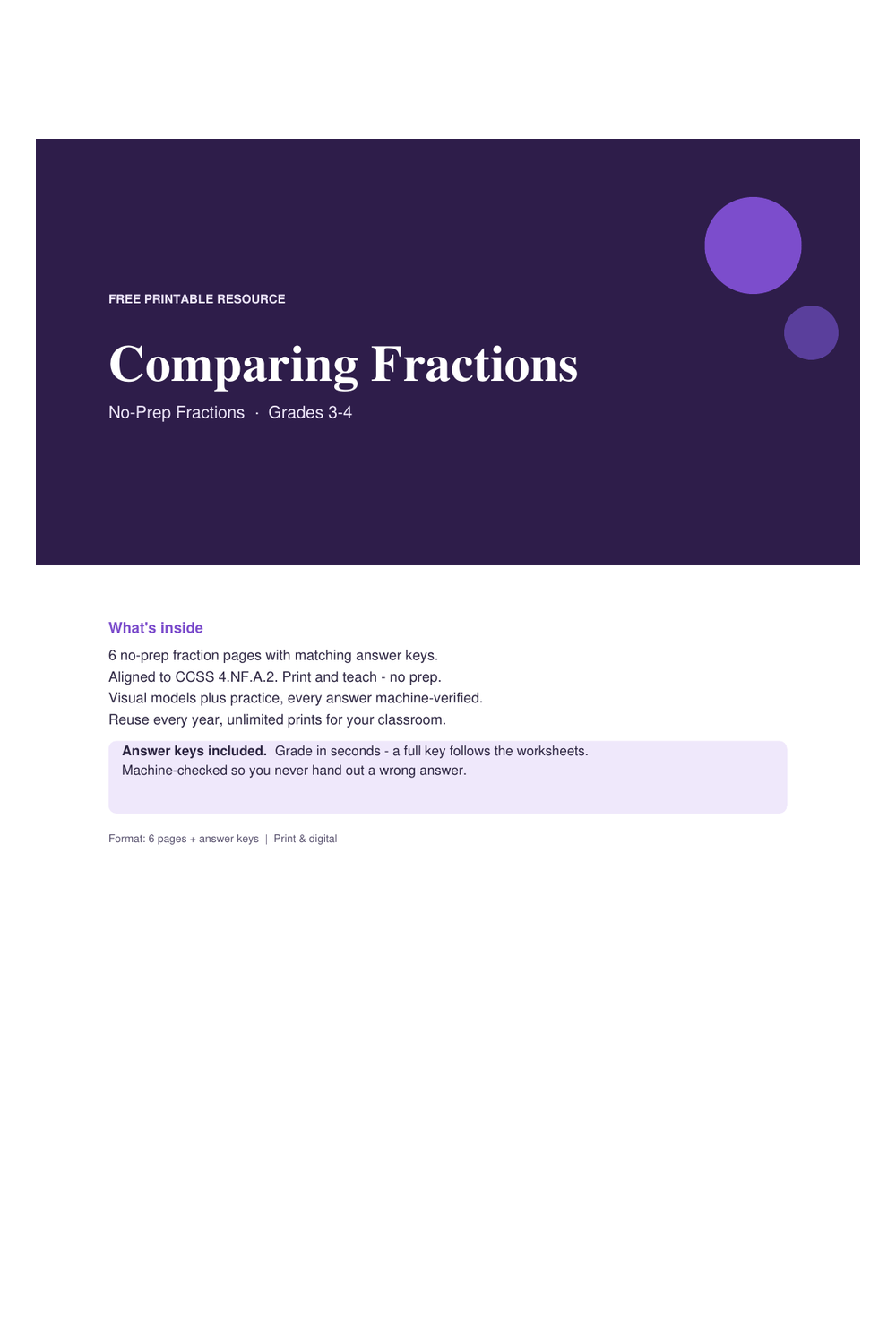
Free 13-page pack
Comparing Fractions Worksheets PDF
A 13-page US Letter math pack for grades 3-4. The PDF keeps the student practice and matching answer-key pages together in one file so you can print only the pages you need. The main skill is to compare fraction size using models, benchmarks, or common-sized parts instead of comparing numerators alone. The pack references 4.NF.A.2 on the cover. Standards noted for this pack: 4.NF.A.2.
View & download →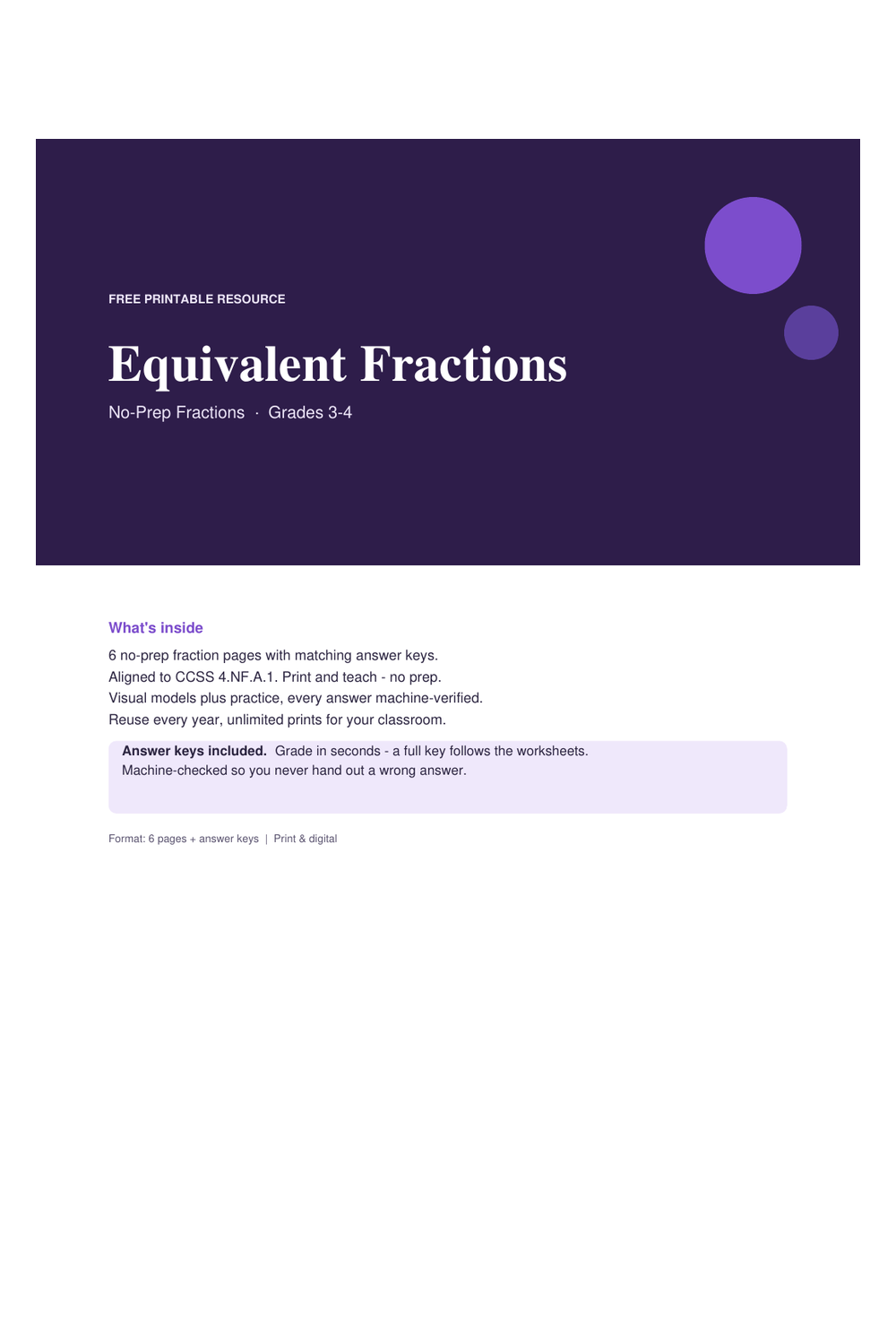
Free 13-page pack
Equivalent Fractions Worksheets PDF
A 13-page US Letter math pack for grades 3-4. The PDF keeps the student practice and matching answer-key pages together in one file so you can print only the pages you need. The main skill is to recognize when different numerator-denominator pairs represent the same quantity. The pack references 4.NF.A.1 on the cover. Standards noted for this pack: 4.NF.A.1.
View & download →