Math Worksheets · Free 13-page pack
Free Skip Counting by 2, 5, and 10 Worksheets PDF
This 13-page pack for kindergarten through grade 2 practices skip counting by 2, 5, and 10. Students complete number sequences that begin at different values, such as 8, 10 or 25, 30, by filling missing terms. Six practice pages and an answer key are included.
Edited by Tessa Vaughn · Planning & Organization Editor
Free download
Download the 13-page pack
This multi-page pack currently has one print-ready format. Preview the PDF, then print the whole pack or only the page range you need.
Share to Google Classroom ↗No sign-up required · personal/classroom use
Practice this skill on screen30 questions in three levels (easy, medium, hard) with instant feedback. Nothing to install.Get the whole set: 6 packs in one zipMultiplication and skip counting worksheet packs. Grades K–5: skip counting, multi-digit multiplication and fact fluency. US Letter PDFs with answer keys, 436 KB.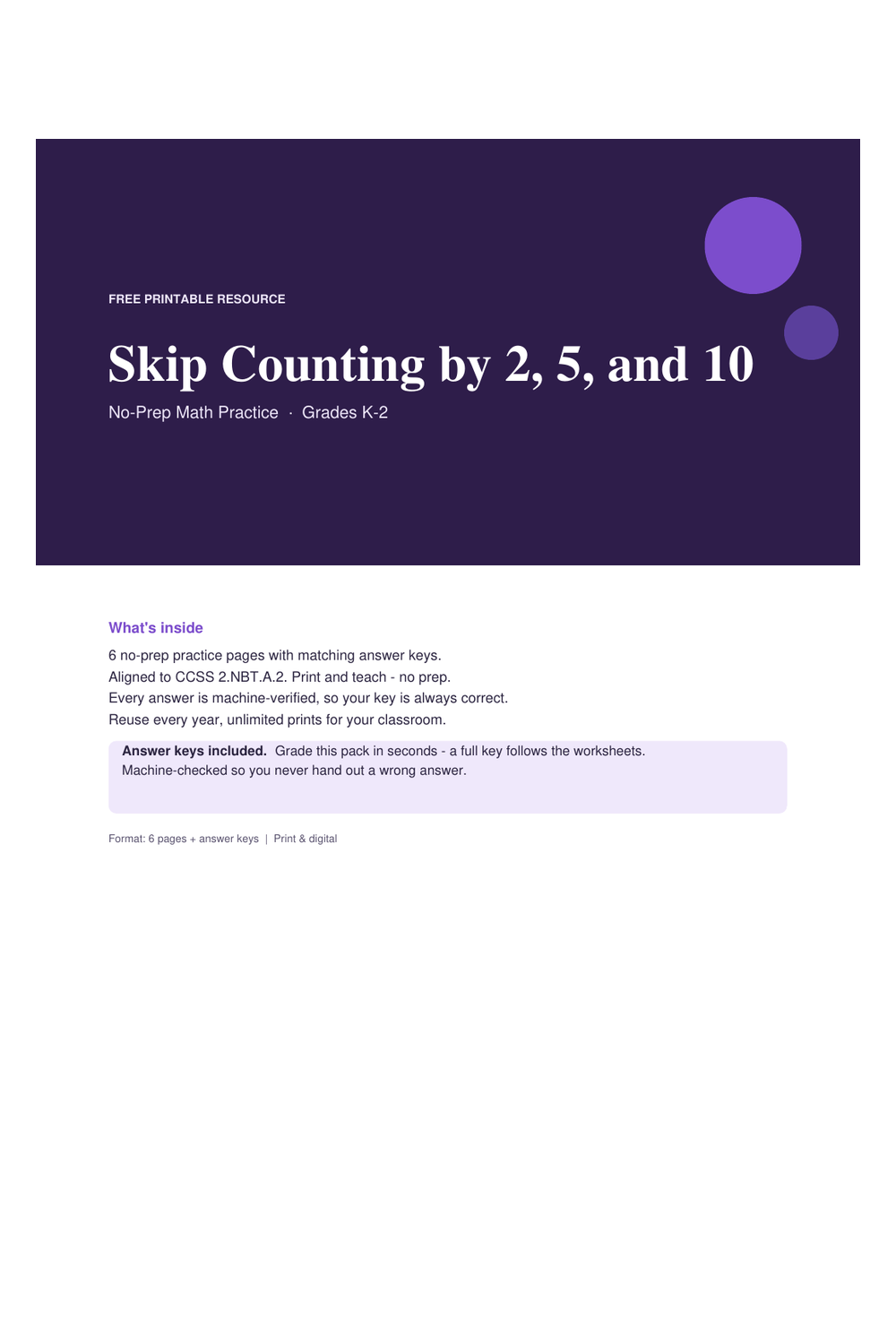
About this printable
This 13-page US Letter pack includes a cover, six practice pages, and an answer key. On pages 2, 3, and 7, students complete 10 sequences per page; each row has eight places, with some numbers omitted. The counts use intervals of 2, 5, or 10 and begin at values such as 4, 25, and 50. Other practice pages use the same sequence task. Name and Date lines are included. Check answers on pages 8 to 13.
Keeping a counting interval steady
Skip counting means adding the same amount each time. In a sequence by 5, each new term is five more than the one before; the number pattern stays steady even when some entries are missing. Students can check a sequence by subtracting neighboring terms, or by saying the count aloud while tracking each step. Starting in the middle of a familiar count is useful because it shows the interval matters more than memorizing only the first number.
A hundred chart makes the three intervals look different. Adding 2 moves two spaces at a time, adding 5 moves between rows in a repeating way, and adding 10 keeps the ones digit while moving to the next ten. For example, from 50, counting by 10 reaches 60, 70, and 80. When blanks interrupt the pattern, identify the interval first, then move forward or backward by that same amount.
Worked example 1
Complete the count by 10: 50, 60, __, __, __, 100.
Keep the +10 jump: fill the three blanks in order with 70, 80, 90.
Answer: 70, 80, 90
Worked example 2
Complete the count by 2: 12, 14, __, __, __, 22, 24, 26.
Keep adding 2: the three blanks are 16, 18, and 20.
Answer: 16, 18, 20
Worked example 3
Complete the count by 5: 25, 30, 35, __, __, 50, __, 60.
Keep the +5 jump; fill the open spaces in order with 40, 45, 55.
Answer: 40, 45, 55
A teaching routine for this pack
Hop across a chart
On a hundred chart, trace a route that jumps two, five, or ten spaces. Start at 25 and point to 30, then 35. Ask the learner to describe the repeated move before filling any written sequence.
Use paired counters
Place counters in equal groups to model repeated jumps. Add two counters at a time for counting by 2, five for counting by 5, or ten for counting by 10. Say the total after each addition so the count stays tied to quantity.
Cover a missing term
Write a complete pattern, then cover one number. Ask what was added to move from the term before to the term after. For instance, 25 to 35 spans two equal jumps of 5, so the hidden value is 30.
Track the ones digit
For counts by 10, record the ones digit of several terms beginning at 50 or 20. Notice that it stays the same as the tens increase. Contrast this with counting by 5, where the ones digits alternate between 0 and 5.
Good matches for this page
Three ways to use it
Count a collection in groups
Connect a sequence by 2, 5, or 10 to objects placed in equal groups. Students can point to each group once and say the running total as they count.
Resume from a starting value
Choose a sequence that begins at 25 or 50 rather than one. Ask learners to name the interval and continue, reinforcing that skip counting can start at many points.
Spot an interrupted pattern
Hide one term in a spoken count and invite students to explain the repeated jump. A chart or counters can help verify the missing value before independent written practice.
Common mistakes to avoid
Writing 19 in the blank after switching from +2 to +5 in 12, 14, __, 18.
In a count by 2, add 2 for each position. The blank after 14 is 16, followed by 18. Keep the interval fixed across the whole sequence.
Writing 45 as the next number after 25, 30, 35 in a count by 5.
Only one step separates adjacent positions. Add 5 to 35 to get 40; the following term is 45. Count one jump for each open position so no term is skipped.
Writing 90 immediately after 50, 60, 70 in a count by 10.
Move forward by one interval at a time. After 70, the next term is 80, followed by 90. Give each open position one jump of ten.
Replacing the given start 25 with 5, then writing 10 and 15 in a count by 5.
The interval tells how much to add, not where the sequence must begin. Keep the given 25, then continue 30, 35, and 40 by adding five each time.
Common questions
How do you skip count by 2, 5, or 10?
Choose the interval and add that amount each time. A count by 2 increases by two at every step; a count by 5 adds five; and a count by 10 adds ten. If a term is missing, use the same jump from the nearest known number to fill the gap.
How can I teach skip counting with a hundred chart?
Pick a starting number and trace equal jumps on the chart. Two-space moves model counting by 2, while moving to the next row can support counting by 10. Have the child predict the next number before pointing to it, then explain how far each jump travels.
What is a simple activity for skip counting by 5?
Place objects in groups of five and count the total after each group is added. Start with a count such as 25, 30, 35 and ask what changes from one total to the next. This links the spoken rhythm to equal groups and the repeated addition of five.
What is included in this skip counting by 2, 5, and 10 worksheet pack?
The 13-page PDF begins with its cover, then has six practice sheets and their solutions. Practice pages 2, 3, and 7 contain ten sequences apiece. Each sequence has eight number positions, some left blank, and the intervals are 2, 5, or 10. Name and Date lines identify the student work.
Is this skip counting by 2, 5, and 10 worksheet pack free?
Yes, the file has no price and you need not register. It is supplied as a PDF for US Letter paper; an A4 edition and PNG images are not available. To check completed counts, consult the answer key in the closing section, numbered 8 to 13.
Keep organizing
You might also like
Free 13-page pack
Comparing Numbers — 2-Digit Worksheets PDF
A 13-page US Letter math pack for grades 1-2. The PDF keeps the student practice and matching answer-key pages together in one file so you can print only the pages you need. The main skill is to compare tens first and use ones only when the tens digits match. The pack references 1.NBT.B.3 on the cover. Standards noted for this pack: 1.NBT.B.3.
View & download →
Free 13-page pack
Comparing Numbers — 3-Digit Worksheets PDF
A 13-page US Letter math pack for grades 2-3. The PDF keeps the student practice and matching answer-key pages together in one file so you can print only the pages you need. The main skill is to compare hundreds, then tens, then ones so the first unequal place determines the relationship. The pack references 2.NBT.A.4 on the cover. Standards noted for this pack: 2.NBT.A.4.
View & download →
Free 13-page pack
Expanded Form — 2-Digit Numbers Worksheets PDF
A 13-page US Letter math pack for grades 1-2. The PDF keeps the student practice and matching answer-key pages together in one file so you can print only the pages you need. The main skill is to read each 2-digit number as tens and ones before rewriting it in expanded form. The pack references 2.NBT.A.3 on the cover. Standards noted for this pack: 2.NBT.A.3.
View & download →