Math Worksheets · Free 13-page pack
Free Skip Counting by 3 and 4 Worksheets PDF
Children in grades 2 to 3 can use this 13-page pack to extend number sequences by 3 and 4. Each practice sheet has ten eight-position counts with some terms missing, including patterns such as 24, 28 and 9, 12. A matching answer key follows the six practice pages.
Edited by Tessa Vaughn · Planning & Organization Editor
Free download
Download the 13-page pack
This multi-page pack currently has one print-ready format. Preview the PDF, then print the whole pack or only the page range you need.
Share to Google Classroom ↗No sign-up required · personal/classroom use
Practice this skill on screen30 questions in three levels (easy, medium, hard) with instant feedback. Nothing to install.Get the whole set: 6 packs in one zipMultiplication and skip counting worksheet packs. Grades K–5: skip counting, multi-digit multiplication and fact fluency. US Letter PDFs with answer keys, 436 KB.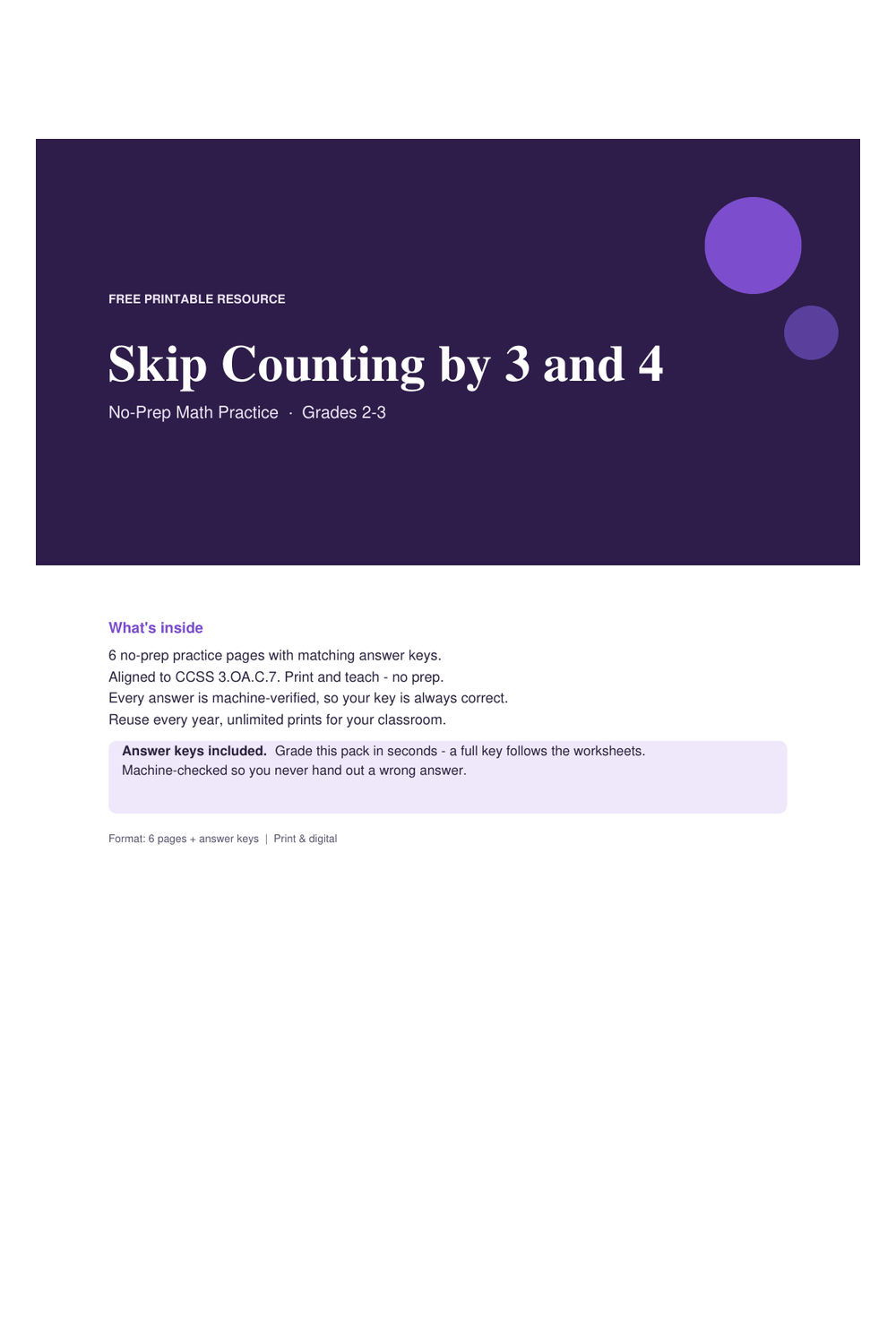
What this page helps with
A US Letter PDF with 13 pages, this pack has six practice sheets and a matching answer key. Practice pages 2, 3, and 7 contain 10 number sequences apiece, each with eight positions and blank entries. Students count by 3 or 4 from given starts such as 3, 8, 12, and 24. The other practice pages follow this sequence format. Each sheet has a Name and Date line. Answer key pages are 8 to 13.
Building equal jumps of three and four
Counting by 3 or 4 is repeated addition: each new number is three or four greater than the one before. These counts may not land on the easy landmarks children know from tens, so a consistent jump is especially important. A learner can check a row by subtracting consecutive terms. If 24 is followed by 28, the increase is four; the next term must preserve that same increase.
Arrays make the connection to multiplication visible. Three rows of four objects contain 12, and adding another row of four gives 16. A skip-counting sequence lists those growing totals: 4, 8, 12, 16. The order can begin at a later multiple, such as 24, and blanks do not change the rule. Find the interval, then add it once for each step until the known endpoint is reached.
Worked example 1
Complete the count by 4: 24, 28, __, 36, 40, __, __, 52.
Keep the +4 step. Fill the open slots in order with 32, 44, 48.
Answer: 32, 44, 48
Worked example 2
Complete the count by 3: 9, 12, 15, __, 21, __, __, 30.
With a +3 step, place 18, 24, and 27 in the blanks from left to right.
Answer: 18, 24, 27
Worked example 3
Complete the count by 4: 8, 12, __, __, 24, __, 32, 36.
Continue in +4 jumps: the missing entries, in order, are 16, 20, and 28.
Answer: 16, 20, 28
A teaching routine for this pack
Build a rows-of-four array
Arrange four counters in each row and record the running totals as rows are added: 4, 8, 12, 16. Point to the new row each time so students connect the changing total with adding one more group of four.
Use equal-length hops
Draw a blank number line and make jumps of three or four. Start at a value from a sequence, such as 24, and let the learner label each landing point. Equal hop lengths make an accidental change in interval easier to notice.
Compare neighboring terms
Ask children to find the difference between two adjacent entries before filling the blank. If 15 is followed by 21 in a count by 3, there are two jumps in the gap; the missing middle total is 18.
Connect totals to groups
Show four objects in each small group and count the totals aloud as groups are added. Repeat with groups of three. Then begin from a later total so learners see the same interval continues beyond the first group.
Good matches for this page
Three ways to use it
Link counting and arrays
After constructing an array with rows of three or four, record the total after each row. A sequence then names the same growing totals in a compact form.
Practice an unfamiliar interval
Use one row from a practice page to focus on adding three or four consistently. Students can compare neighboring terms to confirm the size of each jump.
Explain a hidden term
Ask a learner to show how a missing number fits between known values. Naming the repeated addition makes the answer understandable instead of a guessed continuation.
Common mistakes to avoid
Writing 22 after adding 4 to 18 in a count by 3: 15, 18, __, 24.
Read the count label and keep its interval steady. Add 3 to 18 to get 21, then add 3 again to reach 24. A different jump breaks the pattern.
Filling the blank with 36 in 24, 28, __, 36 when counting by 4.
There is one position after 28 before 36. Add four once to get 32. The next jump reaches 36, so match each step to exactly one place.
Writing 21 in the blank after 15 in 9, 12, 15, __, 21.
Add three once per position: after 15 comes 18, then 21. The endpoint confirms there is one intermediate term, rather than replacing that missing value with the endpoint.
Replacing the given start 24 with 4, then counting 8 and 12 in a count by 4.
Start with the number printed in the sequence and continue from there. After 24, add four to reach 28, then add four again for 32. The interval does not reset the starting value.
Common questions
How do you skip count by 3 and 4?
Add the same interval at every step: three for a count by 3, or four for a count by 4. For example, from 9 a count by 3 continues 12, 15, 18. Check the pattern by finding the difference between neighboring terms.
How can I teach skip counting by 3 and 4 with groups?
Make equal groups of three or four objects, then add one group at a time and record the total. The running totals become the count. Arrays are useful because children can see each added row while also connecting the pattern to multiplication.
What is an easy way to find a missing number in skip counting?
First read whether the sequence counts by 3 or 4. Then add that amount to the term before the blank, or subtract it from the term after. For a longer gap, mark each intermediate landing on a line so no equal jump is skipped.
What is included in this skip counting by 3 and 4 worksheet pack?
This 13-page file includes six sheets of counting sequences and six answer sheets, after a cover. Practice pages 2, 3, and 7 show ten counts apiece with eight places per row; missing terms are to be supplied. Each count advances by 3 or 4. Name and Date lines appear on student sheets.
Is this skip counting by 3 and 4 worksheet pack free?
Yes, there is no cost and no registration step. This download is limited to PDF pages sized for US Letter; it does not come in A4 or PNG formats. Completed sequences can be checked with the answer key, which is printed on pages 8 to 13.
Keep organizing
You might also like
Free 13-page pack
Comparing Numbers — 2-Digit Worksheets PDF
A 13-page US Letter math pack for grades 1-2. The PDF keeps the student practice and matching answer-key pages together in one file so you can print only the pages you need. The main skill is to compare tens first and use ones only when the tens digits match. The pack references 1.NBT.B.3 on the cover. Standards noted for this pack: 1.NBT.B.3.
View & download →
Free 13-page pack
Comparing Numbers — 3-Digit Worksheets PDF
A 13-page US Letter math pack for grades 2-3. The PDF keeps the student practice and matching answer-key pages together in one file so you can print only the pages you need. The main skill is to compare hundreds, then tens, then ones so the first unequal place determines the relationship. The pack references 2.NBT.A.4 on the cover. Standards noted for this pack: 2.NBT.A.4.
View & download →
Free 13-page pack
Expanded Form — 2-Digit Numbers Worksheets PDF
A 13-page US Letter math pack for grades 1-2. The PDF keeps the student practice and matching answer-key pages together in one file so you can print only the pages you need. The main skill is to read each 2-digit number as tens and ones before rewriting it in expanded form. The pack references 2.NBT.A.3 on the cover. Standards noted for this pack: 2.NBT.A.3.
View & download →