Math Worksheets · Free 13-page pack
Free Subtracting Fractions — Like Denominators Worksheets PDF
This grade 4 pack offers six practice pages for subtracting fractions with matching denominators. Its 13-page PDF also has an answer key. Learners remove equal-sized parts by subtracting the numerators and retaining the denominator. Problems include 7/8 - 3/8 and 3/10 - 1/10.
Edited by Tessa Vaughn · Planning & Organization Editor
Free download
Download the 13-page pack
This multi-page pack currently has one print-ready format. Preview the PDF, then print the whole pack or only the page range you need.
Share to Google Classroom ↗No sign-up required · personal/classroom use
Practice this skill on screen30 questions in three levels (easy, medium, hard) with instant feedback. Nothing to install.Get the whole set: 8 packs in one zipFractions worksheet packs. Grades 1–5: identify, compare, add, subtract and simplify fractions. US Letter PDFs with answer keys, 509 KB.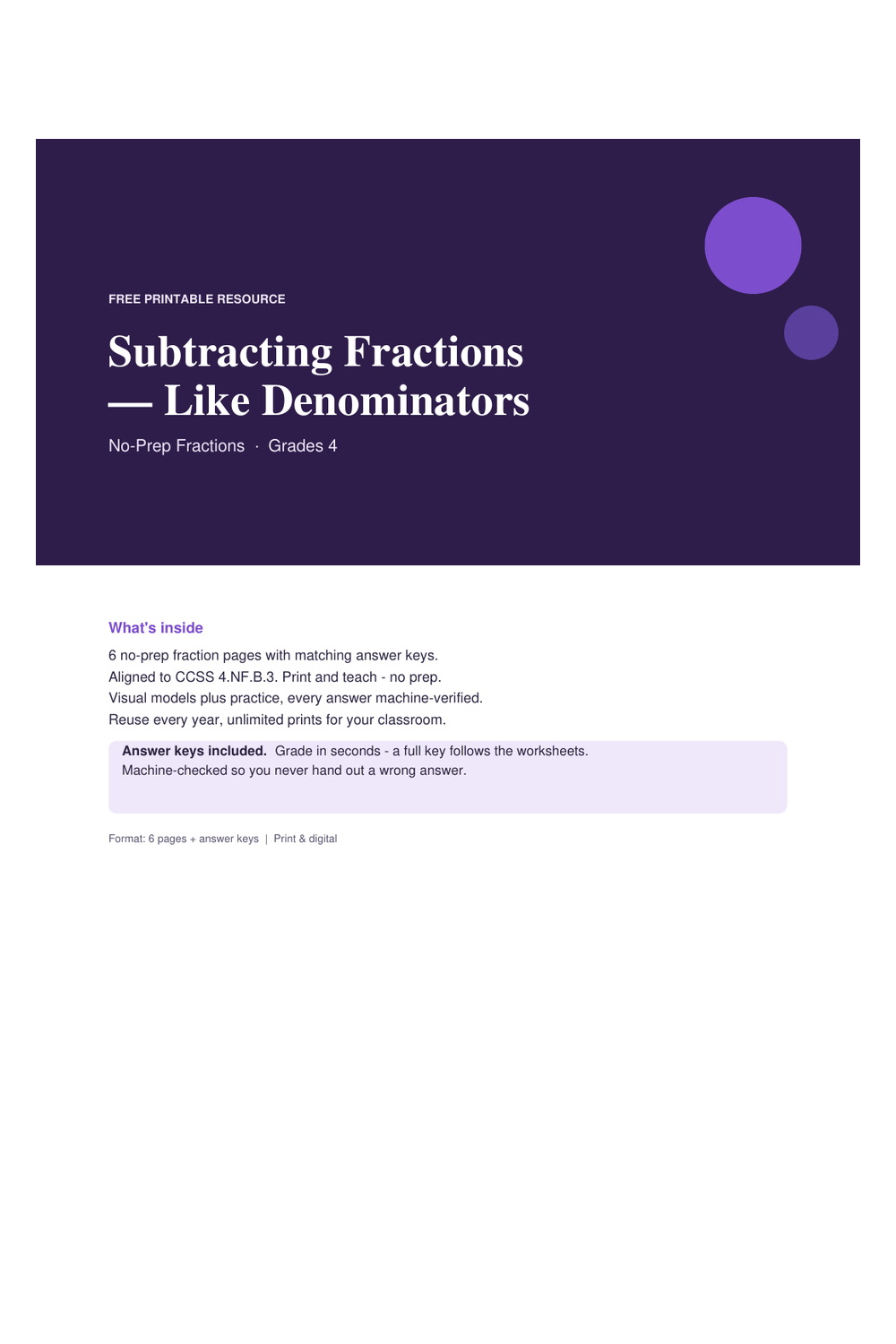
About this printable
The subtraction pack runs 13 pages: a cover, six worksheets, then its key on pages 8-13. Pages 2, 3, and 7 have 10 subtraction problems apiece. Each sheet has a Name/Date line. Each problem uses one matched denominator; values range from 3 to 10. One equation is 7/8 - 3/8. The later sheets offer more fraction subtraction practice.
Taking away same-sized parts
When fractions have a common denominator, they count equal-size units. Subtracting means taking away some of those units, so subtract the numerators and keep the denominator. For 5/6 - 3/6, remove three sixths from five sixths, leaving two sixths. The unit remains sixths because the remaining pieces have not changed size.
A child may picture a strip divided into equal boxes, with some shaded and then crossed out. Count the shaded parts first and the parts removed next; what remains is the answer. This also helps distinguish subtraction from dividing the denominator. If the numerator difference is zero, none of that fractional unit remains; if it is positive, count those leftover units over the same denominator.
Worked example 1
Find 4/8 - 3/8.
Both amounts are eighths. Take away three of the four eighth-size pieces: 4 - 3 = 1, keeping the eighth as the unit.
Answer: 1/8
Worked example 2
Find 7/8 - 3/8.
Start with seven eighths and remove three eighths. Four eighth-size parts remain because 7 - 3 = 4.
Answer: 4/8
Worked example 3
Find 3/10 - 1/10.
Subtract the counts of tenths: 3 - 1 = 2. The remaining pieces are still tenths, so retain the denominator 10.
Answer: 2/10
A teaching routine for this pack
Cross out equal sections
Draw a strip divided into eight equal boxes and shade four. Cross out three of the shaded boxes. Count the uncrossed shaded boxes to see one eighth remaining in 4/8 - 3/8. The drawing makes the take-away action clear before the learner writes the equation.
Say what is removed
Have the student read 5/6 - 3/6 as “five sixths take away three sixths.” Ask what unit remains after the removal. The spoken unit keeps the denominator meaningful while the subtraction is carried out on the count of sixths.
Count what remains
Use counters or marks grouped into equal fractional units. Begin with the numerator's number of units, remove the subtrahend's number, then count the leftovers. Translate that count back into a fraction using the original common denominator.
Check the size of the result
Compare the answer with the starting fraction. Taking away a positive amount should leave less than the original. For 7/8 - 3/8, four eighths remain, which is smaller than seven eighths and still nonnegative.
Good matches for this page
Three ways to use it
Model a take-away story
Use an equation to represent a quantity of fractional parts being removed. Ask students to describe what the numerator counts before and after the action.
Check common-denominator fluency
A short set of equations can reveal whether learners subtract the counts while preserving the shared unit size. Request a verbal explanation for one response.
Compare before and after
Have a learner estimate whether the result should be less than the first fraction. This quick check ties the written difference to the amount removed.
Common mistakes to avoid
Subtracting the denominators too and writing 5/6 - 3/6 = 2/0.
Both fractions measure sixths, so only the number of sixths changes. Subtract 5 - 3 and keep the unit sixths: the difference is 2/6.
Reversing the order in 4/8 - 3/8 and writing -1/8.
Start with four eighths and remove three of them; one eighth remains. A strip with four shaded parts makes the direction of the take-away clear.
Adding instead of subtracting and answering 8/8 for 5/6 - 3/6.
Read the minus sign as a removal. From five sixths, take away three sixths, leaving two sixths. Check that the answer is smaller than the starting amount.
Changing 7/8 - 3/8 to 4/5 by reducing the denominator along with the numerator difference.
The denominator still names the unit size after subtraction. Four eighths remain, so record 4/8. Simplifying is a separate step and is not needed to state the result shown by this subtraction.
Common questions
How do you subtract fractions with like denominators?
Subtract the numerators because they count how many equal parts are present, and keep the common denominator because the size of each part stays the same. For example, 5/6 - 3/6 leaves 2/6. A quick sketch can show the starting pieces and the ones removed.
How to teach subtracting fractions with a visual model?
Draw a bar divided into equal sections matching the denominator. Shade the first fraction, then cross out the number of sections named by the second numerator. Count the shaded sections that remain. Connecting the crossed-out pieces to the subtraction sentence helps children see why the unit size does not change.
Which subtraction examples use fractions with like denominators?
Try 4/8 - 3/8, 7/8 - 3/8, and 3/10 - 1/10. In each problem, subtract the top counts and retain the shared denominator. The answers are 1/8, 4/8, and 2/10. Ask learners to explain what the remaining numerator counts.
What is included in this subtracting fractions like denominators worksheet pack?
A 13-page PDF includes a cover and six worksheets. The matching key is gathered in its last section, pages 8-13. Practice pages 2, 3, and 7 each contain 10 subtraction problems, with a Name/Date line. The denominators match within each equation, from thirds through tenths. Examples include 7/8 - 3/8 and 3/10 - 1/10.
Is this subtracting fractions like denominators worksheet pack free?
Yes, you can download it free without registering. This pack comes only as a US Letter PDF; no A4 or PNG file is offered. Its matching answers are gathered on pages 8-13, after the six fraction subtraction sheets. Print when needed.
Keep organizing
You might also like
Free 13-page pack
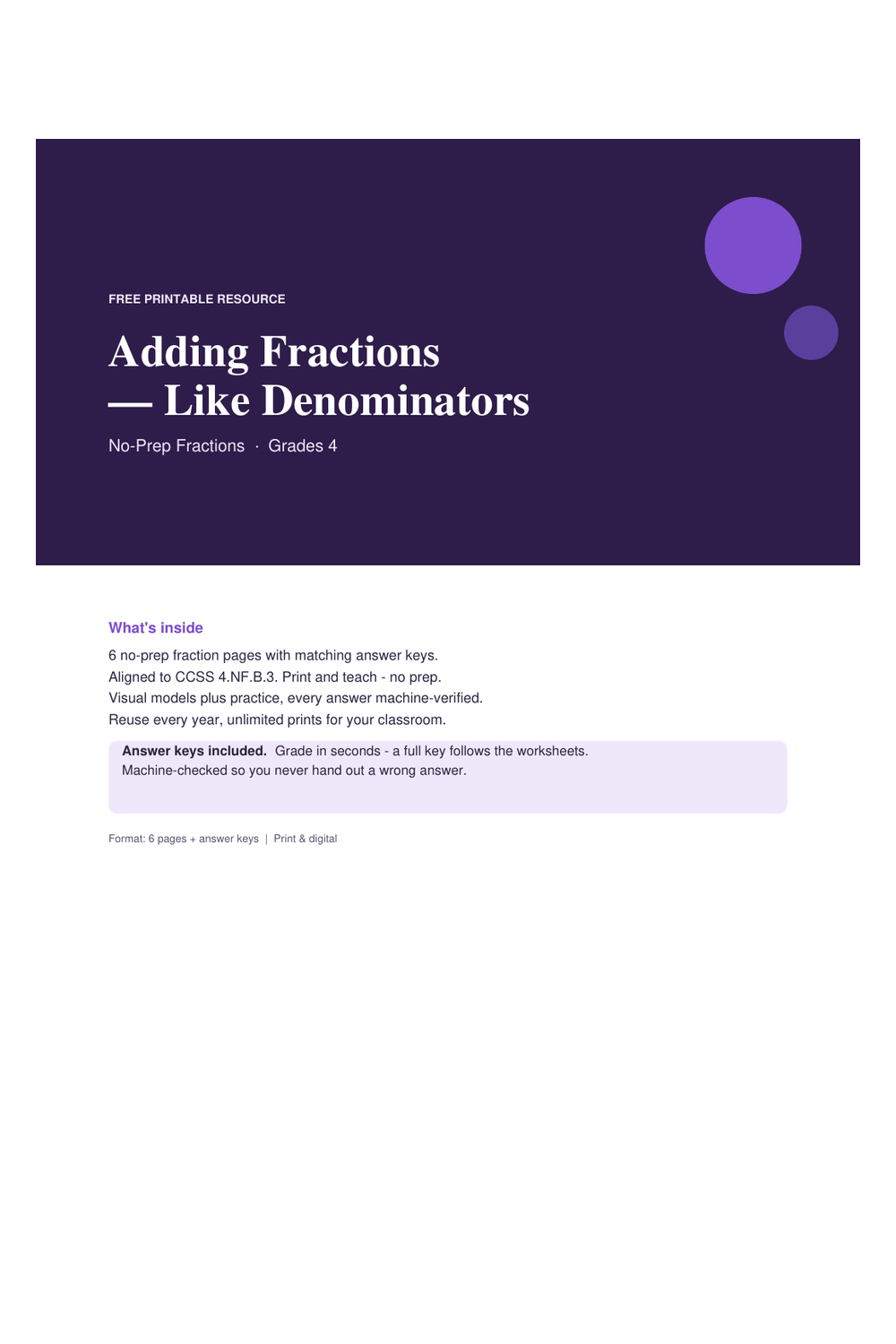
Adding Fractions — Like Denominators Worksheets PDF
A 13-page US Letter math pack for grades 4. The PDF keeps the student practice and matching answer-key pages together in one file so you can print only the pages you need. The main skill is to combine like-sized fractional parts by adding numerators and keeping the common denominator. The pack references 4.NF.B.3 on the cover. Standards noted for this pack: 4.NF.B.3.
View & download →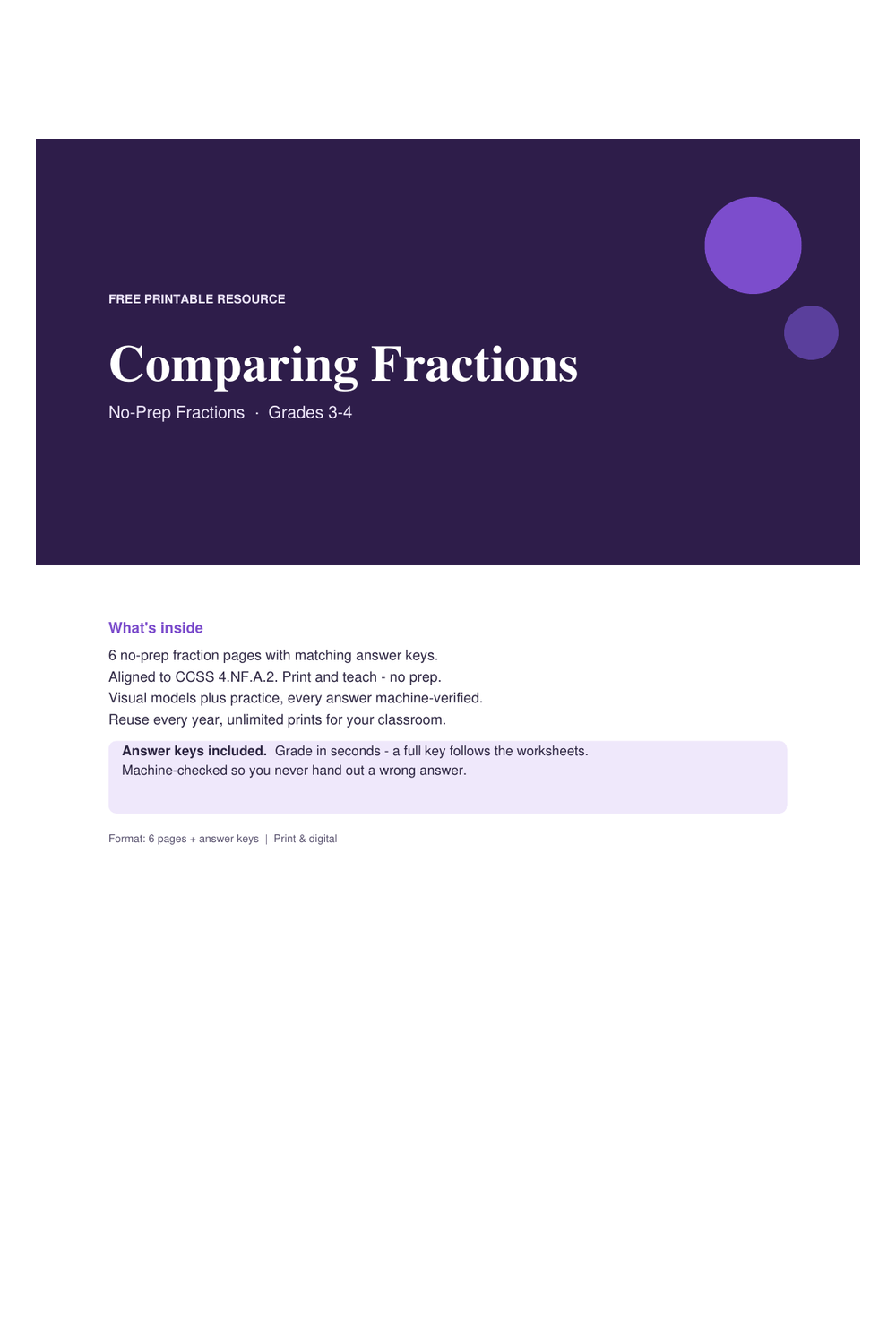
Free 13-page pack
Comparing Fractions Worksheets PDF
A 13-page US Letter math pack for grades 3-4. The PDF keeps the student practice and matching answer-key pages together in one file so you can print only the pages you need. The main skill is to compare fraction size using models, benchmarks, or common-sized parts instead of comparing numerators alone. The pack references 4.NF.A.2 on the cover. Standards noted for this pack: 4.NF.A.2.
View & download →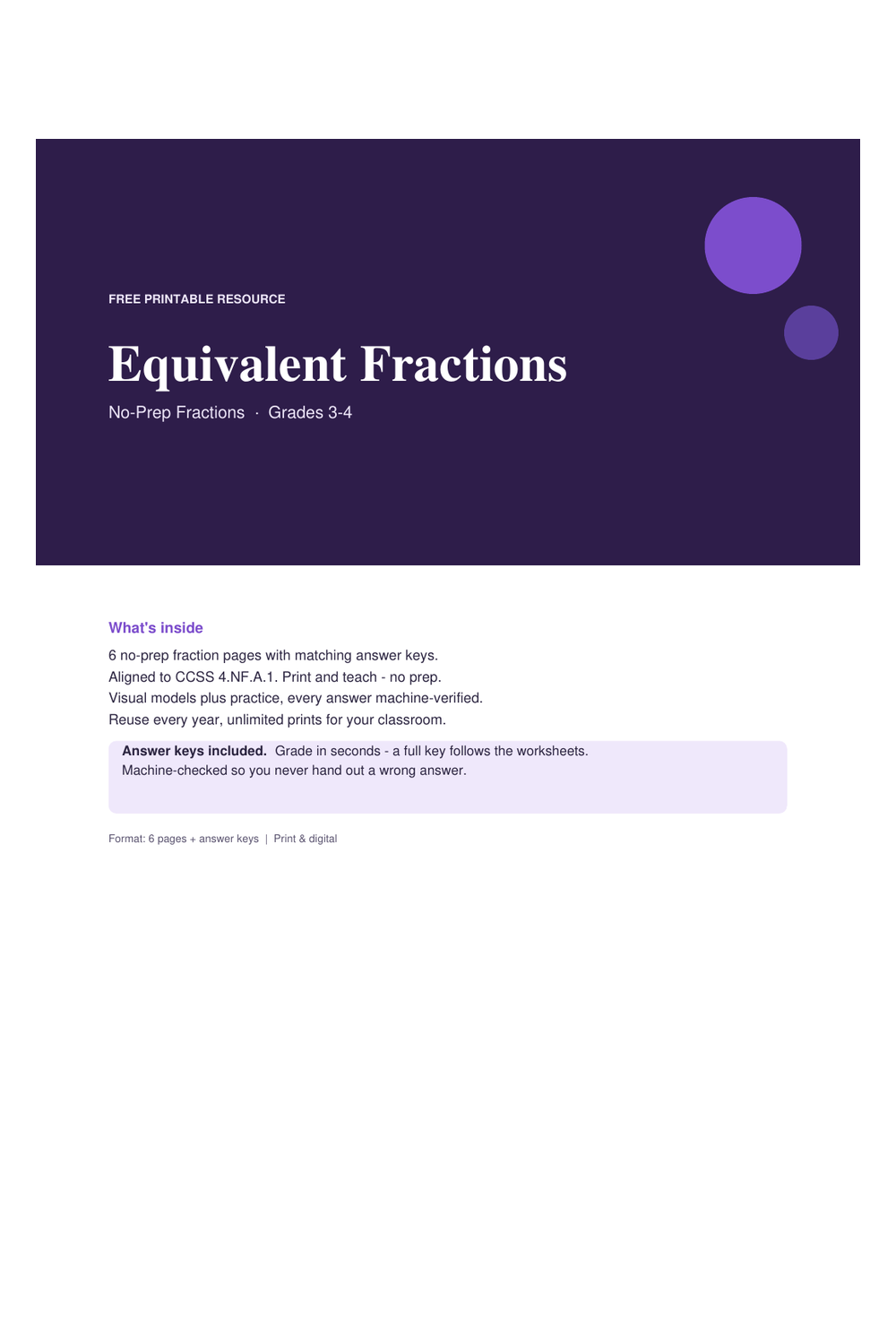
Free 13-page pack
Equivalent Fractions Worksheets PDF
A 13-page US Letter math pack for grades 3-4. The PDF keeps the student practice and matching answer-key pages together in one file so you can print only the pages you need. The main skill is to recognize when different numerator-denominator pairs represent the same quantity. The pack references 4.NF.A.1 on the cover. Standards noted for this pack: 4.NF.A.1.
View & download →