Math Worksheets · Free 13-page pack
Free Telling Time to 5 Minutes Worksheets PDF
This 13-page PDF helps grades 2-3 read analog clocks to five-minute intervals. Six practice pages ask students to write the time shown on six clock faces per page; the answer key is on pages 8-13. Children connect each numeral with a five-minute count and track the hour hand between numbers.
Edited by Tessa Vaughn · Planning & Organization Editor
Free download
Download the 13-page pack
This multi-page pack currently has one print-ready format. Preview the PDF, then print the whole pack or only the page range you need.
Share to Google Classroom ↗No sign-up required · personal/classroom use
Practice this skill on screen30 questions in three levels (easy, medium, hard) with instant feedback. Nothing to install.Get the whole set: 6 packs in one zipTelling time worksheet packs. Grades 1–3: hour, half hour, quarter hour, 5 minutes, the minute and drawing hands. US Letter PDFs with answer keys, 565 KB.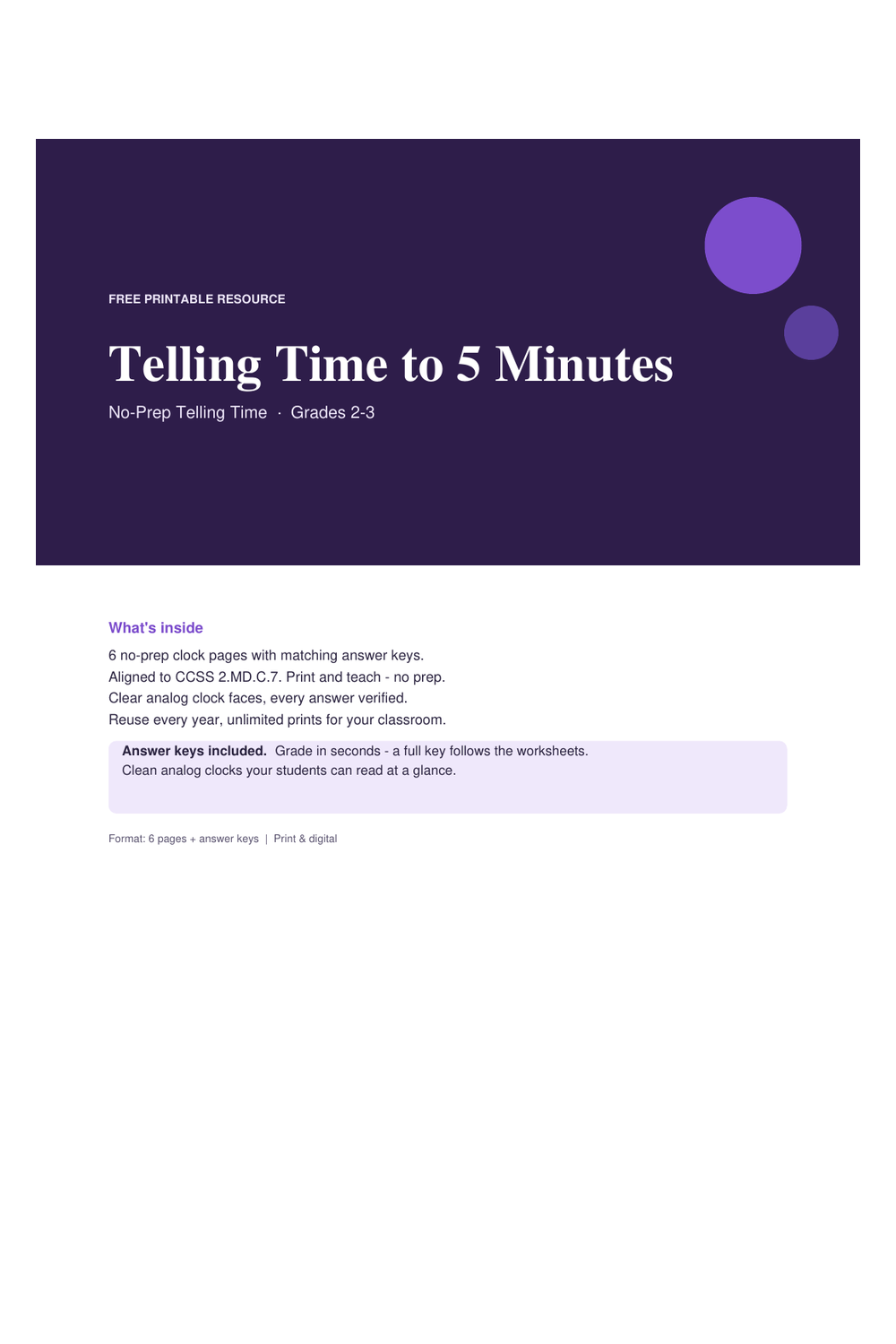
What is on the page
A set of six clock-reading sheets and their answer key makes up this 13-page PDF for grades 2-3. Pages 8-13 carry the key. Each of pages 2, 3, and 7 asks for six written readings from numbered clock faces, with a Name and Date line above. The student task is to record times in five-minute intervals; the remaining practice sheets continue that same reading exercise.
How five-minute clock reading works
The minute pointer measures minutes around the clock. Starting at 12, each numeral adds five minutes: 1 means five, 2 means ten, and 6 means thirty. After locating that hand, read the hour pointer to identify the hour it has reached or passed. When the hour pointer lies between two numerals, use the earlier hour because the next one has not arrived yet.
Consider 8:55, an answer listed in this pack's key. The minute pointer reaches 11 after eleven groups of five minutes. The hour pointer is still in the 8 o'clock hour, nearly at 9, so the reading is 8:55 rather than 9:55. Children can check their reading by seeing whether the hour hand's position makes sense with the minutes: at :55 it should be close to the next hour.
Worked example 1
Read a clock showing 8:55.
Count eleven five-minute groups to 11 for the minutes. The hour pointer is still before 9, so keep 8 as the hour.
Answer: 8:55
Worked example 2
Read a clock with the minute pointer on 4 and the hour pointer just past 7.
The minute pointer at 4 represents four groups of five, or 20 minutes. The hour pointer has passed 7, so the hour is 7.
Answer: 7:20
Worked example 3
Read a clock with the minute pointer at 9 and the hour pointer between 2 and 3.
Nine groups of five make 45 minutes. Since the hour pointer has not reached 3, the hour remains 2.
Answer: 2:45
How to teach this skill
Label five-minute stops
On a teaching clock, start at 12 and say 5, 10, 15 as you move clockwise. Continue around once, including 35 at 7 and 55 at 11. Pointing and counting together helps learners see why the numeral 8 can stand for 40 minutes rather than eight minutes.
Read hour before minutes
Have students first name the hour numeral the hour pointer has reached or passed, then count the minute pointer. With the minute pointer at 9 and hour pointer between 2 and 3, the hour is 2 and the minutes are 45. This order keeps the two hand jobs distinct.
Use the hand's direction
Compare :05 and :55 on clocks in the same hour. At :05 the hour pointer has only begun moving; at :55 it is near the next hour. Ask children to describe that motion so they do not read the closest numeral as the current hour.
Check against the hour
After a child reads a clock, ask whether the hour pointer's position fits the minutes. An answer of 8:55 should show the hour pointer close to 9, while an answer of 8:10 should place it closer to 8. This reasonableness check catches many hour errors.
Works well for
Classroom and home ideas
Daily clock warm-up
Show a clock and invite students to count around its edge by fives before saying the time. Ask one child to explain which numeral identifies the hour.
Minute-count conference
When a learner pauses on a clock, ask them to start at 12 and count the minute pointer's groups aloud. Their count reveals where understanding of the five-minute intervals needs support.
Practice with near-hour times
Use an item such as 8:55 to discuss why the hour is still 8. The answer key provides times that can support a separate teacher demonstration alongside the reading exercises.
What usually goes wrong
A child reads the minute pointer at 8 as 8 minutes and writes 3:08.
Count five minutes for each numeral passed by the minute pointer. At 8, the count is 40, so if the hour pointer is in the 3 o'clock hour, the time is 3:40.
With the hour pointer just before 9 at 8:55, a child writes 9:55.
The next hour has not begun until the hour pointer reaches 9. Keep 8 as the hour and use the minute pointer at 11 for 55 minutes, giving 8:55.
A child sees the minute pointer at 6 and writes :06 instead of :30.
The clock numbers stand for groups of five when reading minutes. Six groups make 30, so a clock with its minute pointer at 6 shows a half hour, not six minutes.
A child reads 8:55 as 8:11, using the clock numeral 11 as the minute count.
The numeral 11 marks eleven groups of five, or 55 minutes. Count by fives to read the minute pointer's position; do not write the numeral itself as the minute value.
Questions people ask
How do the clock numerals help you read time to 5 minutes?
Count by fives from 12 to where the minute pointer points, then read the hour the hour pointer has reached or passed. If the minute pointer points to 7, it marks 35 minutes. A hour pointer between 4 and 5 makes that time 4:35.
How to teach telling time in five-minute intervals?
Use a movable clock and have the learner touch each numeral while counting 5, 10, 15, and onward. Then move the hour pointer gradually and ask which hour it has passed. Mixing times near the beginning and end of an hour makes the hour-hand decision clear.
What is a simple way to practice telling time to 5 minutes?
Pair each clock numeral with its minute count: 1 with 5, 2 with 10, and so on through 11 with 55. Practice reading a few positions, then ask the child to explain the hour hand. This keeps minute counting tied to the clock face.
What is included in this telling time to 5 minutes worksheet pack?
There are 13 pages in all, split between six reading exercises and their answer key at pages 8-13. Turn to practice pages 2, 3, or 7 for six clocks to interpret on each. Students record the time shown, with Name and Date spaces at the top.
Is this telling time to 5 minutes worksheet pack free?
Yes. No sign-up is needed to get the free worksheet file. It comes as a US Letter PDF only, without an A4 or PNG edition. For answer checking, use the key in the closing section, pages 8-13, after the six practice sheets.
Keep organizing
You might also like
Free 13-page pack
Draw the Clock Hands Worksheets PDF
A 13-page US Letter math pack for grades 2-3. The PDF keeps the student practice and matching answer-key pages together in one file so you can print only the pages you need. The main skill is to translate a written digital time into correctly placed hour and minute hands. The pack references 2.MD.C.7 on the cover. Standards noted for this pack: 2.MD.C.7.
View & download →
Free 13-page pack
Telling Time to the Half Hour Worksheets PDF
A 13-page US Letter math pack for grades 1-2. The PDF keeps the student practice and matching answer-key pages together in one file so you can print only the pages you need. The main skill is to recognize :30 and notice that the hour hand sits between two hour numbers. The pack references 1.MD.B.3 on the cover. Standards noted for this pack: 1.MD.B.3.
View & download →
Free 13-page pack
Telling Time to the Hour Worksheets PDF
A 13-page US Letter math pack for grades 1. The PDF keeps the student practice and matching answer-key pages together in one file so you can print only the pages you need. The main skill is to read the hour hand and minute hand together when the minute hand points to 12. The pack references 1.MD.B.3 on the cover. Standards noted for this pack: 1.MD.B.3.
View & download →