Math Worksheets · Free 13-page pack
Free Telling Time to the Minute Worksheets PDF
Grade 3 students can use this 13-page PDF to read analog clocks to the minute. Six practice pages each include six numbered clock faces and a space for the time; the answer key appears on pages 8-13. Children count individual minute marks and use the hour hand to identify the hour underway.
Edited by Tessa Vaughn · Planning & Organization Editor
Free download
Download the 13-page pack
This multi-page pack currently has one print-ready format. Preview the PDF, then print the whole pack or only the page range you need.
Share to Google Classroom ↗No sign-up required · personal/classroom use
Practice this skill on screen30 questions in three levels (easy, medium, hard) with instant feedback. Nothing to install.Get the whole set: 6 packs in one zipTelling time worksheet packs. Grades 1–3: hour, half hour, quarter hour, 5 minutes, the minute and drawing hands. US Letter PDFs with answer keys, 565 KB.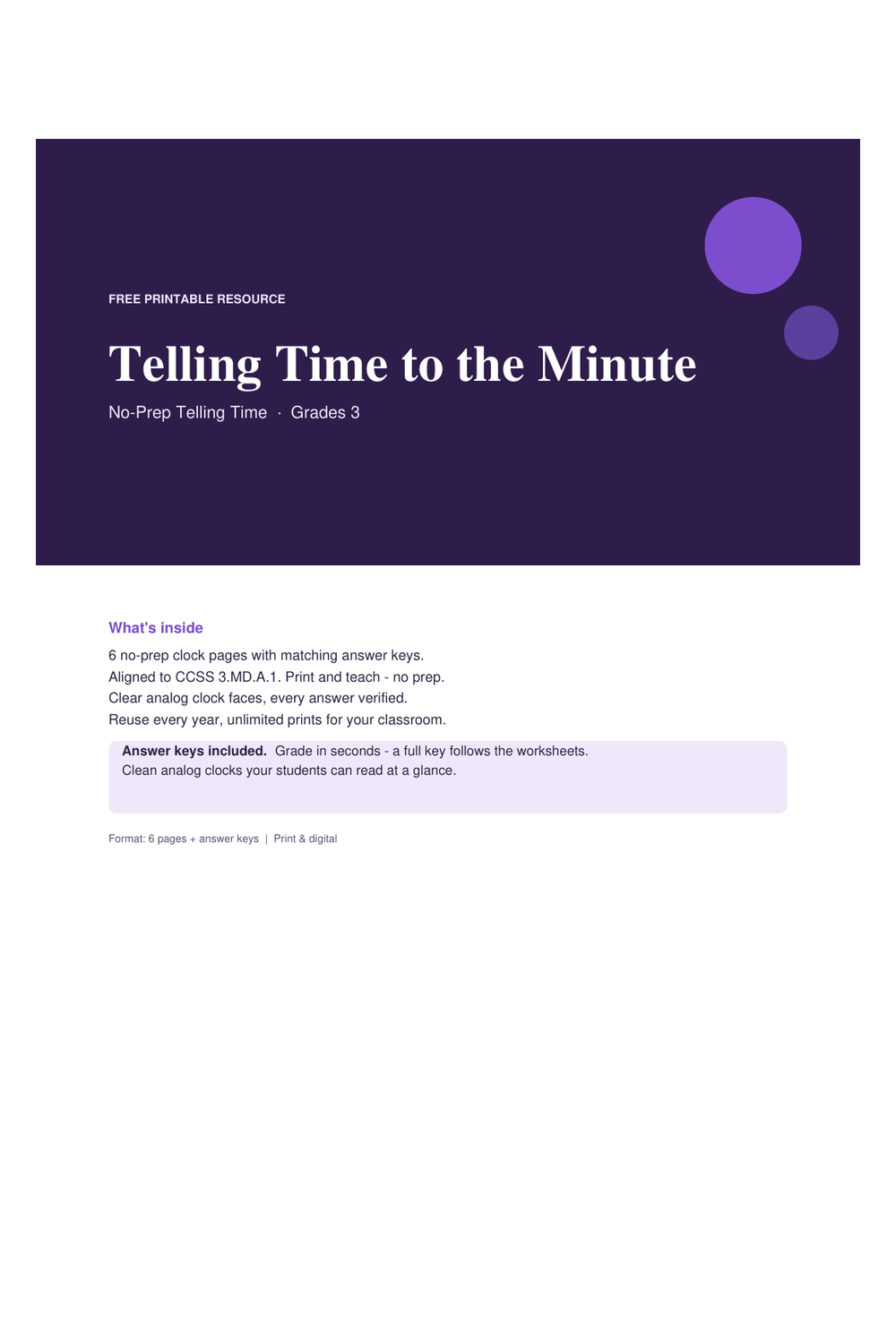
About this printable
Minute-by-minute clock reading is the grade 3 focus of this 13-page US Letter resource. Its answer key fills pages 8-13, after six student practice sheets. On sheet 2, sheet 3, and sheet 7, students record readings for six numbered clock faces. Name and Date lines are included. The remaining practice sheets carry on with the same written-reading task.
Reading each minute on an analog clock
For minute-level time, the minute hand can land on any of the 60 minute marks around a clock. Each small step advances one minute; the numbered positions still help anchor groups of five. Count forward from 12 to find the minutes, then use the hour hand to decide which hour is in progress. Near the end of an hour, that hour hand sits close to the next numeral but has not reached it.
The answer key includes 4:38 and 9:59. For 4:38, locate 35 at the 7 and count three additional minute marks. The hour remains 4 because the hour hand has not reached 5. At 9:59, the minute hand is one minute before 12, while the hour hand is nearly at 10. Reading both positions prevents a late-hour time from being mistaken for the next hour.
Worked example 1
Read 4:38 on a clock face.
Count to 35 at the 7, then move three minute marks farther. The hour hand is still within the 4 o'clock hour.
Answer: 4:38
Worked example 2
Read a clock showing 9:59.
The minute hand is one mark before 12, or 59 minutes. The hour hand is nearly at 10 but has not arrived there.
Answer: 9:59
Worked example 3
Read a clock showing 10:02.
The minute hand has moved two minute marks past 12. The hour hand has just entered the 10 o'clock hour.
Answer: 10:02
A teaching routine for this pack
Bridge fives and ones
Count by fives to the nearest numbered position, then add single minute marks. For 4:38, reach 35 at 7 and move three ticks forward. This strategy is more manageable than counting all 38 steps from the top each time.
Track the hour's progress
Draw attention to the hour hand when the minute hand is near 12. At 9:59 the hour hand is almost at 10, but the hour is still 9. Ask learners what must happen before they can call it 10:00.
Count marks carefully
Use a pointer or pencil tip to keep place while counting the individual minute marks. Start from a known five-minute numeral, say 25, and continue one by one. This reduces skipped or double-counted marks when the hands are close together.
Say both parts aloud
Have students state the hour first and minute count second, then combine them. For a clock showing 10:02, they can say, 'The hour is 10, and two minutes have passed.' Verbalizing each hand's clue helps catch a swapped digit or hour.
Good matches for this page
Three ways to use it
Minute-mark demonstration
Use a clock face to show how one small tick changes the minute value. Start at a labeled five-minute point and count individual marks from there.
Near-hour reasoning
Discuss a reading such as 9:59 and ask whether the hour hand has reached 10. This checks that children use the hour hand's position as well as the minute count.
Written clock reading
Assign a page when students can interpret the clock faces. Ask them to write each exact reading, then consult the key and revisit the hand positions where needed.
Common mistakes to avoid
A child reads 4:38 as 4:35 because the minute hand is near the 7.
Use the numbered position as 35, then count the three small marks after it. The minute hand's exact location gives 38, so a nearby numeral alone is not enough.
At 9:59, a child writes 10:59 because the hour hand is almost at 10.
The hour changes only after the hour hand reaches 10. At one minute before that point, the hour is still 9 and the reading is 9:59.
A child counts the 12 position as minute 1 and reads 10:02 as 10:03.
The top position is zero minutes past the hour. Count two marks after 12 to get :02, taking care not to count the starting point as a step.
A child sees the minute hand at 6 and writes :06 instead of :30.
The numbered marks are five minutes apart. Six groups of five reach 30, so a minute hand at 6 means thirty minutes, before any extra individual marks are counted.
Common questions
What clues help you read an analog clock to the minute?
Find the minutes by counting from 12, using the numbered five-minute points and then individual marks between them. Read the hour the hour hand has passed. If the minute hand is three marks after 7 and the hour hand is in the 4 hour, the time is 4:38.
How to teach students to count individual clock minutes?
Anchor the count at a numeral first, since each numeral represents a multiple of five minutes. Then count each small mark after it one at a time. Have students watch the hour hand too, especially when the minute hand approaches the next hour.
What is a good way to check a minute-level time reading?
Ask the learner to explain the minute count and the hour separately. For 9:59, they should identify one mark before the top and note that the hour hand has not yet reached 10. The explanation helps locate a misread hand or tick.
What is included in this telling time to the minute worksheet pack?
Inside the 13-page resource are six activities for reading clocks and an answer key covering pages 8-13. The second, third, and seventh practice pages each pose six clock-reading items; children write their readings and can fill in the Name and Date lines.
Is this telling time to the minute worksheet pack free?
There is no charge and no account or sign-up is needed. You receive a US Letter PDF; an A4 copy and PNG images are not part of this pack. Its answer key appears on pages 8-13, following the six clock-reading sheets.
Keep organizing
You might also like
Free 13-page pack
Draw the Clock Hands Worksheets PDF
A 13-page US Letter math pack for grades 2-3. The PDF keeps the student practice and matching answer-key pages together in one file so you can print only the pages you need. The main skill is to translate a written digital time into correctly placed hour and minute hands. The pack references 2.MD.C.7 on the cover. Standards noted for this pack: 2.MD.C.7.
View & download →
Free 13-page pack
Telling Time to 5 Minutes Worksheets PDF
A 13-page US Letter math pack for grades 2-3. The PDF keeps the student practice and matching answer-key pages together in one file so you can print only the pages you need. The main skill is to count minute marks in groups of five while tracking the hour hand accurately. The pack references 2.MD.C.7 on the cover. Standards noted for this pack: 2.MD.C.7.
View & download →
Free 13-page pack
Telling Time to the Half Hour Worksheets PDF
A 13-page US Letter math pack for grades 1-2. The PDF keeps the student practice and matching answer-key pages together in one file so you can print only the pages you need. The main skill is to recognize :30 and notice that the hour hand sits between two hour numbers. The pack references 1.MD.B.3 on the cover. Standards noted for this pack: 1.MD.B.3.
View & download →