How-to guide · Work & Study
How to Teach Cause and Effect in Reading Without Teaching a Guessing Game
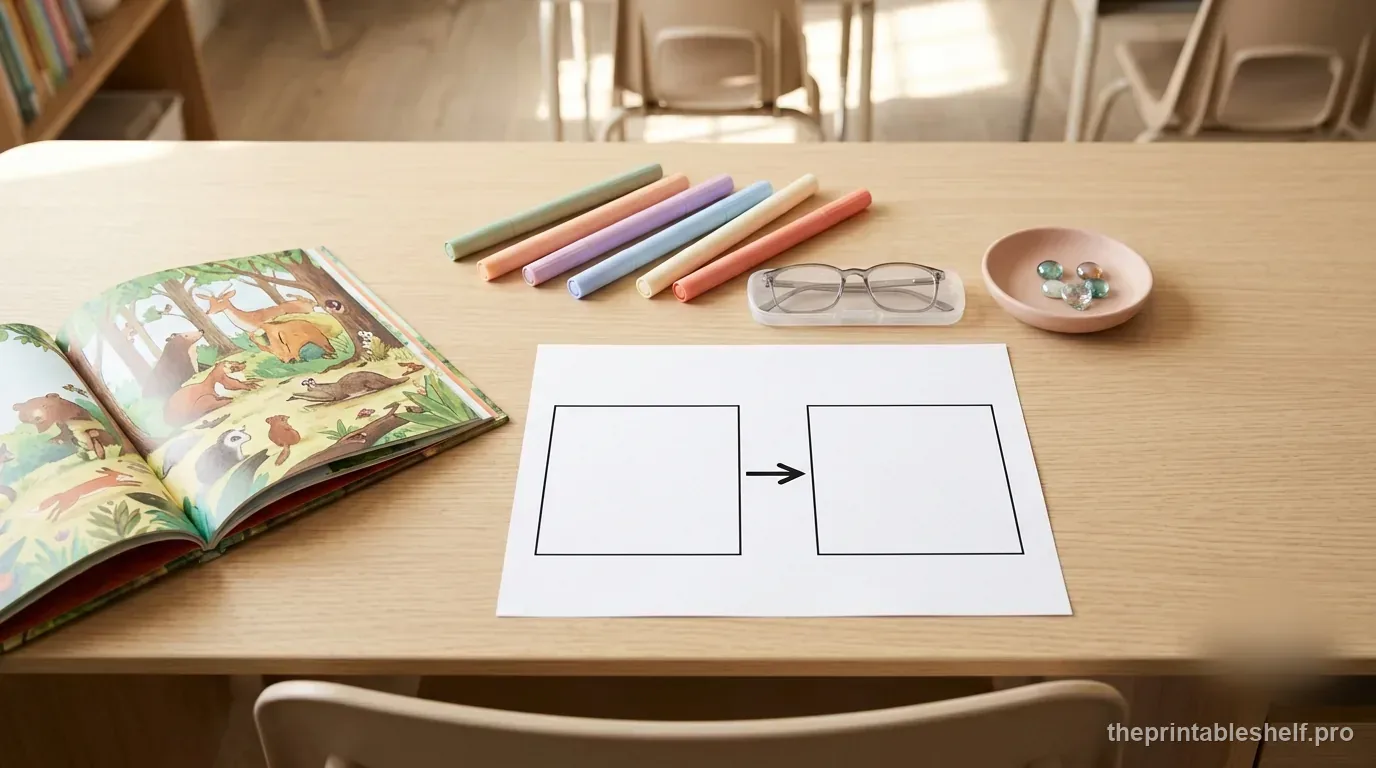
Cause and effect looks simple on a worksheet: one event goes in the cause box and another goes in the effect box. The difficult part is deciding whether one event actually helped produce the other. Students often mistake chronology for causation, copy sentences that contain signal words without understanding the relationship, or identify an effect without being able to explain what caused it. A useful lesson therefore has to teach the reasoning before it asks students to fill boxes.
The routine below moves from concrete examples to text evidence, then from single pairs to more complicated chains. It can be used with fiction, informational text, science passages, and social studies. The free cause-and-effect organizer linked in the article is a recording tool, not the lesson itself: students should be able to defend each arrow they draw.
Start with the relationship, not the signal words
Begin with an event students can explain without reading: a cup tips over and water spills; a plant is not watered and wilts; a character forgets an umbrella and gets soaked. Ask two questions in order: What happened? Why did it happen? The first question usually reveals the effect, and the second searches for a cause. Then reverse the language: What happened because the cup tipped? This makes the directional relationship visible before vocabulary such as therefore, because, as a result, or consequently enters the lesson.
Signal words are useful, but they are not a dependable shortcut. A sentence may contain because and state a clear relationship, while another passage may imply cause and effect across several sentences with no obvious marker. Teach students to treat signal words as a reason to look more closely. The final test is whether the text supports the claim that one condition, action, or event contributed to the result.
Teach students to separate cause, effect, and evidence
A strong response contains three parts. The cause names the condition or event that contributed to something else. The effect names what changed or happened. The evidence shows where the relationship comes from. Keeping those jobs separate prevents a common problem in which students fill both boxes correctly but cannot explain the arrow between them.
For a short passage about a school garden, a student might write Cause: several days passed without rain. Effect: the top layer of soil became dry. Evidence: the passage says the garden had no rainfall for a week and that the soil surface cracked. The evidence does not need to be copied word for word; a concise paraphrase can be enough when it preserves the relevant detail and the task does not require a direct quotation or source locator.
| Part | Question to ask | Example |
|---|---|---|
| Cause | What condition, choice, or event helped make this happen? | No rain for several days |
| Effect | What happened or changed as a result? | The topsoil dried and cracked |
| Evidence | What in the text supports this link? | The passage connects the dry week with the cracked soil |
Model one pair with a think-aloud before handing out the organizer
Choose a short paragraph with one unmistakable causal relationship. Read it once for meaning. On the second read, stop at the effect and think aloud: I know what happened, but I am not going to call the sentence before it the cause just because it came first. I need to ask what made or helped this result happen. Point to the wording that answers that question and then place the two ideas on opposite sides of the organizer.
During the model, keep the writing short. The organizer should capture the relationship, not become a copying exercise. A phrase such as roads froze overnight is usually more useful in a cause box than a full sentence lifted from the passage. Once the pair is recorded, say the relationship as a complete sentence using because or so. If the sentence sounds illogical, revisit the arrow.
Use the chronology test to catch false causes
One of the most useful checks is to ask whether the proposed cause merely happened earlier. Suppose a story says Maya ate breakfast, walked to school, and later missed the bus home because soccer practice ended late. Breakfast occurred first, but it did not cause her to miss the bus. Chronology tells us when events happened; cause and effect asks whether one helped produce another.
Have students challenge weak pairs with the sentence frame: This happened before the effect, but did it help cause the effect? If the answer is no, ask whether the order itself matters. If it does, the events may belong on a sequence organizer; if it does not, the pair may simply be irrelevant to the causal question. This distinction is especially important in history and science, where several events may appear next to each other in time without a simple one-to-one causal link.
Download the Cause and Effect Graphic Organizer →
Use the three paired rows to record relationships only after students can explain what makes each arrow causal.
Compare with the Sequence of Events Organizer →
Switch to sequence when the learning goal is order rather than why one event produced another.
Move from one cause and one effect to causal chains
After students can identify a single pair, show that one effect can become the next cause. Heavy rain may saturate the soil; saturated soil may loosen a slope; the loosened slope may slide across a road. Recording this as a chain helps students see that cause and effect is not always two isolated boxes. It also gives them practice deciding where one relationship ends and the next begins.
At the next level, discuss multiple causes and multiple effects. A character may leave a team because of an injury, a schedule conflict, and frustration. A new town policy may reduce traffic in one street but increase it on another. Do not force these situations into a simplistic single-arrow model. Let students sketch branches beside the printable, use multiple rows for related pairs, or move to a concept map when the network matters more than a neat worksheet.
Teach fiction and nonfiction with slightly different questions
In fiction, causes often involve character choices, motives, misunderstandings, or external events. Ask: What choice changed the situation? What did the character believe? What consequence followed? This keeps students from treating every earlier plot event as the cause of every later one. A useful pair should help explain character action or a turning point.
In informational text, the relationship may involve physical processes, historical conditions, policy decisions, or interacting systems. Ask: What mechanism connects these ideas? Does the author say the factor contributed to the outcome, or are we adding that conclusion ourselves? For older students, this wording matters because a text may describe correlation, contribution, or several interacting causes rather than a simple guaranteed result.
A worked reading example
Imagine a short passage about a neighborhood pond. During a heat wave, the water level drops. The shallower water warms quickly, and the amount of dissolved oxygen falls. Several fish begin gathering near a fountain where the water is being stirred. A weak response might write heat wave as the cause and fish near fountain as the effect and stop there. The endpoints are related, but the reasoning is hidden.
A stronger analysis breaks the chain into testable links: prolonged heat contributed to lower water levels; shallower water warmed more quickly; all else equal, warmer water can hold less dissolved oxygen; the fish gathered near the fountain, where moving water may have increased aeration. Students do not need a separate worksheet box for every scientific detail, but they should be able to explain the middle of the chain orally or in a note. That is what turns the organizer into comprehension rather than matching.
Common teaching mistakes and quick repairs
Mistake one is teaching signal words as if they guarantee the answer. Repair it by including examples with no signal word and non-examples that contain time-order words. Mistake two is accepting any event that came first as a cause. Repair it with the chronology test. Mistake three is asking students to copy full sentences into boxes. Repair it by limiting entries to a short phrase, then requiring an oral or written because statement.
Mistake four is using only obvious one-cause/one-effect passages. Once the basic relationship is secure, introduce chains and competing causes. Mistake five is grading only whether the boxes match an answer key. Ask students to justify one arrow with text evidence. That tiny addition reveals whether they actually saw the relationship.
A simple lesson sequence you can reuse
For a first lesson, spend a few minutes on real-life examples, model one short text pair, complete one pair together, and let students try a second pair with a partner. End with a quick exit question that asks them to distinguish cause and effect from sequence. On a later day, use a richer passage with a causal chain and ask students to choose the most important link rather than recording everything.
The organizer becomes more useful when it appears again in science, social studies, and narrative reading instead of being treated as a one-week reading worksheet. Repeated use across different content teaches the transferable question: What made this happen, and what evidence supports that explanation?
Questions people ask
What are fun activities to teach cause and effect?
Try a domino or ball-and-ramp demonstration and have children describe each cause and effect aloud. Use a cause-and-effect card match, act out simple events from a read-aloud, or have students build a chain from a picture book. Always ask why the effect happened, so children link the two parts instead of just naming events.
How do you explain cause and effect to a child?
Say that a cause is why something happened and the effect is what happened because of it. Use an everyday example, such as the glass tipping over and the milk spilling. Then ask the child to tell you the cause and effect in a short story, and look for the word because to connect them.
What is the easiest way to teach cause and effect to beginners?
Start with an obvious real-life event, ask what happened and why it happened, then state the pair using because or so. Move to a short text only after students understand the direction of the relationship.
Are signal words enough to identify cause and effect?
No. Words such as because, therefore, and as a result are useful clues, but the reader still has to determine whether the text supports a causal relationship. Some causal links are implied without signal words.
When should I use a sequence organizer instead?
Use sequence when the main question is what happened first, next, and later. Use cause and effect when the main question is why something happened or what resulted from a condition, action, or event.
Matching templates
Free Cause and Effect Graphic Organizer →
Use this cause and effect graphic organizer to connect why something happened with what happened as a result. The page includes a focus event plus three clearly paired cause-and-effect rows, making it useful for reading, science, history, and process analysis. Download it in Letter, A4, or PNG format.
Free Sequence of Events Graphic Organizer →
This sequence of events organizer gives you five ordered steps labeled First, Next, Then, After That, and Finally, plus a final reflection on what changed. Use it to retell a story, track historical events, explain a process, or plan a procedure. Download the printable in Letter, A4, or PNG.
Sources & further reading
These sources support the instructional background in this guide. The printable recommendations and usage notes above are The Printable Shelf's editorial guidance.
- Iowa Reading Research Center — Effective Literacy Lesson: Teaching Identification of Cause and Effect Relationships in Texts — University literacy resource demonstrating explicit modeling of cause-and-effect text structure and use of a graphic organizer.
- Reading Rockets — Teaching Text Structure — Overview of common informational text structures, including chronology/sequence and cause/effect, with signal questions and classroom guidance.
- Iowa Reading Research Center — Cause and Effect Graphic Organizer — University-provided organizer describing the direct relationship between events and allowing written or drawn responses.
- Teach Britannica — Cause and Effect — Instructional routine that pairs a cause-and-effect organizer with reading, discussion, and scaffolded versions.
Other guides you may like
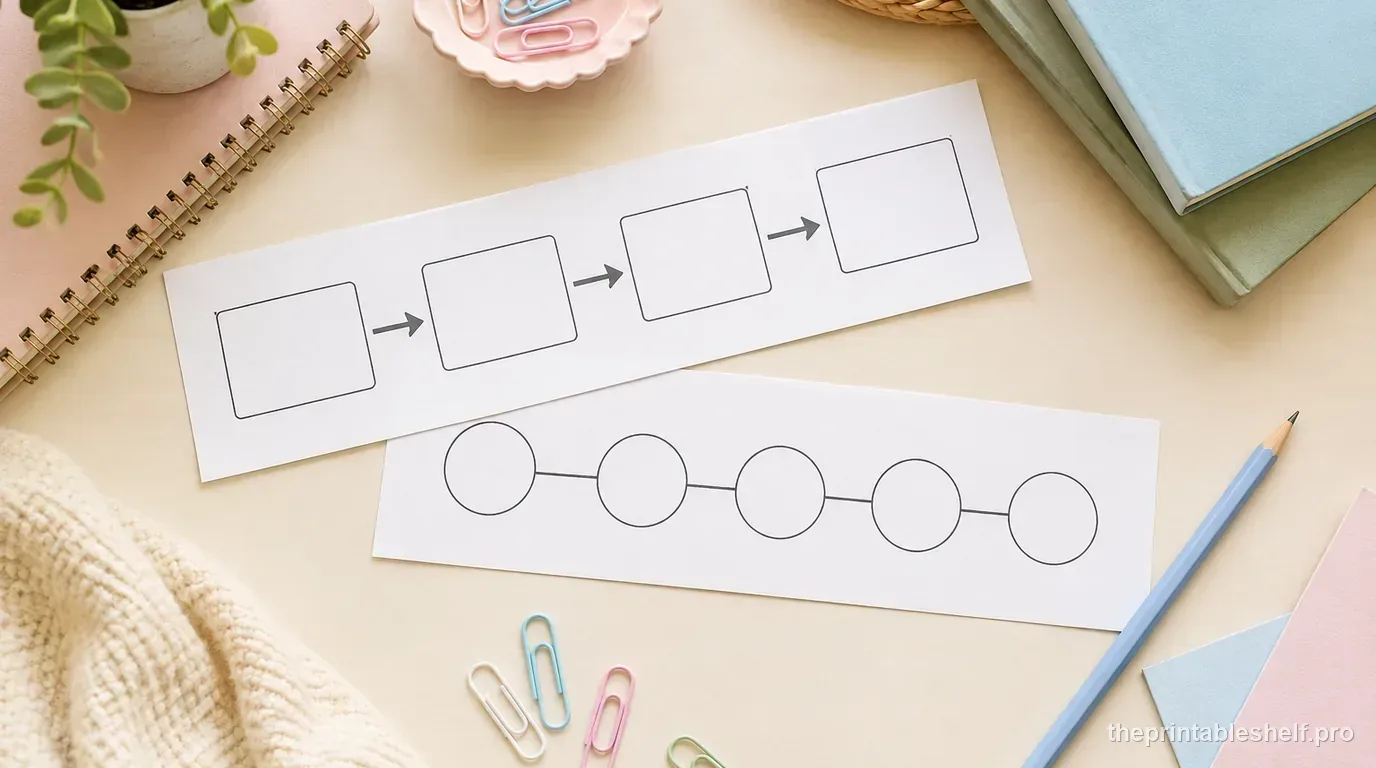
Cause and Effect vs. Sequence: How to Tell the Difference
Learn the difference between cause and effect and sequence, spot each text structure, and choose the right graphic organizer for reading or writing.
Read guide →
Free Reading Comprehension Graphic Organizers by Reading Skill
Free reading comprehension graphic organizers for story elements, main idea, sequence, cause and effect, comparison, vocabulary, and prior knowledge.
Read guide →
How to Use Graphic Organizers Effectively (Without Turning Them Into Busywork)
Learn how to choose, model, scaffold, and reuse graphic organizers so students think with them instead of simply filling in boxes.
Read guide →