How-to guide · Work & Study
Cause and Effect vs. Sequence: How to Tell the Difference
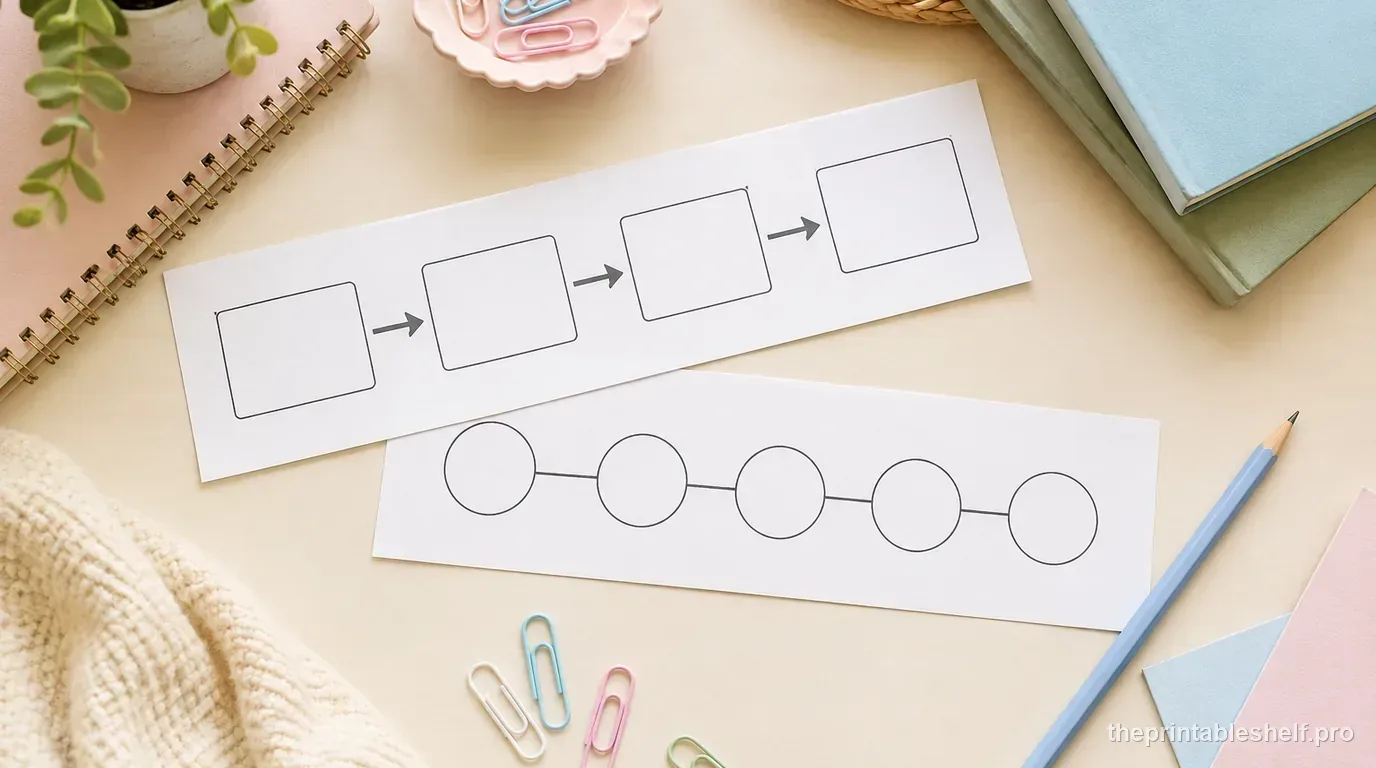
Sequence and cause and effect are easy to confuse because both can involve the same events. If a storm knocks out power, the storm happens first and the outage happens second, so there is an order. But the important relationship is not merely first-then; the storm caused the outage. That difference—order versus explanation—is the fastest way to decide which text structure or graphic organizer fits the task.
Reading Rockets describes sequence as information arranged in numerical or chronological order, while cause and effect identifies one or more causes and the effects that follow. ReadWriteThink also notes that a sequence chart can sometimes be used to explore causal relationships, which is useful because real texts often nest one structure inside another. The goal is not to label every paragraph with one permanent category. The goal is to identify the relationship a reader needs to understand at that moment.
Cause and effect vs. sequence at a glance
Use the question you are trying to answer as the deciding test. Sequence answers questions such as What happened first? What came next? What is the next step? Cause and effect answers What made this happen? What changed because of it? What conditions produced this result? If you can rearrange the events and the explanation collapses only because the timeline is wrong, sequence is probably central. If the explanation collapses because the reason-result link is missing, cause and effect is central.
| Feature | Sequence | Cause and effect |
|---|---|---|
| Main relationship | Order in time or steps | Reason and result |
| Best question | What happened first, next, and last? | Why did this happen, and what happened because of it? |
| Typical uses | Procedures, timelines, life cycles, plot events | Science explanations, history, consequences, problem analysis |
| Common signals | first, next, then, later, finally | because, due to, therefore, as a result, consequently |
| Organizer shape | Ordered boxes or arrows | Cause boxes connected to effect boxes |
| Big mistake | Assuming earlier always means causal | Listing events without supporting the causal connection |
Order does not automatically mean cause
One event happening before another is not enough to prove that the first caused the second. Imagine a student reads: The bell rang. Students packed their bags. Rain started outside. Those events have a sequence, but the bell did not cause the rain. A sequence organizer can record all three accurately. A cause-and-effect organizer should connect only relationships the text supports, such as the bell causing students to begin packing if the context makes that relationship clear.
This distinction matters in nonfiction. A history chapter may put five events on a timeline, but only some of them have a direct causal relationship. A science passage may describe several stages of a process and then explain why one stage triggers the next. Asking students to write the connector aloud—because, led to, resulted in, made, triggered—often exposes whether they have evidence for a cause or are simply pointing to the event that came earlier.
The same passage can use both structures
Many real texts combine sequence and cause and effect instead of choosing one. Reading Rockets' text-structure guidance gives the example of historical events being studied as a cause-and-effect relationship nested within a sequence. A reader may first need the timeline to know what happened, then examine selected links to explain why events changed direction.
Consider a simple plant experiment. Day 1: two seedlings are placed in different light conditions. Day 4: one plant becomes pale. Day 7: its growth slows. The dates create a sequence. The comparison between light conditions and plant outcomes creates a possible causal explanation. A strong response may need both: sequence to report the procedure and observations, then cause and effect to explain the result. Do not force the whole passage into one organizer if two relationships matter.
Do not treat signal words as an answer key
Signal words are clues, not proof. First, next, after, and finally often point toward sequence. Because, therefore, due to, and as a result often point toward cause and effect. Reading Rockets lists these kinds of cues when teaching text structure, but students still need to inspect the relationship between ideas. A paragraph can contain the word after without making a causal claim, and it can explain a cause without using the word because at all.
A better routine is to circle the signal word, then draw an arrow between the ideas it seems to connect. Ask what the arrow means. Does it mean happens before, or produces a result? If the student cannot explain the arrow in a short sentence, the signal word has not yet become comprehension. This is especially important with informational texts that mix dates, conditions, examples, and explanations in the same paragraph.
Choose the organizer based on what the final response must explain
Use a sequence organizer when the final response needs a retelling, process, procedure, chronology, or ordered set of stages. The numbered or arrowed structure keeps events from drifting out of order and makes missing steps visible. Our free Sequence of Events organizer is designed for that job: short event labels plus enough room to explain each stage without turning the page into a long paragraph.
Use a cause-and-effect organizer when the response needs reasoning about why an event occurred or what consequences followed. The page should make the causal link explicit instead of hiding it inside a timeline. Our Cause and Effect organizer separates causes from outcomes so a learner can test whether each arrow is supported by the text or evidence.
If the assignment asks for both—such as Explain how the events leading to a war unfolded and why one event intensified the conflict—start with sequence to stabilize the chronology. Then move only the most important relationships into cause and effect. Two smaller organizers are often clearer than one overloaded sheet.
Three worked examples
Reading example: A character forgets an umbrella, walks home in heavy rain, and arrives soaked. A sequence answer lists forgets umbrella → walks home → arrives soaked. A cause-and-effect answer focuses on the supported relationship: walking through heavy rain without an umbrella caused the character to become soaked. The organizer choice depends on whether the question asks for plot order or an explanation of the outcome.
History example: A timeline may show a law being passed, protests occurring, negotiations beginning, and a policy changing. Sequence preserves the dates. Cause and effect requires evidence about which conditions or actions contributed to the policy change. The nearest event on the timeline is not automatically the sole cause, so students may need multiple causes feeding one effect.
Process example: To explain how bread rises, the order of mixing, resting, proofing, and baking is useful, but the scientific explanation requires cause and effect: yeast ferments available sugars and produces carbon dioxide, the dough's structure traps much of that gas, and the dough expands. A procedure chart and a causal explanation answer different questions about the same topic.
Quick practice: sequence, cause and effect, or both?
Try classifying the relationship before looking at the answer. The point is not to hunt for one signal word; it is to identify what the sentence or task actually asks you to understand. When a prompt contains both chronology and causation, decide which relationship the final response must explain most clearly.
| Prompt | Best structure | Why |
|---|---|---|
| Mix the batter, pour it into the pan, then bake for 30 minutes. | Sequence | The meaning depends on the order of procedural steps. |
| The road froze overnight, so the district delayed school. | Cause and effect | The sentence explains a reason and a result, not just which event came first. |
| The caterpillar forms a chrysalis and later emerges as a butterfly. | Sequence | The main relationship is the ordered stages of a life cycle. |
| Heavy rainfall saturated the soil, which triggered a landslide. | Cause and effect | The important relationship is why the landslide occurred. |
| A drought continued for months; reservoir levels fell, restrictions were introduced, and household water use declined. | Both | A timeline helps preserve the order, while cause-and-effect reasoning explains why later conditions and actions followed. |
A simple teaching routine that prevents guessing
First, give students a short paragraph and ask them to underline only the events or conditions, without naming the structure yet. Second, have them place the events in order. Third, ask which arrows mean only next in time and which arrows can be rewritten as X caused Y or Y happened because of X. This separates chronology from causal reasoning before a worksheet format influences the answer.
Then choose the organizer. For sequence, include the key stages needed for the task and check any jump that makes the order hard to follow; the organizer does not need to reproduce every minor event. For cause and effect, require evidence for each causal arrow. Finally, ask the student to turn the organizer into a brief explanation. If the sentences become a list of first-next-finally statements, the thinking is sequential. If they explain reasons and consequences, the thinking is causal. The final prose is a useful check that the diagram represents an understood relationship rather than boxes filled for completion.
Common mistakes and quick fixes
Mistake one is using every earlier event as a cause. Fix it by requiring a because sentence for each proposed connection and checking that the text or evidence supports it. Mistake two is treating a cause-and-effect chain as if every link has one cause and one result. Real explanations may have multiple causes, multiple effects, or feedback loops; simplify only as far as the source allows.
Mistake three is putting too much prose into a sequence box. Use short labels for the event and reserve a second line for the important detail. Mistake four is selecting an organizer because the worksheet title matches a vocabulary word in the assignment. Choose based on the relationship the final response must communicate, not the word printed on the handout.
Frequently asked questions
What is the difference between sequence and cause and effect?
Sequence shows the order in which events or steps happen. Cause and effect explains why something happens and what result follows from that cause.
Can a text be both sequence and cause and effect?
Yes. A text can present events chronologically and also explain causal relationships among some of those events. History and science texts often combine both structures.
How can students tell which organizer to use?
Ask what the final answer must show. If it must show first-next-last or procedural order, use sequence. If it must explain why something happened or what resulted, use cause and effect.
Printables for this topic
Free Cause and Effect Graphic Organizer →
Use this cause and effect graphic organizer to connect why something happened with what happened as a result. The page includes a focus event plus three clearly paired cause-and-effect rows, making it useful for reading, science, history, and process analysis. Download it in Letter, A4, or PNG format.
Free Sequence of Events Graphic Organizer →
This sequence of events organizer gives you five ordered steps labeled First, Next, Then, After That, and Finally, plus a final reflection on what changed. Use it to retell a story, track historical events, explain a process, or plan a procedure. Download the printable in Letter, A4, or PNG.
References
These sources support the instructional background in this guide. The printable recommendations and usage notes above are The Printable Shelf's editorial guidance.
- Reading Rockets — Teaching Text Structure — Defines sequence and cause/effect text structures and provides common signal words and questions.
- Reading Rockets — Implementing the Text Structure Strategy — Explains that texts can combine structures, including cause/effect relationships nested in a sequence of historical events.
- ReadWriteThink — Sequence of Events Chart — Shows how a sequence organizer can support chronology and, when appropriate, exploration of causal relationships among events.
- Iowa Reading Research Center — Reading Graphic Organizers — Describes cause-and-effect organizers as tools for identifying events and the reasons those events occurred.
Keep reading

How to Use Graphic Organizers Effectively (Without Turning Them Into Busywork)
Learn how to choose, model, scaffold, and reuse graphic organizers so students think with them instead of simply filling in boxes.
Read guide →
Free Reading Comprehension Graphic Organizers by Reading Skill
Free reading comprehension graphic organizers for story elements, main idea, sequence, cause and effect, comparison, vocabulary, and prior knowledge.
Read guide →
10 Free Graphic Organizers for Reading, Writing, and Studying
Download 10 free graphic organizers for reading, writing, comparison, vocabulary, sequencing, and study. Includes a guide to choosing the right one.
Read guide →
How to Teach Cause and Effect in Reading Without Teaching a Guessing Game
Teach cause and effect in reading with a practical routine for identifying real causal links, using evidence, and avoiding common student misconceptions.
Read guide →
How to Teach Sequence of Events in Reading Beyond First, Next, Then, Last
Teach sequence of events in reading with a step-by-step routine for choosing key events, using order clues, retelling, and avoiding overloaded timelines.
Read guide →