Work & Study · Free printable
Free Sequence of Events Graphic Organizer
This sequence of events organizer gives you five ordered steps labeled First, Next, Then, After That, and Finally, plus a final reflection on what changed. Use it to retell a story, track historical events, explain a process, or plan a procedure. Download the printable in Letter, A4, or PNG.
Edited by Tessa Vaughn · Planning & Organization Editor
Free download
Choose your file size
Print at 100% / Actual Size for the cleanest margins. Pick the paper size your printer normally uses.
Share to Google Classroom ↗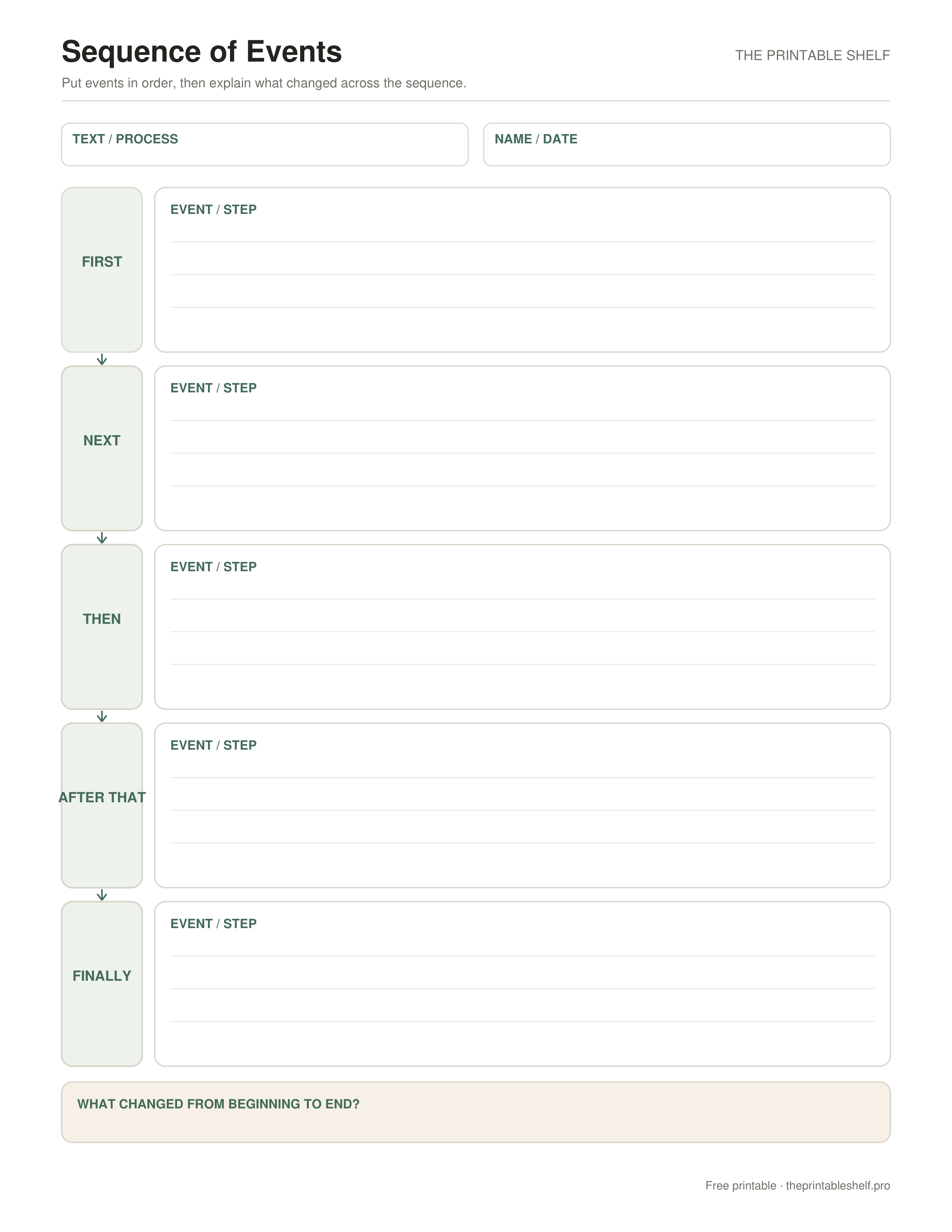
No sign-up required · personal/classroom use
About this printable
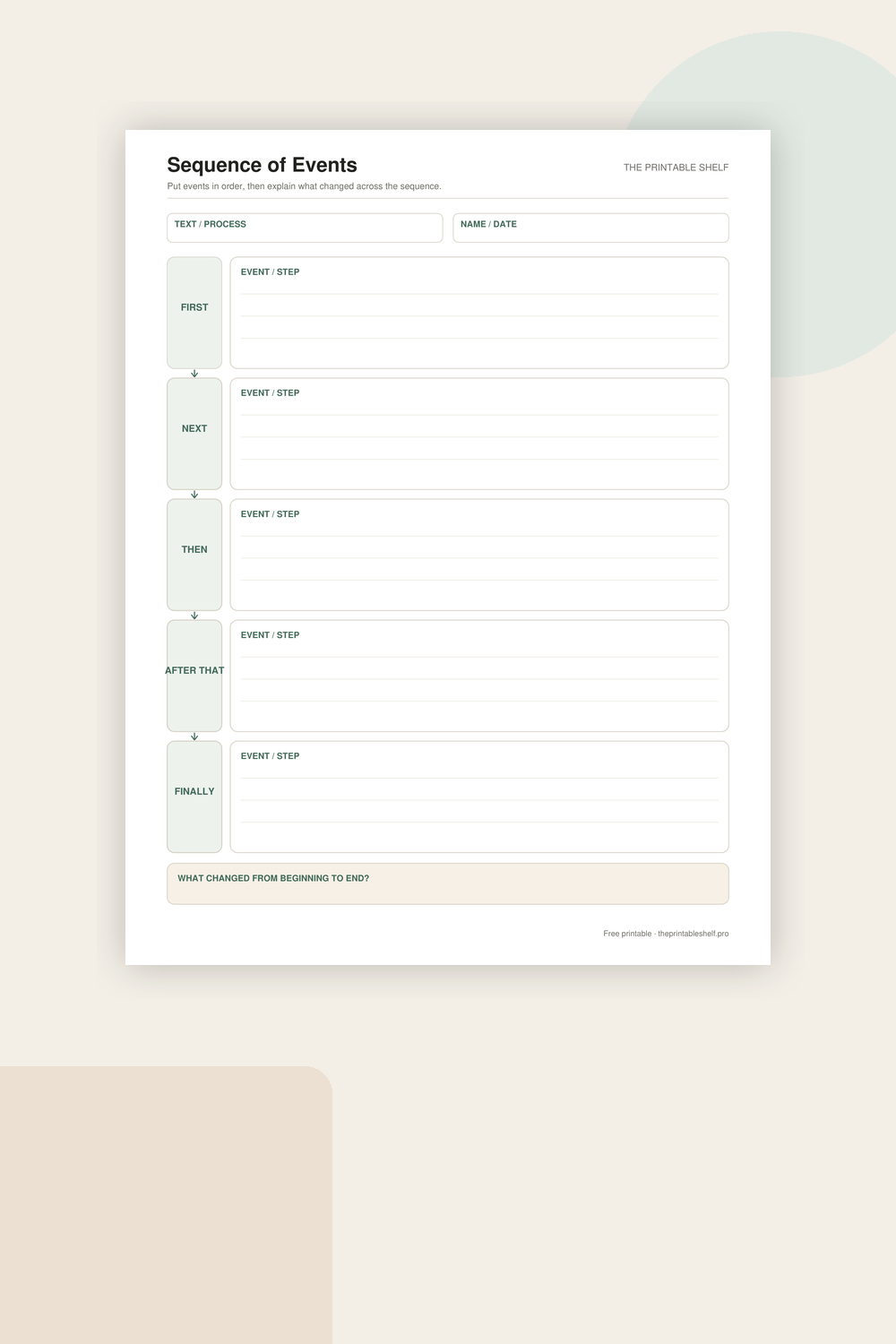
A vertical sequence chain that makes order visible without squeezing each event into tiny boxes. Five linked writing areas support short event summaries or process steps, and a final reflection box pushes the learner to notice the overall change from beginning to end rather than merely copying chronology.
Using it in class or at home
Write the text, process, or topic at the top, then identify the starting point before filling every box. In a story, that may be the event that sets the plot in motion. In a process, it should be the first action that must happen. In history, choose a sequence narrow enough to show the key events clearly on one page rather than trying to summarize an entire era; combine or omit minor events when they are not needed for the task.
Use the First, Next, Then, After That, and Finally boxes for the most important steps in order. Keep each entry focused on one event or action. If a source gives ten small details, combine minor steps that belong together instead of writing microscopic notes. The goal is to reveal the structure of the sequence, not to copy every sentence from the source.
Check the transitions between boxes. Ask whether Event 2 could really happen before Event 1, whether a later step depends on something earlier, or whether you accidentally left out a necessary bridge. For procedures, this check catches missing instructions. For reading, it helps distinguish a true sequence from a list of facts that happen to appear in the same paragraph.
Use the final “What changed from beginning to end?” box to synthesize the sequence. A strong response describes the result of the chain: how the character, situation, system, or outcome is different after the last event. This is more useful than simply rewriting the final box because it asks the learner to connect the individual steps to the larger meaning of the sequence.
For younger students, let them sketch a tiny symbol beside each written event or complete a three-event version verbally before using all five boxes. For older learners, add dates, evidence, or cause-and-effect notes beside important events. When the assignment is specifically about beginning, middle, and end, a story map may be a better fit; use this sequence organizer when the exact order of several events or steps matters.
Fill it online
Type directly into this organizer →
Your answers autosave only in this browser. Print or save the filled page as PDF, download a high-resolution PNG, or clear it and start again—no account required.
Customize instead
Need a different title, paper size, or orientation? →
Use the free Graphic Organizer Maker to build a custom Venn, KWL, Frayer, story map, T-chart, main-idea, sequence, or cause-and-effect page.
Also in a free pack
Download this organizer together with related pages when you want one reusable master PDF instead of separate files.
Choose the support level
Blank, guided, example, or fill online
Use the blank page when students already know the routine. Choose the guided version when they need short prompts inside the sections. A completed example is available when this template benefits from modeling, and the online version lets students type before printing.
Blank
Independent use →
The standard printable with open writing space and no embedded hints. Download the Letter PDF.
Guided
Prompted scaffold
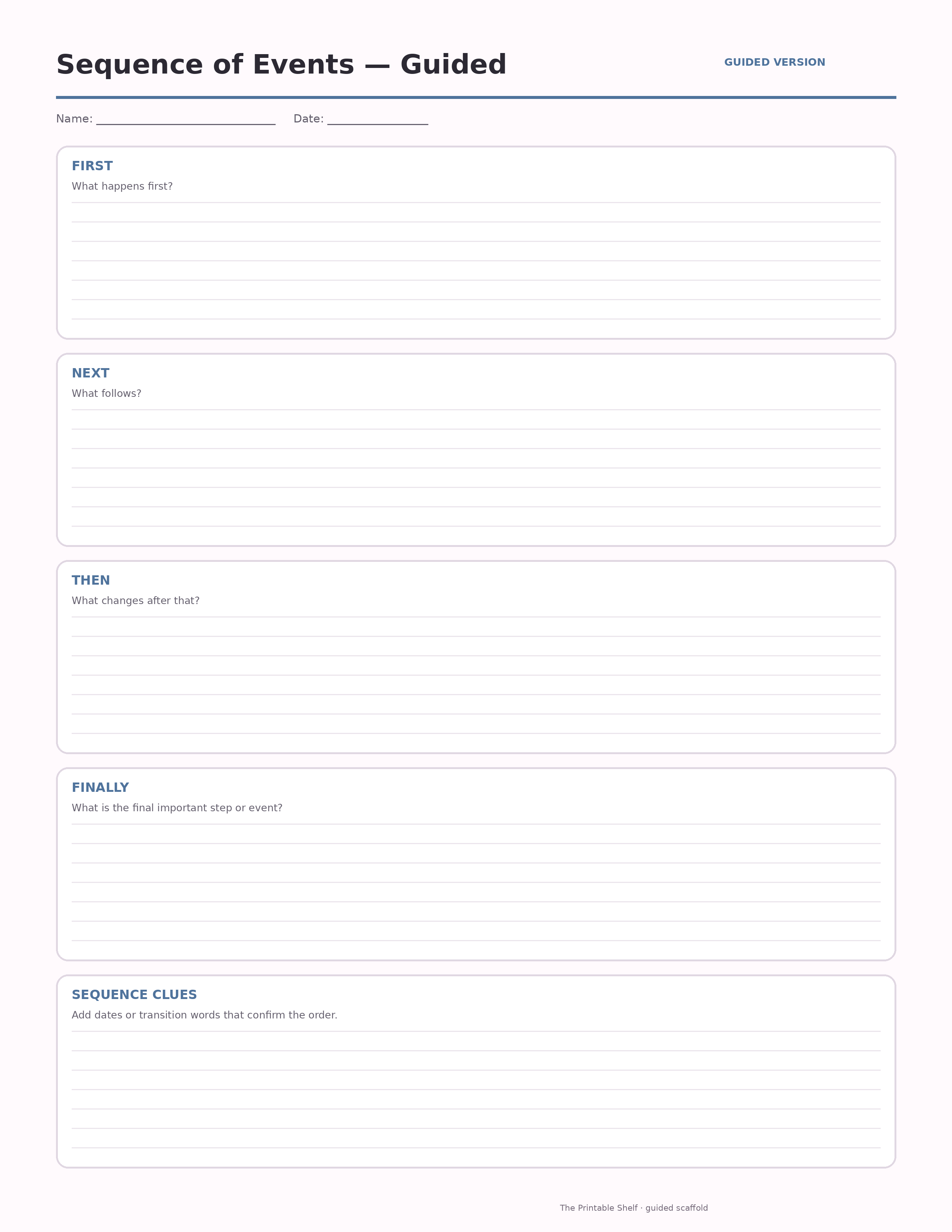
A scaffolded version with short prompts inside each section to help students know what kind of evidence or thinking belongs there.
Model
Completed example ↓
Use the finished sample to model the thinking before students work independently.
Online
Type before printing →
Autosave locally, print/save as PDF, or export the filled organizer as PNG.
Teaching set · 3 pages
Blank + guided + completed example in one PDF
Print the model first, practice with prompts, then move to the blank page without downloading three separate files.
Completed example
Worked page to compare against
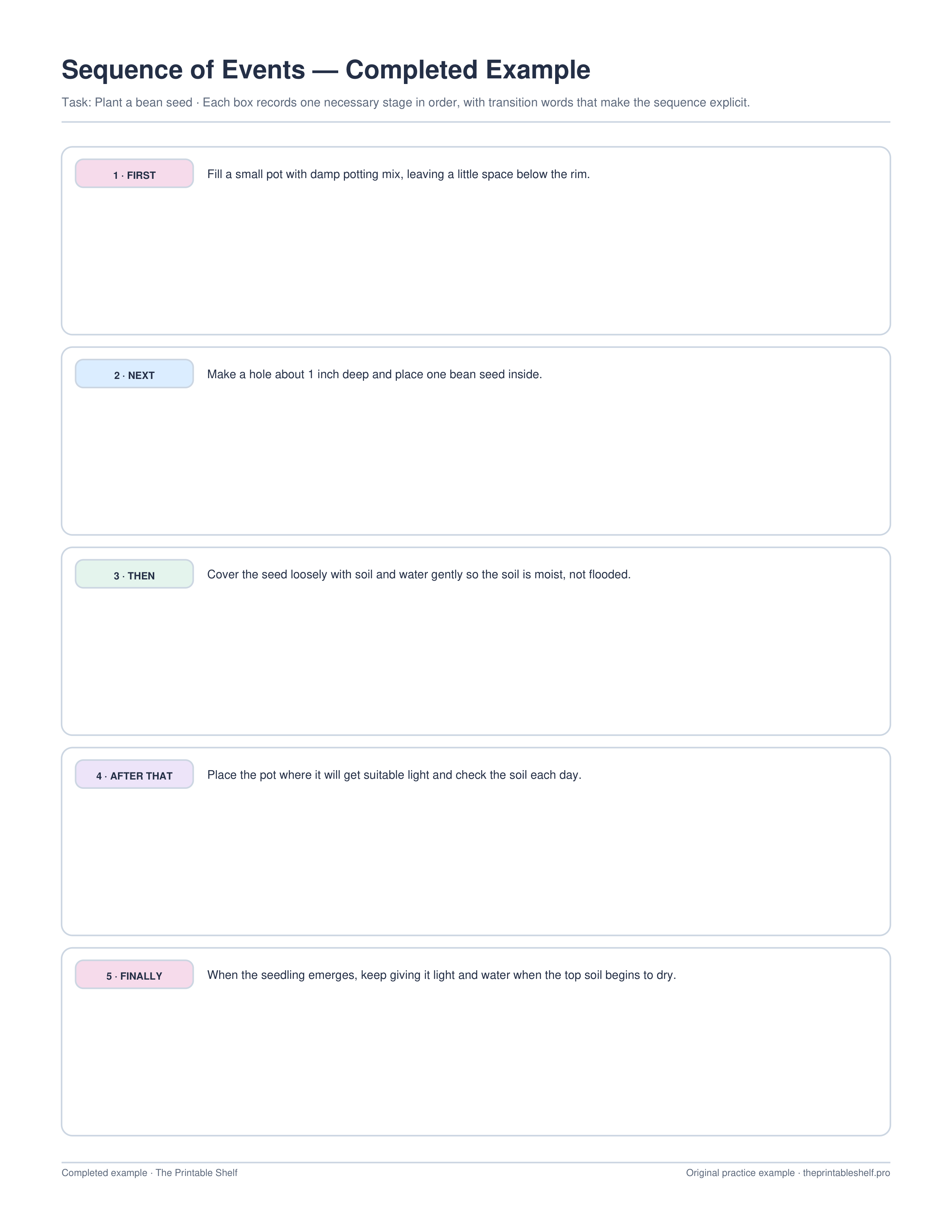
The completed page models a five-step process with transition words and only the information needed to preserve order from preparation through seedling care.
Best uses for this template
Ideas for using this page
Order a process
Write only the major stages needed to understand or reproduce the process, then add transition or time words where they clarify movement from one step to the next.
Retell key events
Use the boxes to preserve chronology before turning the sequence into a spoken or written retell with complete connections between events.
Reconstruct from evidence
For history or science, place events or stages in order first, then discuss which relationships are merely chronological and which are actually causal.
Mistakes to watch for
Using sequence when the real question is why
Switch to cause and effect when the learner must explain what produced an outcome rather than just what came next.
Including every tiny action
Select the turning points or essential steps that preserve the process without overwhelming the page.
Leaving order implicit
Use numbering, arrows, or transition words consistently so the reader can follow the intended sequence without guessing.
Classroom fit
Where it fits: grades and standards
Suggested grade bands
These are practical use ranges, not hard limits. Text complexity and the amount of teacher modeling matter more than the worksheet alone.
Good fit for
Scaffold level: Beginner.
Common Core crosswalk
- RL.3.3 · Explain how character actions contribute to a sequence of events
- RI.3.3 · Describe the relationship between a series of events or steps
- RI.4.5 · Describe the overall structure of events, ideas, concepts, or information
These codes are a practical crosswalk for skills this organizer can support. They are not a claim that the worksheet alone fully teaches or assesses the standard.
Quick answers
What can I use a sequence of events organizer for?
Use it for story retelling, historical timelines, science processes, procedures, biographies, or any task where order changes the meaning.
Do I have to use exactly five events?
No. You can leave an unused box blank or combine minor steps. The five spaces are there to keep one-page sequences manageable.
How is sequence different from cause and effect?
Sequence focuses on the order events happen. Cause and effect focuses on why one event leads to another result. Some texts use both structures.
Guides that go with this page
See where this organizer fits, when a different layout works better, and how to turn the completed page into a useful next step.
10 Free Graphic Organizers for Reading, Writing, and Studying
Download 10 free graphic organizers for reading, writing, comparison, vocabulary, sequencing, and study. Includes a guide to choosing the right one.
Read guide →
Free Writing Graphic Organizers: Which One to Use and When
Use free writing graphic organizers to plan ideas, structure paragraphs, compare evidence, sequence steps, and organize explanations before drafting.
Read guide →
Free Reading Comprehension Graphic Organizers by Reading Skill
Free reading comprehension graphic organizers for story elements, main idea, sequence, cause and effect, comparison, vocabulary, and prior knowledge.
Read guide →
How to Use Graphic Organizers Effectively (Without Turning Them Into Busywork)
Learn how to choose, model, scaffold, and reuse graphic organizers so students think with them instead of simply filling in boxes.
Read guide →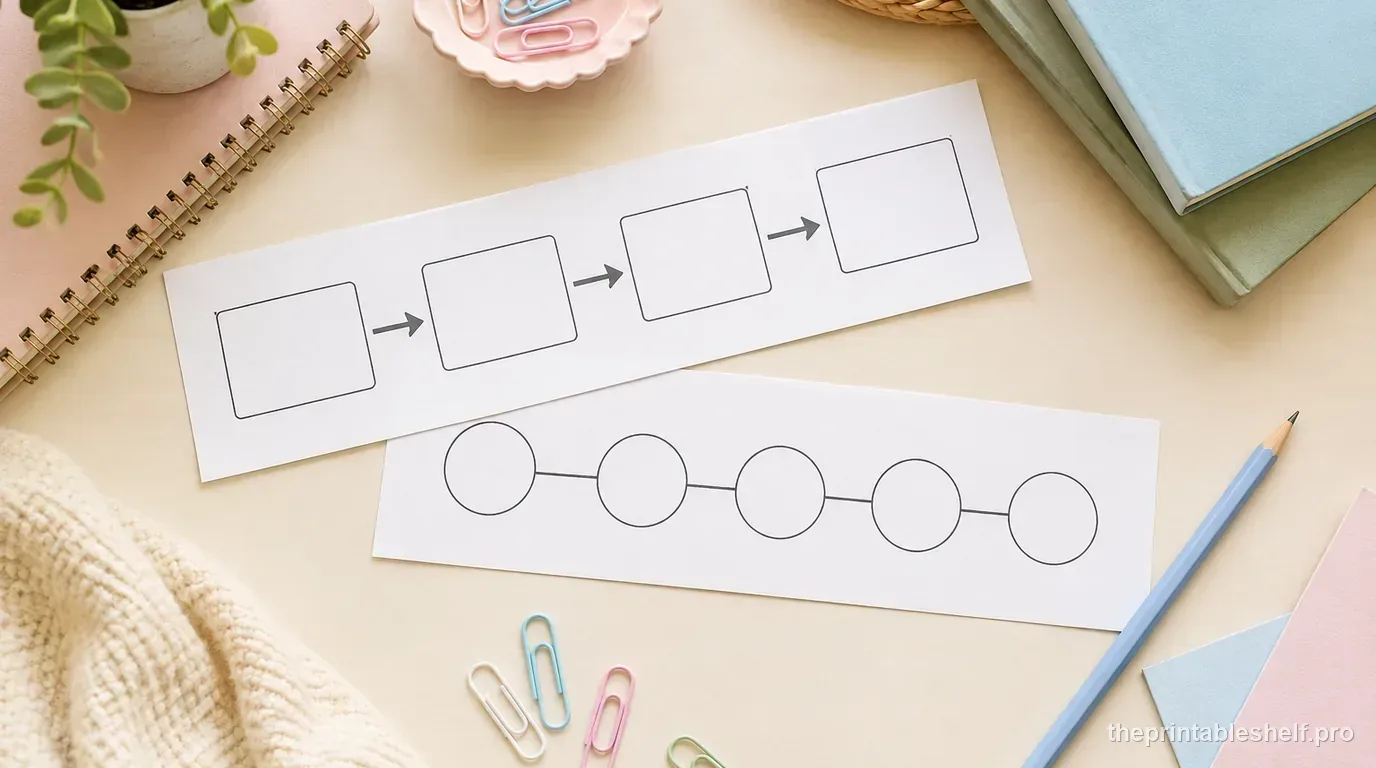
Cause and Effect vs. Sequence: How to Tell the Difference
Learn the difference between cause and effect and sequence, spot each text structure, and choose the right graphic organizer for reading or writing.
Read guide →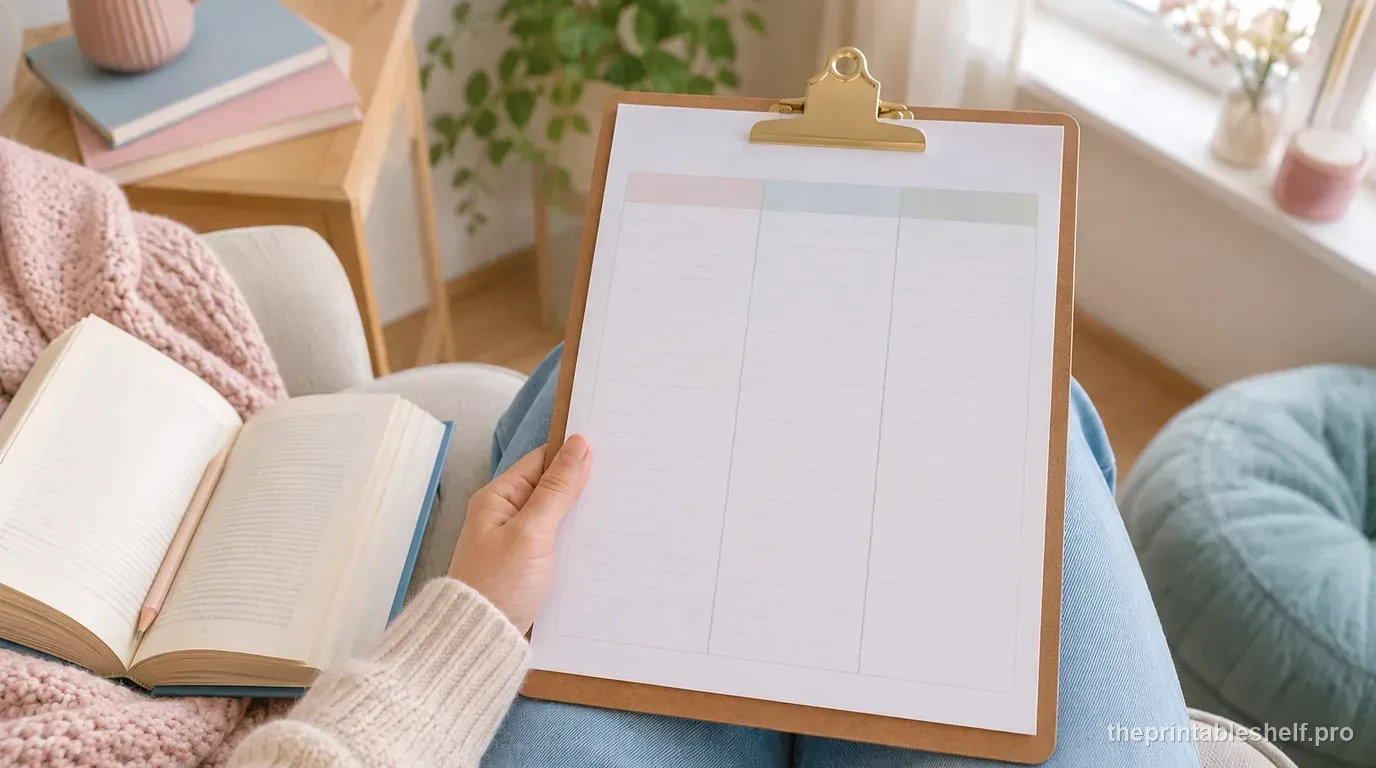
How to Use a KWL Chart Before, During, and After Reading
Learn how to use a KWL chart before, during, and after reading, with practical prompts, a worked example, and fixes for common KWL mistakes.
Read guide →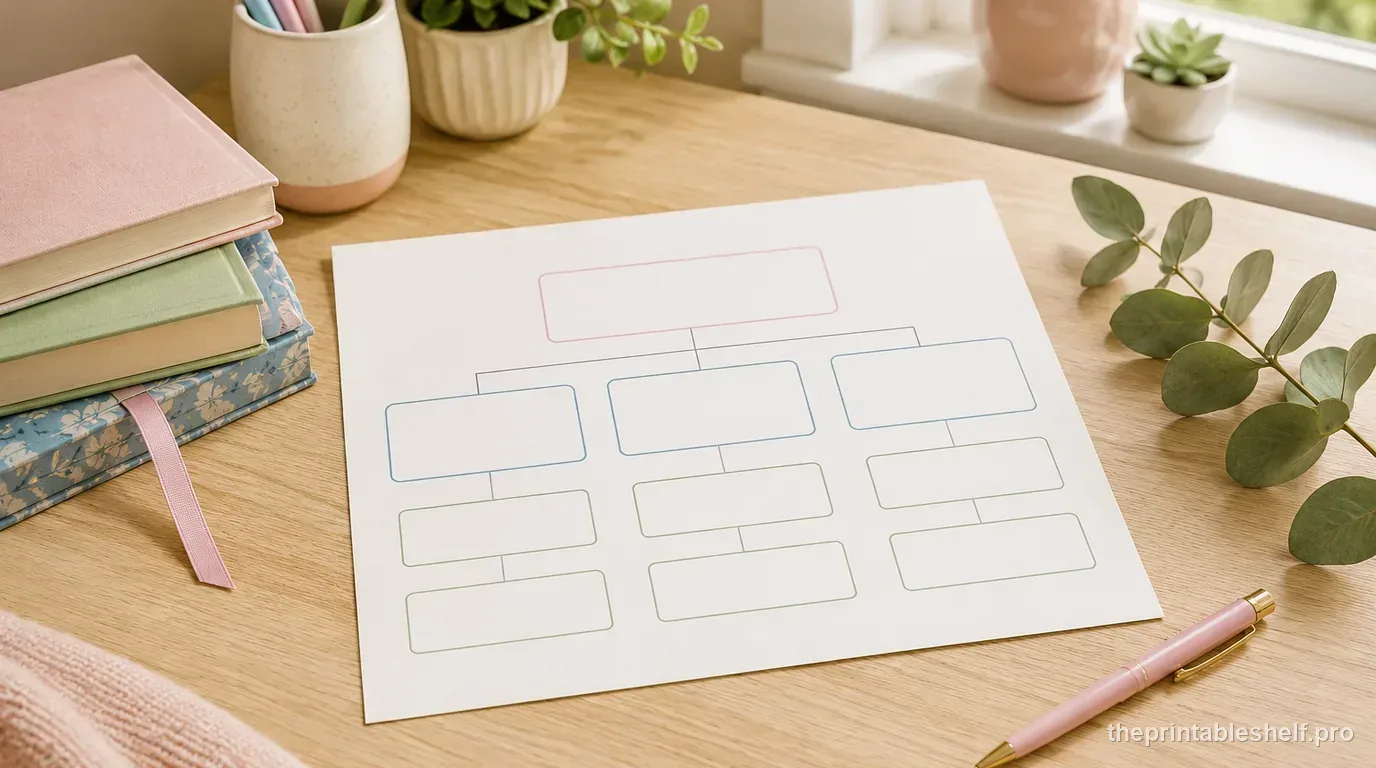
How to Use a Story Map for Better Reading Comprehension
Learn how to use a story map for characters, setting, problem, key events, and resolution, with a worked example and common fixes.
Read guide →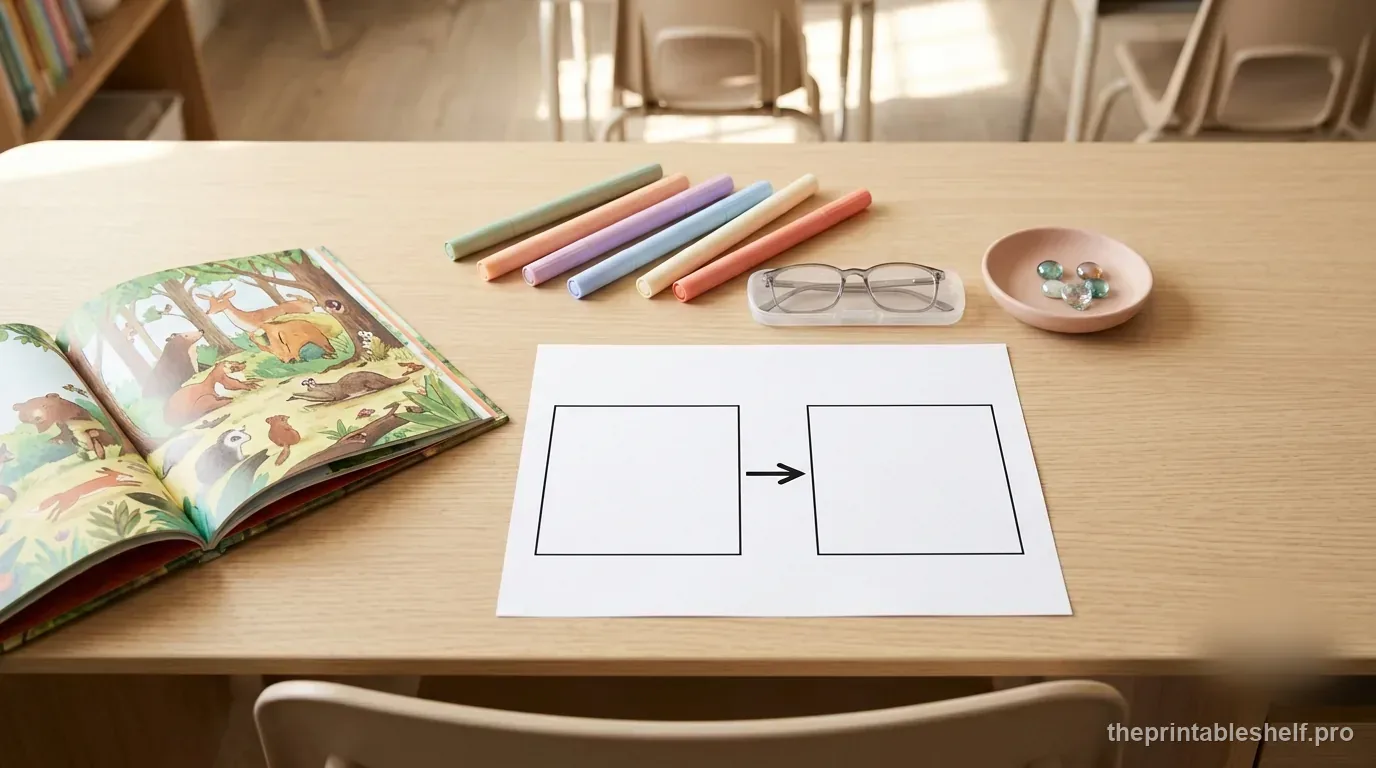
How to Teach Cause and Effect in Reading Without Teaching a Guessing Game
Teach cause and effect in reading with a practical routine for identifying real causal links, using evidence, and avoiding common student misconceptions.
Read guide →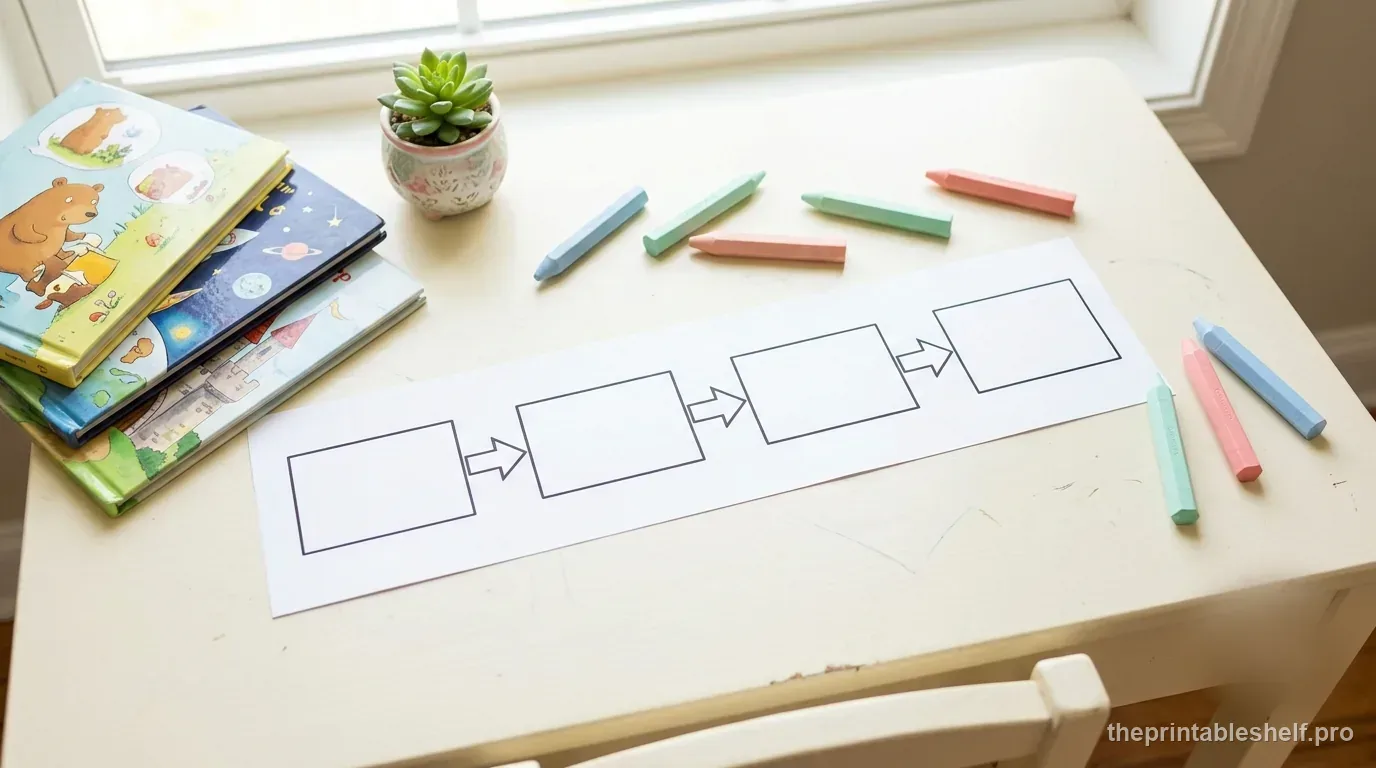
How to Teach Sequence of Events in Reading Beyond First, Next, Then, Last
Teach sequence of events in reading with a step-by-step routine for choosing key events, using order clues, retelling, and avoiding overloaded timelines.
Read guide →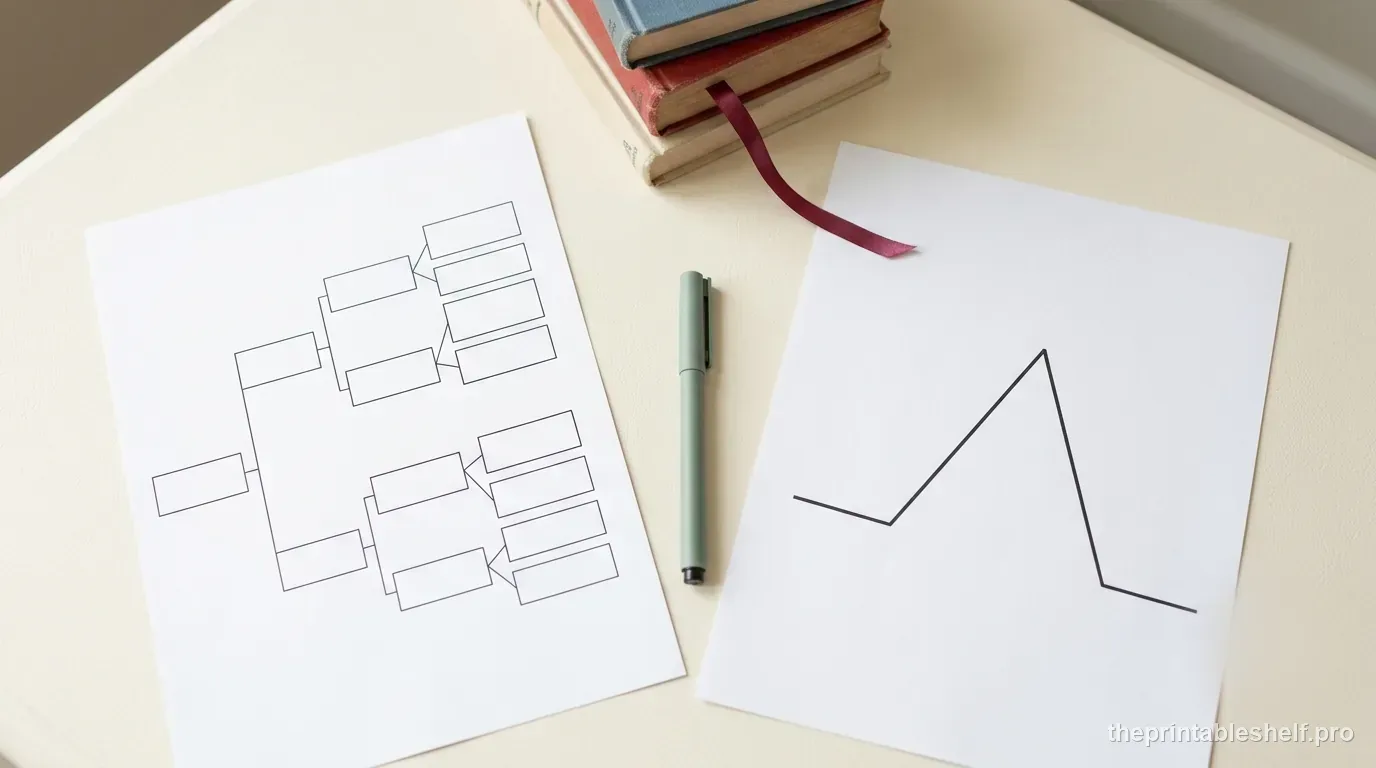
Story Map vs. Plot Diagram: Which Graphic Organizer Do You Need?
Compare story maps and plot diagrams, see what each organizer captures, and choose the right one for comprehension, retelling, or plot analysis.
Read guide →How to Identify Informational Text Structure
Learn how to identify description, sequence, cause/effect, compare/contrast, and problem/solution from idea relationships—not signal words alone.
Read guide →Keep organizing
You might also like
Free printable
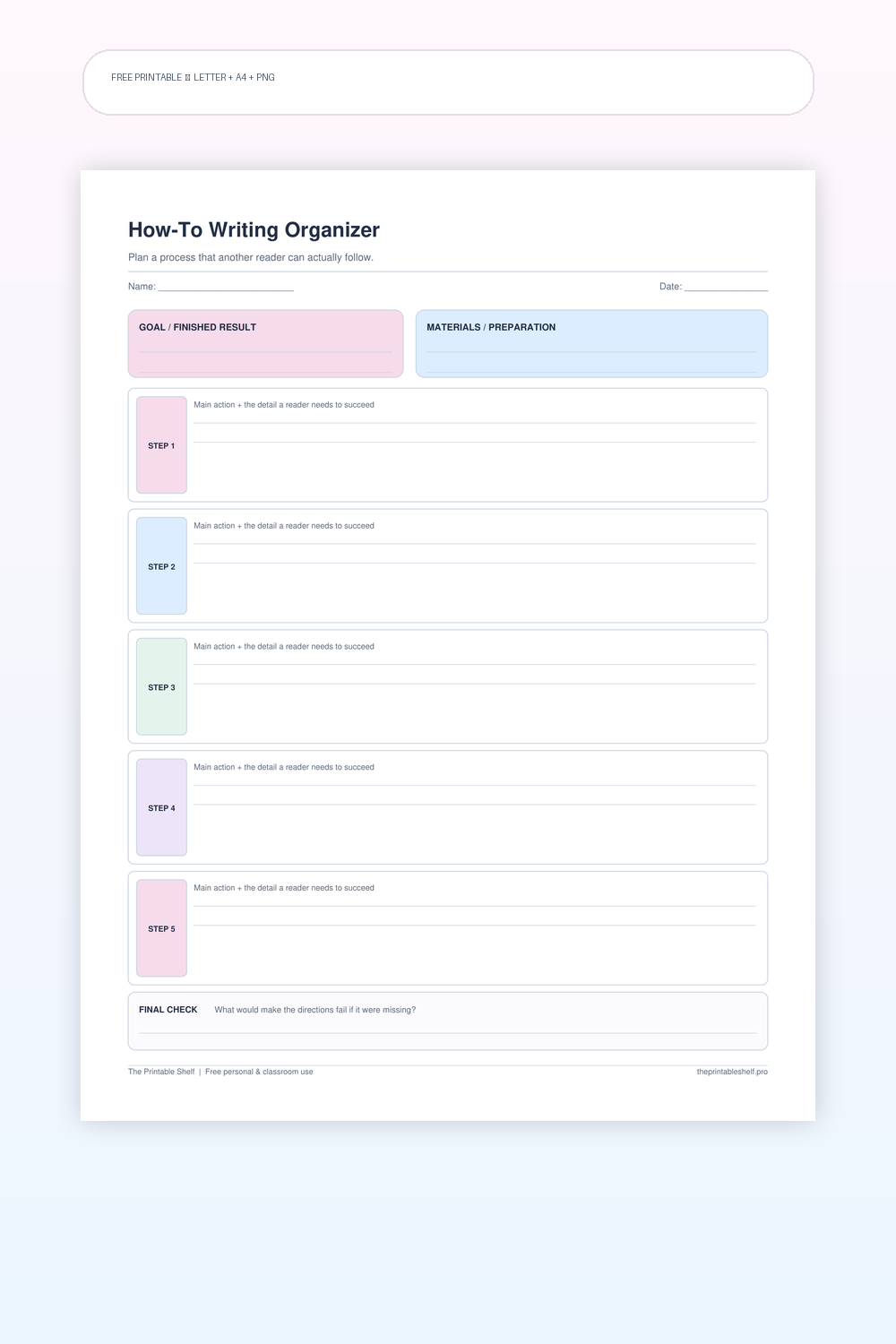
How-To Writing Graphic Organizer
A one-page procedural-writing planner built around the reader’s task rather than a generic sequence alone. It combines a clear outcome, preparation or materials, numbered steps, transition words, and a final check for hidden assumptions. That makes it useful for recipes, classroom procedures, simple experiments, crafts, game instructions, and any explanation of how to complete a repeatable process.
Free printable
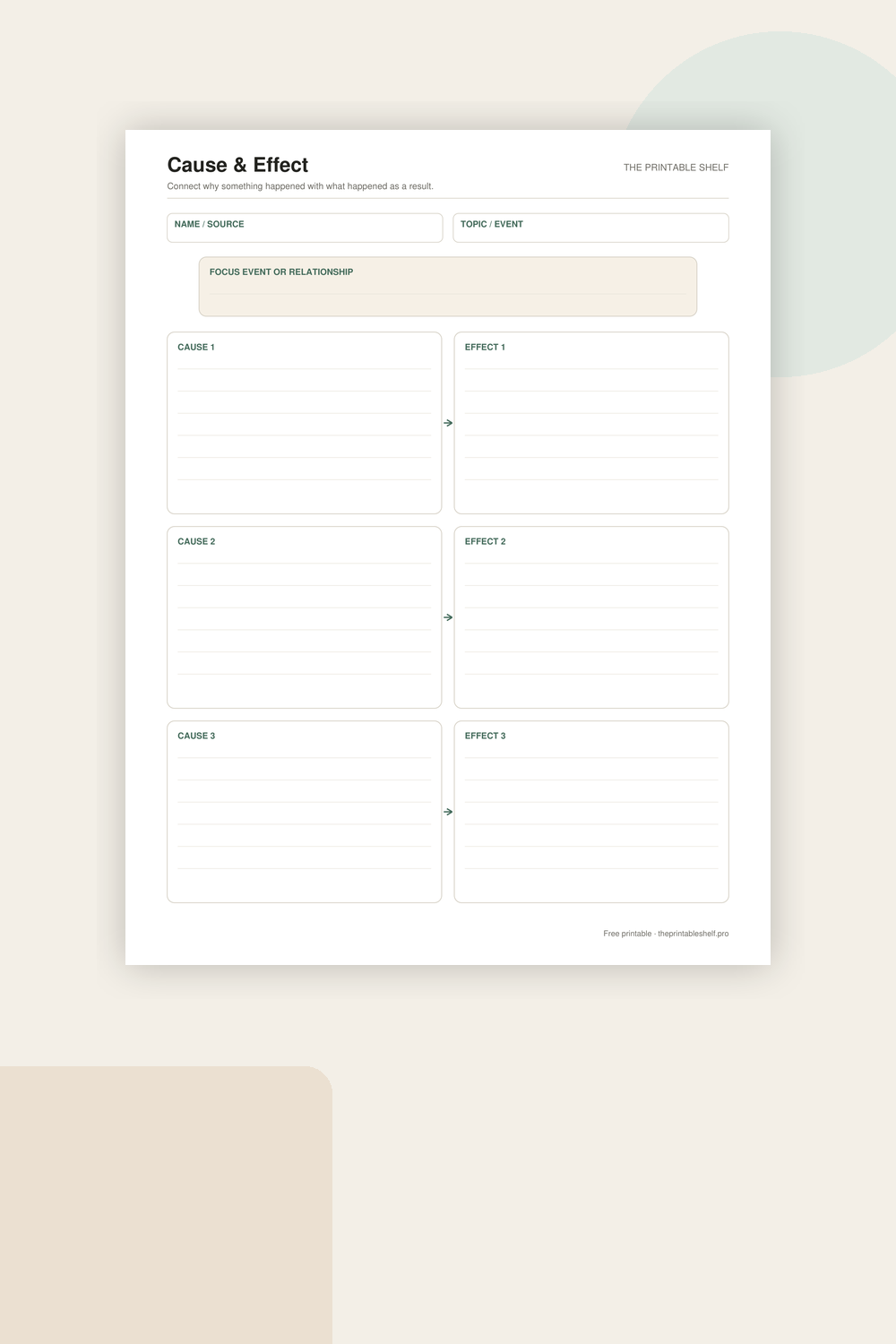
Cause and Effect Graphic Organizer
A one-page organizer for examining causal relationships instead of simply listing events. Each cause is visually connected to its effect, and the focus box at the top gives the page one clear subject so students can analyze several relationships without losing track of the larger event, text, or concept.
Free printable
Printable Story Map Template
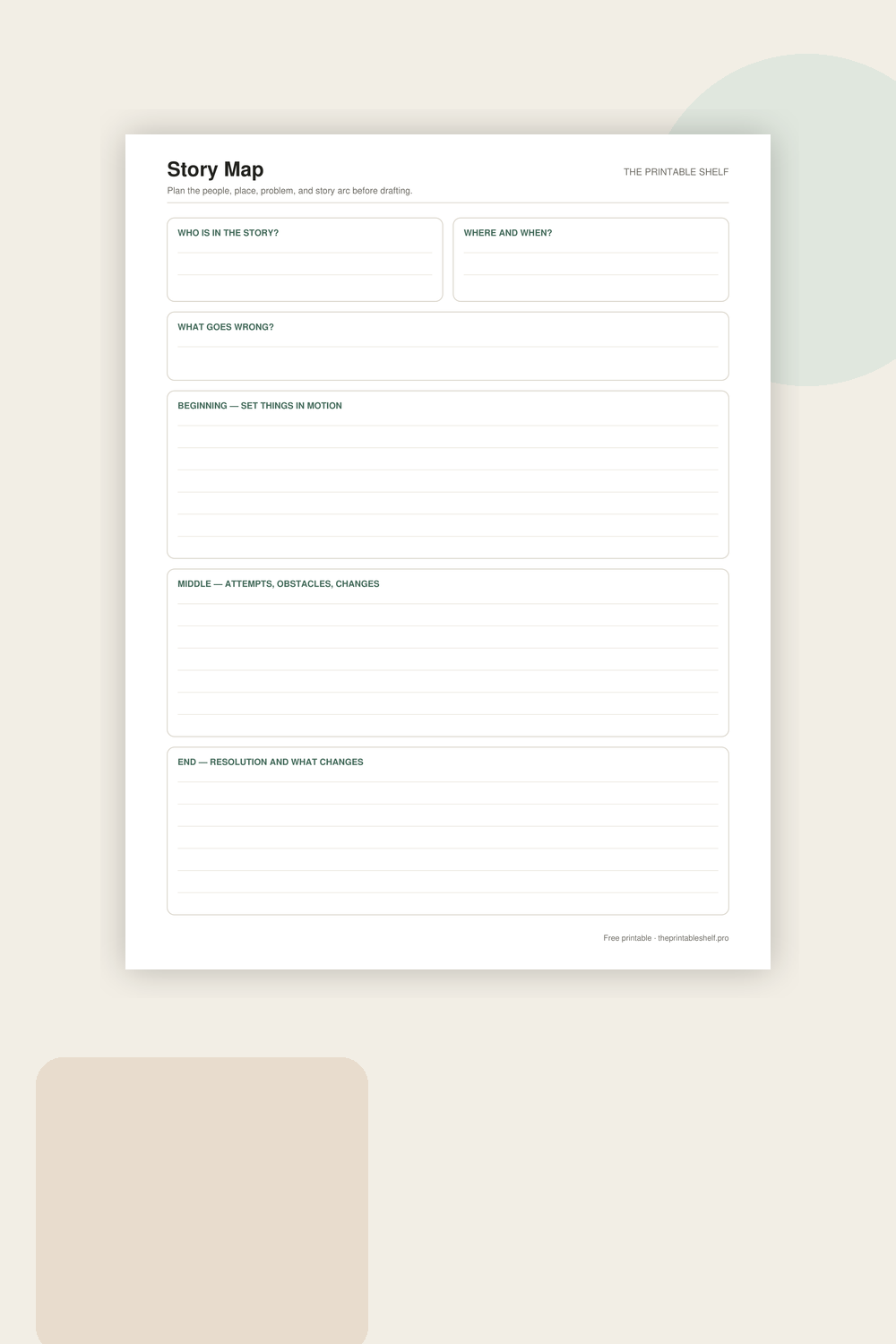
A one-page story organizer that separates the pieces students often mix together. Characters and setting establish who and where, the problem gives the story something to resolve, and three larger boxes organize the sequence into beginning, middle, and end. It works for reading response or prewriting.