How-to guide · Work & Study
How to Use a KWL Chart Before, During, and After Reading
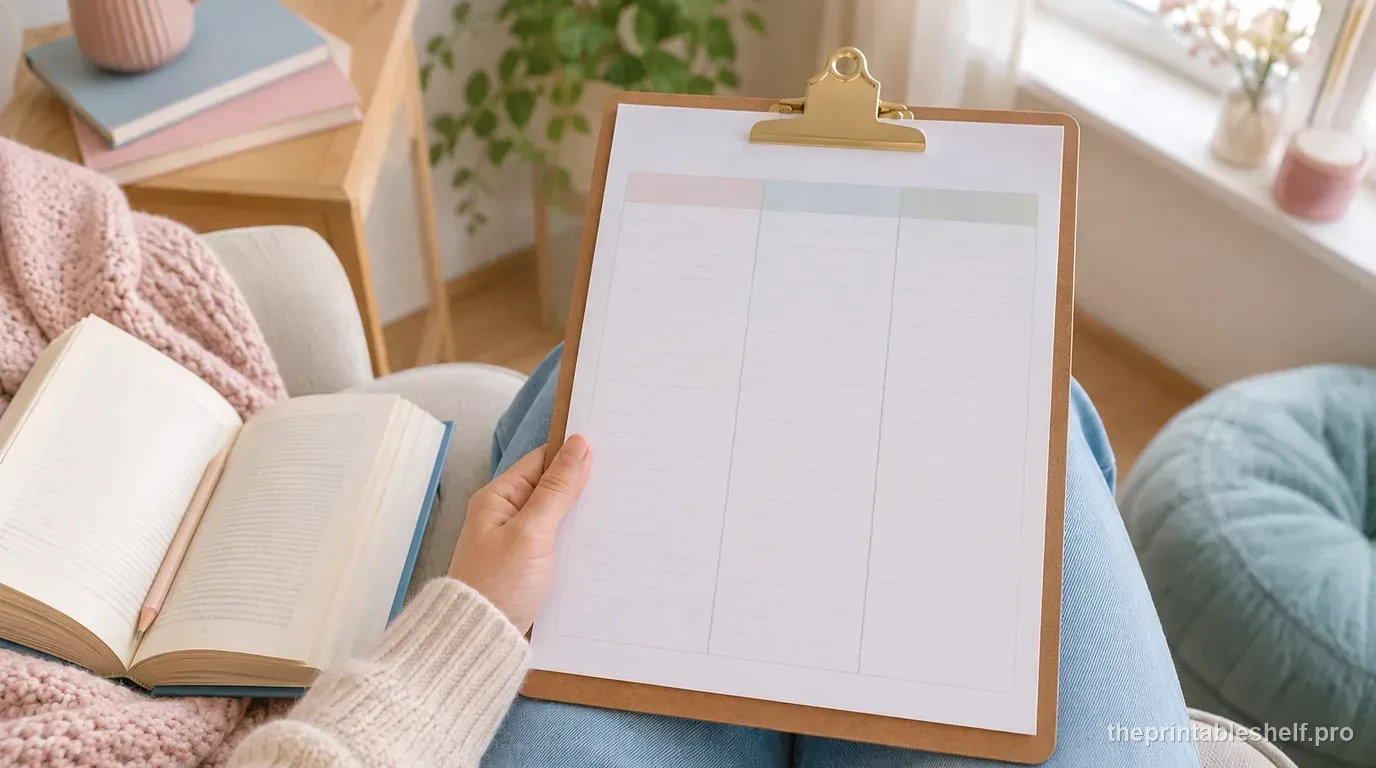
A KWL chart looks almost too simple: three columns labeled Know, Want to Know, and Learned. The value is not the columns themselves. The value comes from using them at different moments. K makes prior knowledge visible before the learner encounters new information. W gives the reading or lesson a purpose. L forces a return to the original ideas and questions so the learner can identify what changed.
Texas A&M's Academic Success Center presents KWL as a purposeful reading strategy: assess what you know, decide what you want to learn, then reflect on what you learned. Britannica's current teaching guide similarly places the strategy before, during, and after reading. That timing is the part most likely to disappear when KWL becomes a one-page worksheet completed in a rush.
What each KWL column is actually for
The K column is not a quiz and should not be graded for perfect accuracy. It is a snapshot of what the learner currently believes, remembers, or associates with the topic. The W column is not a list of generic wishes such as I want to know more. It should contain questions specific enough to guide attention. The L column is not a copy box for facts from the final paragraph; it is where the learner records important learning, answers earlier questions, and revises ideas that changed.
| Column | When to use it | Best prompt | What good entries look like |
|---|---|---|---|
| K — Know | Before reading or instruction | What do I already think I know that is relevant? | Short prior-knowledge statements, labeled uncertainty when needed |
| W — Want to know | Before reading and updated during learning | What specific question do I want this source or lesson to answer? | Answerable questions, not broad topic labels |
| L — Learned | During checkpoints and especially after learning | What important idea can I now explain, and which earlier question does it answer? | Paraphrased learning, corrections, remaining gaps |
Before reading: build K without turning it into a guessing contest
Start with a precise topic. Rainforests is broad; How tropical rainforests recycle water gives the learner a clearer target. Ask for a few things the learner already knows or thinks they know that could help make sense of the reading. Encourage labels such as sure, think, or not sure if confidence matters. That small distinction makes it easier to correct prior knowledge later without treating an early misconception as a failure.
Do not spend so long brainstorming K that the activity replaces the reading. Record a compact set of relevant entries—enough to establish a starting point without turning prior-knowledge activation into the main task. For group work, have students write privately before sharing. Independent thinking reduces the chance that the first confident speaker supplies the entire class's K column and makes everyone else's prior knowledge invisible.
Before reading: turn W into questions that can guide attention
The W column becomes useful when entries are specific enough to be answered. I want to learn about volcanoes does not tell the reader what to notice. What makes some eruptions explosive? and How do scientists monitor a volcano before an eruption? create targets. Texas A&M frames this step as setting a purpose for reading, which is a better mental model than treating W as a decorative middle column.
If students struggle to generate questions, preview headings, diagrams, captions, or the first paragraph, then write questions prompted by that preview. ReadWriteThink's KWL graphic organizer explicitly includes a preview stage before reading. The questions do not need to predict everything the source will cover; they need to give the learner a reason to look for relationships, explanations, definitions, or evidence.
During reading: do not wait until the end to look at the chart again
Keep the KWL sheet beside the text instead of underneath a stack of papers. When a W question is answered, mark it lightly or add a short note rather than writing the full L response immediately. When a new question emerges, add it to W. When the text contradicts something in K, put a small question mark or correction arrow beside the original statement so the change remains visible.
This during-reading pass turns the sheet into a monitoring tool. A learner who reaches the midpoint with no answered questions and no new questions has useful information: perhaps the source is not relevant to the inquiry, perhaps the questions are too broad, or perhaps comprehension has broken down. The chart can prompt a reread, a vocabulary check, or a decision to consult another source rather than simply producing an empty L column at the end.
After reading: make L do more than list facts
Complete L with the source closed or partly covered if possible. Start by answering the strongest W questions in the learner's own words. Then add important ideas that were not anticipated. Return to K and identify statements that were confirmed, refined, or contradicted. A useful final KWL sheet should show movement in understanding, not three unrelated lists.
Facing History describes KWL as a way to organize information before, during, and after a lesson, while Britannica highlights summarization and metacognition as part of the strategy. Those benefits require reflection. Ask: What changed in my thinking? Which question remains unanswered? Which idea could I now explain to someone else? That final comparison is more valuable than copying six facts into L because the boxes need to look full.
Worked example: a KWL chart for volcanoes
Suppose the topic is Why volcanoes erupt. Before reading, K might contain: Volcanoes contain hot melted rock; eruptions can release ash; some volcanoes are dormant. One entry could be marked unsure: Pressure builds inside every volcano in the same way. W could include: What creates the pressure? Why are some eruptions explosive? Can scientists tell when an eruption is likely? These questions are specific enough to guide attention.
During reading, the learner discovers that magma contains dissolved gases and that pressure changes can allow gases to expand. A diagram raises a new question about magma viscosity, so that question is added to W. After reading, L does not merely say Magma has gas. A stronger entry is: As magma rises and surrounding pressure drops, dissolved gases can come out of solution and expand; if the magma is viscous enough to trap those gases, pressure can build and contribute to explosive behavior. The learner then revisits the unsure K statement and revises it instead of silently abandoning it.
The point of the example is the movement: prior belief → targeted question → evidence → revised explanation. If the finished chart cannot show that movement, the learner may have used the page as three separate note boxes rather than a before-during-after strategy.
Use KWL differently for a lesson, a chapter, and a research project
For a short lesson, keep the chart compact: a small set of K entries, focused W questions, and a short L reflection. For a textbook chapter, let W questions map to section headings and add L notes after major sections instead of waiting until the end. For a research project, keep unanswered W questions active across multiple sources and note which source resolved each one in the research notes rather than squeezing citations into the KWL page itself.
For independent study, the chart can also act as a readiness check. If K is empty because the topic is genuinely new, that is not a problem; preview the material and build initial questions. If W is empty after previewing, the learner may need a stronger purpose. If L repeats wording from the source, cover the source and try again in plain language. The template should adapt to the learning task rather than forcing every use case into the same number of entries.
Choose the KWL variation that matches the task
Use standard KWL when the goal is prior knowledge → questions → learning. A lined version supports longer responses; a guided version can turn the labels into prompts such as What do I think I know? and What changed in my thinking? Younger learners may benefit from a picture-and-words layout that reduces writing load without removing the before-and-after reasoning.
Add a column only when it solves a real problem. KWLQ adds Questions Remaining; KWHL adds How will I find out? for research planning. Otherwise, the three-column chart is clearer. The current free download is the standard lined KWL; expanded formats should remain separate.
When a KWL chart is the wrong tool
KWL is strongest when prior knowledge and inquiry matter. It is less useful for tasks where the central challenge is showing event order, comparing two subjects, mapping cause and effect, or developing one vocabulary concept in depth. In those cases, the three KWL columns can hide the relationship the learner actually needs to see.
Choose a sequence organizer for chronology, a Venn diagram for shared and unique traits, a cause-and-effect organizer for causal reasoning, or a Frayer model for a concept that needs characteristics, examples, and non-examples. Using a different organizer is not abandoning KWL; it is matching the visual structure to the thinking task, which is the same principle that makes any graphic organizer useful.
Free Sequence of Events Graphic Organizer →
Better than KWL when the main job is preserving order or steps.
Free Venn Diagram Template →
Better when the learner must make similarities and differences visible.
Free Frayer Model Vocabulary Template →
Better when one concept needs definition, characteristics, examples, and non-examples.
Common KWL mistakes and quick fixes
Mistake one is correcting K immediately. Instead, preserve questionable ideas and revisit them after learning so conceptual change is visible. Mistake two is filling W with vague phrases. Turn each phrase into a question that the learner could recognize as answered. Mistake three is completing all three columns at the same time after the reading. That removes the before-and-after comparison that gives KWL much of its value.
Mistake four is grading the number of entries. A learner can write eight trivial facts and learn less than a learner who revises one important misconception. Mistake five is treating unanswered W questions as incomplete work. Some unanswered questions are the most valuable output because they identify what the current source did not explain and point toward the next reading or research step.
Common questions
How do you fill out a KWL chart?
Before reading, write what you already know in the K column and what you want to find out in the W column. After reading or the lesson, return to the chart and write what you learned in the L column, including corrections to anything you listed under K. Questions that were not answered can move into a follow-up W list.
What is the 3-2-1 reading strategy?
After reading, a student writes three things they learned, two things they found interesting, and one question they still have. It is a quick closing routine that works well after a KWL chart because it reuses the same ideas of learning, interest, and curiosity in a short format.
What does KWL stand for?
K stands for what I Know, W for what I Want to know, and L for what I Learned. The columns are normally used at different points before, during, and after learning.
Should students fill out the L column during reading or after reading?
The main L reflection is best completed after reading or instruction, but students can mark answers and important discoveries during reading. The key is to return to the earlier K and W entries rather than treating L as an isolated fact list.
What if a student has nothing to write in the K column?
That is acceptable when the topic is genuinely unfamiliar. Preview headings, images, captions, or a short introduction, record any relevant associations, and use the W column to create questions that give the reading a purpose.
Free printables to go with this guide
Free Printable KWL Chart →
A KWL chart helps learners organize what they already know, what they want to find out, and what they learned. Fill in K and W before reading or instruction, then return to L afterward. This free version includes writing lines and comes in US Letter, A4, and PNG formats.
Free Sequence of Events Graphic Organizer →
This sequence of events organizer gives you five ordered steps labeled First, Next, Then, After That, and Finally, plus a final reflection on what changed. Use it to retell a story, track historical events, explain a process, or plan a procedure. Download the printable in Letter, A4, or PNG.
Free Printable Venn Diagram Template →
This free Venn diagram template gives you two large overlapping circles for comparing two topics. Put traits unique to each topic in the outer sections and shared traits in the overlap. It works for reading, science, social studies, decision-making, and study review, with Letter, A4, and PNG downloads.
Free Printable Frayer Model Vocabulary Template →
This free Frayer Model template helps learners understand a word or concept through four lenses: definition, characteristics, examples, and non-examples. The format is useful for vocabulary in reading, science, social studies, and math because it makes the boundaries of a concept visible. Download Letter, A4, or PNG.
Where this comes from
These sources support the instructional background in this guide. The printable recommendations and usage notes above are The Printable Shelf's editorial guidance.
- Texas A&M Academic Success Center — The KWL Method — Frames KWL as a purposeful reading strategy: assess prior knowledge, set a reading purpose, and reflect on learning.
- Teach Britannica — K-W-L — Describes KWL as a before-, during-, and after-reading strategy that activates background knowledge and supports reflection.
- Facing History & Ourselves — K-W-L Charts — Current teaching-strategy guidance for using KWL to organize what students know, want to learn, and learn across a lesson.
- ReadWriteThink — KWL Graphic Organizer — Printable KWL resource that explicitly separates before-reading, after-previewing, and after-reading stages.
- U.S. Geological Survey — How Do Volcanoes Erupt? — Supports the worked volcano example: viscous magma can inhibit gas escape, allowing pressure to build and contribute to explosive eruptions.
More guides

How to Use Graphic Organizers Effectively (Without Turning Them Into Busywork)
Learn how to choose, model, scaffold, and reuse graphic organizers so students think with them instead of simply filling in boxes.
Read guide →
Free Reading Comprehension Graphic Organizers by Reading Skill
Free reading comprehension graphic organizers for story elements, main idea, sequence, cause and effect, comparison, vocabulary, and prior knowledge.
Read guide →
10 Free Graphic Organizers for Reading, Writing, and Studying
Download 10 free graphic organizers for reading, writing, comparison, vocabulary, sequencing, and study. Includes a guide to choosing the right one.
Read guide →