Math Worksheets · Free 13-page pack
Free 2-Digit Addition with Regrouping Worksheets PDF
For grades 1-2, this 13-page pack gives children 2-digit addition practice with regrouping. Each of its six practice sheets has 20 vertical addition problems, including sums such as 26 + 17 and 24 + 19. The answer key follows the practice pages, so students can work with two-place numbers while keeping tens and ones in view.
Edited by Tessa Vaughn · Planning & Organization Editor
Free download
Download the 13-page pack
This multi-page pack currently has one print-ready format. Preview the PDF, then print the whole pack or only the page range you need.
Share to Google Classroom ↗No sign-up required · personal/classroom use
Practice this skill on screen30 questions in three levels (easy, medium, hard) with instant feedback. Nothing to install.Get the whole set: 7 packs in one zipAddition and subtraction worksheet packs. Grades K–3: fact fluency, regrouping and word problems. US Letter PDFs with answer keys, 287 KB.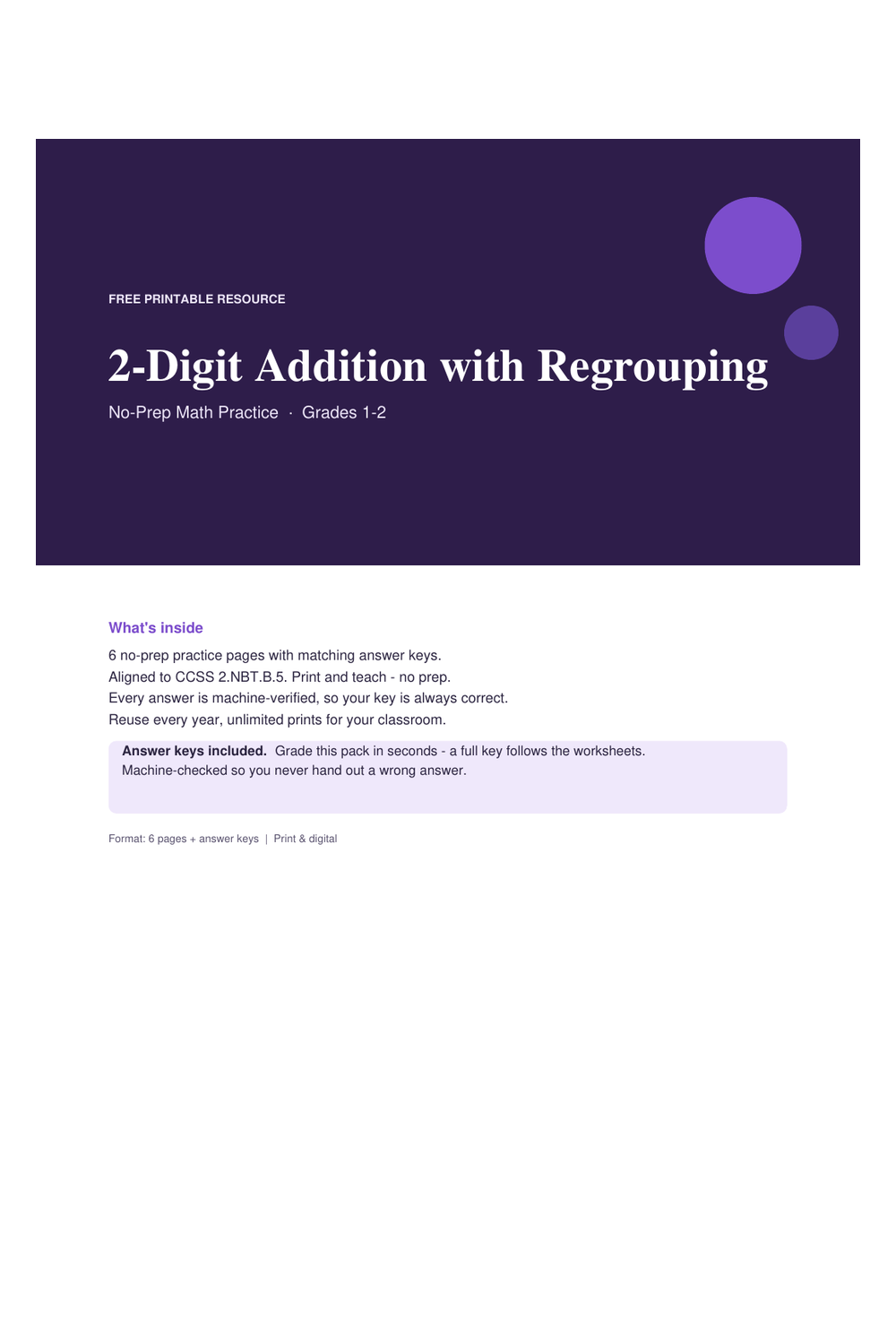
What this page helps with
There are 13 US Letter pages in this file. A cover comes first; six student sheets numbered 2 through 7 follow, with their matching solutions on pages 8-13. The counted practice sheets (pages 2, 3, and 7) have 20 vertical two-digit sums apiece; the others use the same format. Examples range from 12 + 29 to 68 + 12. Every practice sheet provides Name and Date lines. An answer key is included.
Why ten ones become another ten
A two-digit number has a tens place and a ones place. Add the ones first. When their total is ten or more, trade ten ones for one ten: write the leftover ones in the ones place and add the traded ten to the tens column. This keeps the value unchanged. For example, 26 + 17 has 6 + 7 = 13 ones, which is 1 ten and 3 ones.
Next combine the tens, including any ten carried from the ones. In 26 + 17, the tens are 2 + 1 + 1 carried ten, making 4 tens; together with 3 ones, the sum is 43. Children can model the trade with ten single counters exchanged for a ten-stick, then record the same exchange above the written columns. The column position matters because each digit represents a different unit.
Worked example 1
26 + 17
Add ones: 6 + 7 = 13. Exchange 10 ones for 1 ten, leaving 3 ones. Add tens: 2 + 1 + 1 carried ten = 4 tens.
Answer: 43
Worked example 2
34 + 58
8 + 4 = 12 ones, so record 2 ones and carry 1 ten. Then 3 + 5 + 1 = 9 tens.
Answer: 92
Worked example 3
68 + 12
Eight ones and two ones make one full ten, leaving zero ones. Exchange that ten, then total the tens: six + one + one = eight.
Answer: 80
Teaching it step by step
Trade with ten counters
Give the child two groups of counters for an example such as 26 + 17: two tens and six ones, then one ten and seven ones. Join the ones. When there are thirteen, bundle ten as a new ten-stick and leave three loose counters. Count the four tens and three ones, then write 43 in aligned columns.
Mark the place columns
Draw a tens column and an ones column before solving 34 + 58. Put each digit in its place, and keep the carried ten above the tens column. Have the learner point to each column while saying its unit. This makes the exchange visible and discourages adding digits across different places.
Connect trade and notation
After modeling 15 + 79 with counters, ask the child to record 5 + 9 ones as 14, write four ones, and note the extra ten. Add that ten to 1 + 7 tens. Compare the concrete bundle with the written carry so both records describe the same quantity.
Check by estimating
Before calculating 39 + 45, round each addend to a nearby ten: about 40 plus 50 is about 90. Solve with the columns, then see whether the exact answer 84 is reasonable. Ask the learner to explain why carrying changes the tens count but does not add a new value to the total.
Where it fits best
Ways to use it
A short column routine
Use a selected set of vertical sums when a learner is practicing the exchange from ten ones to one ten. The repeated layout keeps attention on the regrouping step and the place-value columns.
Partner explanation
Pairs can solve a problem such as 42 + 49 separately, then compare where the carried ten belongs. Ask each child to describe the ones trade before they discuss the tens total.
Independent check
After a worked model, let a student complete a few sums and compare them with the included answer key. Review any mismatch by checking the ones exchange and the tens column in order.
Where learners go wrong
For 26 + 17, writing 13 in the ones place without carrying the extra ten.
Represent thirteen ones with ten counters bundled as one ten and three loose ones. Record the 3 in the ones place, carry 1 ten, then add 2 + 1 + 1 tens to get 43.
Adding the tens first in 34 + 58 and forgetting the ten carried from the ones column, leading to 82.
Add the ones first: 4 + 8 makes 12, so record 2 and carry 1 ten. Then add 3 + 5 + 1, giving 9 tens. The correct total is 92.
For 15 + 79, carrying the 1 from 14 ones but leaving the 4 out of the ones column.
Write the leftover four ones below the ones column before adding tens. The carried ten joins 1 ten and 7 tens, giving 9 tens; the complete sum is 94.
Adding the carried ten twice in 29 + 38 after writing it above the tens column.
Use one mark for the carried ten and include it once in 2 + 3 + 1. The tens total is 6 and the ones total is 7, so 29 + 38 = 67.
Frequently asked questions
How do you add two-digit numbers with regrouping?
Line up tens with tens and ones with ones. Add the ones first. If they make ten or more, write the leftover ones and carry one ten. Then add both tens digits and the carried ten. For 26 + 17, thirteen ones become one ten and three ones, and the tens total becomes four, so the sum is 43.
How can I teach regrouping in addition to a young learner?
Start with bundles and loose counters so a child can exchange ten ones for a ten. Use a problem such as 34 + 58, then draw the same tens and ones in columns. Ask the learner to explain how the bundle appears in the written work. This links the carry mark to a real change in units.
How can a learner check addition with regrouping?
Estimate the total by rounding each addend, then compare the estimate with the exact sum. For 39 + 45, about 40 + 50 suggests a result near 90, while the exact total is 84. A second check is to add the answer's tens and ones back against the original columns, watching that the carried ten was counted once.
What is included in this 2-digit addition with regrouping worksheet pack?
The file has a cover and six student sheets; each sheet contains 20 vertical addition items. Worked answers are collected at the end, on pages 8-13. Examples in the pack include 26 + 17, 34 + 58, and 24 + 19. The practice pages also provide spaces for a student name and date.
Is this 2-digit addition with regrouping worksheet pack free?
Yes. There is no charge and downloading does not require a sign-up. The file is supplied as a US Letter PDF; the pack information lists no A4 or PNG edition. Within its 13 pages, the six practice sheets are followed by their answer key, placed on pages 8-13.
Keep organizing
You might also like
Free 13-page pack
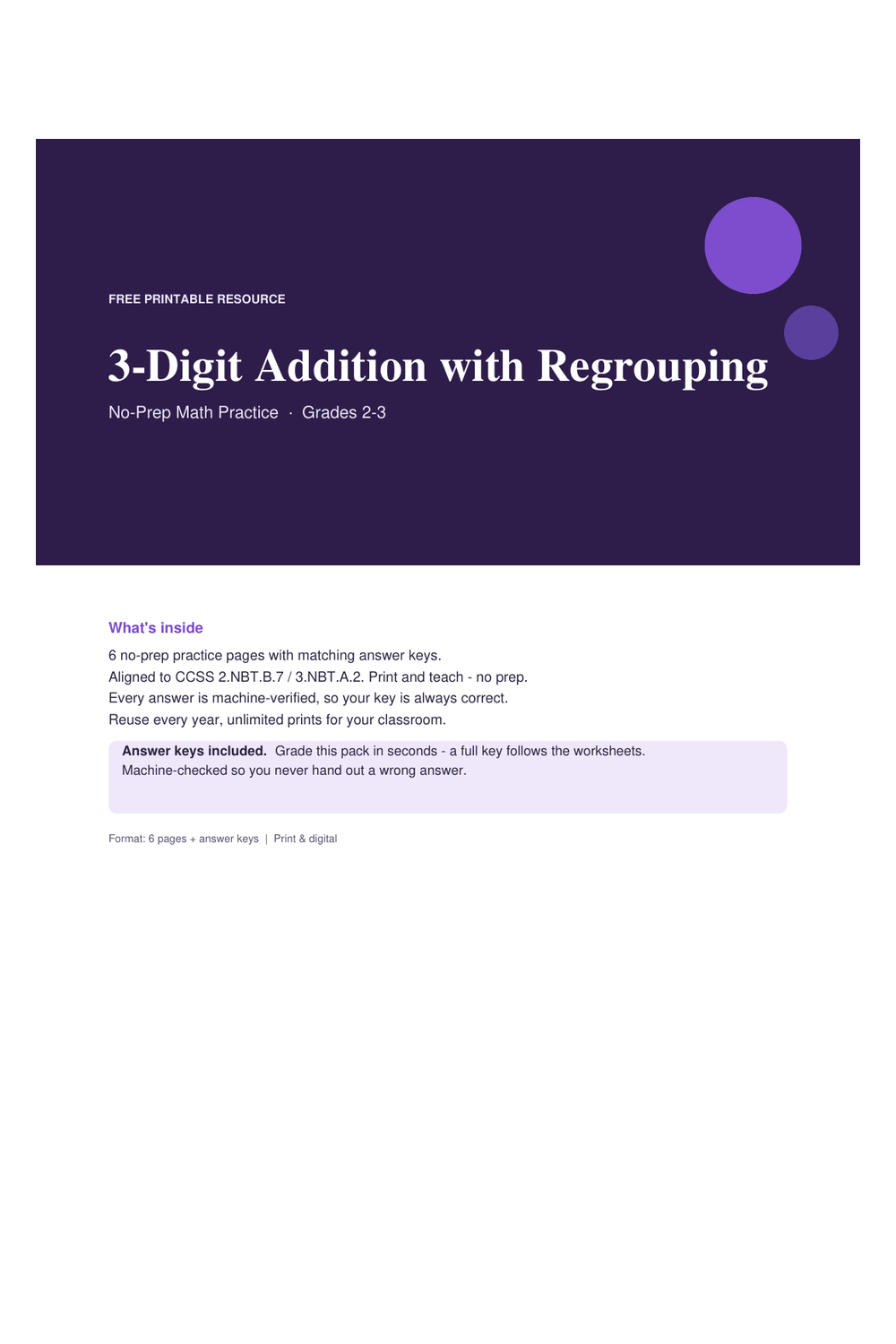
3-Digit Addition with Regrouping Worksheets PDF
A 13-page US Letter math pack for grades 2-3. The PDF keeps the student practice and matching answer-key pages together in one file so you can print only the pages you need. The main skill is to manage regrouping across ones, tens, and hundreds without losing carried values. The pack references 2.NBT.B.7, 3.NBT.A.2 on the cover. Standards noted for this pack: 2.NBT.B.7, 3.NBT.A.2.
View & download →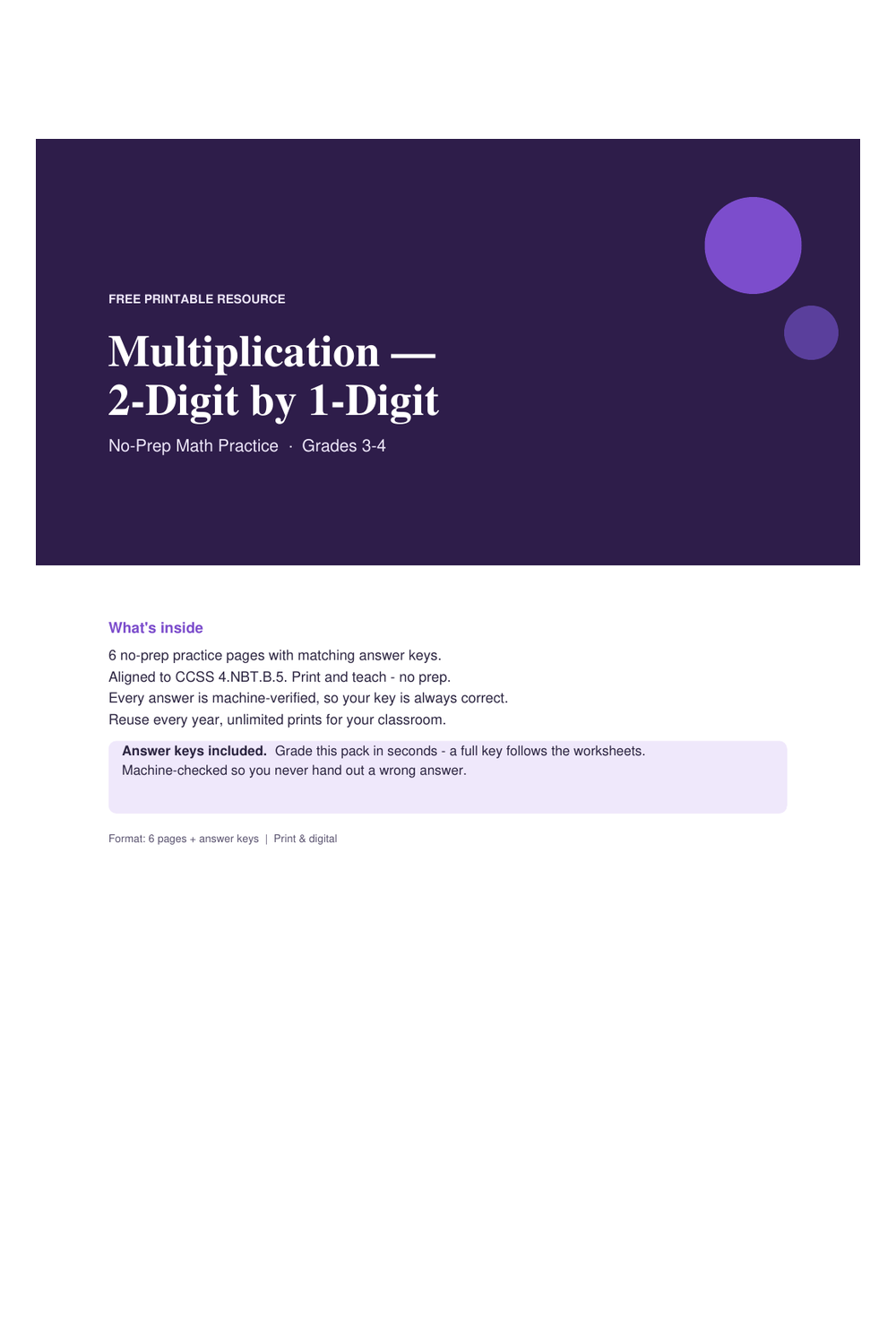
Free 13-page pack
Multiplication — 2-Digit by 1-Digit Worksheets PDF
A 13-page US Letter math pack for grades 3-4. The PDF keeps the student practice and matching answer-key pages together in one file so you can print only the pages you need. The main skill is to use place value or the distributive property to multiply a 2-digit number by a 1-digit factor. The pack references 4.NBT.B.5 on the cover. Standards noted for this pack: 4.NBT.B.5.
View & download →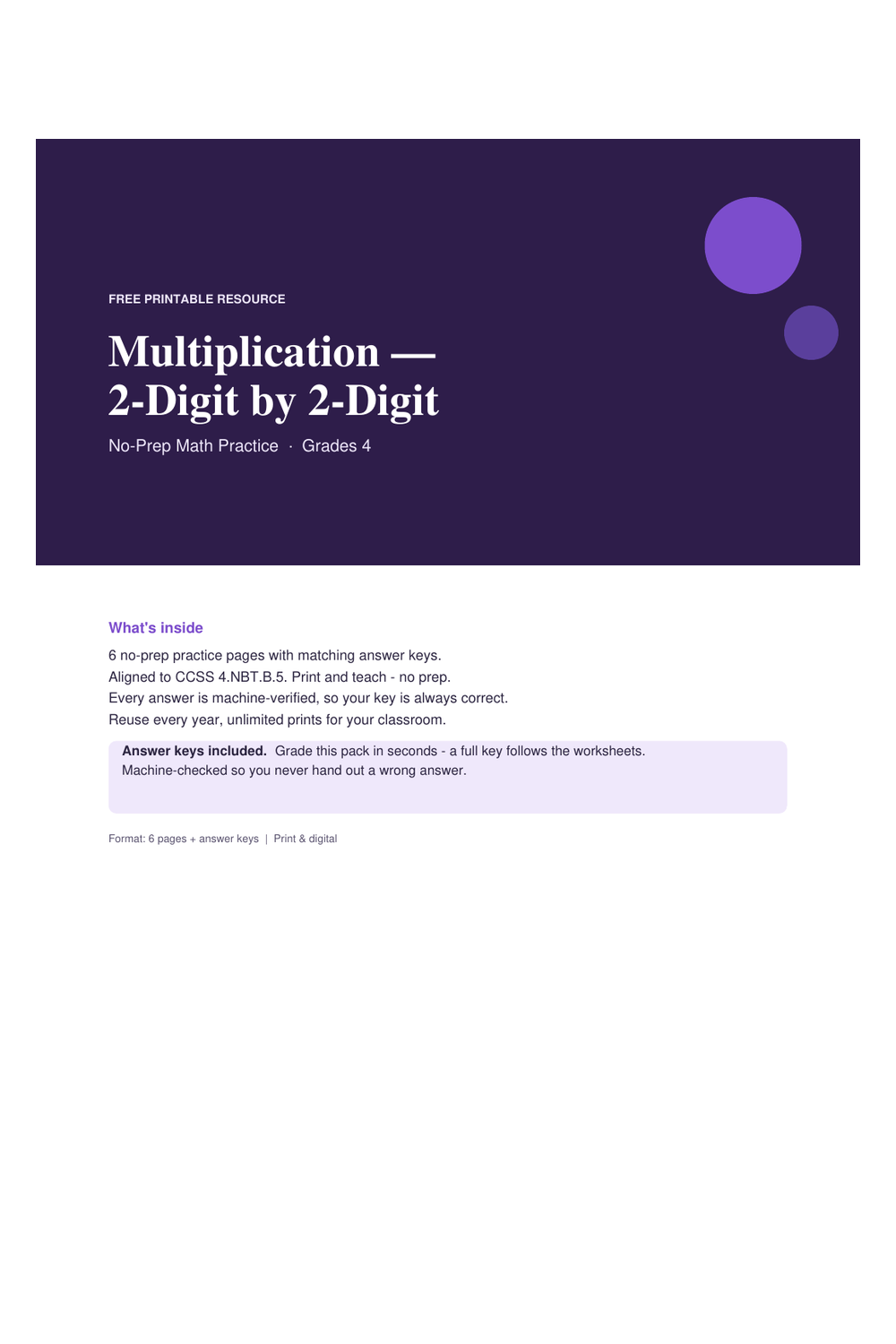
Free 13-page pack
Multiplication — 2-Digit by 2-Digit Worksheets PDF
A 13-page US Letter math pack for grades 4. The PDF keeps the student practice and matching answer-key pages together in one file so you can print only the pages you need. The main skill is to organize partial products for two 2-digit factors and combine them accurately. The pack references 4.NBT.B.5 on the cover. Standards noted for this pack: 4.NBT.B.5.
View & download →