Math Worksheets · Free 13-page pack
Free Multiplication — 2-Digit by 1-Digit Worksheets PDF
This 13-page grade 3-4 PDF gives learners practice with products built from a two-place factor and a single-digit multiplier. Each of the three cited sheets has 20 vertical items, from a ×1 fact such as 42 × 1 to a regrouping problem such as 78 × 9. The six-sheet sequence has matching answer keys.
Edited by Tessa Vaughn · Planning & Organization Editor
Free download
Download the 13-page pack
This multi-page pack currently has one print-ready format. Preview the PDF, then print the whole pack or only the page range you need.
Share to Google Classroom ↗No sign-up required · personal/classroom use
Practice this skill on screen30 questions in three levels (easy, medium, hard) with instant feedback. Nothing to install.Get the whole set: 6 packs in one zipMultiplication and skip counting worksheet packs. Grades K–5: skip counting, multi-digit multiplication and fact fluency. US Letter PDFs with answer keys, 436 KB.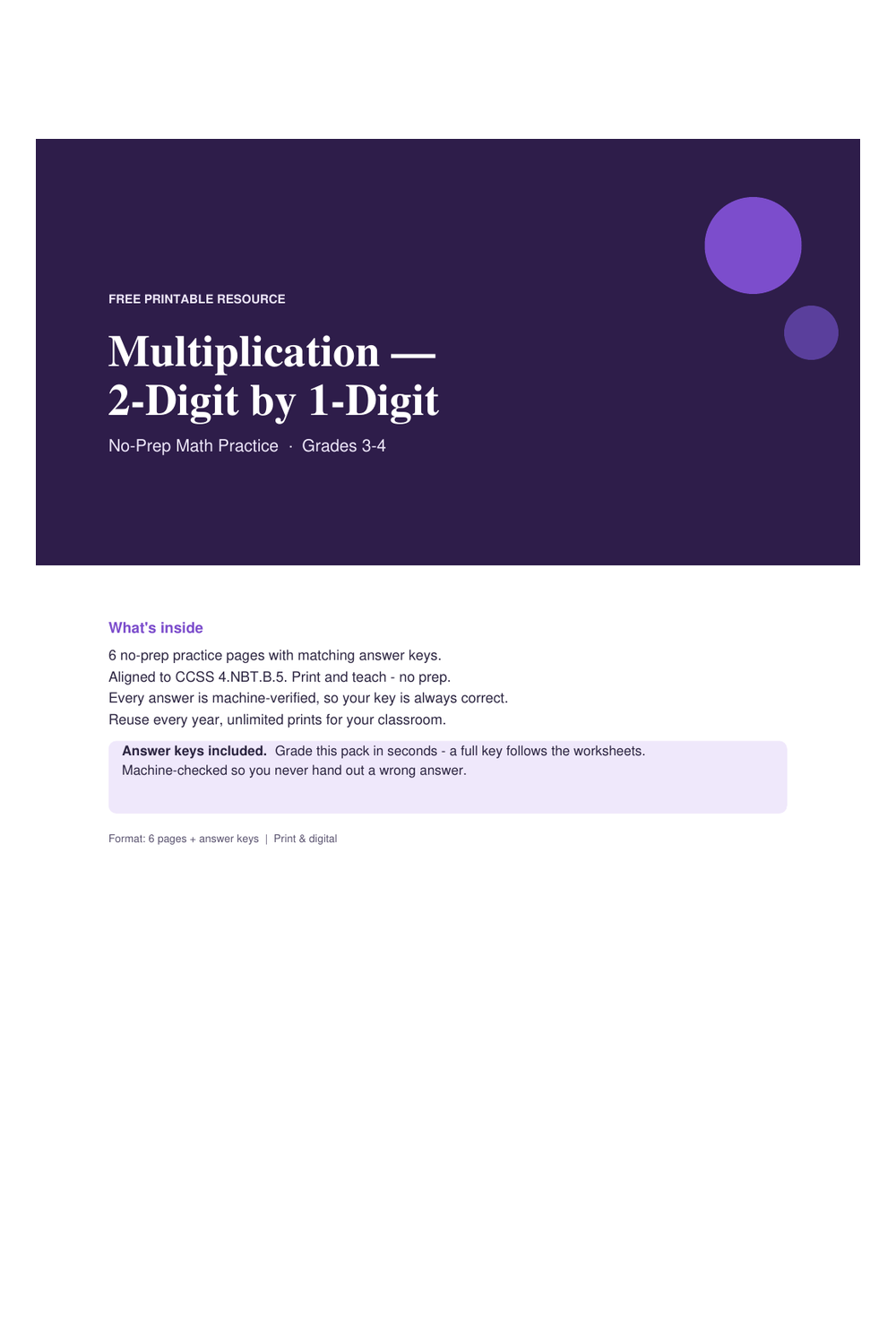
What you get in this download
Marked for grades 3-4 and CCSS 4.NBT.B.5, the 13-page US Letter file has six student sheets. Worksheets numbered 2, 3 and 7 each set 20 products vertically, with student name and date spaces. Each pairs a two-digit value with one single-digit multiplier, including ×1 facts and regrouping cases such as 78 × 9. Additional sheets use the same format. Matching solutions fill the key section, pages 8-13.
Why multiplication can split by place
A two-digit number is made of tens and ones. Multiplying it by one digit means taking that many groups of both parts. For 43 × 4, think of four groups of 40 and four groups of 3. Their partial products are 160 and 12; together they make 172. This explains why multiplying only the ones digit cannot finish the problem.
A written algorithm keeps the same place-value idea while working from the ones column. Multiply the ones, regroup any tens into the tens column, then multiply the tens and include the regrouped amount. With 78 × 9, nine groups of 8 ones make 72 ones, or 7 tens and 2 ones. Those 7 tens must join the 63 tens from nine groups of 70.
Worked example 1
Find 43 × 4.
Split 43 into 40 and 3. Multiply each part: 40 × 4 = 160 and 3 × 4 = 12. Add the partial products.
Answer: 172
Worked example 2
Find 78 × 9.
9 × 8 ones = 72 ones, regroup as 7 tens and 2 ones. Then 9 × 7 tens = 63 tens; add the 7 regrouped tens for 70 tens.
Answer: 702
Worked example 3
Find 42 × 1.
One group of 42 is 42. In place-value terms, 40 × 1 = 40 and 2 × 1 = 2; combine the parts.
Answer: 42
How to teach this skill
Split tens and ones
Write a two-digit factor as tens plus ones, then draw one group for each part. For 43 × 4, record 40 × 4 and 3 × 4 before adding. The split method makes the source of both partial products explicit and gives children a way to check a vertical solution.
Bundle ten ones
Use place-value disks or draw dots for a problem that makes more than nine ones. In 78 × 9, the ones produce 72. Circle ten groups of ten once, leaving two ones and seven tens to carry into the tens total. This shows what regrouping means instead of treating it as a mark to copy.
Estimate before calculating
For 78 × 9, replace 78 with 80 while keeping nine groups. That benchmark is 720, so the exact product should sit nearby. Compare the final result with this scale check; a large gap can point to a misplaced digit or a forgotten regrouping step.
Read the columns aloud
Have the learner say the ones product, any regrouped tens, and then the tens product while writing vertically. Keep the carried value beside the tens column until it is combined. This verbal sequence is useful when a problem such as 59 × 8 creates a regrouping step.
Works well for
Classroom and home ideas
A regrouping lesson
Select a problem such as 78 × 9 and pause after the ones product. Ask students to show how 72 ones become seven tens and two ones before finishing the tens column.
A fact fluency bridge
For a problem with a multiplier of 1, such as 42 × 1, connect multiplication to one equal group. Then contrast it with a larger factor to discuss repeated groups.
An estimation check
Have students estimate a product using a nearby ten, then calculate exactly. Discuss whether the answer is in a reasonable neighborhood, especially when regrouping is involved.
What usually goes wrong
For 43 × 4, multiplying only 3 × 4 gives 12 and ignores the 40.
Separate 43 into 40 and 3. Find 40 × 4 = 160 and 3 × 4 = 12, then combine both partial products. Ask which part of the original number each product represents.
In 78 × 9, writing 72 in the ones place drops the seven regrouped tens.
Rename 72 ones as 7 tens and 2 ones. Put 2 in the ones place and add 7 tens to the tens product, 9 × 7 tens. The complete product is 702.
In 59 × 8, placing the tens product directly beside 72 can shift a place.
Label the columns before calculating. The 9 × 8 result gives 2 ones and 7 tens to regroup; 5 tens × 8 is 40 tens. Combine 40 tens and 7 tens to get 470, plus 2 ones.
Writing 42 × 1 as 421 treats the multiplier like a digit appended to the factor.
Ask what one group of 42 contains: it still has 42. Or split it into 40 × 1 and 2 × 1, then add 40 + 2. The product is 42, not a new three-digit numeral.
Questions people ask
How do you multiply a two-digit number by a one-digit number?
You can split the two-digit number into tens and ones, multiply each part, and add the partial products. For 43 × 4, calculate 40 × 4 = 160 and 3 × 4 = 12, then combine them to get 172. A vertical method organizes the same values by place and regroups when needed.
How to teach regrouping in two-digit multiplication?
Use a problem where the ones product is more than nine, such as 78 × 9. Show 72 individual ones, then trade 70 of them for seven tens. Keep two ones in the ones place and add the seven tens to the tens product. This connects the written carry to an actual place-value trade.
How can an estimate help check a two-digit multiplication answer?
Replace the two-digit factor with a nearby multiple of ten before calculating exactly. For 78 × 9, use 80 × 9, or 720, as a benchmark. A final product should be close to that amount. Estimation cannot confirm every digit, but it can expose a result that is much too large or small.
What is included in this multiplication 2-digit by 1-digit worksheet pack?
This 13-page US Letter file serves grades 3-4. The three identified worksheets, numbered 2, 3 and 7, each set 20 vertical multiplication items and include Name and Date spaces. The remaining student sheets use the same operation. Factors include a two-digit value and a single digit. A problem such as 78 × 9 illustrates regrouping. Answers appear on pages 8-13.
Is this multiplication 2-digit by 1-digit worksheet pack free?
Yes. Anyone can download it without registering. The available file is a US Letter PDF, and this pack does not come in A4 or PNG. It spans 13 pages; its answer key appears on pages 8-13. Students in grades 3-4 use the vertical exercises to work with two-digit and one-digit factors.
Keep organizing
You might also like
Free 13-page pack
2-Digit Addition with Regrouping Worksheets PDF
A 13-page US Letter math pack for grades 1-2. The PDF keeps the student practice and matching answer-key pages together in one file so you can print only the pages you need. The main skill is to regroup ten ones as one ten while keeping place-value columns aligned. The pack references 2.NBT.B.5 on the cover. Standards noted for this pack: 2.NBT.B.5.
View & download →
Free 13-page pack
3-Digit Addition with Regrouping Worksheets PDF
A 13-page US Letter math pack for grades 2-3. The PDF keeps the student practice and matching answer-key pages together in one file so you can print only the pages you need. The main skill is to manage regrouping across ones, tens, and hundreds without losing carried values. The pack references 2.NBT.B.7, 3.NBT.A.2 on the cover. Standards noted for this pack: 2.NBT.B.7, 3.NBT.A.2.
View & download →
Free 13-page pack
Multiplication — 2-Digit by 2-Digit Worksheets PDF
A 13-page US Letter math pack for grades 4. The PDF keeps the student practice and matching answer-key pages together in one file so you can print only the pages you need. The main skill is to organize partial products for two 2-digit factors and combine them accurately. The pack references 4.NBT.B.5 on the cover. Standards noted for this pack: 4.NBT.B.5.
View & download →