Math Worksheets · Free 13-page pack
Free Multiplication — 2-Digit by 2-Digit Worksheets PDF
Grade 4 students can use this 13-page pack to multiply two two-digit factors. The listed practice sheets, 2, 3 and 7, each present 20 vertical calculations, from round tens such as 20 × 50 to products such as 79 × 92. Six answer key sheets provide corresponding results.
Edited by Tessa Vaughn · Planning & Organization Editor
Free download
Download the 13-page pack
This multi-page pack currently has one print-ready format. Preview the PDF, then print the whole pack or only the page range you need.
Share to Google Classroom ↗No sign-up required · personal/classroom use
Practice this skill on screen30 questions in three levels (easy, medium, hard) with instant feedback. Nothing to install.Get the whole set: 6 packs in one zipMultiplication and skip counting worksheet packs. Grades K–5: skip counting, multi-digit multiplication and fact fluency. US Letter PDFs with answer keys, 436 KB.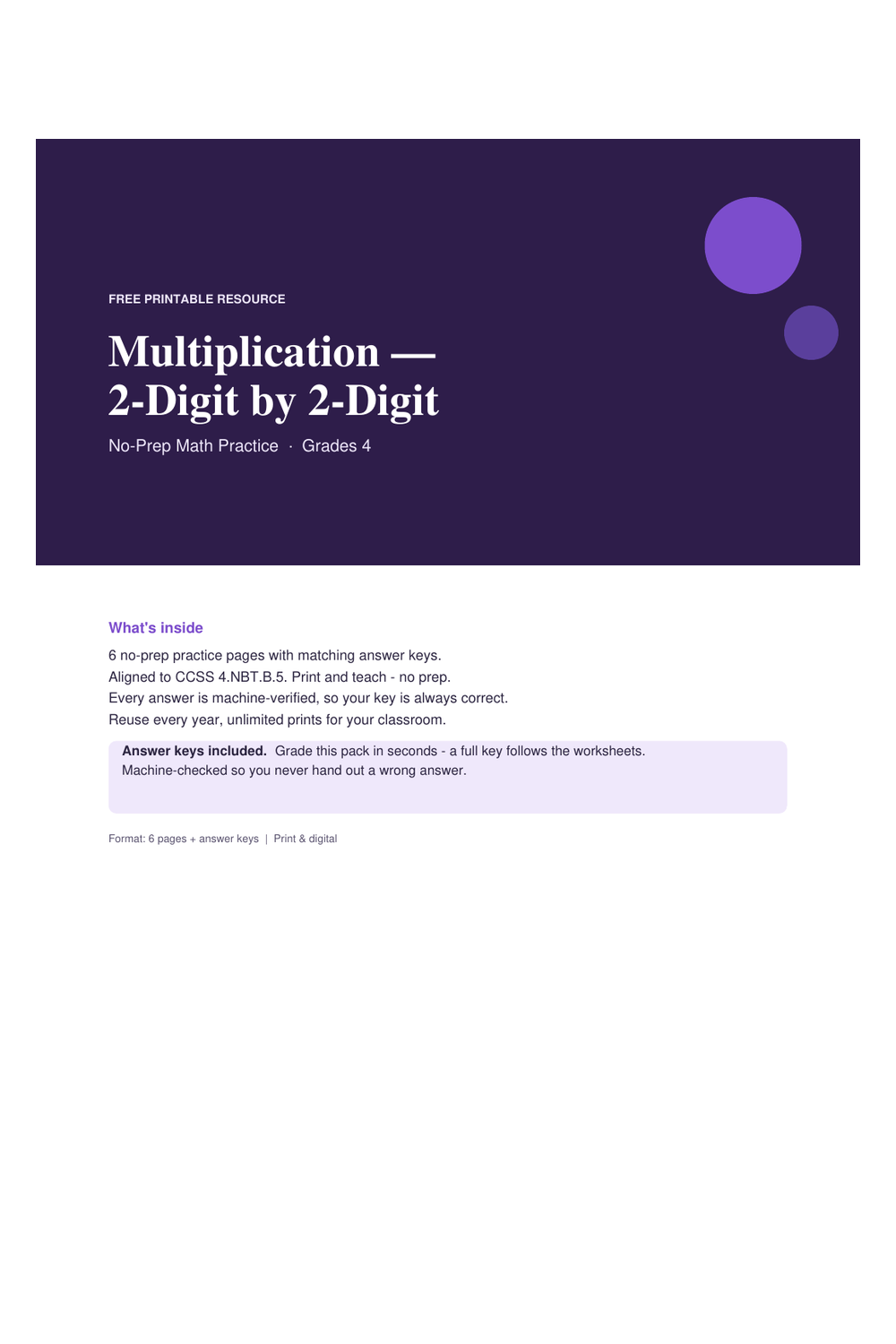
What this page helps with
Grade 4 learners get six student sheets and their keys in this 13-page US Letter resource aligned with 4.NBT.B.5. Worksheets numbered 2, 3, and 7 hold 20 vertical calculations apiece; learner identification blanks sit above each set. Both factors have two digits, with examples ranging from 20 × 50 to 96 × 96. Additional sheets continue the two-factor work. Corresponding solutions are grouped on pages 8-13 in the answer key.
How partial products combine
Each two-digit factor contains a tens part and a ones part. An area model or distributive strategy multiplies every part of one factor by every part of the other. For 24 × 13, the four products are 20 × 10, 20 × 3, 4 × 10, and 4 × 3. Adding 200, 60, 40, and 12 gives 312. Each rectangle or line of work represents a portion of the full product.
A vertical method records those same partial products in aligned rows. The tens in the second factor represent groups of ten, so that row has a place shift; zeros can help hold the ones column. For 79 × 92, multiply 79 by 2 ones and by 9 tens, then add 158 and 7,110. Keeping the tens row in its proper place is essential to the total.
Worked example 1
Find 24 × 13.
Split into 20 + 4 and 10 + 3. The partial products are 200, 60, 40, and 12. Add those four amounts.
Answer: 312
Worked example 2
Find 79 × 92.
Compute 79 × 2 = 158 and 79 × 90 = 7,110. The second product represents nine tens, so combine it with the first product in the correct place.
Answer: 7,268
Worked example 3
Find 20 × 50.
Multiply the nonzero digits: 2 × 5 = 10. Since 20 is two tens and 50 is five tens, the product is 10 hundreds.
Answer: 1,000
How to teach it with this pack
Draw a four-part model
Split each factor into tens and ones along the sides of a rectangle. For 24 × 13, label the sides 20 and 4, then 10 and 3. Fill the four regions with their products and add them. This makes clear why two two-digit factors create four partial products.
Align the tens row
In a vertical solution, identify the tens digit of the second factor before multiplying. Its product represents groups of ten, so begin that row one place to the left or use a placeholder zero. Compare the written rows with an area model to see that both methods represent the same quantities.
Estimate the size first
Approximating 79 × 92 with 80 × 90 gives 7,200. Keep that amount in mind as you add the partial products. An answer far from the benchmark may mean the tens row was treated as ones or a value slipped into the wrong column.
Track each partial product
Have the learner name which pair of place-value parts is being multiplied on every line. In 24 × 13, 20 × 10 is different from 4 × 10 even though both include a ten. Naming the factors before adding helps prevent skipped or repeated rows.
Best uses for this template
Ideas for using this page
A model-to-algorithm transition
Solve one item with a four-part rectangle, then set the same factors vertically. Ask students to match each partial product to a region and notice where the tens row is shifted.
A place-shift check
Use a round-tens example such as 20 × 50 to discuss why two tens factors produce hundreds. Students can compare their result with 2 × 5 before restoring both place values.
A strategy discussion
Invite students to compare an area model with vertical multiplication for one problem. They can describe how both organize the same tens and ones, then choose a clear method for independent practice.
Mistakes to watch for
For 24 × 13, omitting 4 × 10 leaves out an entire partial product.
Use the four cells of a model as a checklist: 20 × 10, 20 × 3, 4 × 10, and 4 × 3. Add all four values, 200 + 60 + 40 + 12, to get 312.
Adding the tens row for 79 × 92 as 711 instead of 7,110 makes it ten times too small.
Read the 9 in 92 as nine tens, not nine ones. Thus 79 × 90 is 7,110. In the vertical setup, shift that row one place left, then add 158 to reach 7,268.
Calculating 20 × 50 as 100 drops one of the two place-value zeros.
Think of 20 as two tens and 50 as five tens. Two times five is ten, and tens times tens gives hundreds, so ten hundreds equal 1,000. Check that it is close to 2 × 5 tens squared.
For 24 × 13, adding 200 + 60 + 40 + 12 as 302 skips a ten in the sum.
Combine by place: 200, then 60 + 40 = 100, then 12. Add 200 + 100 + 12 to get 312. A labeled model can help group hundreds, tens, and ones before totaling.
Quick answers
How do you multiply two two-digit numbers?
Break each factor into tens and ones, multiply every pairing, then add the four partial products. For 24 × 13, calculate 20 × 10, 20 × 3, 4 × 10, and 4 × 3. Their values total 312. A rectangle divided into four regions can show what each multiplication represents.
How to teach the tens row in two-digit multiplication?
Explain that a tens digit counts groups of ten. In 79 × 92, the 9 in 92 means 90, so that partial product is 79 × 90 = 7,110. In vertical work, its row shifts one place to the left. An area model with a 90 side makes the same shift visible.
Can estimation check two-digit multiplication products?
Yes. Round each factor to a convenient ten, multiply those rounded values, and compare the scale with your exact work. For 79 × 92, 80 × 90 is 7,200. Also inspect the partial products: the row for the tens digit must represent groups of ten before the rows are added.
What is included in this multiplication 2-digit by 2-digit worksheet pack?
There are 13 US Letter pages for grade 4. Sheets 2, 3 and 7 hold 20 vertical calculations each, pairing two two-digit factors; Name and Date lines are present. The sets range from 20 × 50 to 96 × 96. Other student sheets continue these products, and the answer key is numbered 8-13.
Is this multiplication 2-digit by 2-digit worksheet pack free?
Yes, downloading the file costs nothing and requires no account. The format supplied is US Letter PDF only, with neither A4 nor PNG included. Across 13 pages, it provides grade 4 multiplication practice and an answer key on pages 8-13. Students calculate products from two two-digit factors.
Keep organizing
You might also like

Free 13-page pack
2-Digit Addition with Regrouping Worksheets PDF
A 13-page US Letter math pack for grades 1-2. The PDF keeps the student practice and matching answer-key pages together in one file so you can print only the pages you need. The main skill is to regroup ten ones as one ten while keeping place-value columns aligned. The pack references 2.NBT.B.5 on the cover. Standards noted for this pack: 2.NBT.B.5.
View & download →
Free 13-page pack
3-Digit Addition with Regrouping Worksheets PDF
A 13-page US Letter math pack for grades 2-3. The PDF keeps the student practice and matching answer-key pages together in one file so you can print only the pages you need. The main skill is to manage regrouping across ones, tens, and hundreds without losing carried values. The pack references 2.NBT.B.7, 3.NBT.A.2 on the cover. Standards noted for this pack: 2.NBT.B.7, 3.NBT.A.2.
View & download →
Free 13-page pack
Multiplication — 2-Digit by 1-Digit Worksheets PDF
A 13-page US Letter math pack for grades 3-4. The PDF keeps the student practice and matching answer-key pages together in one file so you can print only the pages you need. The main skill is to use place value or the distributive property to multiply a 2-digit number by a 1-digit factor. The pack references 4.NBT.B.5 on the cover. Standards noted for this pack: 4.NBT.B.5.
View & download →