Math Worksheets · Free 13-page pack
Free 3-Digit Addition with Regrouping Worksheets PDF
This 13-page 3-digit addition pack serves grades 2-3. Its six practice sheets each show 20 vertical sums, with regrouping across ones, tens, and hundreds; examples include 780 + 365 and 388 + 707. Children track each exchange from one place to the next, and an answer key accompanies the practice in the PDF.
Edited by Tessa Vaughn · Planning & Organization Editor
Free download
Download the 13-page pack
This multi-page pack currently has one print-ready format. Preview the PDF, then print the whole pack or only the page range you need.
Share to Google Classroom ↗No sign-up required · personal/classroom use
Practice this skill on screen30 questions in three levels (easy, medium, hard) with instant feedback. Nothing to install.Get the whole set: 7 packs in one zipAddition and subtraction worksheet packs. Grades K–3: fact fluency, regrouping and word problems. US Letter PDFs with answer keys, 287 KB.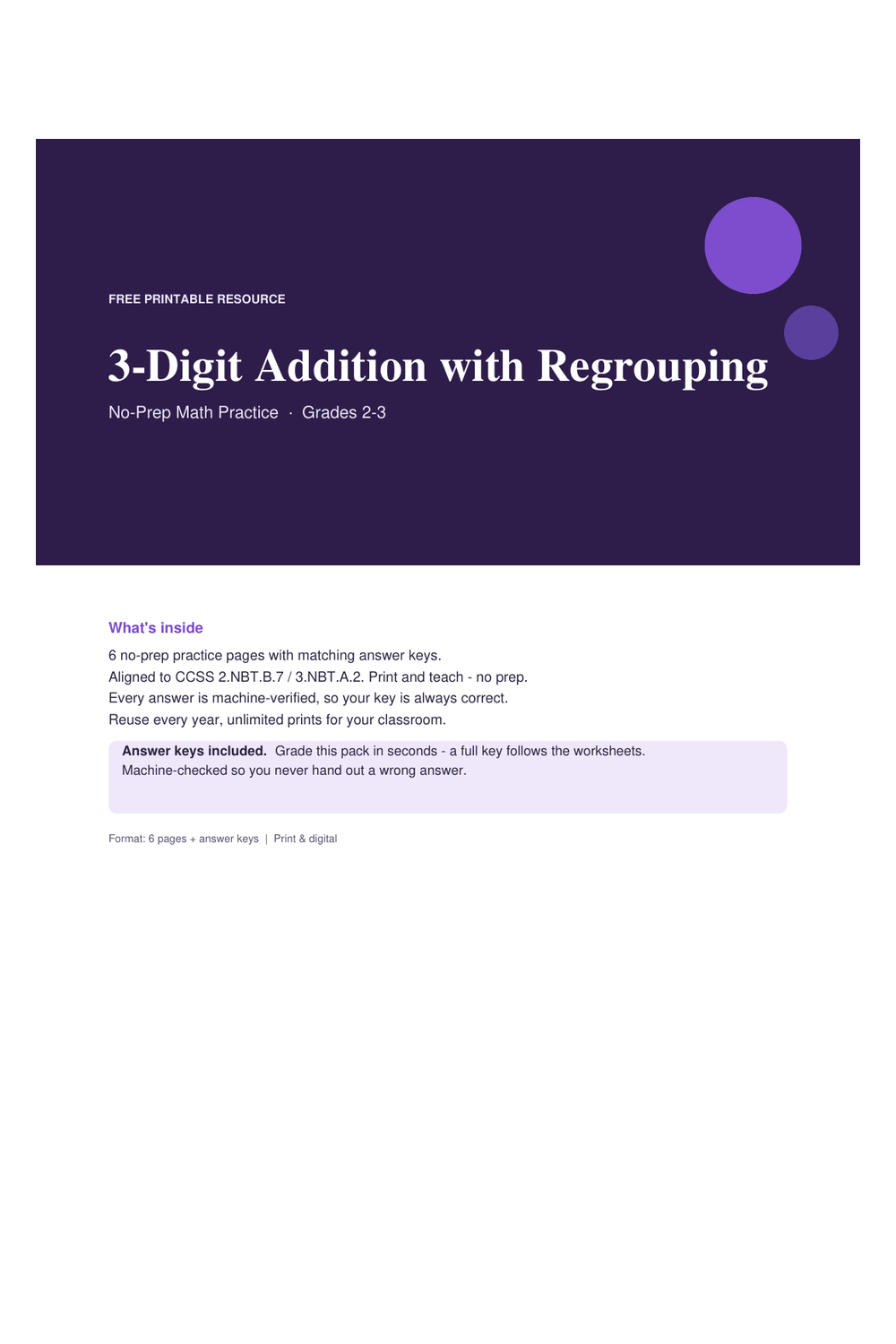
About this printable
Students in grades 2-3 get a 13-page US Letter document: the opening cover, six sheets of work, then the solutions. Practice pages 2, 3, and 7 each present 20 vertical three-digit sums; the other practice pages follow the same format. Examples include 780 + 365 and 388 + 707, with totals passing 1,000. Name and Date lines are printed on each practice sheet. An answer key fills pages 8-13.
Follow each exchange to the left
In a three-digit sum, each column counts a different unit: ones, tens, or hundreds. Begin with the ones. If that column reaches ten, record the leftover ones and exchange ten ones for one ten in the next column. A tens total of ten or more is handled the same way: keep the leftover tens and pass one hundred to the hundreds column. Each exchange preserves the total value.
For 780 + 365, the ones make 5, and the tens make 8 + 6 = 14 tens. Fourteen tens are one hundred and four tens, so record 4 tens and add one hundred to the hundreds column. Then 7 + 3 + 1 = 11 hundreds. The answer is 1,145. Tracking the units at each step helps children see why a result can grow past 999.
Worked example 1
780 + 365
Ones: 0 + 5 = 5. Tens: 8 + 6 = 14 tens; write 4 tens and carry 1 hundred. Hundreds: 7 + 3 + 1 = 11 hundreds.
Answer: 1,145
Worked example 2
532 + 548
2 + 8 = 10 ones: write 0, carry 1 ten. Then 3 + 4 + 1 = 8 tens. Hundreds: 5 + 5 = 10 hundreds.
Answer: 1,080
Worked example 3
388 + 707
8 + 7 = 15 ones: write 5, carry 1 ten. Tens: 8 + 0 + 1 = 9. Hundreds: 3 + 7 = 10 hundreds.
Answer: 1,095
A teaching routine for this pack
Build a three-place chart
Draw hundreds, tens, and ones columns and place 780 and 365 beneath the headings. Start at the right and mark each exchange as a small note in the next column. When fourteen tens become one hundred and four tens, ask the child to point to both parts of that trade before finishing the hundreds.
Bundle place-value blocks
For 388 + 707, model three hundreds, eight tens, and eight ones alongside seven hundreds and seven ones. Exchange ten loose ones for a ten rod, then exchange ten tens for a hundred flat if the tens column reaches ten. Count the remaining pieces and translate each bundle into the written sum.
Keep a carry trail
Have the learner circle each column's total before recording its digit and carry. In 532 + 548, the ones produce a carry into tens, while the hundreds produce 10 hundreds. A small arrow or note can show where each new unit travels, reducing the chance that a carried amount is forgotten.
Read the total aloud
After solving a problem that passes 1,000, read the answer by place value and compare it with the addends. For 780 + 365, say eleven hundreds, four tens, and five ones, then rename eleven hundreds as one thousand one hundred. This makes the four-digit result understandable instead of surprising.
Good matches for this page
Three ways to use it
Trace a multi-column sum
Select problems with exchanges in more than one place and have students annotate each carry. The routine helps a teacher see whether the child understands how a unit changes as it moves left.
Discuss totals over one thousand
Use sums such as 780 + 365 to connect hundreds beyond nine with a thousand. Ask learners to explain how eleven hundreds can be renamed as one thousand and one hundred.
Review a carry error
When an answer differs from the answer key, compare the ones, tens, and hundreds steps separately. A student can identify the first column where an exchange was omitted or counted twice.
Common mistakes to avoid
For 532 + 548, writing 10 in the ones column instead of exchanging ten ones for one ten.
Ten ones have the same value as one ten. Write 0 ones and carry 1 ten into the tens column, then calculate 3 + 4 + 1. The final total is 1,080.
In 780 + 365, recording 14 in the tens column and leaving out the hundred it represents.
Rename fourteen tens as one hundred and four tens. Write 4 in the tens place and carry 1 hundred to 7 + 3. That makes eleven hundreds, or 1,145 overall.
For 388 + 707, adding 3 + 7 hundreds but overlooking that ten hundreds make a thousand.
The hundreds total is ten, so write 0 hundreds in that place and carry 1 thousand to the left. Combine it with 9 tens and 5 ones to read 1,095.
Treating the carried 1 in 532 + 548 as one hundred when it came from the ones column.
Name the unit of every carry: ten ones make one ten, while ten tens make one hundred. In this example, the first carry is a ten, so add it to the tens digits, not the hundreds.
Common questions
How do you add three-digit numbers with regrouping?
Align hundreds, tens, and ones, then add from right to left. Exchange each group of ten units for one unit in the next column. For 780 + 365, fourteen tens become one hundred and four tens; the hundreds then total eleven. Rename that as one thousand one hundred, giving 1,145.
How can I teach regrouping across three place-value columns?
Use place-value blocks or a chart with hundreds, tens, and ones. Model a sum such as 388 + 707 and label the unit being carried at every exchange. Ten ones become one ten; ten tens become one hundred. Then have the learner explain how the written digits represent the same bundles.
Which steps help with three-digit addition with regrouping?
Estimate first by rounding the addends to nearby hundreds, then judge whether the exact answer is in range. For 780 + 365, the total should be around 1,100. Also check each column's carry trail, especially when ten or more hundreds need to be renamed as a thousand.
What is included in this 3-digit addition with regrouping worksheet pack?
The PDF contains six sheets, each with 20 vertical three-digit addition problems, plus their matching solutions. Among the exercises are 780 + 365, 532 + 548, and 388 + 707. The answer key is on pages 8-13 of the 13-page file. Student Name and Date lines appear on the practice sheets.
Is this 3-digit addition with regrouping worksheet pack free?
Yes, this pack costs nothing and calls for no registration. It is a US Letter PDF; the pack details do not offer an A4 or PNG file. The 13-page document pairs its six sets of addition problems with solutions in the answer section, which occupies pages 8 to 13.
Keep organizing
You might also like
Free 13-page pack
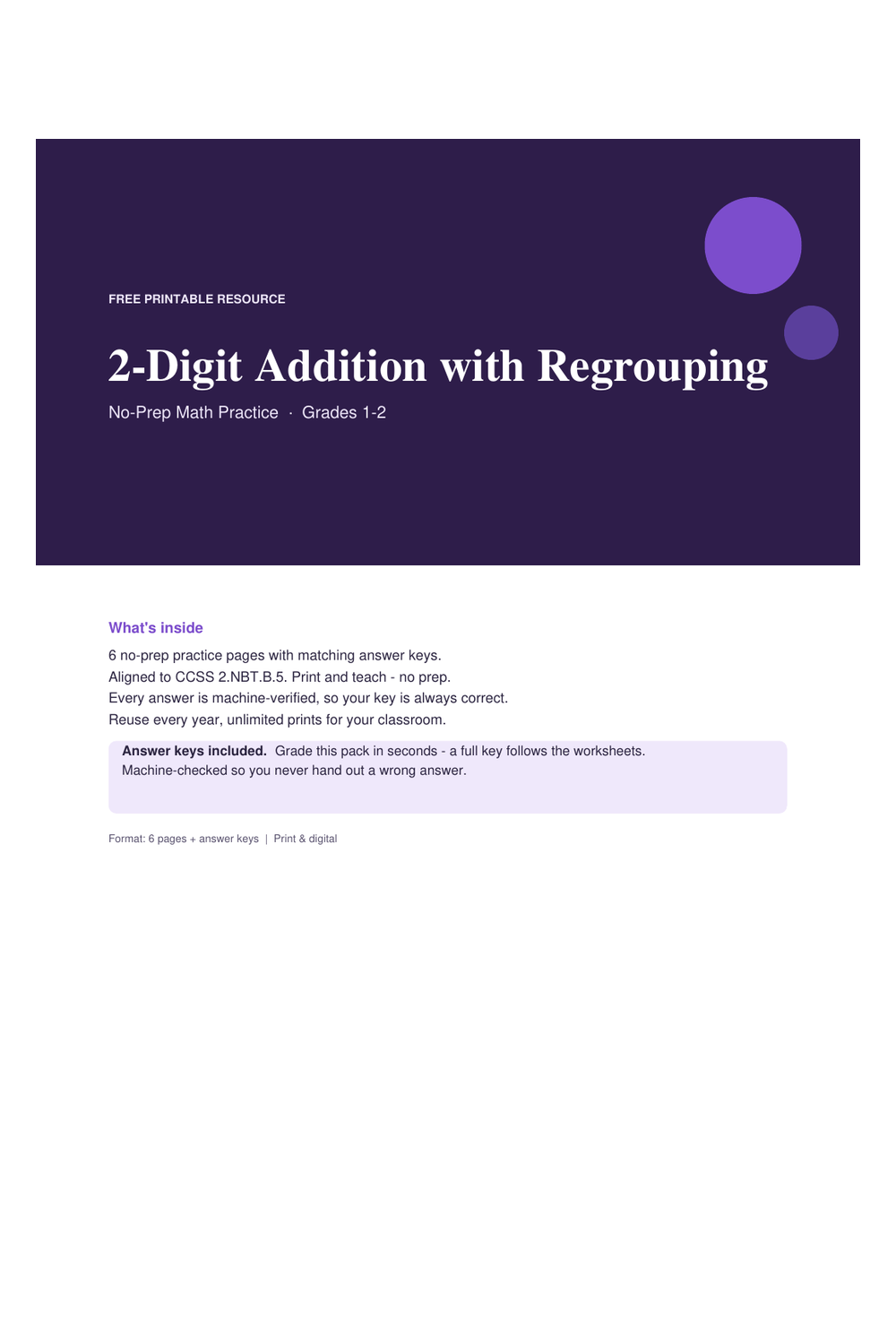
2-Digit Addition with Regrouping Worksheets PDF
A 13-page US Letter math pack for grades 1-2. The PDF keeps the student practice and matching answer-key pages together in one file so you can print only the pages you need. The main skill is to regroup ten ones as one ten while keeping place-value columns aligned. The pack references 2.NBT.B.5 on the cover. Standards noted for this pack: 2.NBT.B.5.
View & download →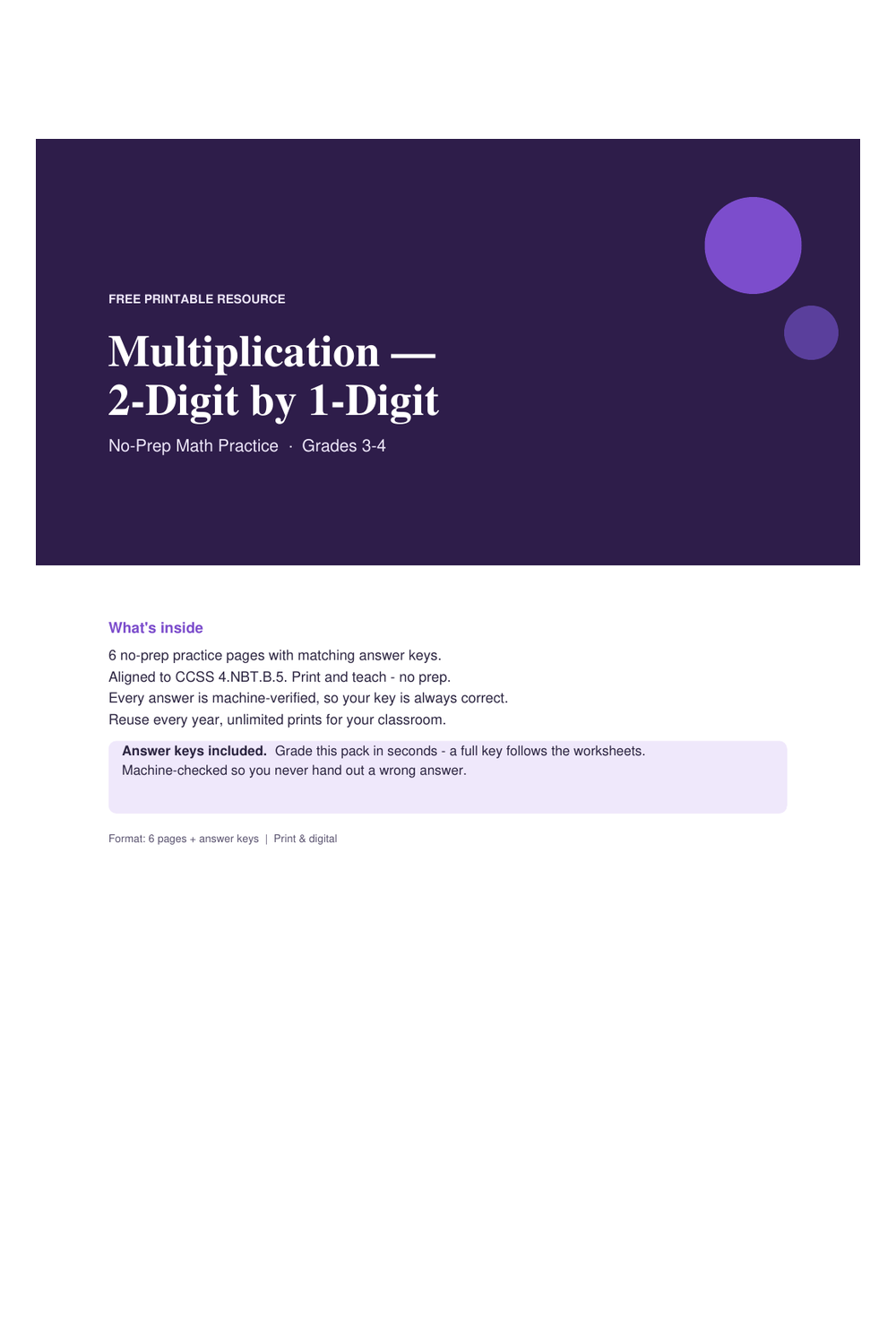
Free 13-page pack
Multiplication — 2-Digit by 1-Digit Worksheets PDF
A 13-page US Letter math pack for grades 3-4. The PDF keeps the student practice and matching answer-key pages together in one file so you can print only the pages you need. The main skill is to use place value or the distributive property to multiply a 2-digit number by a 1-digit factor. The pack references 4.NBT.B.5 on the cover. Standards noted for this pack: 4.NBT.B.5.
View & download →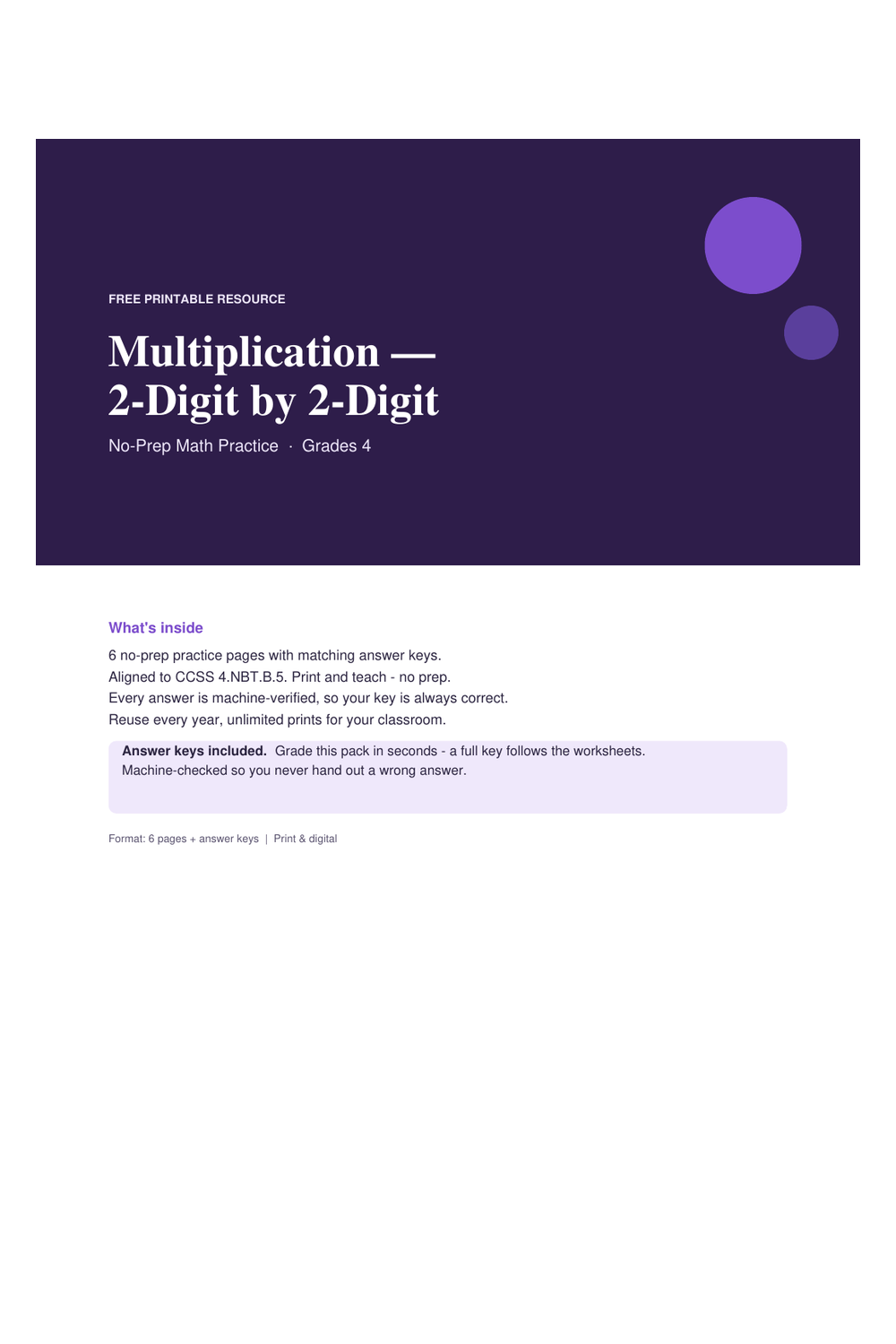
Free 13-page pack
Multiplication — 2-Digit by 2-Digit Worksheets PDF
A 13-page US Letter math pack for grades 4. The PDF keeps the student practice and matching answer-key pages together in one file so you can print only the pages you need. The main skill is to organize partial products for two 2-digit factors and combine them accurately. The pack references 4.NBT.B.5 on the cover. Standards noted for this pack: 4.NBT.B.5.
View & download →