Math Worksheets · Free 13-page pack
Free 3-Digit Subtraction with Regrouping Worksheets PDF
Students in grades 2 to 3 can practice subtracting three-digit numbers with regrouping in this 13-page pack. The vertical equations involve trading across tens or hundreds, including 702 - 422 and 404 - 190. Six practice pages are followed by their answer key for checking each difference.
Edited by Tessa Vaughn · Planning & Organization Editor
Free download
Download the 13-page pack
This multi-page pack currently has one print-ready format. Preview the PDF, then print the whole pack or only the page range you need.
Share to Google Classroom ↗No sign-up required · personal/classroom use
Practice this skill on screen30 questions in three levels (easy, medium, hard) with instant feedback. Nothing to install.Get the whole set: 7 packs in one zipAddition and subtraction worksheet packs. Grades K–3: fact fluency, regrouping and word problems. US Letter PDFs with answer keys, 287 KB.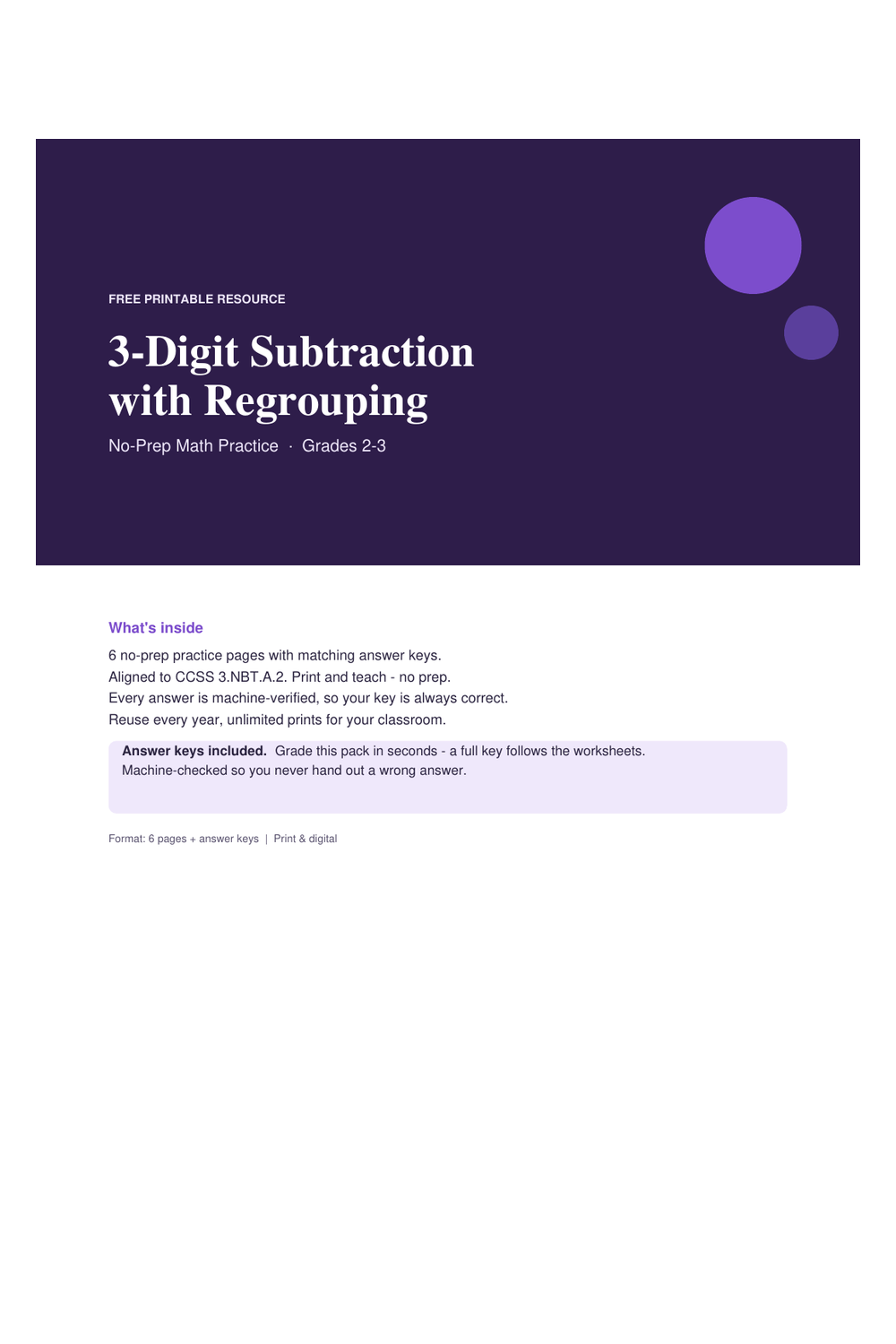
What this printable is for
This US Letter PDF has 13 pages. Six practice pages present vertical three-digit subtraction, and the answer key gives the matching results. Practice pages 2, 3, and 7 have 20 problems each, including 702 - 422, 404 - 190, and 905 - 623. The other practice pages keep this format. Students can fill Name and Date lines. Answers appear on pages 8 to 13.
Regrouping across three places
A three-digit number contains hundreds, tens, and ones. Subtraction begins in the ones place; when a place is short, rename one from the place immediately to its left as ten in the current place. One hundred can become ten tens, and one ten can become ten ones. Each trade preserves the number's value. When a place contains zero, the exchange may need to travel across it before there are tens or ones available to subtract.
Consider 404 − 190. There are 4 ones, so first exchange one hundred across the zero tens: 4 hundreds become 3 hundreds and 10 tens. Exchange one of those tens for 10 ones, leaving 9 tens and 14 ones. Now subtract 0 ones, 9 tens, and 1 hundred from the renamed number. The answer is 214. Keeping each place visible prevents a trade from adding or losing value.
Worked example 1
Solve 702 − 422.
Trade one hundred for ten tens: 702 becomes 6 hundreds, 10 tens, and 2 ones. Subtract by place: 2 - 2, 10 - 2, and 6 - 4.
Answer: 280
Worked example 2
Solve 404 − 190.
Trade across the zero tens: 4 hundreds become 3 hundreds and 10 tens, then 9 tens and 14 ones. Subtract 190 by place.
Answer: 214
Worked example 3
Solve 905 − 623.
Rename 905 as 8 hundreds, 9 tens, and 15 ones. Subtract 3 ones, 2 tens, and 6 hundreds in their columns.
Answer: 282
A teaching routine for this pack
Show trades with blocks
Build hundreds flats, tens rods, and ones cubes. For a subtraction needing regrouping, physically exchange a flat for ten rods and a rod for ten cubes. Students can see that the amount stays constant even though the pieces change.
Mark every column
Set up a hundreds-tens-ones chart and record each renamed amount above its place. In 404, a trade must pass through the empty tens column. Label the result of each exchange before subtracting any column, keeping the value in view.
Rename in expanded form
Break a number into hundreds, tens, and ones, then rewrite the same value after an exchange. For example, 702 can be shown as 600 + 90 + 12. This makes the regrouping transparent when a zero appears in one place.
Use addition to verify
After solving, add the difference to the subtracted number. For 905 - 623, check that 282 + 623 returns to 905. This confirms both the computation and that regrouping preserved the starting value through every exchange.
Good matches for this page
Three ways to use it
Model a zero in the middle
Choose an equation such as 404 − 190 and represent the trade with place-value pieces. The empty tens place makes the chain of exchanges visible for discussion.
Practice column alignment
Have students label hundreds, tens, and ones before solving a few vertical items. Accurate alignment keeps each trade attached to the place it changes and helps prevent digits from shifting columns.
Review inverse operations
Invite learners to choose one completed equation and add the difference to the subtrahend. Compare the sum with the starting number to check the answer key or student work.
Common mistakes to avoid
Subtracting 2 from the 0 tens in 702 - 422 and writing 2 in that place.
There are no tens available, so rename one hundred as ten tens. Then subtract 2 tens from 10 tens, 2 ones from 2 ones, and 4 hundreds from 6 hundreds. The difference is 280.
Trying to take a ten from the zero tens in 404 - 190 without regrouping a hundred.
The zero tens cannot supply a ten. Exchange one hundred for ten tens, then one of those tens for ten ones. This renames 404 as 3 hundreds, 9 tens, and 14 ones before subtracting.
Reporting 382 for 905 - 623 after making 10 tens but forgetting to reduce the hundreds from 9 to 8.
When one hundred is renamed as ten tens, the hundreds decrease from 9 to 8. Subtract 623 from 8 hundreds, 10 tens, and 5 ones to get 282. Each trade must preserve the starting value.
In 362 - 296, subtracting each smaller-looking digit from the larger one in its column, giving 134.
The starting number is reduced, so exchange a hundred and a ten as needed instead of reversing digits. Rename 362 as 2 hundreds, 15 tens, and 12 ones, then subtract by place to get 66.
Common questions
How do you subtract three-digit numbers with regrouping?
Work from ones to tens to hundreds. If a place lacks enough, rename one from the place to its left as ten in the current place. A zero may require a trade to pass through it. Record each new amount so the original value is preserved during subtraction.
How can I teach regrouping across a zero?
Use base-ten blocks or a place-value chart to show that a zero place cannot provide a unit for the subtraction. Trade from the next nonzero place, then rename again as needed. For 404, one hundred becomes ten tens, and one of those tens becomes ten ones.
How can a learner verify a three-digit subtraction answer?
Reverse the operation: combine the difference with the amount removed. For 905 minus 623, add 282 and 623; the total should be 905. If it differs, inspect the column alignment, every exchange, and the final subtraction before deciding where the error began.
What is included in this 3-digit subtraction with regrouping worksheet pack?
Across 13 pages, the pack provides six vertical equation sheets and six answer-key pages after the cover. Practice pages 2, 3, and 7 each show twenty three-digit problems, including 702 - 422 and 404 - 190. Name and Date spaces let each student label the work.
Is this 3-digit subtraction with regrouping worksheet pack free?
Yes. Downloading costs nothing and asks for no sign-up. The file is a PDF arranged for US Letter paper; PNG graphics and an A4 copy are not part of the offer. Look for the answer key in the final section, spanning numbered pages 8 to 13.
Keep organizing
You might also like
Free 13-page pack
2-Digit Addition with Regrouping Worksheets PDF
A 13-page US Letter math pack for grades 1-2. The PDF keeps the student practice and matching answer-key pages together in one file so you can print only the pages you need. The main skill is to regroup ten ones as one ten while keeping place-value columns aligned. The pack references 2.NBT.B.5 on the cover. Standards noted for this pack: 2.NBT.B.5.
View & download →
Free 13-page pack
3-Digit Addition with Regrouping Worksheets PDF
A 13-page US Letter math pack for grades 2-3. The PDF keeps the student practice and matching answer-key pages together in one file so you can print only the pages you need. The main skill is to manage regrouping across ones, tens, and hundreds without losing carried values. The pack references 2.NBT.B.7, 3.NBT.A.2 on the cover. Standards noted for this pack: 2.NBT.B.7, 3.NBT.A.2.
View & download →
Free 13-page pack
Multiplication — 2-Digit by 1-Digit Worksheets PDF
A 13-page US Letter math pack for grades 3-4. The PDF keeps the student practice and matching answer-key pages together in one file so you can print only the pages you need. The main skill is to use place value or the distributive property to multiply a 2-digit number by a 1-digit factor. The pack references 4.NBT.B.5 on the cover. Standards noted for this pack: 4.NBT.B.5.
View & download →