Math Worksheets · Free 13-page pack
Free Multiplication — 3-Digit by 1-Digit Worksheets PDF
A 13-page set for grades 4-5 works on multiplying three-place values by one digit. The student sheets numbered 2, 3 and 7 each present 20 vertical calculations, including 402 × 2 and the regrouping example 997 × 4. Matching solutions are supplied in the answer key for the six-sheet sequence.
Edited by Tessa Vaughn · Planning & Organization Editor
Free download
Download the 13-page pack
This multi-page pack currently has one print-ready format. Preview the PDF, then print the whole pack or only the page range you need.
Share to Google Classroom ↗No sign-up required · personal/classroom use
Practice this skill on screen30 questions in three levels (easy, medium, hard) with instant feedback. Nothing to install.Get the whole set: 6 packs in one zipMultiplication and skip counting worksheet packs. Grades K–5: skip counting, multi-digit multiplication and fact fluency. US Letter PDFs with answer keys, 436 KB.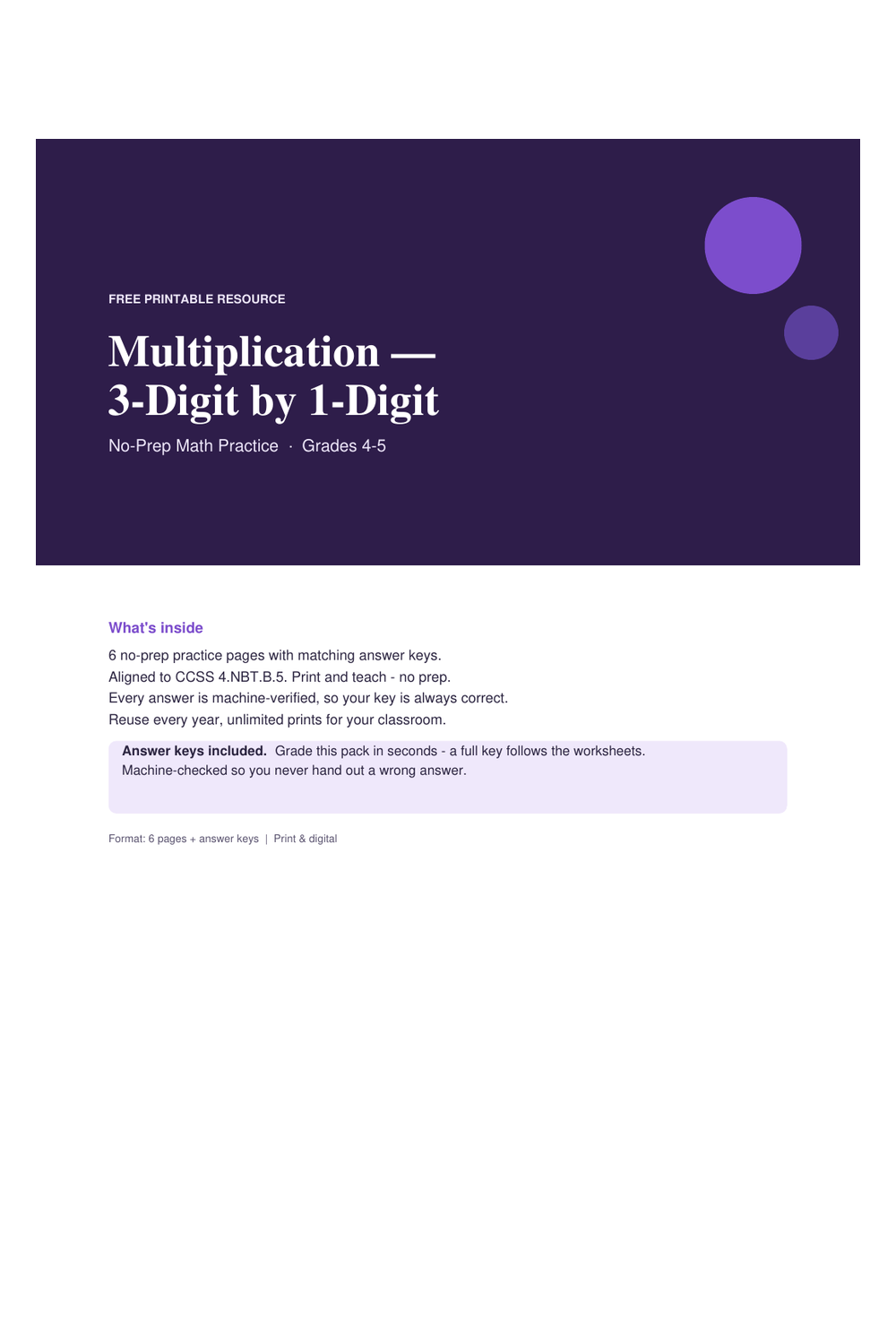
About this printable
For grades 4-5, this US Letter worksheet file references CCSS 4.NBT.B.5 and runs to 13 pages. Six student sheets are paired with solutions. The second, third, and seventh practice sheets each show 20 vertical calculations and a place for the student to write a name and date. Every item scales a three-place number by one digit; sets include ×1, the zero tens position in 402, and regrouping. Other student sheets extend the skill. The answer key runs across pages 8-13.
Multiply hundreds, tens, and ones
A three-digit number is a sum of hundreds, tens, and ones. Multiplying by one digit means multiplying each place-value part by that factor, then combining the partial products. For 324 × 3, calculate 300 × 3, 20 × 3, and 4 × 3. The amounts are 900, 60, and 12, which add to 972. This decomposition explains the columns in the written method.
In the standard algorithm, start with the ones and regroup any full tens. Next multiply the tens, including the amount carried from the ones; then do the same for the hundreds. A zero digit still holds a place even though its partial product is zero. For 402 × 2, there are 800 from the hundreds and 4 from the ones, with no tens contribution.
Worked example 1
Find 324 × 3.
Split 324 into 300, 20, and 4. Multiply each by 3 to get 900, 60, and 12. Add the partial products.
Answer: 972
Worked example 2
Find 997 × 4.
4 × 7 = 28: write 8 and carry 2 tens. Then 4 × 9 tens plus 2 tens is 38 tens: write 8 and carry 3 hundreds. Finally 4 × 9 hundreds plus 3 is 39 hundreds.
Answer: 3,988
Worked example 3
Find 402 × 2.
Multiply the hundreds: 400 × 2 = 800. The tens digit is zero, so that part contributes zero. Multiply 2 ones by 2 to get 4, then combine.
Answer: 804
How to teach it with this pack
Expand before multiplying
Write a three-digit number as hundreds plus tens plus ones. For 324 × 3, show 300 × 3, 20 × 3, and 4 × 3 on separate lines. Combine the results and compare with the vertical algorithm. This helps children see each column as a place-value amount rather than an isolated digit.
Regroup across columns
Use place-value disks or bundles to model a product like 997 × 4. Begin with the ones, trade groups of ten, and carry their value into the tens. Continue trading into hundreds. The model clarifies why the carried amount is added to the next product, and why it can change the next digit.
Protect a zero place
Point to every column in a number such as 402 before calculating. The zero says there are no tens, but the 4 remains in the hundreds position and the 2 remains in ones. Write a placeholder in the vertical setup if needed, and use expanded form to confirm that the product includes the right places.
Estimate the product
For 997 × 4, use 1,000 × 4 as a quick benchmark: about 4,000. Set the finished product beside that amount. If the gap is large, check the carried values and the column positions before accepting the written answer.
Best uses for this template
Ideas for using this page
A regrouping demonstration
Work through 997 × 4 slowly and pause at each exchange from ones to tens and tens to hundreds. Students can explain what each carried amount represents before trying the remaining problems.
A zero-place discussion
Choose 402 × 2 and ask what the zero contributes. Then compare the hundreds and ones products, so learners keep the zero's position without inventing a tens amount.
A mental estimate check
Before calculating, round one factor to a friendly hundred. After completing a product, decide whether the exact answer makes sense beside that estimate and locate any large discrepancy.
Mistakes to watch for
For 997 × 4, stopping at 28 after the ones step leaves the tens and hundreds unmultiplied.
After writing 8 ones, carry 2 tens into the next column. Continue with 4 × 9 tens plus 2, then multiply the hundreds and include the next carry. Check the full product against 1,000 × 4, about 4,000.
For 402 × 2, reading the zero as a missing place can shift the 4 into tens.
Keep the digits aligned in hundreds, tens, and ones columns. The 4 represents 400, the 0 represents no tens, and the 2 represents two ones. Double the nonzero parts to get 800 and 4, totaling 804.
In 324 × 3, writing 12 from 4 × 3 as twelve tens makes the result too large.
The 4 is in the ones place, so 4 × 3 produces 12 ones: write 2 ones and regroup 1 ten. Continue with the tens column, then the hundreds. Expanded form gives 900 + 60 + 12 = 972.
For 449 × 8, forgetting the carry from 9 × 8 changes both later columns.
Keep the 7 tens from 72 visible after multiplying the ones. Add it to 8 × 4 tens, then carry any new hundred before working in the hundreds column. The result should be 3,592, close to 450 × 8.
Quick answers
How do you multiply a three-digit number by a one-digit number?
Multiply the ones, tens, and hundreds by the one-digit factor, moving from right to left. Regroup any groups of ten or hundred into the next column. For 324 × 3, the partial products 900, 60, and 12 combine to 972. Expanded form can make each place's contribution easier to see.
How to teach carrying in three-digit multiplication?
Model the product of one column with bundles or place-value disks. For 997 × 4, four groups of seven ones make 28 ones, which is two tens and eight ones. Carry the two tens into the next column, then continue. Children can see that a carried digit is an amount with a place, not a separate rule.
How can rounding help check a three-digit multiplication result?
Use 1,000 in place of 997, then compare 1,000 × 4 with the exact product. The rounded calculation gives 4,000 as a benchmark. A much smaller or larger result may signal a missed regrouping or a digit in the wrong column. Expanded form gives another way to check each place value.
What is included in this multiplication 3-digit by 1-digit worksheet pack?
The file has 13 US Letter pages for grades 4-5. Worksheets 2, 3 and 7 each present 20 vertical calculations that multiply a three-digit value by one digit, and each provides Name and Date blanks. The other practice sheets continue the operation. Among the problems are 402 × 2 and 997 × 4. The answer key for all six sheets is on pages 8-13. For example, 997 × 4 is included.
Is this multiplication 3-digit by 1-digit worksheet pack free?
Yes, it is available at no cost and asks for no registration. Only the US Letter PDF is supplied for this pack; there is no A4 or PNG version. The 13-page file includes its answer key on pages 8-13. Its grades 4-5 exercises focus on multiplying a three-digit quantity by one digit.
Keep organizing
You might also like
Free 13-page pack
2-Digit Addition with Regrouping Worksheets PDF
A 13-page US Letter math pack for grades 1-2. The PDF keeps the student practice and matching answer-key pages together in one file so you can print only the pages you need. The main skill is to regroup ten ones as one ten while keeping place-value columns aligned. The pack references 2.NBT.B.5 on the cover. Standards noted for this pack: 2.NBT.B.5.
View & download →
Free 13-page pack
3-Digit Addition with Regrouping Worksheets PDF
A 13-page US Letter math pack for grades 2-3. The PDF keeps the student practice and matching answer-key pages together in one file so you can print only the pages you need. The main skill is to manage regrouping across ones, tens, and hundreds without losing carried values. The pack references 2.NBT.B.7, 3.NBT.A.2 on the cover. Standards noted for this pack: 2.NBT.B.7, 3.NBT.A.2.
View & download →
Free 13-page pack
Multiplication — 2-Digit by 1-Digit Worksheets PDF
A 13-page US Letter math pack for grades 3-4. The PDF keeps the student practice and matching answer-key pages together in one file so you can print only the pages you need. The main skill is to use place value or the distributive property to multiply a 2-digit number by a 1-digit factor. The pack references 4.NBT.B.5 on the cover. Standards noted for this pack: 4.NBT.B.5.
View & download →