Math Worksheets · Free 13-page pack
Free Subtraction Word Problems to 100 Worksheets PDF
Children in grades 2 to 3 can practice subtraction stories within 100 in this 13-page pack. The six-question sheets describe cookies sold, apples eaten, and supplies given away or lost, including cases where none remain. A matching answer key follows the practice pages.
Edited by Tessa Vaughn · Planning & Organization Editor
Free download
Download the 13-page pack
This multi-page pack currently has one print-ready format. Preview the PDF, then print the whole pack or only the page range you need.
Share to Google Classroom ↗No sign-up required · personal/classroom use
Practice this skill on screen30 questions in three levels (easy, medium, hard) with instant feedback. Nothing to install.Get the whole set: 7 packs in one zipAddition and subtraction worksheet packs. Grades K–3: fact fluency, regrouping and word problems. US Letter PDFs with answer keys, 287 KB.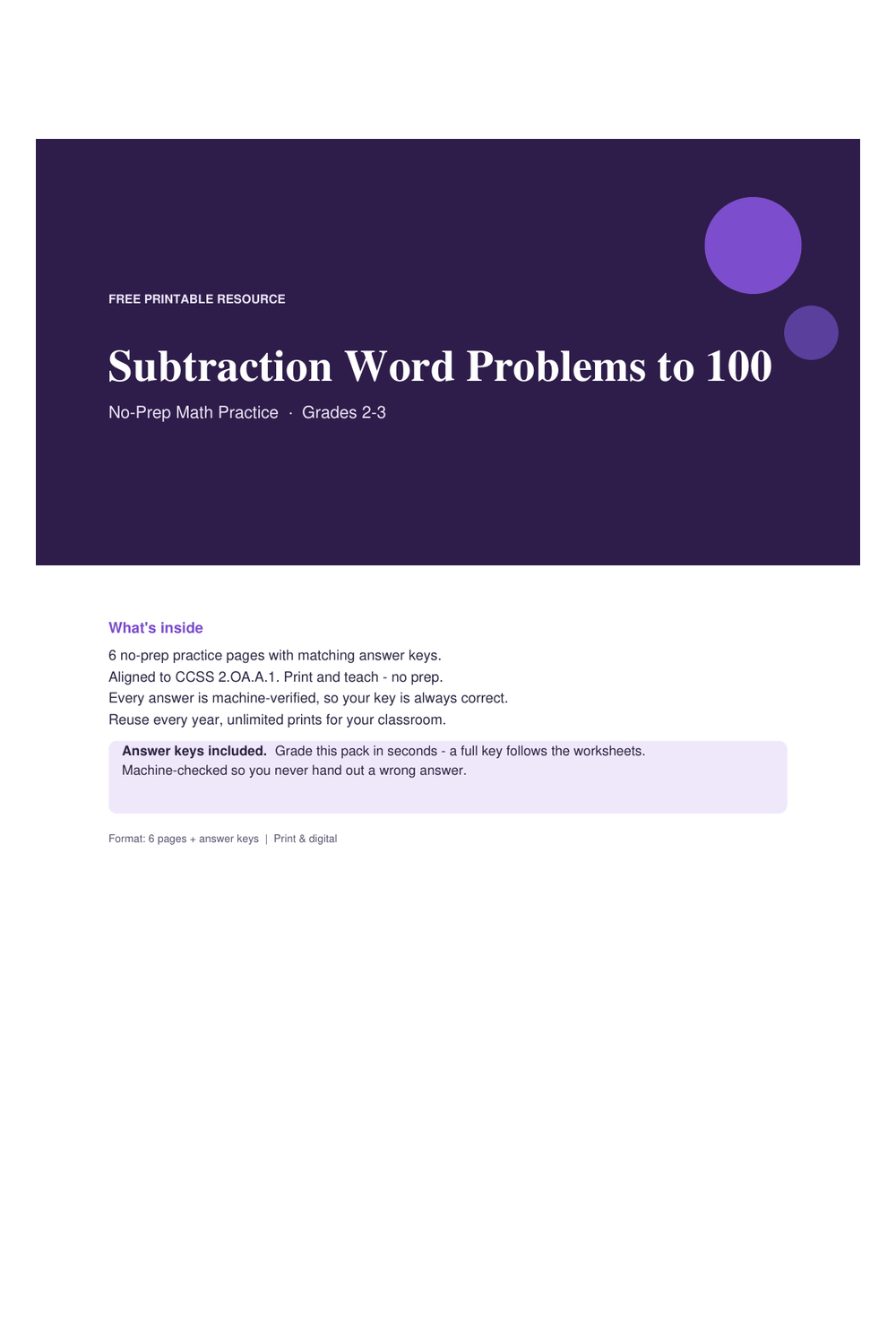
What this printable is for
In this 13-page US Letter PDF, six pages offer subtraction stories and six pages give their answers. Practice pages 2, 3, and 7 each pose six questions about items sold, eaten, lost, or given away. Contexts include cookies, apples, crayons, and pencils, with amounts from 11 to 85; one story removes all 55 crayons. Remaining practice pages use similar take-away stories. Each student page has Name and Date lines. Answers are on pages 8 to 13.
Finding what remains in a story
Subtraction stories often begin with a collection, then describe some of it leaving. The unknown is what remains, so subtract the amount removed from the starting amount. A drawing can show the whole as one bar and the removed part as a section; the unmarked section represents the answer. Other stories may compare two amounts, so first decide what the question asks before choosing which quantity is the whole.
If 85 crayons are on hand and 79 are given away, calculate 85 - 79 to find the remainder. The difference is 6, a small but sensible leftover because 79 is close to 85. When the two amounts are equal, as with 55 crayons and 55 given away, none remain: the difference is zero. Estimating the likely remainder first can help children notice when an answer is unreasonable.
Worked example 1
Ava had 85 crayons and gave away 79. How many are left?
The amount given away leaves a remainder: 85 − 79. Count up from 79 to 85, a difference of 6.
Answer: 6 crayons
Worked example 2
Kai baked 11 cookies and sold 11. How many are left?
All 11 cookies were sold. Subtract the whole amount: 11 − 11.
Answer: 0 cookies
Worked example 3
There were 59 apples. 38 were eaten. How many remain?
Remove 38 from 59. Subtract 30 to reach 29, then 8 more to reach 21.
Answer: 21 apples
How to teach it with this pack
Draw the whole and part
Represent the starting collection as one bar, then mark the part that is sold, eaten, or given away. Ask what section remains unmarked. This makes the unknown visible before writing the subtraction equation and selecting the calculation.
Use counters to remove
Set out a small group of counters for a story and physically remove the stated number. For a case like 11 sold from 11, remove every counter and name the empty set as zero, connecting the action with its numeral.
Count up for a close pair
When the removed amount is near the starting amount, count from the smaller number to the larger. From 79 to 85 is six steps, so 85 − 79 = 6. This strategy highlights the size of the leftover.
State what the answer means
After calculating, finish the response with the object from the story: apples remain, crayons are left, or cookies are left. Then ask whether the quantity is plausible given how many were removed and what the question asks.
Best uses for this template
Ideas for using this page
Discuss a zero remainder
Use an equal-start-and-take-away story to show that removing every item leaves none. Students can model the action and connect the empty set to the numeral zero.
Compare close amounts
Choose a story such as 85 crayons with 79 given away. Ask students to predict a small remainder, then solve and check whether six crayons is reasonable.
Practice reading the action
Invite learners to underline the starting collection and the amount that leaves. Naming those roles before calculating helps translate varied contexts into subtraction and keeps the original amount in the first position.
Mistakes to watch for
Answering 164 crayons after adding 85 and 79 in the give-away story.
The 79 crayons leave Ava’s collection, so subtract them from 85. Counting from 79 up to 85 gives 6 crayons left. Act out the action before writing the equation.
Leaving 1 cookie after 11 cookies are sold from a batch of 11.
The full starting group was sold. Subtract 11 from 11 and all items are removed, leaving 0 cookies. Draw eleven counters and cross each one out to see why none remain.
Subtracting 59 from 38 for the story with 59 apples and 38 eaten, giving -21.
The story starts with 59 apples and removes 38, so calculate 59 - 38. The amount remaining is 21 apples. Keep the original collection first in the equation.
Answering 15 for 22 pencils with 17 lost by subtracting smaller digits from larger in each column.
Regroup 22 as 1 ten and 12 ones. Take away 7 ones, leaving 5; the tens cancel. There are 5 pencils left.
Quick answers
How do you solve subtraction word problems to 100?
Identify the starting amount and the amount that leaves, then subtract the part removed from the whole. Draw the situation or use counters if the relationship is unclear. Finish by naming what remains and checking whether the size of the answer makes sense.
How can I teach subtraction word problems with counters?
Use counters for the starting collection and physically take away the number in the story. Count what remains, then write a subtraction sentence with the starting amount first. For equal amounts, remove every counter and connect the empty group with zero.
What is an easy way to check a subtraction story answer?
Estimate how many should remain before computing. If 79 of 85 crayons are given away, expect only a few; if the answer is 50, revisit the calculation. You can also add the remainder to the amount removed and see whether it returns to the starting amount.
What is included in this subtraction word problems to 100 worksheet pack?
The file has 13 pages: six sheets with six subtraction stories each, paired with six sheets of solutions. Practice pages 2, 3, and 7 use cookies, apples, crayons, and pencils in take-away situations, including a case where the full starting amount is removed. Each question has an answer blank, and the student sheets provide Name and Date fields. The answer key is numbered 8 to 13.
Is this subtraction word problems to 100 worksheet pack free?
Yes, it costs nothing and asks for no registration. The download is one PDF made for US Letter paper; A4 pages and PNG files are not provided. Solutions appear in the answer key at the end, across PDF pages 8 to 13.
Keep organizing
You might also like
Free 13-page pack
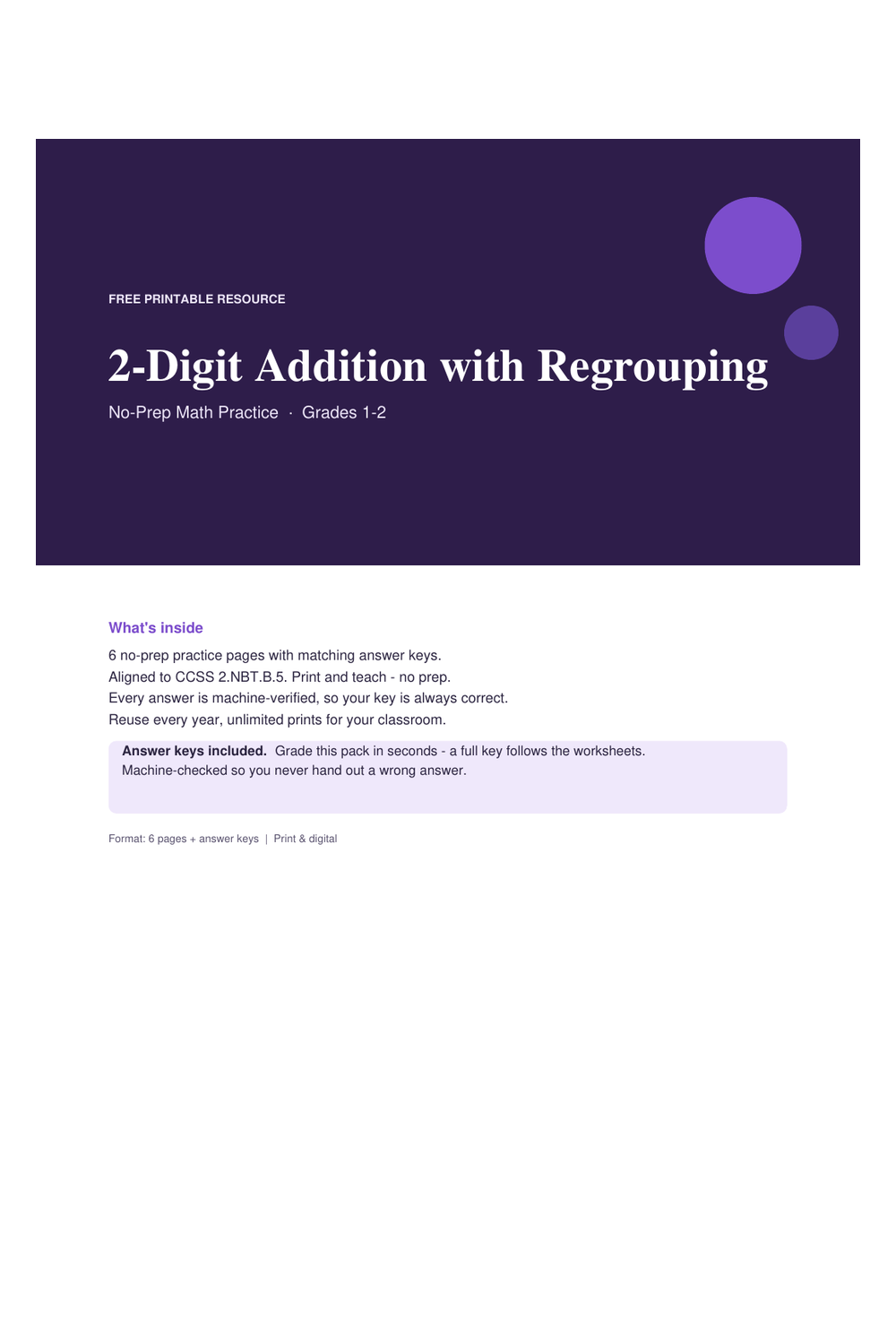
2-Digit Addition with Regrouping Worksheets PDF
A 13-page US Letter math pack for grades 1-2. The PDF keeps the student practice and matching answer-key pages together in one file so you can print only the pages you need. The main skill is to regroup ten ones as one ten while keeping place-value columns aligned. The pack references 2.NBT.B.5 on the cover. Standards noted for this pack: 2.NBT.B.5.
View & download →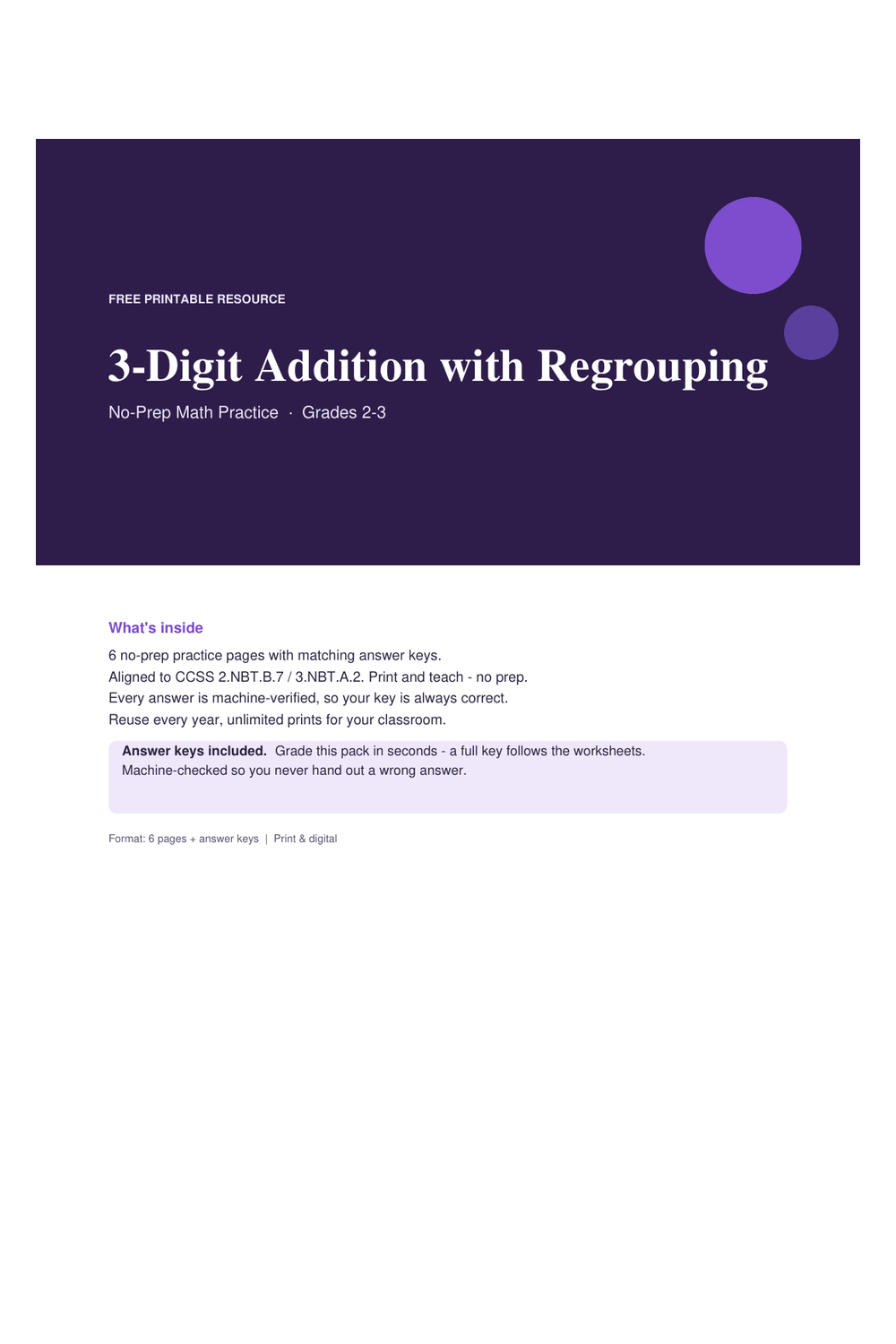
Free 13-page pack
3-Digit Addition with Regrouping Worksheets PDF
A 13-page US Letter math pack for grades 2-3. The PDF keeps the student practice and matching answer-key pages together in one file so you can print only the pages you need. The main skill is to manage regrouping across ones, tens, and hundreds without losing carried values. The pack references 2.NBT.B.7, 3.NBT.A.2 on the cover. Standards noted for this pack: 2.NBT.B.7, 3.NBT.A.2.
View & download →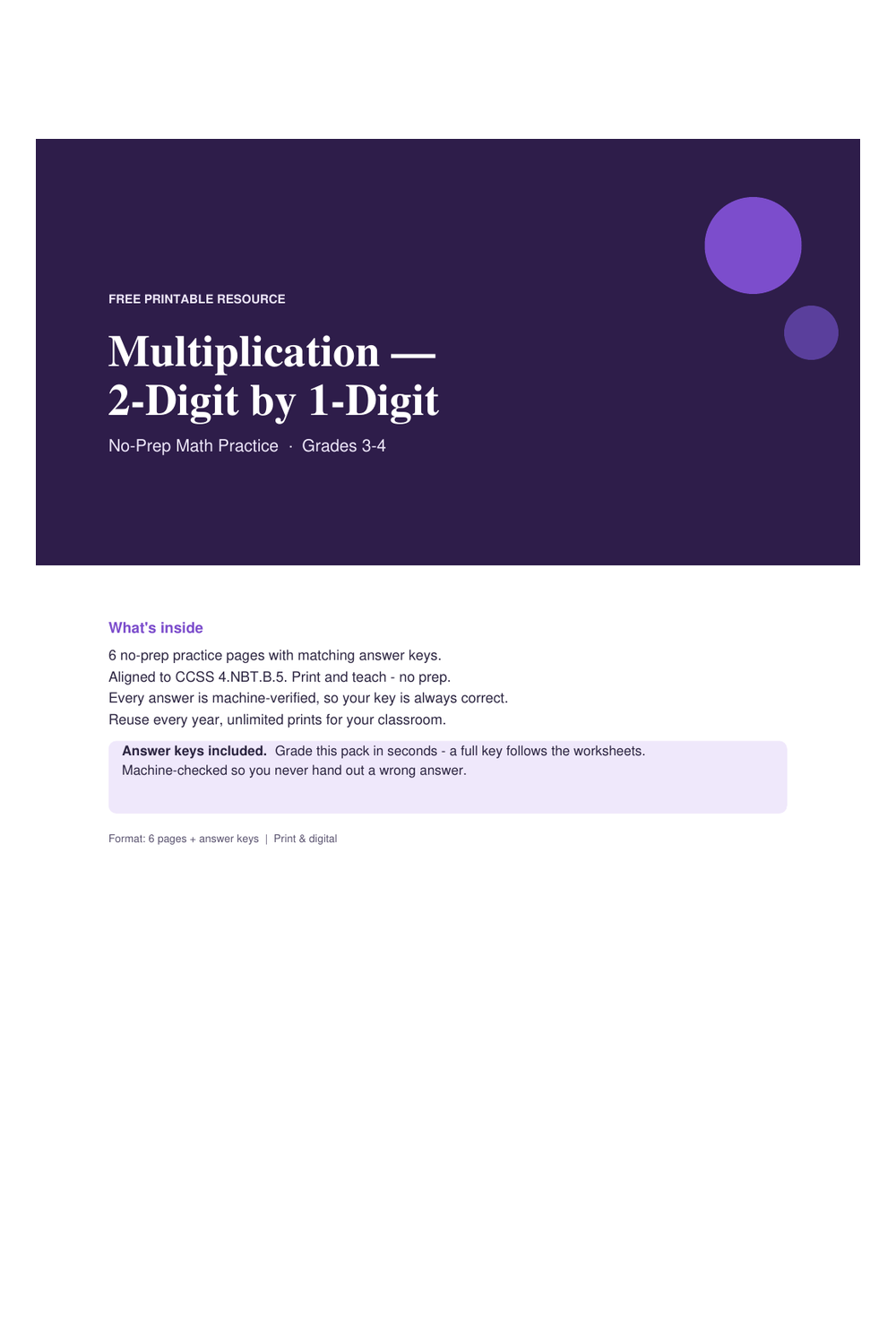
Free 13-page pack
Multiplication — 2-Digit by 1-Digit Worksheets PDF
A 13-page US Letter math pack for grades 3-4. The PDF keeps the student practice and matching answer-key pages together in one file so you can print only the pages you need. The main skill is to use place value or the distributive property to multiply a 2-digit number by a 1-digit factor. The pack references 4.NBT.B.5 on the cover. Standards noted for this pack: 4.NBT.B.5.
View & download →