How-to guide · Work & Study
Main Idea vs. Summary: What's the Difference?
Main idea and summary are related, but they are not interchangeable. If a student writes one sentence that states the central point, that may be a strong main idea statement and still be too thin to count as a summary. If the student retells five interesting facts without identifying what unifies them, the response may be long enough to look like a summary while still missing the main idea.
The useful relationship is hierarchical: first identify what the text is mainly saying, then select the details a reader actually needs in order to preserve that meaning. Reading Rockets' guidance on summarizing explicitly asks readers to identify main ideas, choose crucial supporting details, and discard irrelevant information. That makes main-idea work part of the summarizing process rather than a competing skill.
Main idea vs. summary at a glance
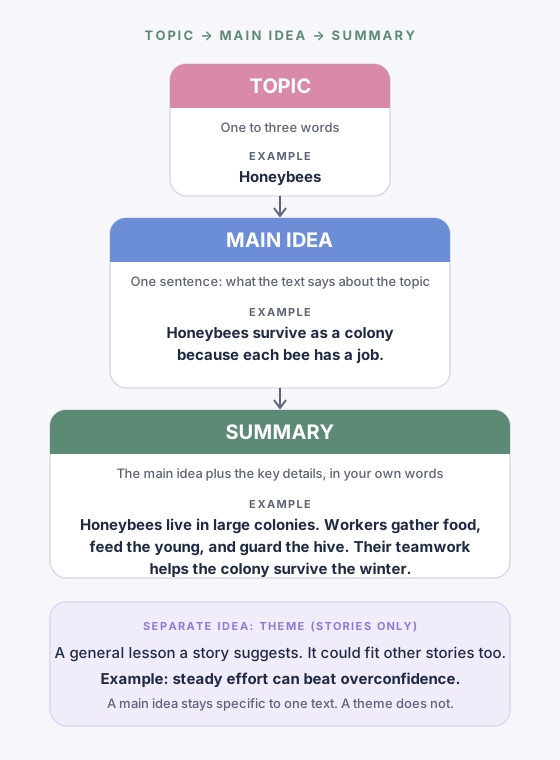
A main idea statement answers What is the author mainly saying about this topic? A summary answers What are the most important ideas I need to retell so another reader understands the text without reading every detail? The summary is therefore broader. It normally contains the main idea plus selected information that explains or supports it.
| Feature | Main idea | Summary |
|---|---|---|
| Purpose | State the central point | Compress the important meaning of the text |
| Typical length | Often one clear sentence | Several sentences or a short paragraph, depending on source length |
| Includes details? | May mention none or only what is needed to state the point | Includes essential supporting details, not every example |
| Best question | What is this mostly saying about the topic? | What must I keep so the reader understands the important message? |
| Common error | Writing only the topic | Retelling everything in order without selecting importance |
| Useful organizer | Main idea + supporting details | Organizer first, then turn selected notes into connected prose |
Main idea vs. theme vs. central idea: one story, side by side
Searches for main idea and summary often turn up two more terms: theme and central idea. They answer different questions, and mixing them up is one of the most common reasons a response gets marked down. A main idea belongs to one specific text and can name its characters and events. A theme is a general lesson that could apply to many stories, and one story can have more than one. In informational text, central idea usually means the main idea of the whole text, while a main idea can also belong to a single paragraph or section.
The table uses one familiar story, The Tortoise and the Hare, so the terms can be compared directly.
| Term | What it answers | Example from The Tortoise and the Hare |
|---|---|---|
| Topic | What is the text about? | A race between a tortoise and a hare. |
| Main idea | What is this text mainly saying? It stays specific to this text. | A boastful hare naps during a race and loses to a slow, steady tortoise. |
| Theme | What general lesson does the story suggest? It could fit other stories too. | Slow, steady effort can beat overconfidence. |
| Summary | What are the important points, retold briefly? | A hare brags about his speed and agrees to race a tortoise. Partway through, he stops to nap. The tortoise keeps moving and crosses the finish line first. |
| Central idea (informational text) | What is the main idea of the whole text? | For the city-trees passage in the worked example below: trees make city neighborhoods more comfortable and resilient. |
Start by separating topic from main idea
The topic is usually a word or short phrase: monarch butterflies, school uniforms, erosion, the water cycle. The main idea says something meaningful about that topic. For example, Butterflies is a topic. Monarch butterflies depend on a multigenerational migration cycle connecting habitats across North America is a main-idea statement because it tells the reader the central point being developed.
This distinction prevents one of the most common weak answers: naming the subject and stopping. Timothy Shanahan's Reading Rockets discussion of main idea notes that statements can be too general, such as merely naming a topic, or too specific because they contain a pile of details. A useful main idea is broad enough to cover the important information but precise enough to say what the text is actually communicating.
Then decide which details are essential
Supporting details do different jobs. Some explain the central point. Some provide evidence. Some are examples, numbers, anecdotes, definitions, or interesting side facts. A summary should not treat all of them as equally important. Reading Rockets' summarizing routine asks readers to consider the main ideas, the crucial details that support them, and information that is irrelevant or unnecessary for the summary.
A practical test is removal. Cover one detail and ask whether the reader can still understand the main idea accurately. If yes, that detail may be useful in the full text but unnecessary in a short summary. If removing it changes the meaning, hides an important condition, or makes the central point unsupported, keep it. The goal is not the fewest words possible; it is the smallest set of ideas that preserves the important meaning.
Free download
Choose your file size
Print at 100% / Actual Size for the cleanest margins. Pick the paper size your printer normally uses.
Share to Google Classroom ↗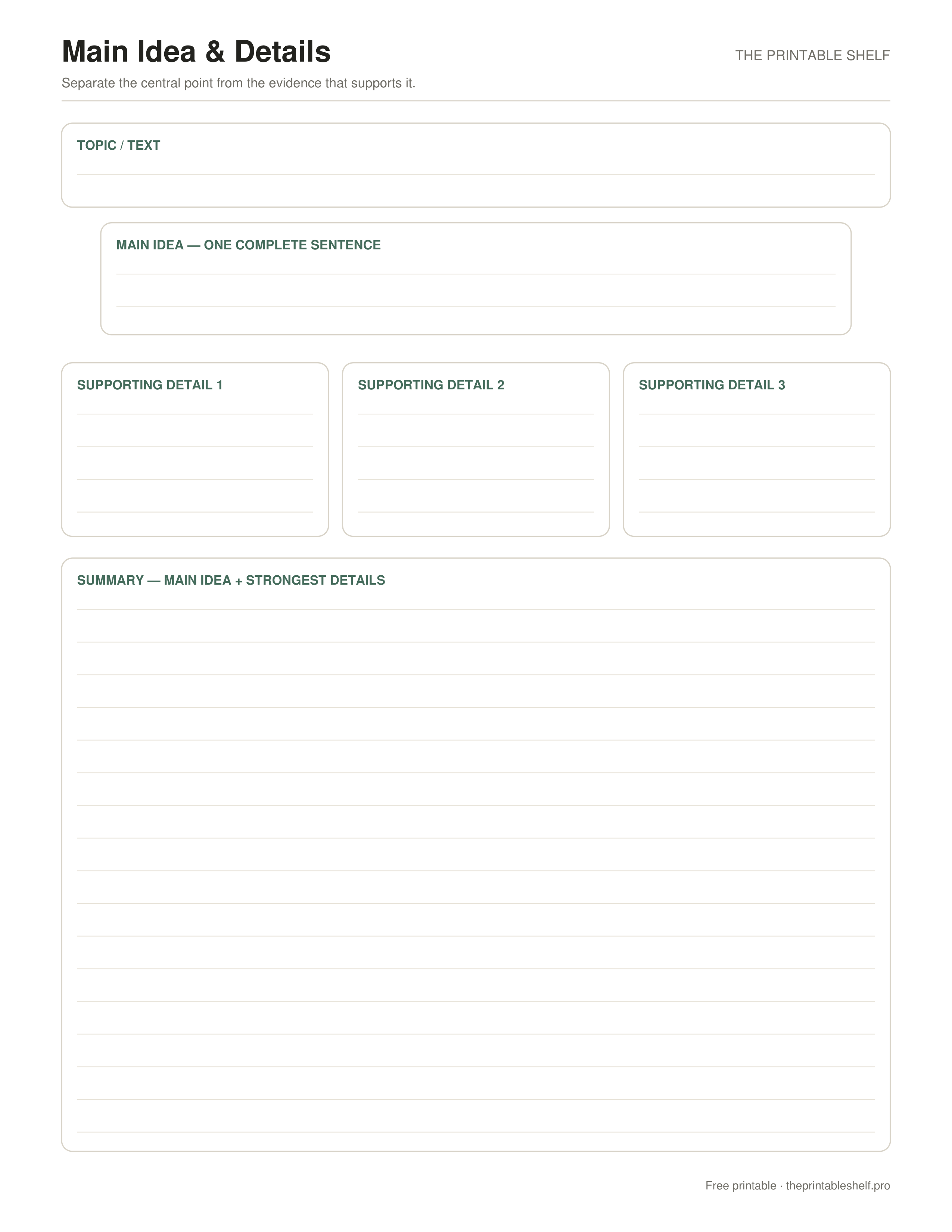
No sign-up required · personal/classroom use
Turn the organizer into a summary instead of submitting the organizer
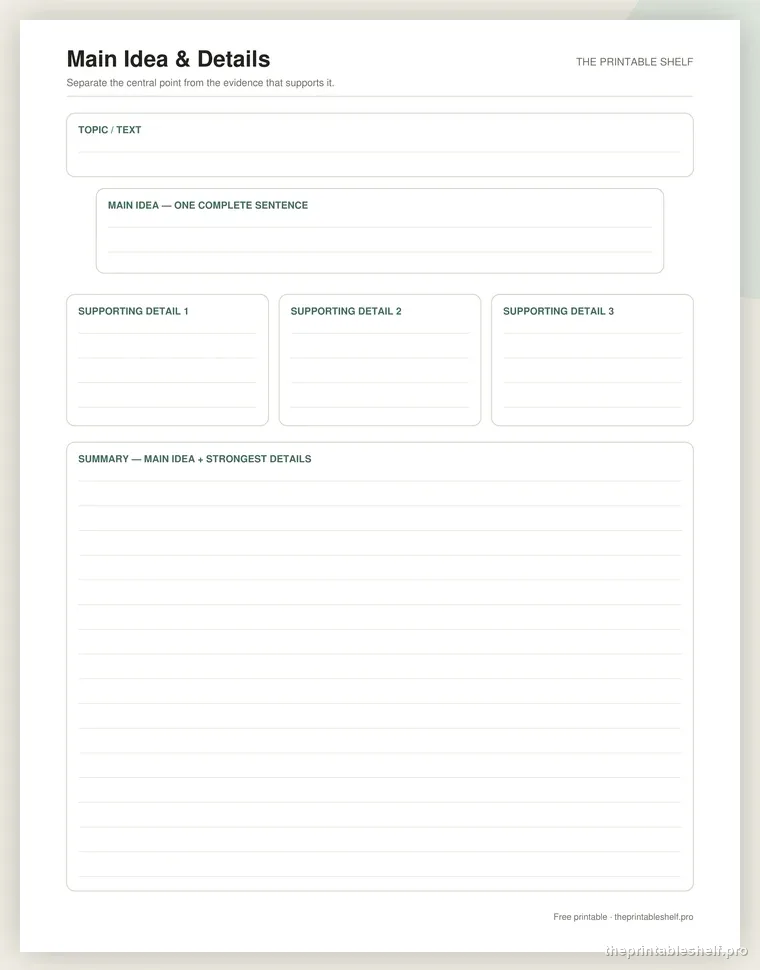
A graphic organizer is an intermediate thinking tool. The center or top box may hold the main idea, while supporting boxes hold key evidence or explanations. That structure helps selection, but a final summary should usually be connected prose. Combine the main idea with the strongest supporting information, remove repeated wording, and add only the transitions needed to make the relationship clear.
This step matters because a filled worksheet can create the illusion of comprehension. A student may copy one sentence into each box without deciding what is important. Ask the learner to close or cover the source and explain the text from the organizer. If the explanation is coherent, the notes are probably doing useful work. If the learner has to reopen the source for every sentence, the organizer may contain copied fragments rather than understood ideas.
Worked example: from paragraph to main idea to summary
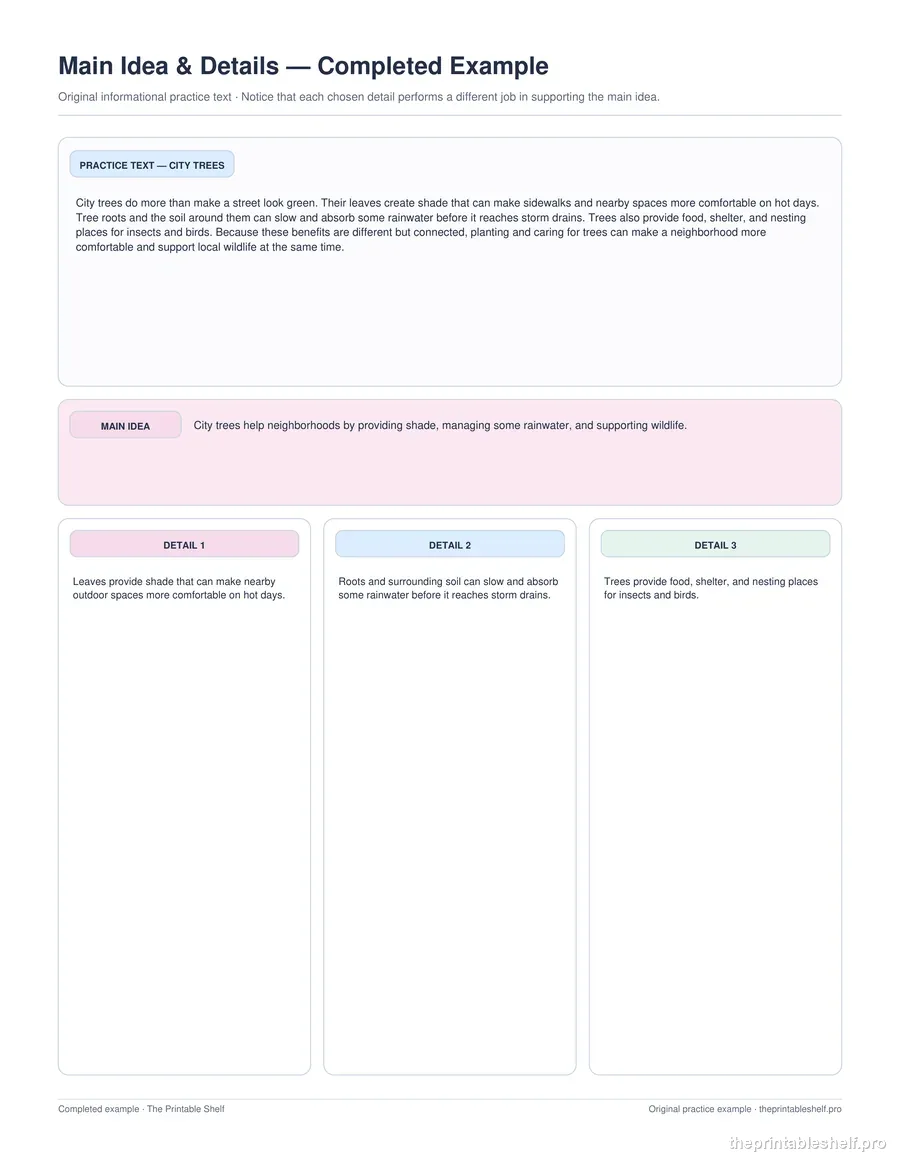
Imagine a short passage explaining that city trees provide shade, lower surface temperatures, reduce some storm-water runoff, and can make streets more comfortable for walking. It also gives the species name of one tree planted on a sample street and describes the color of its autumn leaves. The topic is urban trees. A reasonable main idea is: Trees can make city neighborhoods more comfortable and resilient by providing several environmental benefits.
A short summary might be: City trees can improve neighborhood conditions by providing shade, lowering heat around paved surfaces, and helping manage rainfall. These benefits can also make streets more comfortable for people using them. The species name and leaf color may be interesting, but unless the passage's purpose depends on those facts, they do not need to survive the compression.
Notice the difference in jobs. The main idea names the central claim. The summary restates that claim and preserves selected details that explain it. Neither answer is simply the topic Urban trees, and the summary is not a sentence-by-sentence miniature of the source.
Practice: is it a topic, a main idea, a detail, or a summary?
Read this short passage: “Honeybees live in colonies of tens of thousands. Worker bees collect nectar and pollen, feed the young, and guard the hive, while the queen lays eggs. When a worker finds a good patch of flowers, she dances to tell the others where it is. This teamwork helps the colony survive the winter.”
Each response below is about that passage. Label each one before you read the answer in the last two columns.
| Response | Label | Why |
|---|---|---|
| Honeybees. | Topic only | It names the subject but says nothing about it. |
| Honeybees survive as a colony because each bee has a job and the bees communicate to work together. | Main idea | One sentence that states the central point the whole passage develops. |
| Worker bees collect nectar and pollen. | Single detail | True and taken from the passage, but it is one supporting detail, not the central point. |
| Honeybees live in large colonies. Workers gather nectar and pollen, feed young bees, and guard the hive while the queen lays eggs. Workers also dance to show others where flowers are, and this teamwork helps the colony survive the winter. | Summary | It keeps the main idea plus the key supporting details, shortened and reworded, and leaves out nothing the reader needs. |
Main idea looks different in informational text and fiction
In informational text, the main idea is usually a central point developed with facts, explanations, examples, or reasons. A heading may reveal the topic, but the reader still has to state what the section says about that topic. In fiction, the task may instead center on the conflict, a character's change, or a theme supported by the plot; forcing a textbook-style topic-main-idea frame onto a story can distort what matters.
That is why a story map and a main-idea organizer are not interchangeable. Use main idea and details when evidence develops a central point. Use a story map when character, conflict, important events, and resolution are the relationships the reader needs to preserve.
For longer texts, summarize in layers
Longer texts usually contain more than one important idea. Do not ask students to jump from a six-page article directly to one tiny sentence. Work section by section. Write a short main-idea statement for each meaningful section, keep only the details necessary to understand that section, then look across those mini-summaries for the larger idea that connects them.
Shanahan recommends beginning with shorter texts or paragraphs and then applying the same thinking to longer sections. This layered approach also makes revision easier. If the final summary is too long, the student can inspect which section contributed too many details. If it is too vague, the student can see which section's central idea disappeared during compression.
A four-step routine for students
Step one: write the topic as a brief word or phrase. Step two: finish the sentence The author mainly wants me to understand that... without looking at answer choices. Step three: select only the few details needed to make that statement accurate and understandable. Step four: cover the source and write the summary using the central statement and selected details in your own wording.
Then check the result against the original. Did the summary introduce a claim the author never made? Did it omit a condition that changes the meaning? Did it include a favorite example just because it was memorable? Did it repeat the same idea twice? This verification step is where summarizing becomes more than shortening. The learner is checking whether the compressed version remains faithful to the source.
Self-check: is this actually a summary?
Before calling the response finished, test it against five questions. First, can a reader tell what the text is mainly about and what it says about that topic? Second, are the included details necessary for understanding the central meaning rather than merely interesting? Third, did the writer preserve any condition, contrast, or limitation that changes the author's point? Fourth, is the wording mostly the student's own rather than a stitched-together set of copied phrases? Fifth, is the response substantially shorter than the source while still making sense on its own?
A failed check points to the next revision: restate the main idea, cut trivia, restore an important qualifier, paraphrase copied wording, or compress sentence-by-sentence retelling. The checklist turns the vague instruction to make the summary shorter into a concrete revision routine.
| Check | Pass looks like | If it fails |
|---|---|---|
| Central meaning | The main point is clear without the original beside it | Rewrite the main-idea sentence first |
| Detail selection | Every detail helps explain the central point | Cut examples that are interesting but nonessential |
| Accuracy | Important conditions and contrasts are preserved | Restore the qualifier that changes the meaning |
| Own wording | The response can be explained without copying phrases | Cover the source and paraphrase from notes |
| Compression | The response is much shorter but still coherent | Group repeated ideas and remove sentence-by-sentence retelling |
Common mistakes and how to fix them
If the main idea is only a word or short noun phrase, it is probably just the topic. Turn it into a complete statement about what the text says. If the main-idea sentence has become a list of examples, move those examples into supporting-detail boxes and keep the central relationship in the main-idea statement. If the summary is almost as long as the original, rank details by necessity instead of rewriting every sentence.
If the summary reads like first this happened, then this happened for an informational text, the student may be retelling order rather than importance. If the summary uses long copied phrases, cover the source and paraphrase from the organizer. Reading Rockets' main-idea guidance emphasizes paraphrasing and summarizing as integrated comprehension work; the objective is to build a representation of meaning, not to hunt for a sentence that looks like the answer.
Quick answers
What is Somebody-Wanted-But-So-Then?
Somebody-Wanted-But-So-Then (SWBST) is a summarizing frame for stories. Name the somebody, say what they wanted, what got in the way (but), what happened because of it (so), and how it ended (then). For Cinderella: Cinderella wanted to go to the ball, but her stepmother forbade it, so her fairy godmother helped her, and then she met the prince. It builds a short summary without retelling every scene.
What is an example of a main idea?
In a paragraph about honeybees that explains how they dance to tell others where flowers are, the main idea is that honeybees use dance to share information about food. The topic is honeybees, and the main idea says what the author is mostly telling you about that topic. A summary would add the key details in a few sentences.
What is another term for main idea?
Central idea, key idea, and gist are common alternatives, and in some lessons the term controlling idea is used for writing. These terms are close in meaning: the most important point the author makes about the topic. Theme is different, because it names a message about life in a story, not the point of an informational passage.
Is the main idea the same as a summary?
No. The main idea states the central point, while a summary gives a compressed account of the important content and usually includes the main idea plus essential supporting details.
Does a summary always include the main idea?
A useful summary should preserve the central idea or ideas of the source. If it lists details but leaves out what those details add up to, it is closer to a collection of notes than a summary.
How many details should be in a summary?
There is no fixed number. Include only the details needed to make the central meaning accurate and understandable. A short text may need very little support, while a longer text may require several details grouped across sections.
Is the main idea the same as the theme?
No. A main idea is specific to one text and can include its characters, places, or events. A theme is a general lesson that could apply to many stories, and one story can have more than one. In The Tortoise and the Hare, the main idea is that a boastful hare naps and loses a race to a slow, steady tortoise, while a theme is that steady effort can beat overconfidence.
Is the main idea always the first sentence?
No. In informational paragraphs the main idea often appears near the beginning, but it can also come in the middle or at the end, and sometimes it is only implied. Read the whole paragraph, then state what the details add up to.
How long should a main idea be?
Usually one clear sentence. It should say what the text is mainly saying about its topic and leave most supporting details for the summary.
Download a matching template
Sources
These sources support the instructional background in this guide. The printable recommendations and usage notes above are The Printable Shelf's editorial guidance.
- Smekens Education Solutions — Distinguish main idea from theme — Explains that a main idea is specific to one text and can be stated in a single sentence, while a theme is a global statement about a lesson.
- Reading Rockets — Summarizing — Provides a classroom summarizing framework focused on main ideas, crucial supporting details, and removal of irrelevant information.
- Reading Rockets — How Do I Teach Main Idea? — Discusses teaching main idea through summarizing, paraphrasing, shorter texts, and increasingly independent practice.
- Reading Rockets — Why Main Idea Is Not the Main Idea — Explains why integrated work with summarizing, text structure, and paraphrasing can be more useful than isolated main-idea question practice.
- Reading Rockets — Paragraph Shrinking — Offers a routine for identifying who or what a paragraph is about, the most important information, and a concise main idea.
- IES — Summarizing Bookmark — Defines summarizing as focusing on main ideas and important supporting details, with a short student routine.
Related reading
Free Reading Comprehension Graphic Organizers by Reading Skill
Free reading comprehension graphic organizers for story elements, main idea, sequence, cause and effect, comparison, vocabulary, and prior knowledge.
Read guide →
How to Use Graphic Organizers Effectively (Without Turning Them Into Busywork)
Learn how to choose, model, scaffold, and reuse graphic organizers so students think with them instead of simply filling in boxes.
Read guide →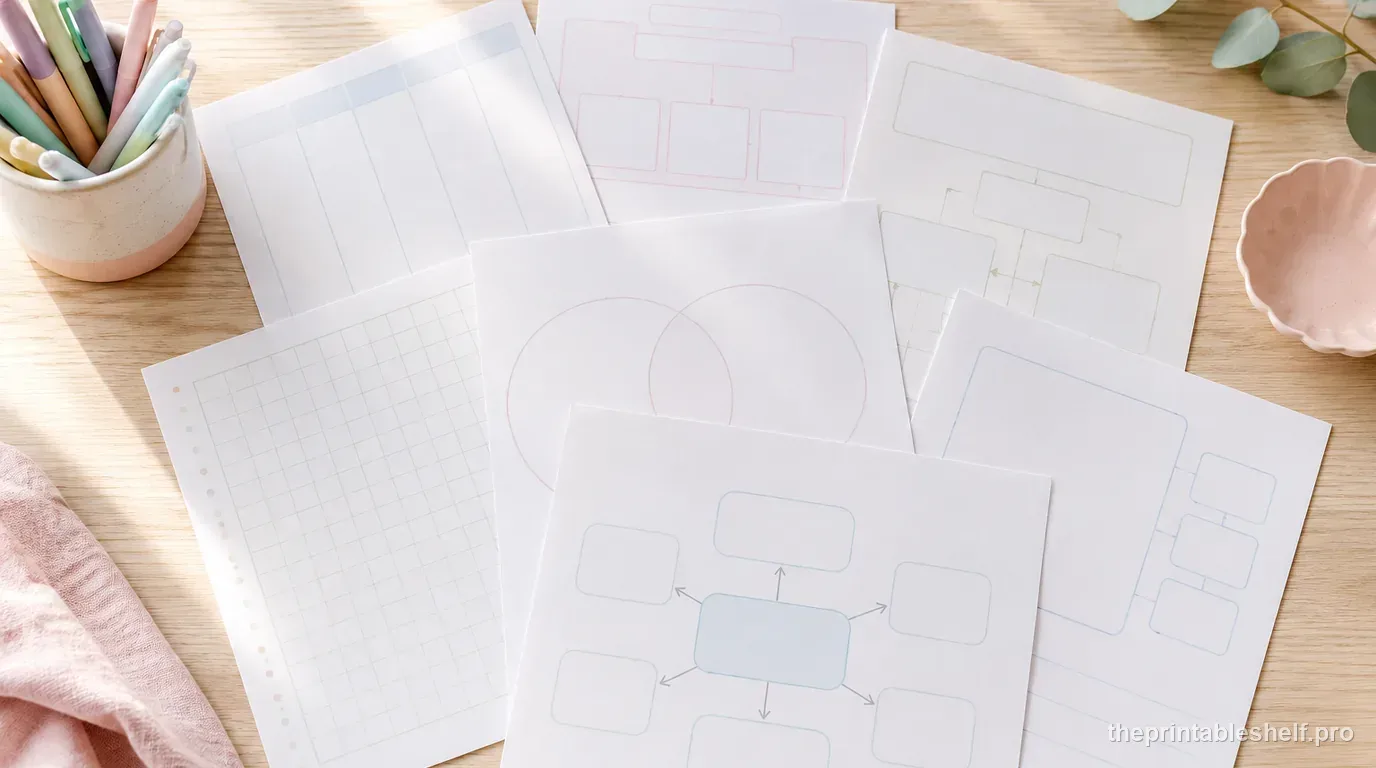
10 Free Graphic Organizers for Reading, Writing, and Studying
Download 10 free graphic organizers for reading, writing, comparison, vocabulary, sequencing, and study. Includes a guide to choosing the right one.
Read guide →
How to Find the Main Idea and Supporting Details in a Text
Learn how to find a text's main idea and supporting details with a step-by-step method, worked examples, and a free graphic organizer.
Read guide →