How-to guide · Work & Study
How to Find the Main Idea and Supporting Details in a Text
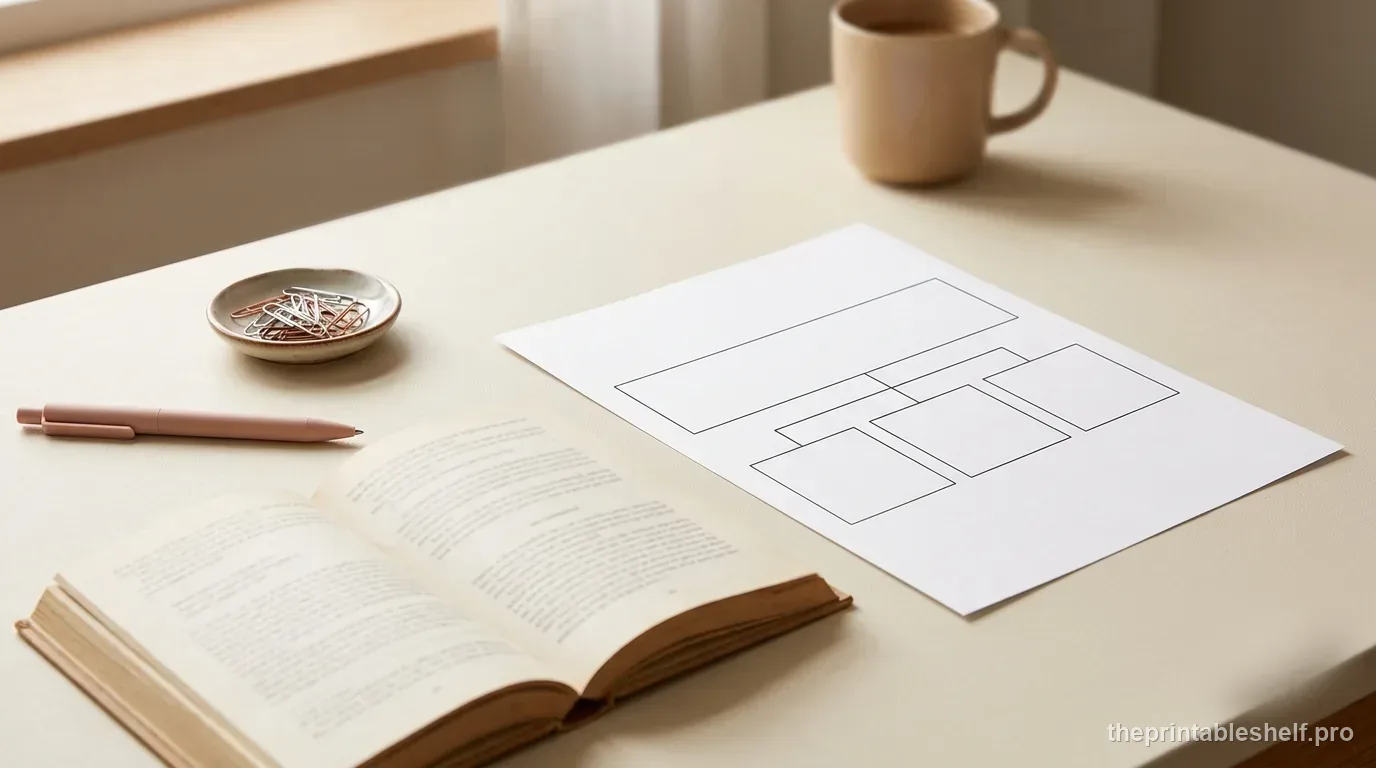
Main-idea questions become confusing when students are told to ‘pick the most important sentence’ as though every text contains one perfect sentence waiting to be copied. Sometimes the author states the central point directly. Other times readers have to combine information and express the idea in their own words. Supporting details are not simply the other sentences on the page; they are the facts, examples, reasons, descriptions, or events that actually help develop that central point.
Reading Rockets has argued that main-idea instruction is more useful when it is connected to broader comprehension work such as summarizing, paraphrasing, and understanding text structure instead of becoming endless practice with isolated question types. That distinction matters for a printable too. A main-idea organizer should help the reader explain the relationship between the central idea and evidence, not just copy four lines from a passage.
Start with topic, then move to main idea
The topic is what the passage is about; the main idea is what the passage communicates about that topic. Topic answers can often be written as a word or phrase: honeybees, city parks, sleep, the water cycle. A main idea needs a complete thought: ‘Honeybees support many food crops by carrying pollen between flowers.’ That statement tells the reader what matters about the topic in this particular text.
If a student keeps writing one-word answers, use the sentence frame: The text is mostly about ___, and the author wants me to understand that ___. The first blank identifies the topic. The second forces a claim about the text. Remove the frame once the distinction becomes automatic.
Step 1: read for the boundaries of the section
Decide what amount of text you are summarizing before searching for a main idea. A paragraph, a textbook subsection, and an entire article can each have a different central idea. A sentence that works for one paragraph may be only a supporting point in the larger article. Headings, subheadings, repeated terms, topic sentences, and concluding sentences can help reveal those boundaries, but none should be treated as an automatic answer.
For a longer text, pause by section. Write a brief note about what each section contributes. Then look across those notes for the idea that unifies them. This is usually more reliable than rereading the whole article and trying to guess which sentence felt most important.
Step 2: identify the topic without making it the answer
Ask, ‘Who or what keeps showing up?’ Then state the topic as briefly as possible. If a passage repeatedly discusses roofs, pavement, shade, and temperatures in cities, the topic might be urban heat. Do not stop there. The topic gives you a search area for the main idea, not the main idea itself.
A useful correction routine is to compare two answers. ‘Urban heat’ is a topic. ‘Cities can reduce extreme surface temperatures by increasing shade and vegetation’ is a main-idea candidate. One labels the subject; the other says something the text is developing about that subject.
Step 3: draft a main-idea candidate in your own words
Before looking for detail boxes to fill, write one sentence that covers the section as a whole. Avoid language so vague that it could fit any passage, such as ‘There are many things to know about trees.’ Also avoid a sentence tied to one example, such as ‘Oak trees can live for hundreds of years,’ if the section discusses several ways trees survive across environments.
A strong candidate has the right level of generality. It is broad enough to cover the important evidence but specific enough that unrelated details would clearly fall outside it. This balance is easier to test than the vague instruction to choose the ‘most important’ sentence.
Step 4: test the candidate against the strongest details
Now ask what each important detail does for the candidate sentence. Does it explain the idea, give evidence for it, provide an example, show a cause, describe a result, or clarify a key part? If a detail has no clear relationship, either it is minor information or the proposed main idea is wrong.
Do not reward quantity. A reader who selects a small set of strong details and can explain each connection demonstrates more understanding than a reader who fills the organizer with copied sentences. On the free organizer, use the detail boxes for the evidence that does the most work. If the text provides several similar examples, choose only the examples that make the relationship clearest.
Worked example: a short informational passage
Imagine a passage explains that some city neighborhoods become much hotter than nearby areas because pavement and dark roofs absorb heat. It then describes planting street trees, adding shade structures, and using lighter roof materials. A final paragraph explains that these changes can lower surface temperatures and make walking routes more comfortable during hot weather.
Topic: heat in cities. A main-idea candidate such as ‘Pavement gets hot in summer’ is too narrow because it ignores the responses and outcomes. ‘Cities are hot’ is too broad. A stronger main idea is: ‘Cities can reduce heat in built-up neighborhoods by adding shade and using surfaces that absorb less heat.’ Supporting details would include the heat-absorbing effect of pavement and roofs, tree or shade interventions, and lighter materials. Each detail either explains the problem or develops the response named in the main idea.
After filling the organizer, cover the main-idea box and try to reconstruct it from the chosen details. If the details point toward the same complete thought, the selection is coherent. If they suggest several unrelated topics, revise the main idea or replace weaker details.
Main idea in nonfiction and fiction is not always the same task
In informational text, the main idea often captures an explanation, claim, process, relationship, or central point about a topic. Text structure can help: cause-and-effect sections often build an idea about why something happens; compare-and-contrast sections may build an idea about an important similarity or difference. Use structure as evidence, not as a shortcut.
In fiction, teachers and worksheets sometimes use ‘main idea’ loosely when they really mean the central event, lesson, message, or what a section is mostly about. For a complete story, a story map or summary is often the better tool because character goals, conflict, and resolution matter more than collecting supporting facts under a single informational statement. Match the organizer to the kind of thinking the text requires.
How to tell a supporting detail from an interesting detail
A detail can be memorable without being important to the central idea. Ask: if I removed this information, would the reader still have the evidence needed to understand the author's main point? A colorful example may make a passage engaging but still be optional. A less dramatic fact may be essential because it supports the relationship the author is explaining.
Try labeling each candidate detail with a job: supports, explains, gives an example, shows a cause, shows an effect, defines, or describes. If you cannot name the job, question whether the detail belongs. This small annotation makes the organizer more analytical and reduces the habit of copying the first sentences students notice.
When the main idea is implied instead of stated
If no sentence states the central idea directly, collect the repeated patterns first. What examples keep appearing? What relationship connects them? What conclusion would make those details belong together? Then write a sentence in your own words and test it against the passage. An implied main idea still has to be supported by the text; it is not a personal opinion about the topic.
For students who struggle with this step, provide two candidate sentences and ask which one covers more of the important details without becoming vague. Discuss why. Once that discrimination becomes easier, remove the choices and have students generate the sentence independently.
Turn the organizer into a summary without copying it
A main-idea organizer is preparation for a summary, not the summary itself. Start with the central idea in your own words. Add only the details a reader needs to understand or support that idea. Combine related details and remove examples that repeat the same point. The final summary should read like connected prose, not a list of boxes joined with and.
This is where main idea and summary overlap but are not identical. The main idea is the central point. A summary communicates that point plus the most important information needed to represent the text accurately. If you need a deeper distinction, use the separate Main Idea vs. Summary guide before asking students to move from the organizer to a finished response.
Common main-idea mistakes and quick repairs
Mistake one is writing the topic as the answer. Require a complete sentence that says what the text communicates about the topic. Mistake two is choosing the first sentence automatically. Treat opening and closing sentences as clues, then verify them against the rest of the section. Mistake three is selecting a detail because it is surprising. Ask what job it performs for the central idea.
Mistake four is writing a main idea so broad that every detail seems to fit. Add the specific relationship, claim, or explanation developed by the text. Mistake five is copying too many details into the organizer. Choose evidence that does different work. Mistake six is practicing main idea only through multiple-choice questions. Pair the skill with paraphrasing, text structure, discussion, and summarizing so the reader has to build an understanding of the text instead of recognizing an answer choice.
Questions people ask
How do you find the main idea of a paragraph?
First name the topic in a word or two. Then ask what the author is mostly saying about that topic, and check your answer against the details: if most of them support it, it is the main idea. The main idea is a complete statement, not just a subject, and it may be stated in a sentence or only implied.
What is a formula for finding the main idea?
A useful formula is: topic plus what the author says about the topic. For example, the topic is honeybees, and the passage says they communicate food locations by dancing, so the main idea is that honeybees share food locations through dance. Test it by asking whether the supporting details back it up.
What is the difference between the topic and the main idea?
The topic names what the text is about, usually in a word or short phrase. The main idea is a complete thought explaining what the author communicates about that topic in the section or text you are reading.
How many supporting details should a main-idea organizer include?
Use the strongest details needed to support or explain the main idea. Three is a common printable layout, but quality matters more than filling a fixed number of boxes. Select details that perform distinct jobs rather than repeating the same evidence.
Can the main idea be implied?
Yes. When the author does not state it directly, readers infer the main idea by combining repeated points and relationships across the text, then testing their sentence against the strongest evidence.
Matching templates
Free Main Idea and Details Graphic Organizer PDF →
Use this main idea and details organizer to separate what a text is mostly saying from the facts, examples, or reasons that support it. The printable includes a topic box, one main-idea statement, three supporting-detail boxes, and a summary section. Download it in Letter, A4, or PNG format.
Free Summary Graphic Organizer →
This free summary graphic organizer helps readers decide what matters before writing. Identify the central idea, select up to four essential details, deliberately name information that can be left out, then write a shorter version in your own words. The layout is designed to prevent a summary from becoming a sentence-by-sentence retell.
Free Printable Story Map Template →
This free story map printable gives students space for characters, setting, the central problem, and a beginning-middle-end story arc. Use it to plan original writing or map a story after reading. Separate Letter, A4, and PNG downloads make it easy to use at home, in class, or in a binder.
Free Cause and Effect Graphic Organizer →
Use this cause and effect graphic organizer to connect why something happened with what happened as a result. The page includes a focus event plus three clearly paired cause-and-effect rows, making it useful for reading, science, history, and process analysis. Download it in Letter, A4, or PNG format.
Free 5 W's Graphic Organizer PDF (5W and 5W+1H) →
A 5 W’s organizer captures the essential Who, What, When, Where, and Why of a topic on one page. Use it to pull key facts from an article, summarize an event, plan a report, prepare interview questions, or check whether a piece of writing gives the reader enough context.
Free Informational Writing Graphic Organizer →
This informational writing organizer helps turn research or background knowledge into a focused explanation. Define the topic, choose three distinct facts or subtopics, add the explanation each one needs, and finish with the main idea you want the reader to remember. Use it before drafting paragraphs, reports, and short explanatory responses.
Sources & further reading
These sources support the instructional background in this guide. The printable recommendations and usage notes above are The Printable Shelf's editorial guidance.
- Reading Rockets — Why Main Idea Is Not the Main Idea — Argues for connecting main-idea work with summarizing, text structure analysis, paraphrasing, and fuller comprehension rather than isolated question practice.
- Reading Rockets — 10 Key Policies and Practices for Teaching English Language Learners — Includes extracting main ideas and supporting details, paraphrasing, and graphic prompts among classroom language and literacy supports.
- Reading Rockets — How Do I Teach Main Idea? — Detailed instructional discussion of main idea as part of broader comprehension, summarizing, paraphrasing, and identifying important supporting details.
- IES What Works Clearinghouse — Read STOP Write study — Describes an intervention in which students identified main ideas and supporting details, used text-structure graphic organizers, summarized, and wrote from informational texts.
Other guides you may like
Main Idea vs. Summary: What's the Difference?
Learn the difference between main idea and summary, see worked examples, and use main idea plus key details to build a concise summary.
Read guide →
Free Reading Comprehension Graphic Organizers by Reading Skill
Free reading comprehension graphic organizers for story elements, main idea, sequence, cause and effect, comparison, vocabulary, and prior knowledge.
Read guide →
How to Use Graphic Organizers Effectively (Without Turning Them Into Busywork)
Learn how to choose, model, scaffold, and reuse graphic organizers so students think with them instead of simply filling in boxes.
Read guide →