Work & Study · Free printable
Free Printable Story Map Template
This free story map printable gives students space for characters, setting, the central problem, and a beginning-middle-end story arc. Use it to plan original writing or map a story after reading. Separate Letter, A4, and PNG downloads make it easy to use at home, in class, or in a binder.
Edited by Tessa Vaughn · Planning & Organization Editor
Free download
Choose your file size
Print at 100% / Actual Size for the cleanest margins. Pick the paper size your printer normally uses.
Share to Google Classroom ↗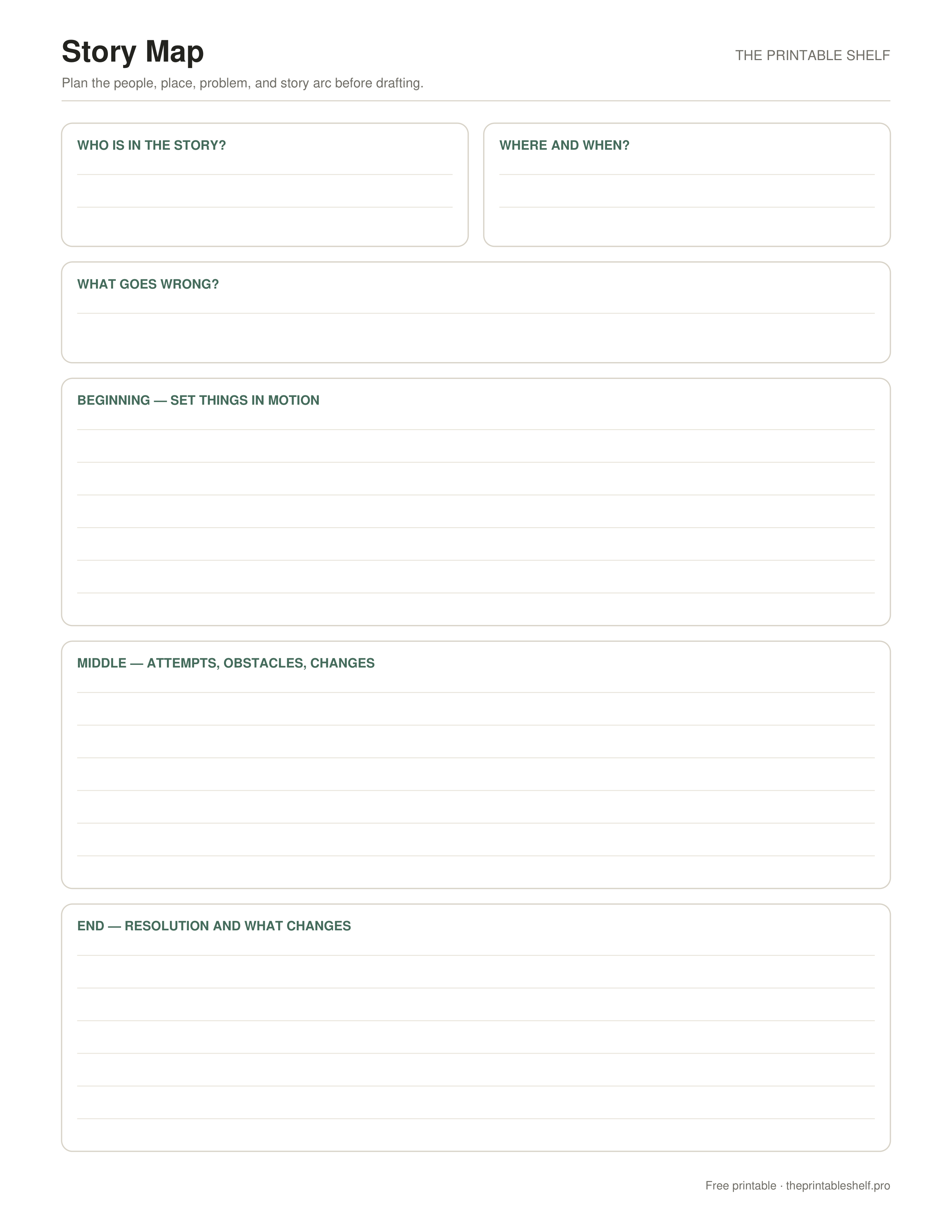
No sign-up required · personal/classroom use
About this printable
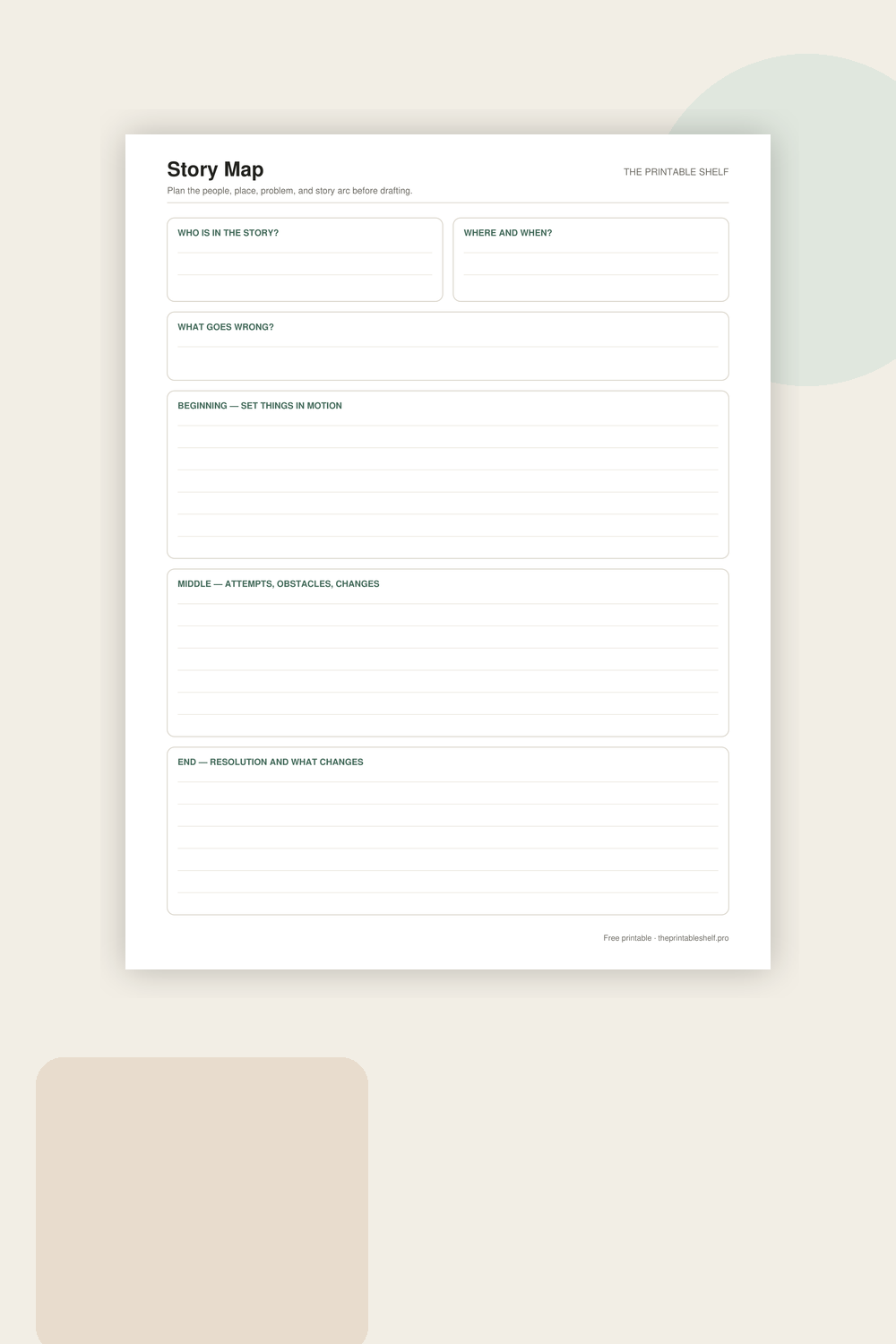
A one-page story organizer that separates the pieces students often mix together. Characters and setting establish who and where, the problem gives the story something to resolve, and three larger boxes organize the sequence into beginning, middle, and end. It works for reading response or prewriting.
How to use it
Fill in the two small boxes first: who is in the story, and where and when it takes place. Names alone are not always enough. Add one useful detail about the main character or setting when it affects what happens next. For a story you are reading, use only information the text actually gives you. For a story you are planning, these boxes help you make early choices before writing full paragraphs.
Next complete What Goes Wrong. This is the most important box on the sheet because it separates a story map from a simple list of events. Write the main problem, goal, conflict, or change that creates pressure on the character. If the problem cannot be stated briefly and clearly, the story may contain several smaller conflicts; choose the one that most strongly drives the important events and ending.
Use the Beginning box for the setup and the event that puts the problem in motion. Use Middle for attempts, obstacles, discoveries, or consequences—not every event that happens. Then use End for the resolution and the change that follows it. When mapping a published story, this structure helps a reader identify which events matter. When planning original writing, it prevents the draft from wandering through unrelated scenes.
Before drafting or answering comprehension questions, read the six boxes from top to bottom and check the logic. The middle should respond to the problem, and the ending should resolve, change, or intentionally leave that problem open. Younger students can sketch first and add labels. Older students can use concise phrases on the map, then expand each part into sentences or paragraphs on separate paper.
If the story has a subplot, do not force it into the same six boxes unless it changes the main conflict. Map the primary arc first. A second sheet can capture a subplot separately, which keeps the main sequence readable and makes connections between the two arcs easier to discuss.
Fill it online
Type directly into this organizer →
Your answers autosave only in this browser. Print or save the filled page as PDF, download a high-resolution PNG, or clear it and start again—no account required.
Customize instead
Need a different title, paper size, or orientation? →
Use the free Graphic Organizer Maker to build a custom Venn, KWL, Frayer, story map, T-chart, main-idea, sequence, or cause-and-effect page.
Also in a free pack
Download this organizer together with related pages when you want one reusable master PDF instead of separate files.
Choose the support level
Blank, guided, example, or fill online
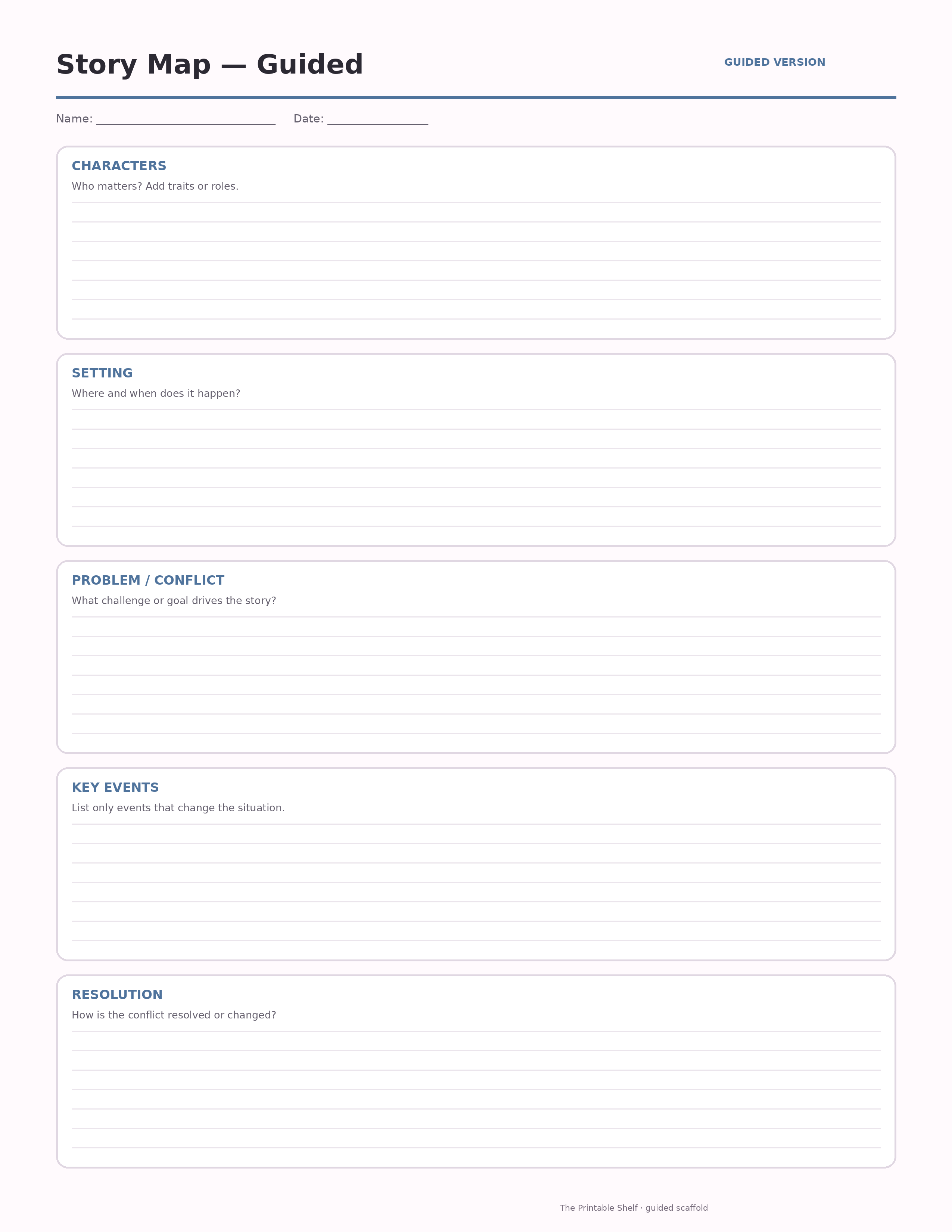
Use the blank page when students already know the routine. Choose the guided version when they need short prompts inside the sections. A completed example is available when this template benefits from modeling, and the online version lets students type before printing.
Blank
Independent use →
The standard printable with open writing space and no embedded hints. Download the Letter PDF.
Guided
Prompted scaffold
A scaffolded version with short prompts inside each section to help students know what kind of evidence or thinking belongs there.
Model
Completed example ↓
Use the finished sample to model the thinking before students work independently.
Online
Type before printing →
Autosave locally, print/save as PDF, or export the filled organizer as PNG.
Teaching set · 3 pages
Blank + guided + completed example in one PDF
Print the model first, practice with prompts, then move to the blank page without downloading three separate files.
Completed example
A completed example
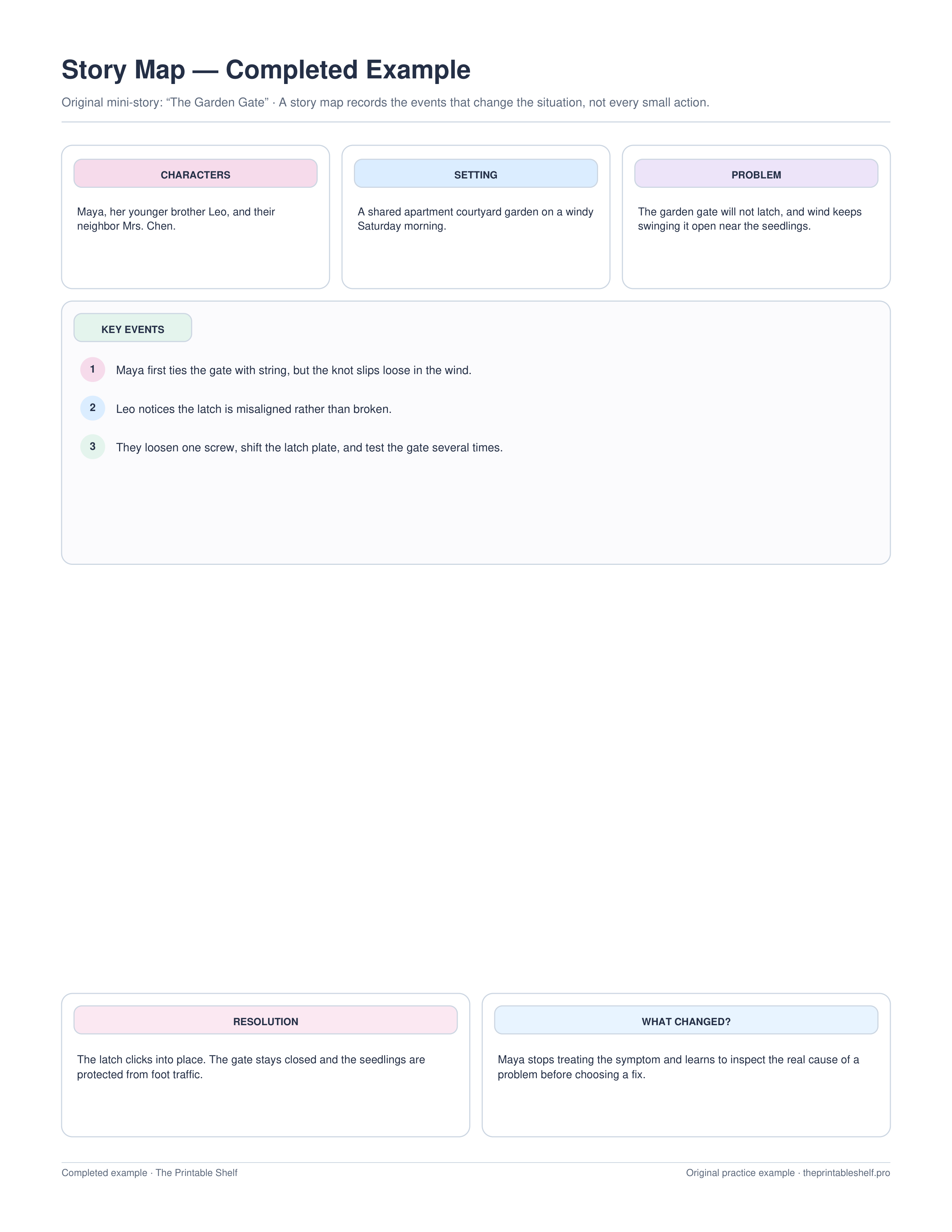
The sample uses an original mini-story to show the difference between story elements and key events. Notice that only events that change the problem or resolution are kept.
Good matches for this page
Three ways to use it
Map the story structure
Record characters, setting, the central problem, only the events that change the situation, and the resolution so the story is visible as a connected whole.
Prepare a retell
Use the completed map as a speaking or writing scaffold, then retell the story in complete sentences instead of reading the boxes as isolated answers.
Compare two narratives
Complete one map for each text, then compare how characters, conflicts, turning points, and resolutions are similar or different.
Common mistakes to avoid
Listing every event in the story
Keep only the events that develop the problem, reveal an important change, or help produce the resolution.
Writing a topic instead of the central problem
State what the character wants, needs, faces, or must resolve in this specific story.
Using a story map for informational text by default
Choose a text-structure organizer such as main idea, sequence, compare/contrast, or cause/effect when the source is not narrative.
Classroom fit
Suggested grades, use modes & standards
Suggested grade bands
These are practical use ranges, not hard limits. Text complexity and the amount of teacher modeling matter more than the worksheet alone.
Good fit for
Scaffold level: Standard.
Common Core crosswalk
- RL.3.3 · Describe characters and how their actions contribute to events
- RL.4.3 · Describe a character, setting, or event using text details
- RL.5.3 · Compare and contrast characters, settings, or events
These codes are a practical crosswalk for skills this organizer can support. They are not a claim that the worksheet alone fully teaches or assesses the standard.
Common questions
Can I use this story map for reading comprehension?
Yes. Fill it in after or during a story to identify characters, setting, the central problem, and the main sequence of events.
Can students use the story map before writing?
Yes. It works well as a prewriting planner because the problem is chosen before the beginning-middle-end sequence is expanded.
Does the printable include a separate problem box?
Yes. The central problem or conflict has its own box before the beginning, middle, and end sections.
Helpful guides
See where this organizer fits, when a different layout works better, and how to turn the completed page into a useful next step.
10 Free Graphic Organizers for Reading, Writing, and Studying
Download 10 free graphic organizers for reading, writing, comparison, vocabulary, sequencing, and study. Includes a guide to choosing the right one.
Read guide →
Free Reading Comprehension Graphic Organizers by Reading Skill
Free reading comprehension graphic organizers for story elements, main idea, sequence, cause and effect, comparison, vocabulary, and prior knowledge.
Read guide →
How to Use Graphic Organizers Effectively (Without Turning Them Into Busywork)
Learn how to choose, model, scaffold, and reuse graphic organizers so students think with them instead of simply filling in boxes.
Read guide →
How to Use a Story Map for Better Reading Comprehension
Learn how to use a story map for characters, setting, problem, key events, and resolution, with a worked example and common fixes.
Read guide →
How to Find the Main Idea and Supporting Details in a Text
Learn how to find a text's main idea and supporting details with a step-by-step method, worked examples, and a free graphic organizer.
Read guide →
How to Teach Sequence of Events in Reading Beyond First, Next, Then, Last
Teach sequence of events in reading with a step-by-step routine for choosing key events, using order clues, retelling, and avoiding overloaded timelines.
Read guide →
Story Map vs. Plot Diagram: Which Graphic Organizer Do You Need?
Compare story maps and plot diagrams, see what each organizer captures, and choose the right one for comprehension, retelling, or plot analysis.
Read guide →Keep organizing
You might also like
Free printable
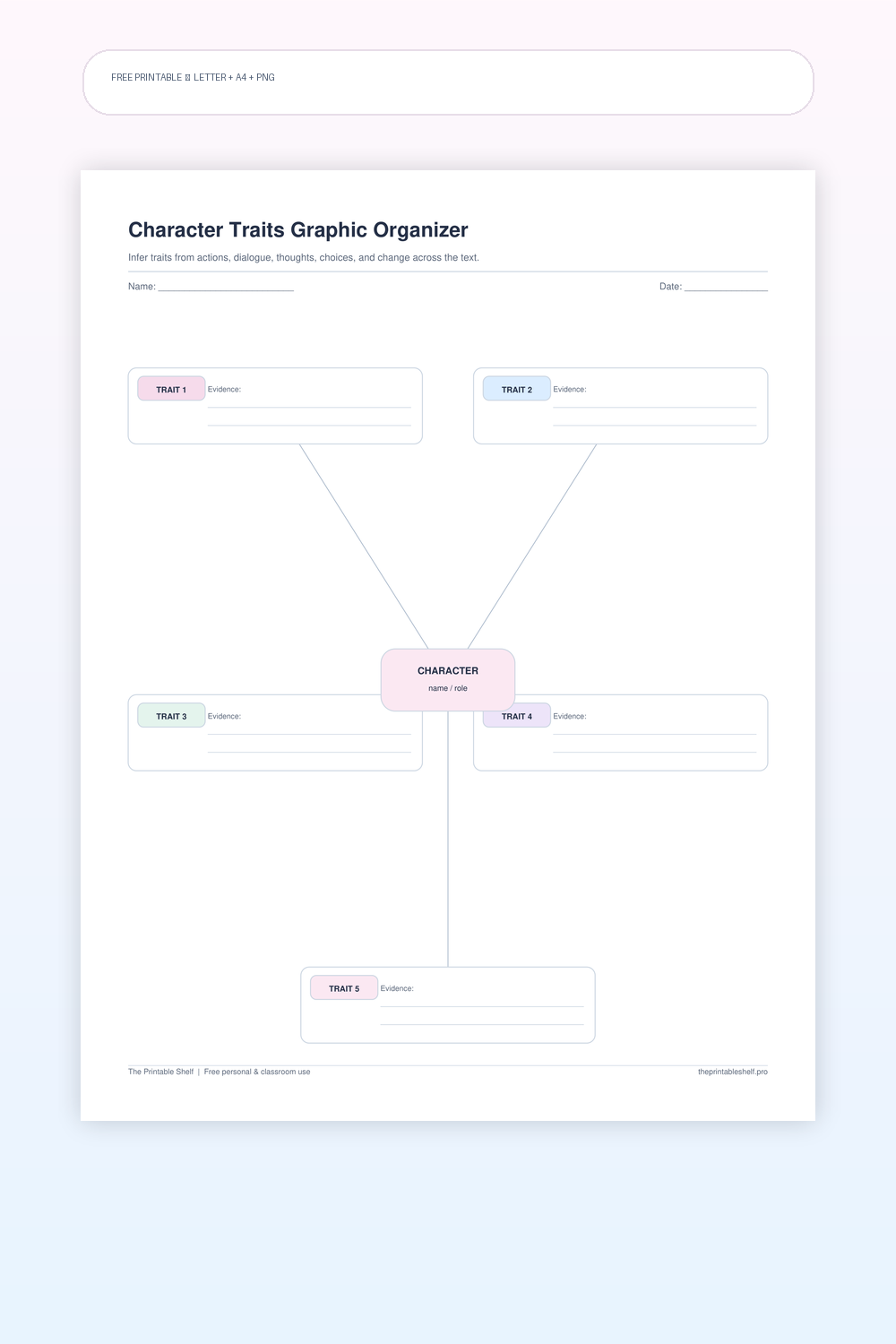
Character Traits Graphic Organizer
A reusable character-analysis page designed to make evidence part of the task. Instead of asking for a list of adjectives with no support, each branch asks for a trait plus evidence from the text. That makes the sheet useful for reading response, discussion preparation, and paragraph planning rather than simple vocabulary practice.
Free printable
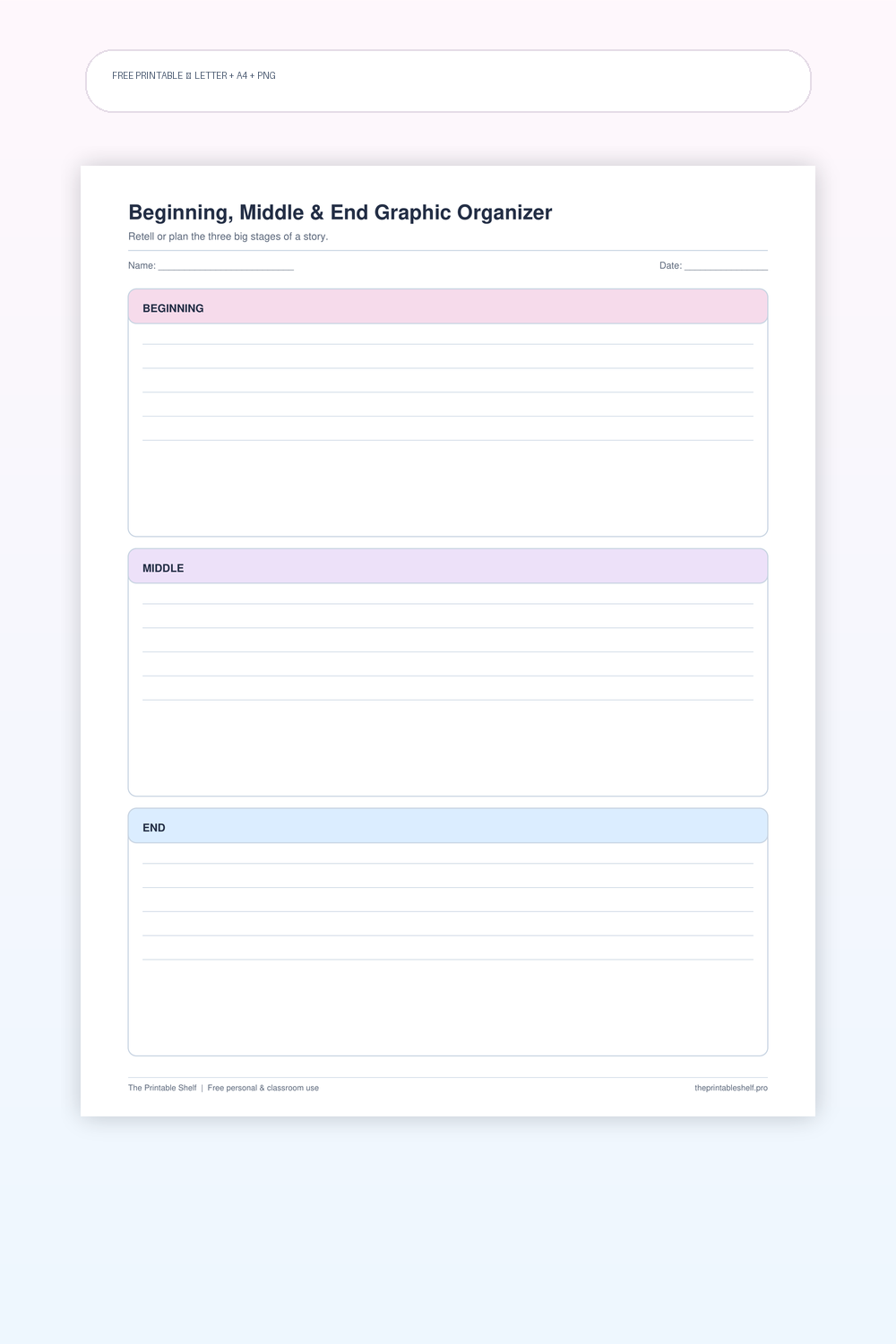
Beginning, Middle, and End Graphic Organizer
A three-part story structure page with enough room to write or sketch the most important events in each stage. It is deliberately simpler than a full story map or five-step sequence organizer, making it especially useful when the goal is basic retelling, summarizing, or planning a short narrative without overwhelming the learner with too many boxes.
Free printable
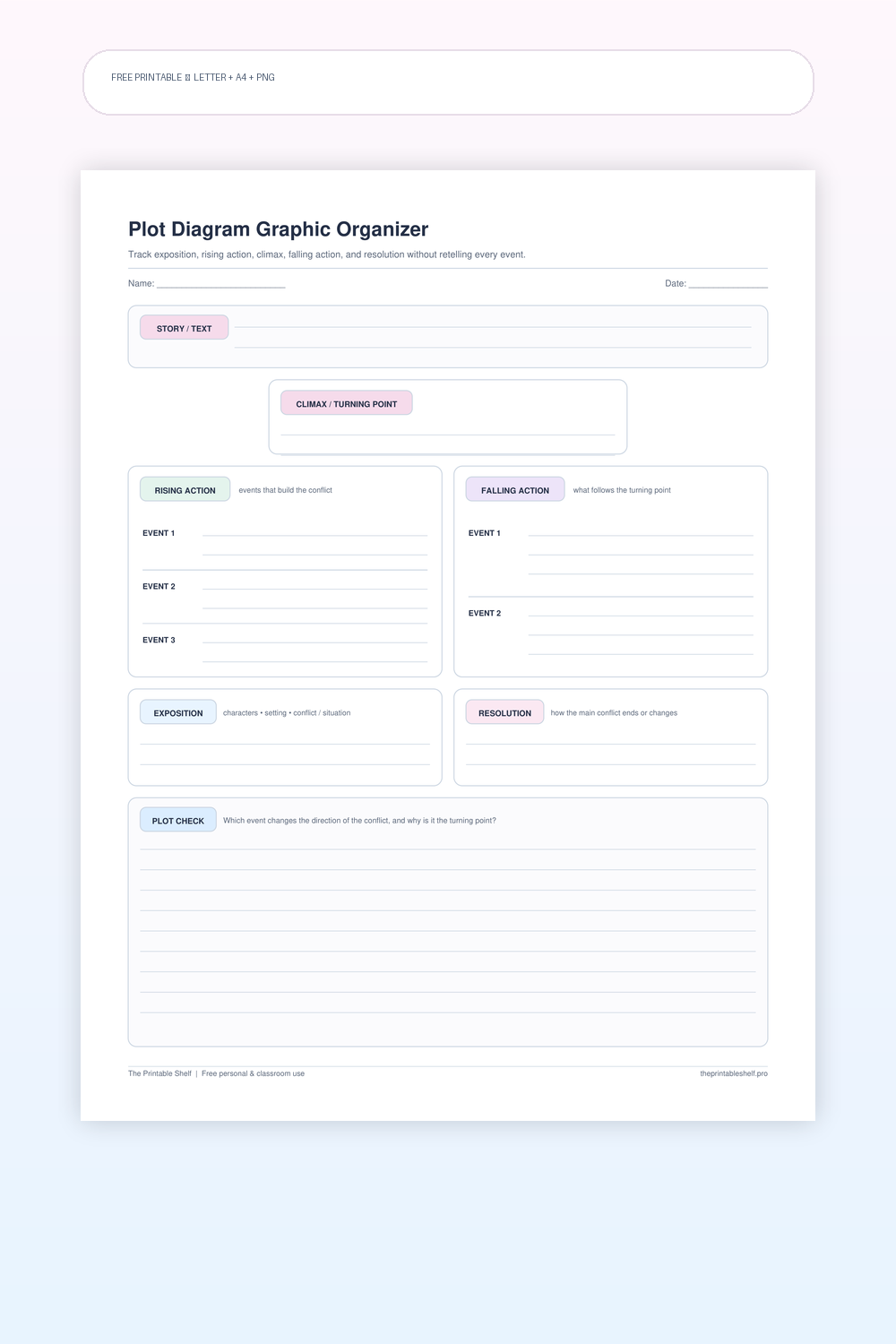
Plot Diagram Graphic Organizer
A plot-structure organizer for examining how a story develops around conflict and a meaningful turning point. It is more specific than a general story map: instead of collecting characters, setting, problem, and solution as separate story elements, this page asks the learner to sort significant events into exposition, rising action, climax, falling action, and resolution. The final plot-check prompt keeps the diagram focused on why the turning point matters rather than on the visual shape of a mountain.