How-to guide · Work & Study
Story Map vs. Plot Diagram: Which Graphic Organizer Do You Need?
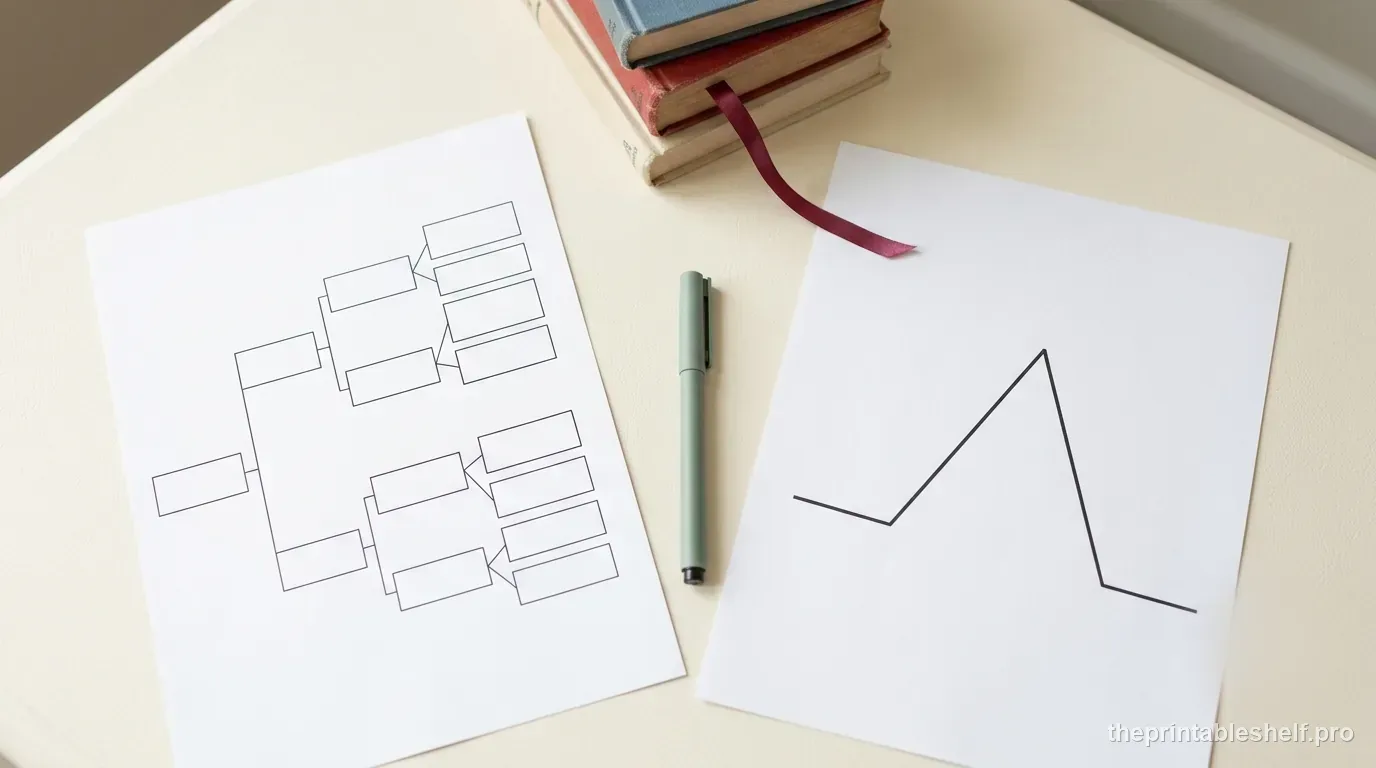
Story maps and plot diagrams are often treated as interchangeable because both organize a narrative. That shortcut works until a student can name the characters and problem but cannot explain where the turning point occurs, or can label a climax but has not identified what the character was trying to solve. The two organizers overlap around plot, yet they put attention on different parts of comprehension.
A useful choice starts with the task, not the worksheet. If the assignment asks who, where, what problem, which events mattered, and how the problem ended, a story map is usually the cleaner fit. If the assignment asks how the action builds, where the major turning point falls, and what happens after it, a plot diagram gives the shape of the story more explicitly. For longer fiction, using both in sequence can be more useful than forcing one page to carry every narrative element.
The quick difference: story elements vs. plot shape
Reading Rockets describes story maps as graphic organizers for narrative elements such as characters, setting, plot, problem, and solution, with simpler versions sometimes using beginning, middle, and end. ReadWriteThink's plot diagram focuses more narrowly on the structure of the action, using a triangular or pyramid-like shape to visualize the beginning, development, turning point, and ending of a story.
That distinction gives you a practical rule: a story map asks what the story is made of; a plot diagram asks how the action develops. A story map can include plot events, and a plot diagram can mention characters or conflict, so the boundary is not absolute. What matters is which relationship the reader needs to see most clearly.
| Question | Story map | Plot diagram |
|---|---|---|
| Main purpose | Organize important narrative elements | Trace the shape and progression of plot |
| Typical fields | Characters, setting, conflict/problem, key events, resolution | Exposition, rising action, climax, falling action, resolution |
| Best for | Comprehension, retelling, story-element review | Plot structure, turning points, pacing, literary analysis |
| Common risk | Listing every event instead of selecting important ones | Labeling stages mechanically without explaining why an event belongs there |
| Good next step | Retell or summarize the story | Explain how the conflict intensifies and changes after the climax |
Choose a story map when the reader is still building the story's skeleton
A story map is the better starting tool when a reader needs to keep track of the basic narrative situation. Characters and setting establish who is involved and where the story occurs. The problem or conflict explains what creates pressure. Key events show the actions that change the situation. The resolution shows how the central problem is settled, changed, or left unresolved.
This makes story mapping especially useful after a read-aloud, short story, chapter, or early novel section. Reading Rockets recommends defining and discussing the story components with a familiar text, modeling the organizer as a class, and then moving toward independent completion. The value is not the boxes themselves. The map provides a repeatable set of questions that helps readers decide which details are structural and which are merely interesting.
Choose a plot diagram when the important question is how the action builds
A plot diagram becomes more useful when students already understand the basic story and need to analyze development. The familiar structure moves from exposition into rising action, reaches a climax or major turning point, then moves through falling action toward resolution. ReadWriteThink notes that plot diagrams help readers and writers visualize key features of stories rather than simply memorize literary terms.
The hardest box is usually not exposition or resolution. It is the climax. Students often choose the loudest event, the final event, or the moment with the most action. A better test is to ask which event most decisively changes the direction of the central conflict. If removing that event would make the rest of the plot unfold differently, it is a stronger climax candidate than a scene that is merely dramatic.
Do not turn the plot diagram into a chronology worksheet
A sequence organizer and a plot diagram both place events in order, but they are not the same task. A sequence chart can record first, next, then, and finally with no judgment about narrative importance. A plot diagram asks the reader to classify events by their role in the story's development. Ten events can happen during rising action; they do not become ten separate plot stages.
When a student fills every part of the mountain with equally sized event descriptions, stop and ask what changed in the conflict at each point. If the answer is only what happened next, the student may still be sequencing. If the answer explains how pressure increased, how a decision narrowed the character's options, or why the climax became possible, the diagram is beginning to show plot structure.
Worked example: one story, two different organizers
Imagine a short story about Maya, a student who promised to keep the school garden alive during a heat wave. On a story map, you might record Maya as the main character, the school garden as the setting, the failing plants and watering restrictions as the problem, several attempts to conserve water as key events, and a successful drip-watering plan as the resolution. That map tells you the important pieces of the narrative.
On a plot diagram, the same story changes shape. Exposition introduces Maya, the garden, and the heat wave. Rising action includes the first wilted plants, failed watering attempts, and growing pressure before the garden showcase. The climax is the moment Maya decides to redesign the watering system rather than keep repeating the same approach. Falling action shows the new system working, and resolution shows the garden surviving the showcase. The facts overlap, but the second organizer asks why each event occupies a structural position.
Use both when the assignment moves from comprehension to analysis
For a longer story, a two-pass workflow works well. First complete a story map so the reader has a stable record of characters, setting, conflict, key events, and resolution. Then move only the plot-relevant events into a plot diagram. The second step should be selective. If an event does not increase pressure, reveal a major change, or help resolve the conflict, it may not belong on the plot diagram even if it was memorable.
This sequence also reduces a common overload problem. Asking a reader to identify character traits, theme, setting, conflict, every event, climax, and resolution on one crowded page can turn the organizer into transcription. Splitting the jobs makes the reasoning visible: first understand the story system, then analyze the action pattern.
Three common mix-ups and how to repair them
Mix-up one is treating the story map as a plot diagram by placing beginning, middle, and end events into every available box. Repair it by restoring the element labels and asking what each box is supposed to explain. Mix-up two is calling the last exciting event the climax. Repair it by tracing the central conflict and locating the decision or event that changes its direction. Mix-up three is putting every scene into rising action. Repair it by selecting only events that meaningfully increase pressure or narrow the possible outcomes.
A fourth warning is assuming every narrative fits a neat mountain. Some stories use multiple conflicts, framed narratives, episodic structures, or quieter turning points. The diagram is a model, not a law. If the story resists the template, let the student explain why. Accurate reasoning about an unusual structure is more valuable than forcing a false climax into a required box.
A five-question self-check before you call the organizer finished
For a story map, ask: Can I identify the central conflict in one clear statement? Did I choose key events because they change the problem rather than because I remember them? Does the resolution connect back to that conflict? For a plot diagram, ask: Can I explain why the climax is a turning point rather than simply an exciting scene? Can I show how the rising action makes the climax more likely or more consequential?
If those questions are hard to answer, the page may be filled in but the story reasoning is not finished. Reopen the text, revise the uncertain boxes, and write a short because statement beside an entry whose role is unclear. That small explanation often reveals whether the event belongs where you placed it.
Which printable should you start with?
Use the free story map printable when the immediate goal is narrative comprehension: characters, setting, conflict, important events, and resolution. If a student is still losing track of what happened, pair it with the sequence-of-events organizer before moving into plot analysis. Once the story is understood, use the dedicated plot-diagram printable to analyze exposition, rising action, climax, falling action, and resolution.
The site keeps the story-map and plot-diagram downloads separate because the two jobs are different. Keeping that distinction explicit is more useful than relabeling one worksheet to target both keywords.
Quick answers
What are the five elements of a story map?
A basic story map covers characters, setting, the problem or conflict, the important events, and the resolution. Some versions add a theme box, but those five give a reader the whole shape of a story. A plot diagram goes further by placing events on a rising and falling arc around the climax.
Is plot different from storyline?
People often use the words loosely for the same thing, but plot is the more precise term: the chain of events linked by cause and effect around a conflict. Storyline usually means the overall story in a few sentences. A story map records the elements, while a plot diagram shows how the events build and resolve.
Is a story map the same as a plot diagram?
No. They overlap, but a story map usually organizes narrative elements such as characters, setting, conflict, events, and resolution, while a plot diagram emphasizes how action develops through stages such as rising action and climax.
Should students use a story map or plot diagram first?
If students are still building basic comprehension, start with a story map. Once they can explain the conflict and important events, a plot diagram can help them analyze how those events build toward a turning point.
Can a story have more than one climax?
A complex work can contain multiple plotlines, and each plotline may have its own major turning point. If a school assignment uses one plot diagram for the central plot, identify the turning point that most directly changes that central conflict and explain the choice.
Download a matching template
Free Printable Story Map Template →
This free story map printable gives students space for characters, setting, the central problem, and a beginning-middle-end story arc. Use it to plan original writing or map a story after reading. Separate Letter, A4, and PNG downloads make it easy to use at home, in class, or in a binder.
Free Plot Diagram Graphic Organizer →
This free plot diagram graphic organizer helps readers or writers identify exposition, rising action, the climax or turning point, falling action, and resolution without retelling every event. The page includes space to name the story, select the events that build the conflict, and explain why one event changes the direction of the plot.
Free Sequence of Events Graphic Organizer →
This sequence of events organizer gives you five ordered steps labeled First, Next, Then, After That, and Finally, plus a final reflection on what changed. Use it to retell a story, track historical events, explain a process, or plan a procedure. Download the printable in Letter, A4, or PNG.
Sources
These sources support the instructional background in this guide. The printable recommendations and usage notes above are The Printable Shelf's editorial guidance.
- Reading Rockets — Story Maps — Defines story maps as narrative-element organizers, outlines classroom modeling, and distinguishes simple beginning-middle-end maps from more advanced story-element formats.
- ReadWriteThink — Plot Diagram — Explains the plot diagram as a visual organizer for plot structure, including Aristotle- and Freytag-style story shapes.
- Reading Rockets — Reading for Meaning — Background on story grammar, including setting, characters, problem, plot steps, resolution, and theme.
Related reading
How to Use a Story Map for Better Reading Comprehension
Learn how to use a story map for characters, setting, problem, key events, and resolution, with a worked example and common fixes.
Read guide →
How to Teach Sequence of Events in Reading Beyond First, Next, Then, Last
Teach sequence of events in reading with a step-by-step routine for choosing key events, using order clues, retelling, and avoiding overloaded timelines.
Read guide →
Free Reading Comprehension Graphic Organizers by Reading Skill
Free reading comprehension graphic organizers for story elements, main idea, sequence, cause and effect, comparison, vocabulary, and prior knowledge.
Read guide →