How-to guide · Work & Study
How to Use a Story Map for Better Reading Comprehension
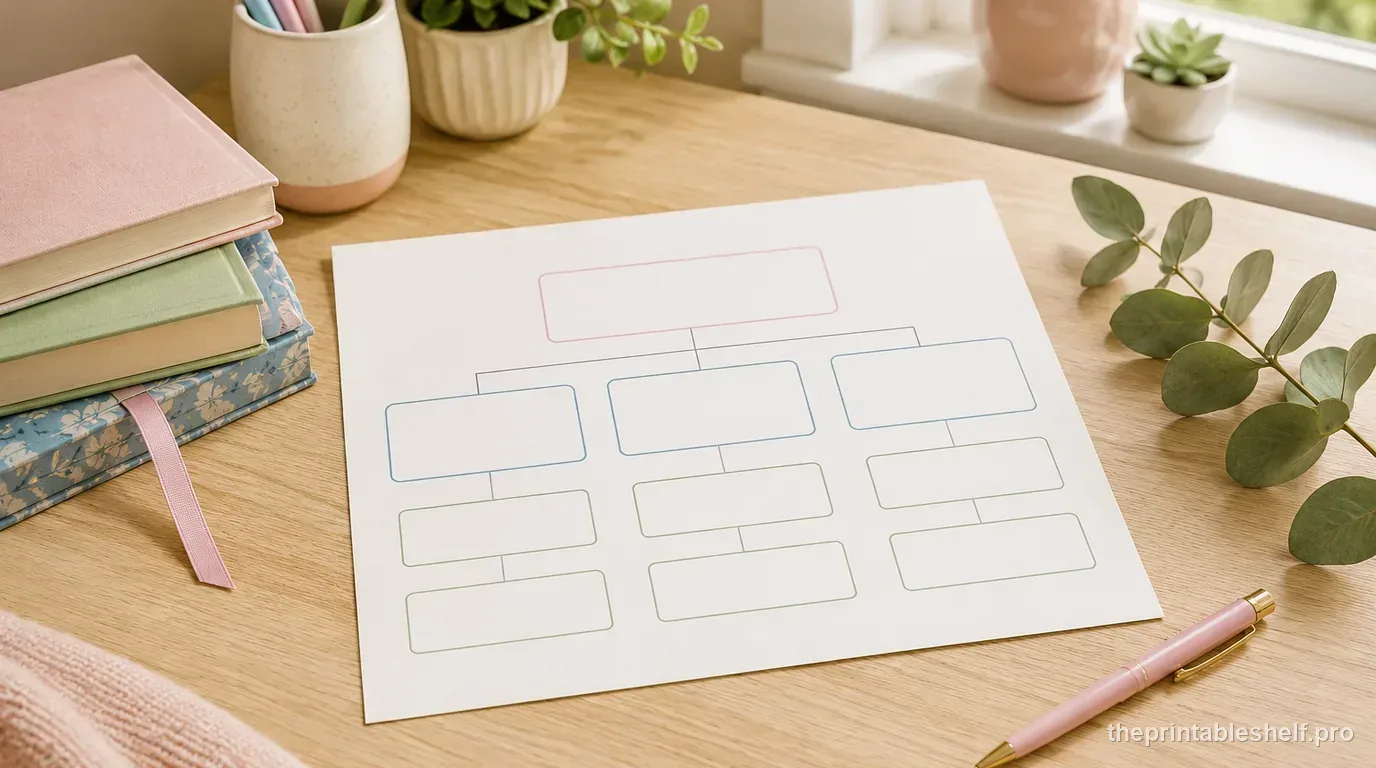
A story map is a graphic organizer that records a story's characters, setting, central problem, key events, and resolution in separate boxes so a reader can see how those parts fit together, rather than sit as unrelated facts. The organizer becomes valuable when the entries reveal those relationships instead of becoming a collection of copied details.
Reading Rockets describes story maps as graphic organizers for identifying narrative elements such as characters, setting, plot, problem, and solution, and recommends explicit modeling before students use them independently. ReadWriteThink uses the same core elements for both post-reading analysis and prewriting. The practical goal, then, is not to fill every blank. It is to identify the few story details that explain the narrative structure clearly enough that the reader can retell, summarize, discuss, or write about the text afterward.
What belongs on a story map?
Most story maps contain some version of five elements: character, setting, problem or conflict, important events, and resolution. Some add theme, character change, or beginning-middle-end. The labels can vary, but the map should answer a coherent set of questions: Who is this story mainly about? What situation are they in? What problem changes that situation? Which events matter because they develop or change the problem? How does the story end or resolve the central conflict?
The hardest part is usually not finding information; it is deciding what deserves space. A story may mention many locations, minor characters, and actions. A useful map filters them. If removing a detail would not change the explanation of the conflict, turning point, or outcome, it probably does not need a box. This selectivity separates story mapping from copying notes.
| Story-map part | Question to ask | What to avoid |
|---|---|---|
| Characters | Who drives the important choices or conflict? | Listing every named person |
| Setting | Where and when does the setting affect what can happen? | Copying a location with no significance |
| Problem / conflict | What obstacle, need, or tension changes the story? | Naming a small inconvenience instead of the central problem |
| Key events | Which actions change the problem, goal, or outcome? | Retelling every event in order |
| Resolution | What happens to the central conflict by the end? | Writing only the last sentence of the story |
Step 1: identify the story's center before filling boxes
Before writing on the organizer, finish one sentence aloud: This story is mainly about __ trying to __ but __. That rough frame forces the reader to name a central character, goal, and obstacle. It does not need to be elegant. Its job is to stop the map from drifting into unrelated details before the reader has identified the narrative center.
For younger readers, model the sentence with a familiar story first. Reading Rockets recommends discussing story components and completing a map together before independent use. Think aloud about why one character belongs in the center of the map while a minor character does not; that reasoning teaches more than supplying the answer.
Step 2: write a setting that matters to the story
Setting is more than a place label. Write enough to explain the conditions that matter. In a survival story, remote mountains in winter carries more meaning than mountains. In historical fiction, the time period may shape laws, travel, communication, or a character's options. In a school story, a specific location such as the cafeteria may matter because that is where the central misunderstanding occurs.
If setting has little effect on the conflict, keep the entry short. Do not fill space for its own sake. ReadWriteThink separates setting from other literary elements so students can analyze it directly, but the point is still to connect setting to the story rather than collect decorative description.
Step 3: state the problem as a relationship, not a topic
A weak problem entry often names a topic: friendship, a storm, a race, moving away. A stronger entry explains what is wrong for the character: Maya wants to stay on the team, but she is afraid to admit that she cannot read the new playbook. That sentence gives later events something to develop. The reader can now ask which actions increase, complicate, or solve that problem.
When a story contains several conflicts, use the one-page map for the conflict that best organizes the main narrative arc you are analyzing. A side argument may be memorable without belonging on that map. If two conflicts develop independently or the text has multiple plotlines, note them separately rather than forcing both into one problem box.
Step 4: choose key events by consequence
Do not choose events only because they happen first, next, and last. A story map is not automatically a sequence chart. Select events because they change the problem, reveal an important choice, increase the stakes, create a turning point, or move the story toward resolution. A useful test is: What is different after this event? If the answer is nothing important, the event may not deserve one of the limited spaces on the map.
Use the fewest key events that still preserve the path from the central conflict through the important turning point to the resolution. A very short story may need only a small handful, while a longer or more complex text may need more. If the assignment is specifically about chronology, switch to the Sequence of Events organizer. If the assignment focuses on why one event leads to another, the Cause and Effect organizer may make the reasoning clearer. The story map should remain focused on narrative structure rather than trying to replace every other organizer.
Free Sequence of Events Graphic Organizer →
Use this when the main task is preserving chronological order rather than explaining the whole narrative structure.
Free Cause and Effect Graphic Organizer →
Use this when the reading response must explain and support why one event or condition contributed to another result.
Step 5: make the resolution answer the original problem
The resolution box should connect back to the problem box. If the problem says a character must decide whether to tell the truth, the resolution should explain what the character decides and what happens because of that choice. Simply writing They went home or The story ended happily misses the narrative relationship the map is supposed to reveal.
Not every ending solves a conflict neatly. A story can leave a problem partly unresolved, change the character's understanding instead of the external situation, or end with a new consequence. Record what the text actually does. A strong map can say The conflict remains unresolved, but Lena accepts that she cannot control her brother's decision. That is more accurate than forcing every story into problem solved.
Worked example: map a simple lost-dog story
Imagine a short story about Jordan, whose dog slips out during a neighborhood block party. Character: Jordan, a careful child who feels responsible for the dog. Setting: a busy neighborhood during an evening party, with open gates and many people moving between yards. Problem: Jordan must find the dog before dark but is embarrassed to admit that the gate was left open.
The first key event is Jordan searching alone and wasting time because nobody knows the dog is missing. The second is Jordan finally telling a neighbor the truth; the neighbor remembers seeing the dog near the playground. The third is several neighbors joining the search and following muddy paw prints after a brief rain. Resolution: they find the dog under a picnic table, and Jordan learns that admitting a mistake early made solving the problem easier.
Notice what the map leaves out: food at the party, the color of the balloons, which houses Jordan passed, and every conversation during the search. Those details may enrich the story, but they are not required to explain the conflict, turning point, and resolution. The map captures structure, not the full text.
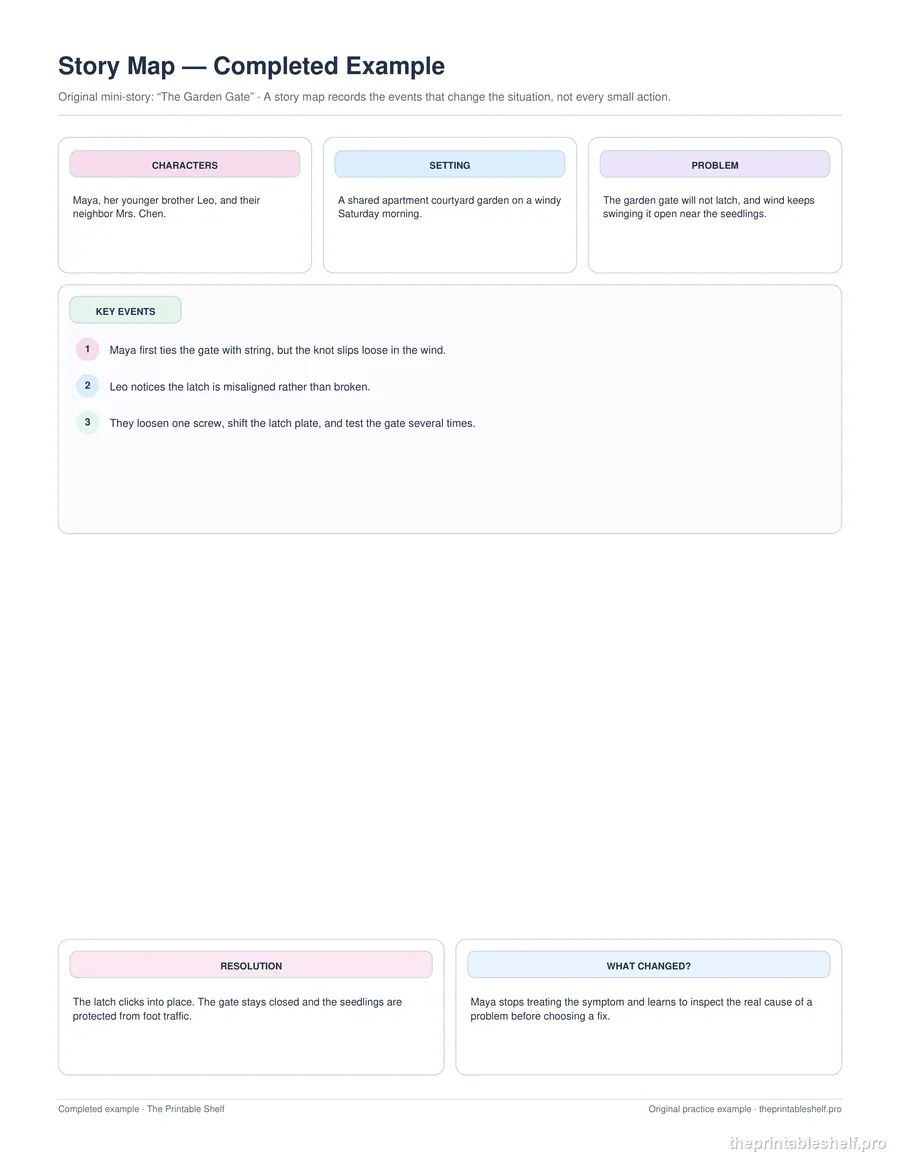
For a second worked model filled into the actual printable boxes, see the completed story-map example below the free download.
| Story-map part | Completed entry for the lost-dog story |
|---|---|
| Characters | Jordan, a careful child who feels responsible for the dog, and the neighbors who help. |
| Setting | A busy neighborhood during an evening block party, with open gates and many people moving between yards. |
| Problem | Jordan must find the dog before dark but is embarrassed to admit the gate was left open. |
| Key events | 1. Jordan searches alone and loses time because nobody knows the dog is missing. 2. Jordan tells a neighbor the truth, and the neighbor remembers seeing the dog near the playground. 3. Several neighbors join the search and follow muddy paw prints after a brief rain. |
| Resolution | They find the dog under a picnic table. Jordan learns that admitting a mistake early made solving the problem easier. |
See a completed story map, not just a description
Reading how a story map works is not the same as seeing one filled in. The table below shows a completed map for a story many readers already know, The Lion and the Mouse by Aesop. Retellings differ slightly, so adjust the entries to match your own version. The free Story Map Printable further down includes another completed example built from an original mini-story, so you can check what a finished entry in each box looks like before mapping your own text.
| Story-map part | Completed entry for The Lion and the Mouse |
|---|---|
| Characters | A lion and a small mouse. |
| Setting | The wild, where the lion rules and hunters set nets. |
| Problem | The lion thinks a tiny mouse could never help him, yet the mouse begs for mercy and promises to repay it. |
| Key events | 1. The lion laughs at the promise and lets the mouse go. 2. Later, hunters trap the lion in a net. 3. The mouse hears the roars and gnaws through the ropes. |
| Resolution | The lion is free, and he learns that even a small friend can give great help. |
Use a story map during reading or after reading?
Either can work. During reading, fill only what the text has established and leave later boxes open. This makes the map a monitoring tool: the reader can revise the problem, add a turning point, or correct an early assumption as the story develops. After reading, complete the map from memory first, then reopen the text to verify uncertain details. That order adds a retrieval step instead of turning the organizer into transcription.
For a first experience with story mapping, complete one example as a class. Reading Rockets recommends teacher modeling and guided construction before independent work. Once students understand the purpose of each section, reduce the support. A learner should eventually be able to decide which events matter and defend those choices, not merely copy the teacher's completed map.
Story map, beginning-middle-end, or character-traits organizer?
Choose a story map when you need a broad view of how character, setting, conflict, important events, and resolution fit together. Choose beginning-middle-end when the learner needs a simpler retelling structure with fewer decisions. Choose a character-traits organizer when the assignment is narrower: infer what a character is like from actions, dialogue, thoughts, or evidence across the story.
For a struggling reader, beginning-middle-end can be a useful first scaffold before moving to a full story map. For a strong reader, a story map can become the launch point for a deeper question such as how the character changed or what theme the resolution suggests. The organizer should match the thinking demand, not the grade label printed on a worksheet.
Free download
Choose your file size
Print at 100% / Actual Size for the cleanest margins. Pick the paper size your printer normally uses.
Share to Google Classroom ↗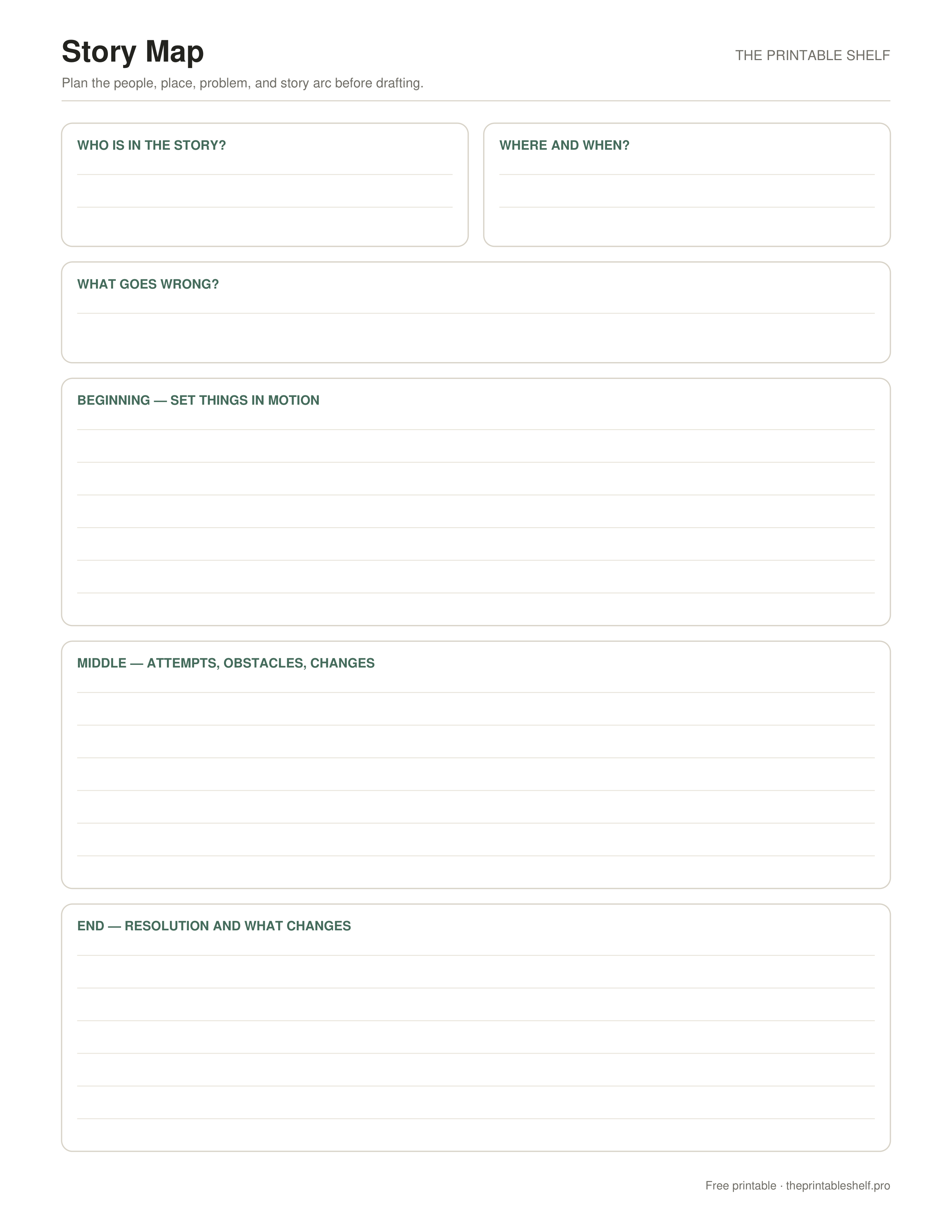
No sign-up required · personal/classroom use
Common story-map mistakes and quick fixes
Mistake one is listing every character. Fix it by asking whose choices or goals drive the conflict. Mistake two is treating setting as a trivia field. Add time or place details only when they shape what can happen. Mistake three is turning key events into a complete retelling. Limit the list to events that change the problem, stakes, character, or outcome.
Mistake four is writing a problem so vague that the resolution cannot answer it. Rewrite the problem as character + goal + obstacle. Mistake five is completing the map once and never revising it. If later reading changes the reader's understanding of the conflict or character, update the earlier box. A story map is a thinking tool; correction is evidence that the reader is monitoring meaning, not evidence that the first answer failed.
Questions people ask
What is a story map?
A story map is a graphic organizer that records a story's narrative elements — usually character, setting, problem or conflict, key events, and resolution — in separate boxes so a reader can see how the parts fit together, rather than listing details in the order they were read.
What are the main parts of a story map?
A practical story map usually includes main characters, setting, the central problem or conflict, a small number of key events, and the resolution. More advanced versions may add character change, theme, or separate plot stages.
Is a story map the same as a sequence chart?
No. A sequence chart focuses on order. A story map focuses on narrative structure, including character, setting, conflict, important events, and resolution. Some events appear in both, but the purpose is different.
Should students complete a story map while reading or after reading?
Both approaches can work. During-reading mapping supports monitoring and revision; after-reading mapping supports retrieval and summary. Beginners often benefit from a teacher-modeled example before independent use.
Is there an example of a completed story map?
Yes. This guide includes two completed maps, one for an original lost-dog story and one for Aesop's The Lion and the Mouse, each with characters, setting, problem, key events, and resolution filled in. The free Story Map Printable also includes a completed example, so you can see the finished product before mapping your own text.
Matching templates
Free Printable Story Map Template →
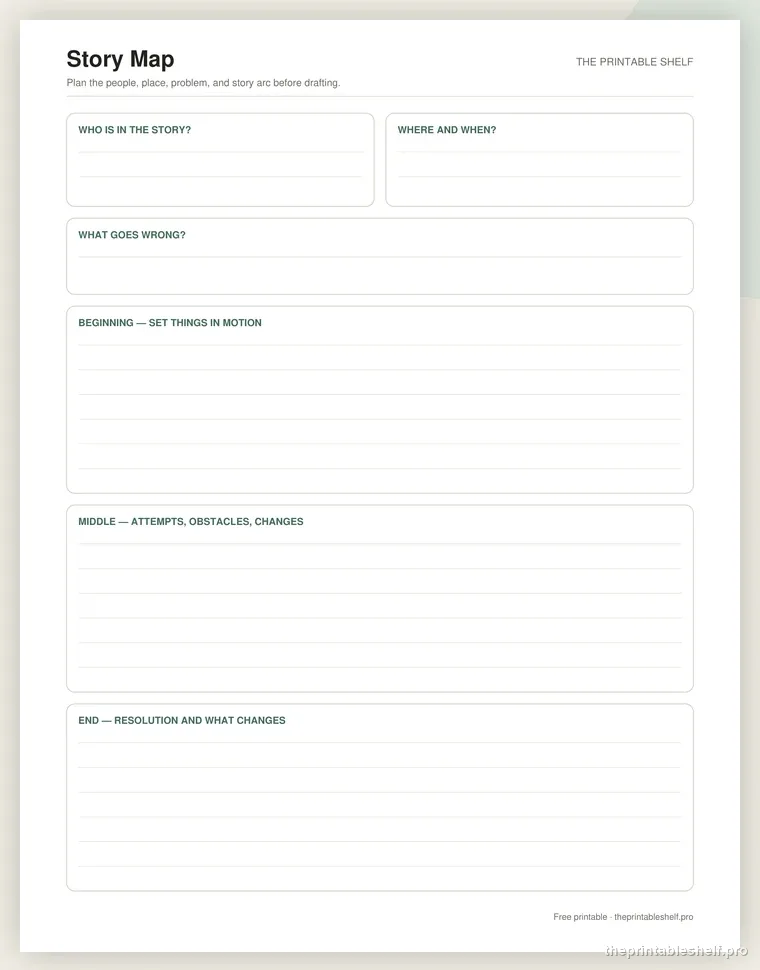
This free story map printable gives students space for characters, setting, the central problem, and a beginning-middle-end story arc. Use it to plan original writing or map a story after reading. Separate Letter, A4, and PNG downloads make it easy to use at home, in class, or in a binder.
Free Plot Diagram Graphic Organizer →
This free plot diagram graphic organizer helps readers or writers identify exposition, rising action, the climax or turning point, falling action, and resolution without retelling every event. The page includes space to name the story, select the events that build the conflict, and explain why one event changes the direction of the plot.
Free Sequence of Events Graphic Organizer →
This sequence of events organizer gives you five ordered steps labeled First, Next, Then, After That, and Finally, plus a final reflection on what changed. Use it to retell a story, track historical events, explain a process, or plan a procedure. Download the printable in Letter, A4, or PNG.
Free Cause and Effect Graphic Organizer →
Use this cause and effect graphic organizer to connect why something happened with what happened as a result. The page includes a focus event plus three clearly paired cause-and-effect rows, making it useful for reading, science, history, and process analysis. Download it in Letter, A4, or PNG format.
Free Beginning, Middle, and End Graphic Organizer →
A beginning-middle-end organizer helps readers retell a story in three meaningful parts instead of listing every event. Record how the story begins, what important change or problem develops in the middle, and how the situation ends. It also works as a simple story-planning sheet for young writers before they draft.
Free Narrative Writing Graphic Organizer →
This narrative writing organizer helps writers plan the parts that make a story move: characters, setting, a clear problem or goal, key events, and a resolution. Use it before drafting to make sure the middle events grow from the conflict and the ending resolves what the story actually set up instead of appearing suddenly.
Sources & further reading
These sources support the instructional background in this guide. The printable recommendations and usage notes above are The Printable Shelf's editorial guidance.
- Reading Rockets — Story Maps — Explains story mapping as a comprehension strategy focused on narrative elements and recommends modeling before independent use.
- ReadWriteThink — Story Map — Uses story-map organizers for character, setting, conflict, and resolution in both post-reading and prewriting contexts.
- ReadWriteThink — Story Elements Alive! — Classroom lesson sequence connecting setting, character, problem/solution, plot, and story-map practice.
Other guides you may like
Free Reading Comprehension Graphic Organizers by Reading Skill
Free reading comprehension graphic organizers for story elements, main idea, sequence, cause and effect, comparison, vocabulary, and prior knowledge.
Read guide →
How to Use Graphic Organizers Effectively (Without Turning Them Into Busywork)
Learn how to choose, model, scaffold, and reuse graphic organizers so students think with them instead of simply filling in boxes.
Read guide →
Main Idea vs. Summary: What's the Difference?
Learn the difference between main idea and summary, see worked examples, and use main idea plus key details to build a concise summary.
Read guide →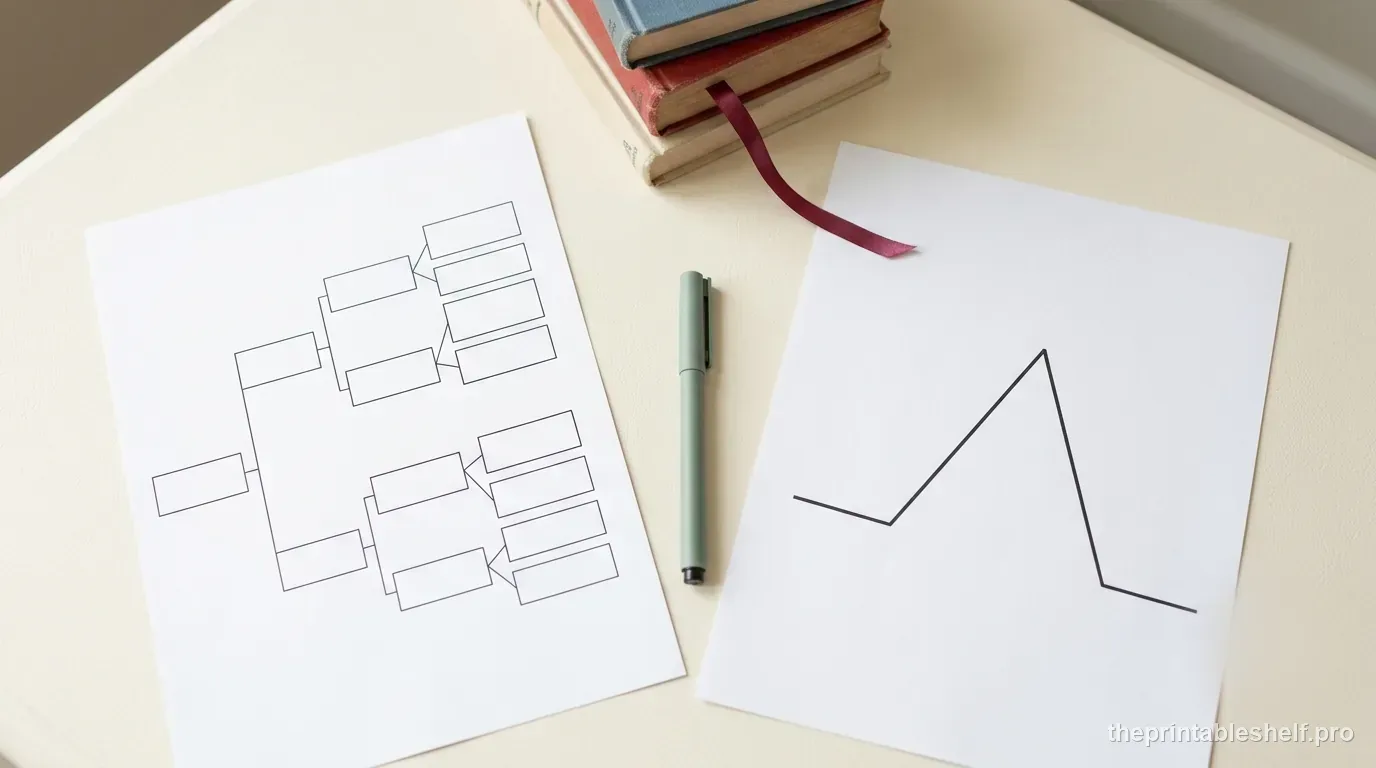
Story Map vs. Plot Diagram: Which Graphic Organizer Do You Need?
Compare story maps and plot diagrams, see what each organizer captures, and choose the right one for comprehension, retelling, or plot analysis.
Read guide →