Work & Study · Free printable
Free 5 W's Graphic Organizer PDF (5W and 5W+1H)
A 5 W’s organizer captures the essential Who, What, When, Where, and Why of a topic on one page. Use it to pull key facts from an article, summarize an event, plan a report, prepare interview questions, or check whether a piece of writing gives the reader enough context.
Edited by Tessa Vaughn · Planning & Organization Editor
Free download
Choose your file size
Print at 100% / Actual Size for the cleanest margins. Pick the paper size your printer normally uses.
Share to Google Classroom ↗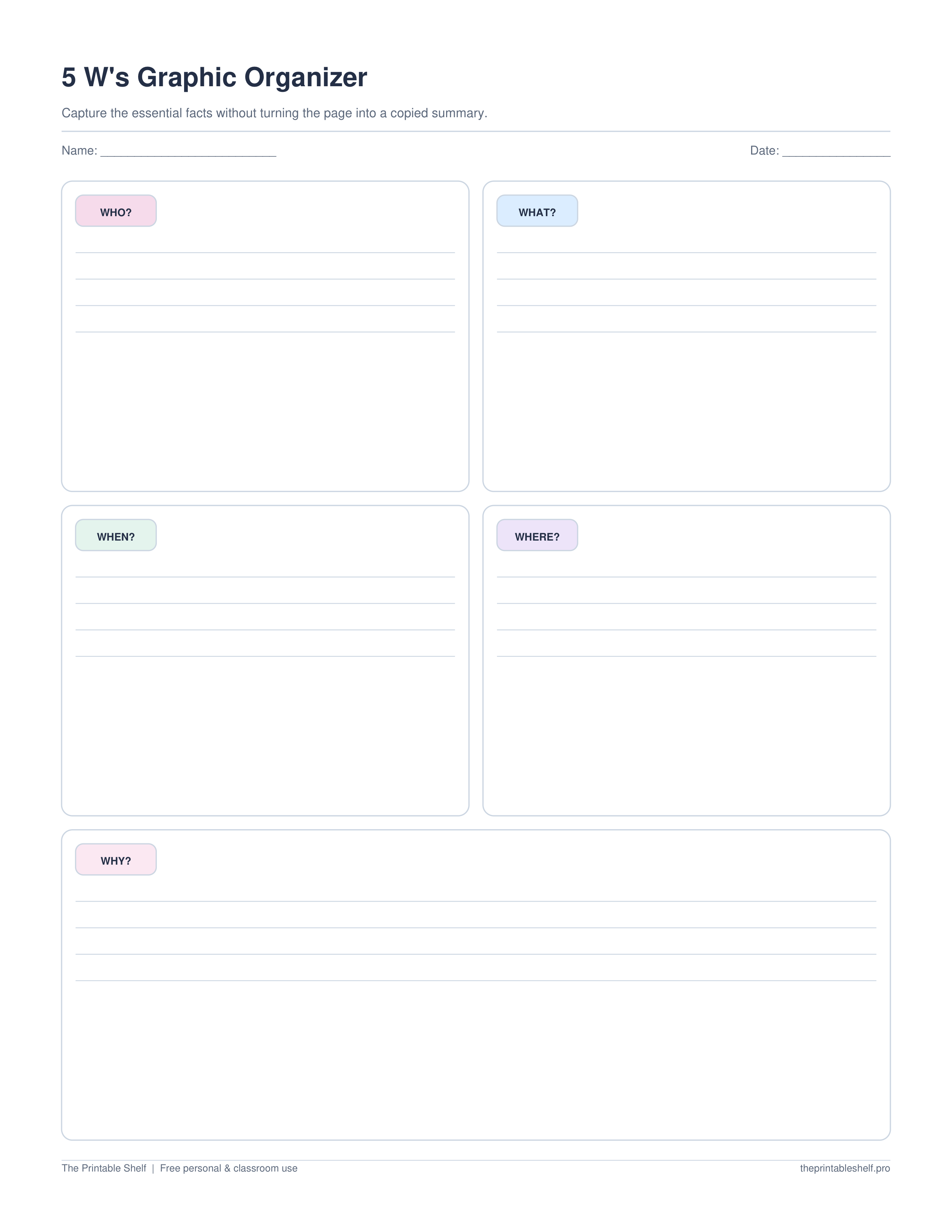
No sign-up required · personal/classroom use
More useful layouts
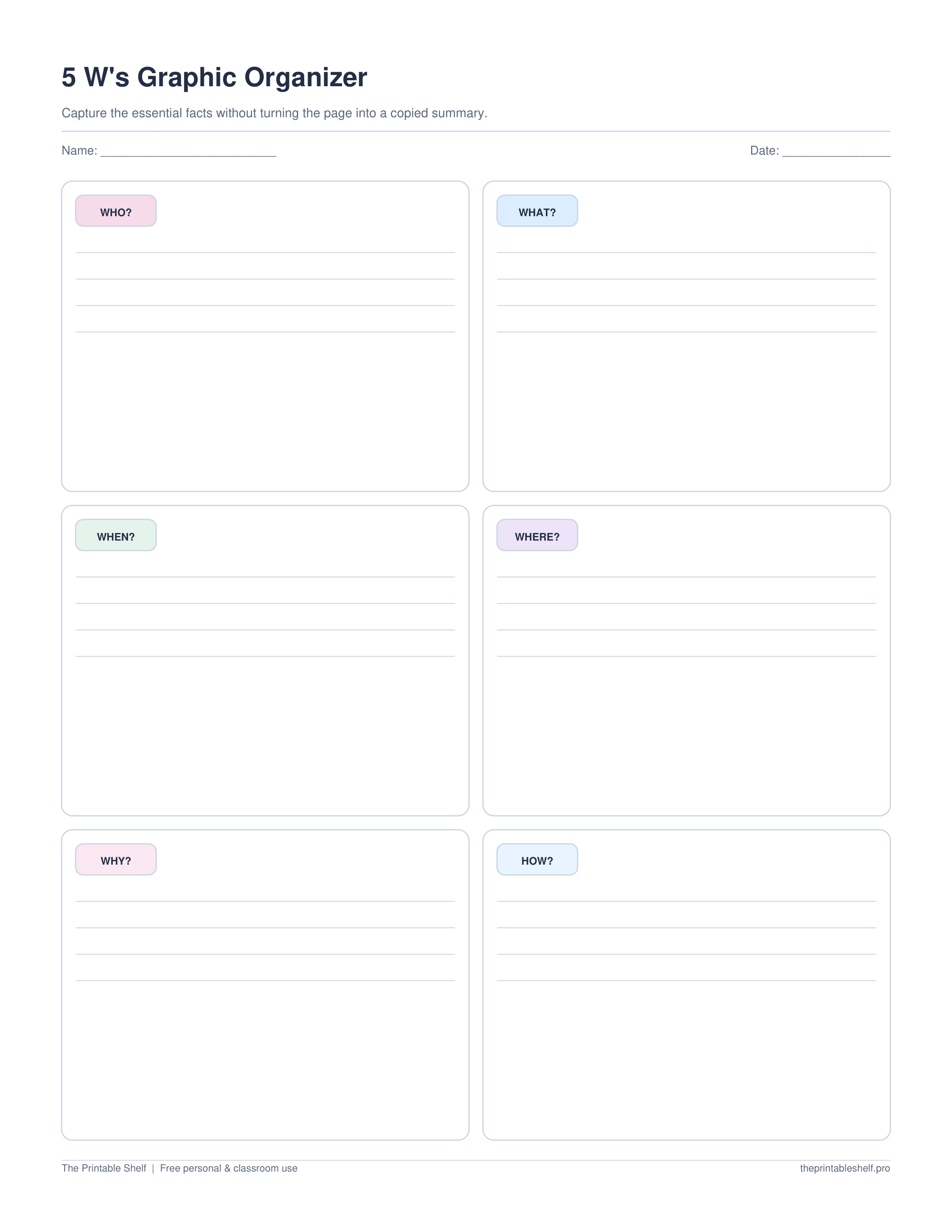
5 W’s + 1 H
Adds a dedicated How box for processes, interviews, reports, and event analysis that needs manner or method.
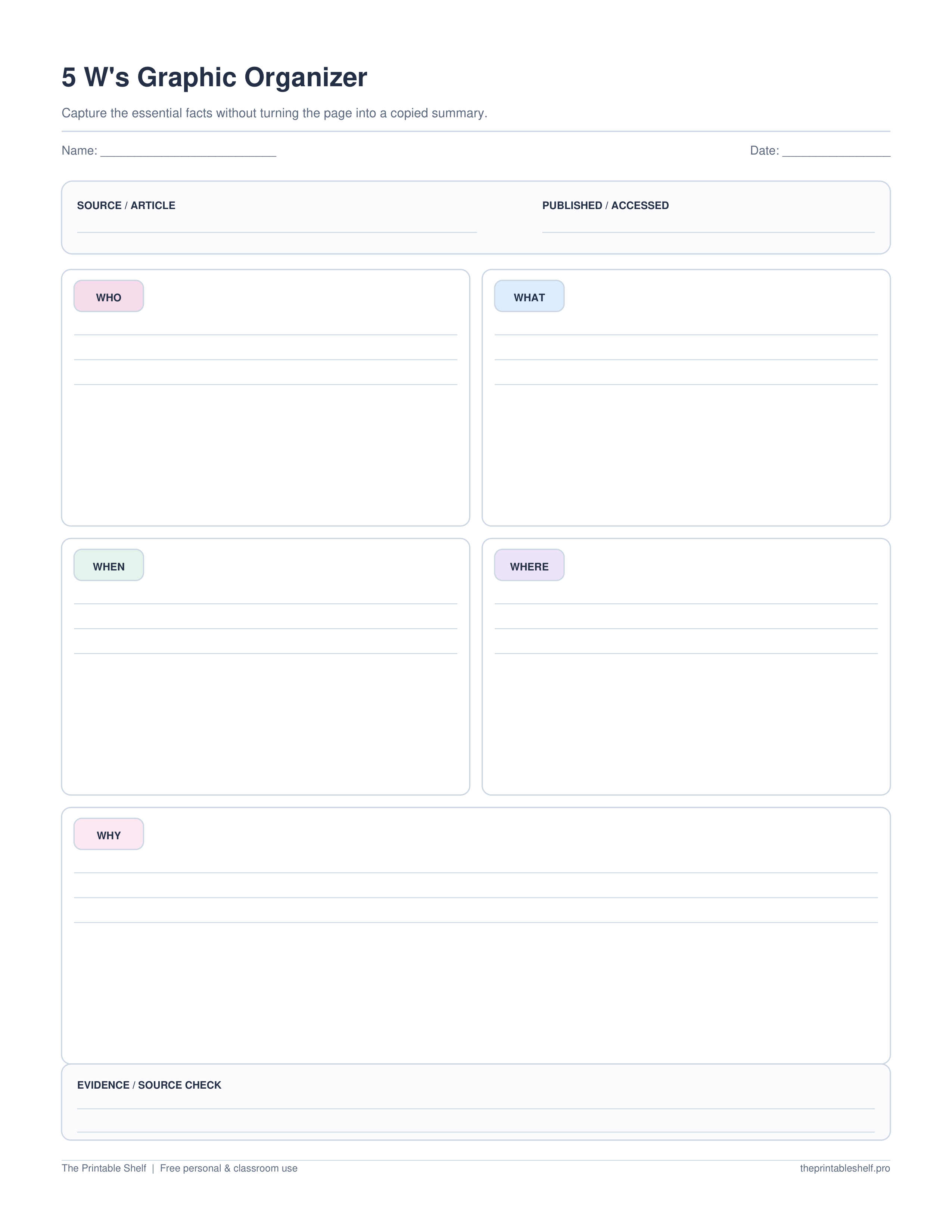
News + source notes
Adds article/source fields and an evidence check for current-events reading and research summaries.
About this printable
A five-part fact and comprehension organizer with one clear writing area for each of the classic 5 W questions. The structure is simple enough for elementary reading work but flexible enough for research notes, current-events summaries, biographies, interviews, and prewriting when a topic needs basic context before deeper analysis.
How to use it
Write the topic or source at the top before filling in the five boxes. Then start with What, because identifying the central event, issue, process, or subject gives the other answers something to attach to. Keep the answer specific. ‘A storm’ is less useful than ‘a hurricane made landfall near the coast and caused widespread flooding.’
Use Who for the people, groups, organizations, animals, or communities that matter to the topic. Do not list every name in the source. Choose the participants whose role helps explain what happened. For a biography, Who may focus on one person plus the people who influenced them. For a science topic, the box may hold the organism, researchers, or affected population rather than a traditional story character.
Fill in When and Where with the amount of detail the task needs. A history source may require an exact date and place; a story retell may need only ‘during the first week of school’ and ‘at the community center.’ If the source does not provide an answer, write ‘not stated’ or mark it as a question to research. Do not invent precision that is not in the material.
Save Why for explanation rather than another fact. Ask what caused the event, why a person acted, why the issue matters, or why the author included the information. Sometimes a source gives several possible reasons. In that case, list the strongest supported reasons and distinguish them from your own guess. If the task also needs How, use the included 5 W’s + 1 H layout so process or manner has its own section without crowding the classic five-question page.
Use the completed organizer as a quality check. Cover the source and read only your five answers. Can someone understand the basic situation without the original article or passage? If not, identify which box is too vague. For writing, reverse the process: plan the five answers before drafting, then make sure the finished paragraph or report gives the reader the important context without mechanically answering the questions in a list.
For research with more than one source, add a tiny source mark beside each answer—such as A, B, or a page number—rather than mixing facts without a trail. If two sources disagree about when, where, or why something happened, keep both notes visible until you can resolve the conflict. The organizer should simplify information, but it should not erase uncertainty that matters to an accurate summary.
Customize instead
Need a different title, paper size, or orientation? →
Use the free Graphic Organizer Maker to build a custom Venn, KWL, Frayer, story map, T-chart, main-idea, sequence, or cause-and-effect page.
Also in a free pack
Download this organizer together with related pages when you want one reusable master PDF instead of separate files.
Best uses for this template
Ideas for using this page
Summarizing an article
Pull the essential facts into five boxes, then use the completed page to write a short summary without copying the source sentence by sentence.
Planning research
Treat blank or weak boxes as research gaps. They show which basic question still needs a reliable source.
Checking a draft
After writing, use the sheet backward: can a reader identify all five answers from the draft, or is important context missing?
Mistakes to watch for
Putting the same fact in several boxes
Give each question a distinct job and repeat information only when it truly answers more than one W.
Guessing missing details
Write ‘not stated’ or turn the gap into a research question instead of inventing an answer.
Treating Why as an opinion box
Use reasons supported by the source and label personal interpretation separately.
Included layout options
Classic 5 W’s
Quickly capture the essential context of a text or event
Layout: Five roomy Who, What, When, Where, and Why response boxes
5 W’s + 1 H
Add process or manner when How deserves its own answer
Layout: Six balanced Who/What/When/Where/Why/How boxes
News / source notes
Summarize current events without losing the source trail
Layout: Source/date header, five W boxes, and evidence/source-check strip
Classroom fit
Where it fits: grades and standards
Suggested grade bands
These are practical use ranges, not hard limits. Text complexity and the amount of teacher modeling matter more than the worksheet alone.
Good fit for
Scaffold level: Beginner.
Common Core crosswalk
No narrow standards code is listed for this general-purpose template. Use it where the thinking task fits your local curriculum.
Quick answers
What are the five W questions?
The five W's are Who, What, When, Where, and Why. They are commonly used to gather the essential facts about a topic or event.
What is the difference between 5 W's and 5 W's and 1 H?
The 5 W's version uses Who, What, When, Where, and Why. A 5 W's and 1 H organizer adds How when the process or manner also needs its own section.
Can I use this for current-events articles?
Yes. It works well for news and nonfiction because the five questions help separate the core facts from less important details.
Guides that go with this page
See where this organizer fits, when a different layout works better, and how to turn the completed page into a useful next step.
How to Use Graphic Organizers Effectively (Without Turning Them Into Busywork)
Learn how to choose, model, scaffold, and reuse graphic organizers so students think with them instead of simply filling in boxes.
Read guide →
How to Find the Main Idea and Supporting Details in a Text
Learn how to find a text's main idea and supporting details with a step-by-step method, worked examples, and a free graphic organizer.
Read guide →Keep organizing
You might also like
Free printable
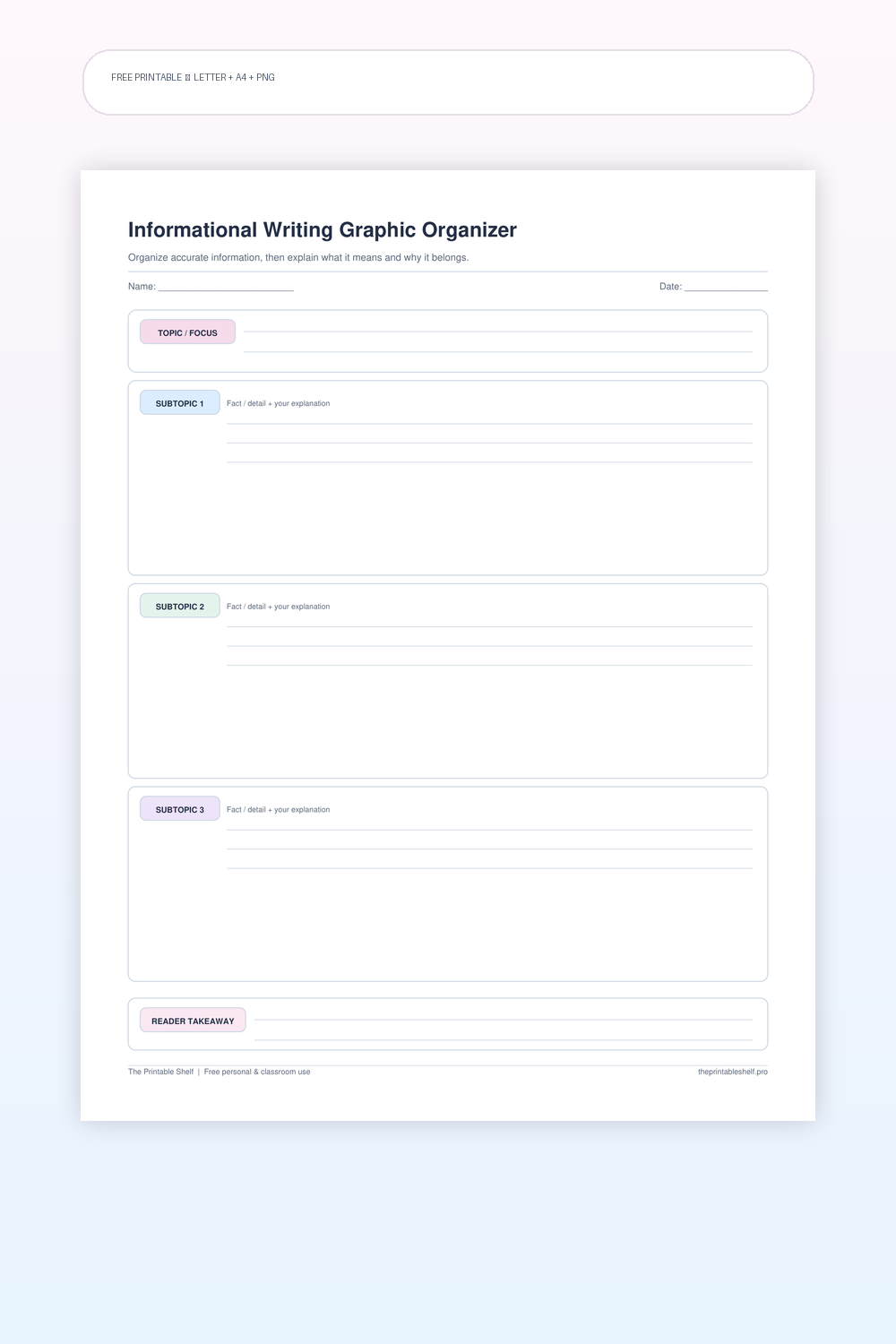
Informational Writing Graphic Organizer
A one-page planning sheet for explanatory and informational writing. It is designed to keep fact collection separate from explanation, because a strong informational paragraph does more than stack facts. The writer chooses a focused topic, groups the most useful information, and identifies the takeaway before drafting.
Free printable
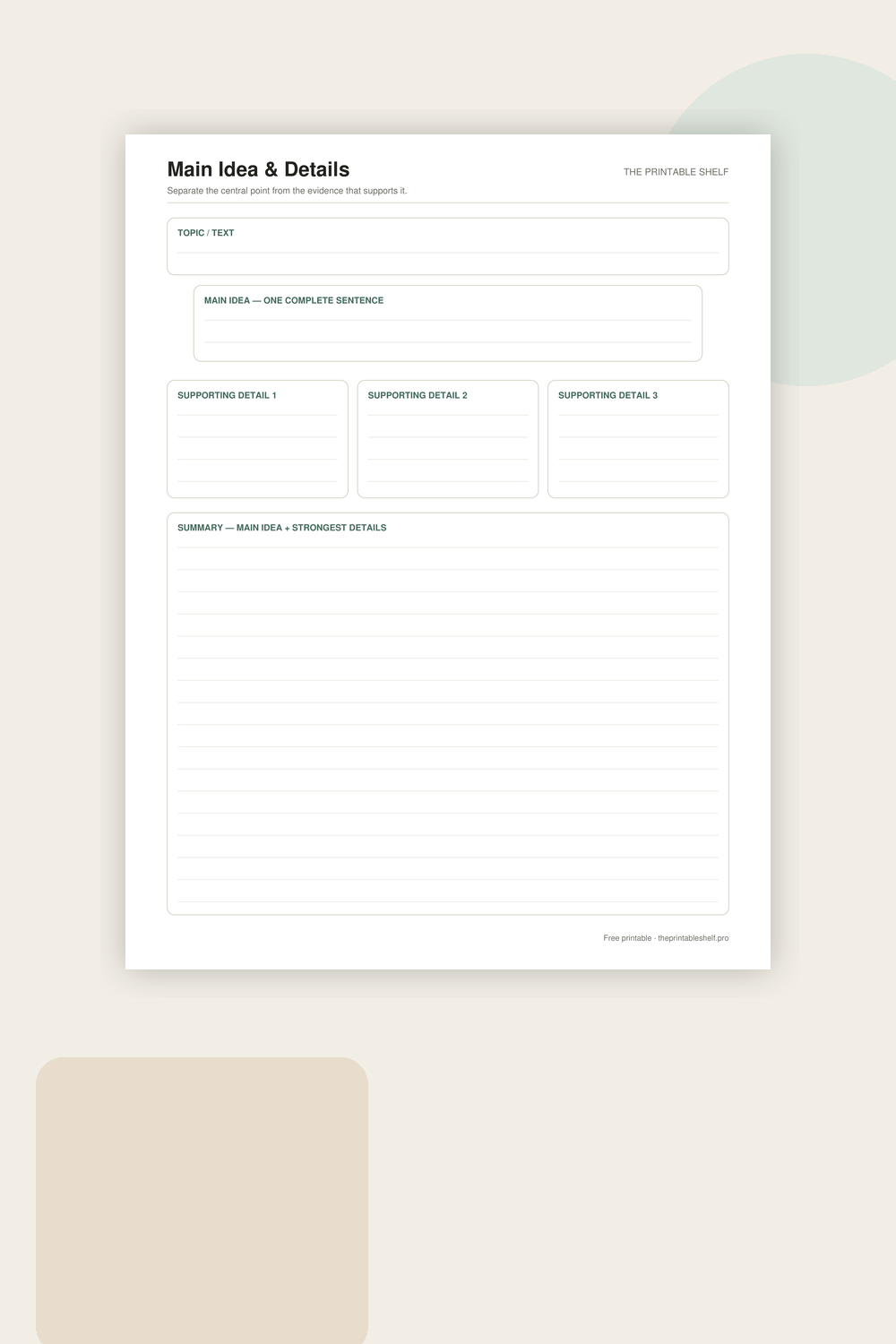
Main Idea and Details Graphic Organizer PDF
A reading and note-taking organizer built around one central idea and three pieces of support. The extra topic box helps learners distinguish a broad subject from the author’s actual main point, while the final summary asks them to recombine the important information in their own words.
Free printable
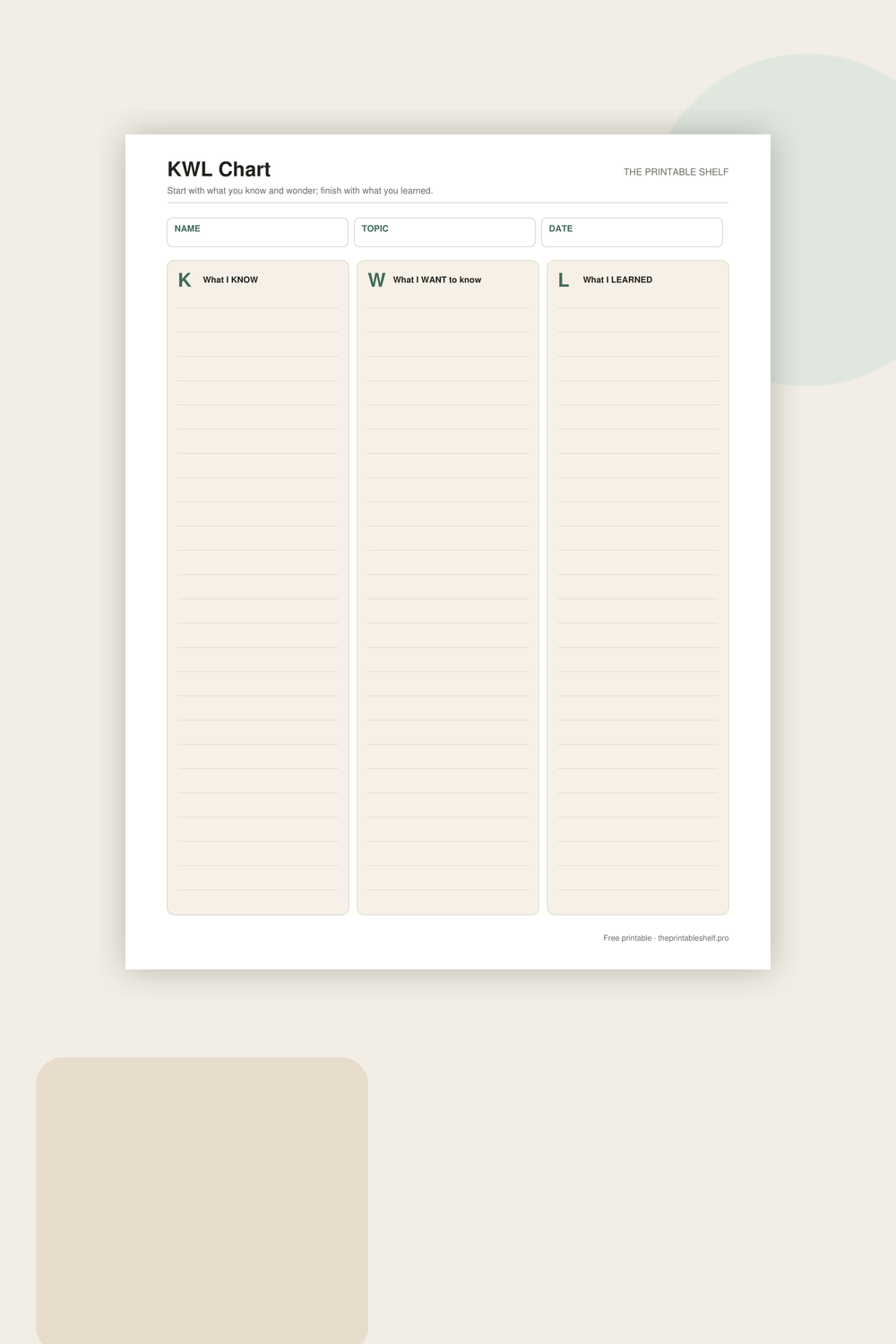
Printable KWL Chart
A three-column learning organizer for activating prior knowledge and making questions visible before a lesson begins. The K column records what the learner thinks they know, W captures questions or wonderings, and L is completed afterward with new information, corrections, and answers discovered during learning.