Work & Study · Free printable
Free Author's Purpose Graphic Organizer
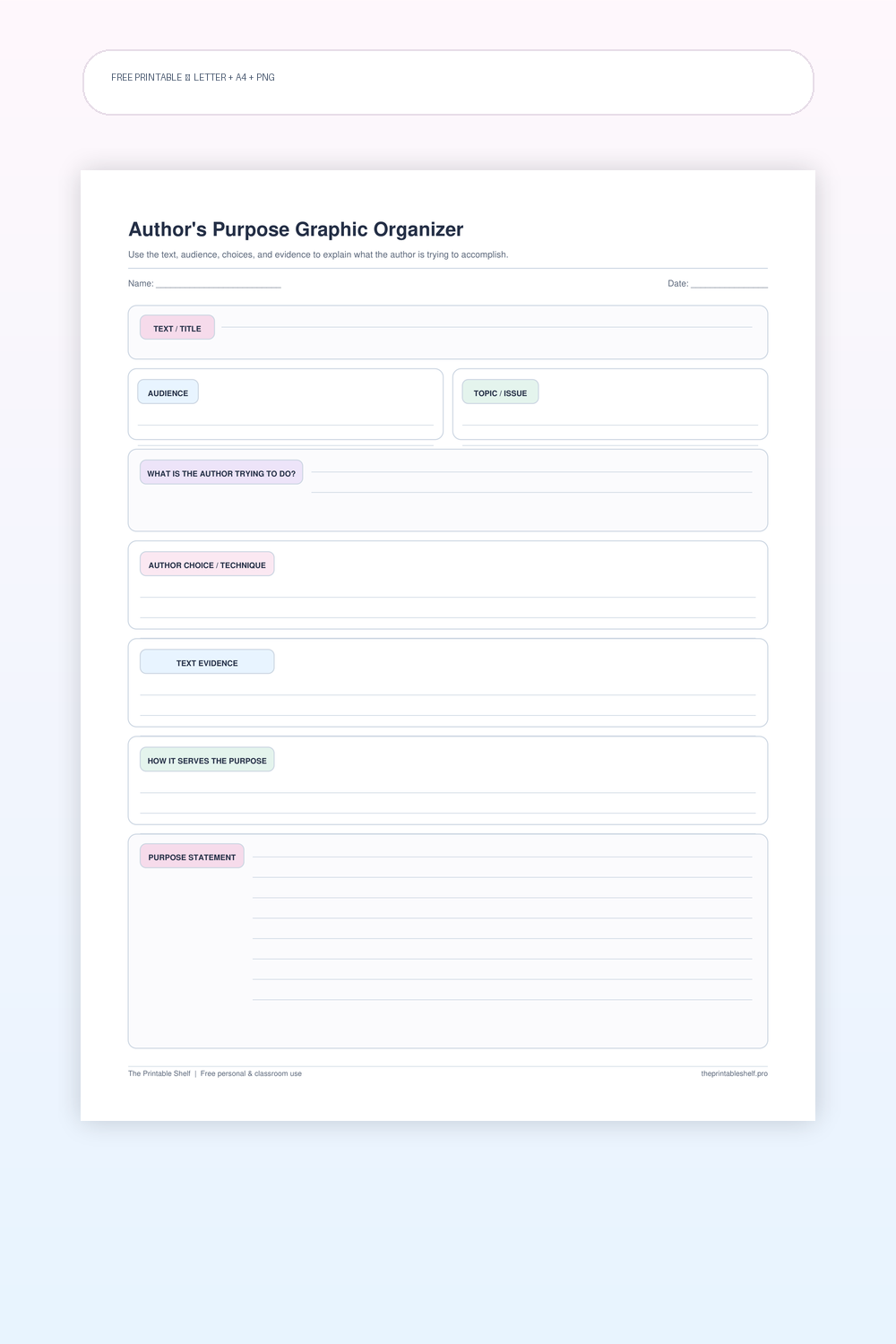
This free author's purpose organizer asks readers to identify the audience and topic, state what the author is trying to accomplish, and support that purpose with an author choice, text evidence, and an explanation of how the choice serves the purpose.
Edited by Tessa Vaughn · Planning & Organization Editor
Free download
Choose your file size
Print at 100% / Actual Size for the cleanest margins. Pick the paper size your printer normally uses.
Share to Google Classroom ↗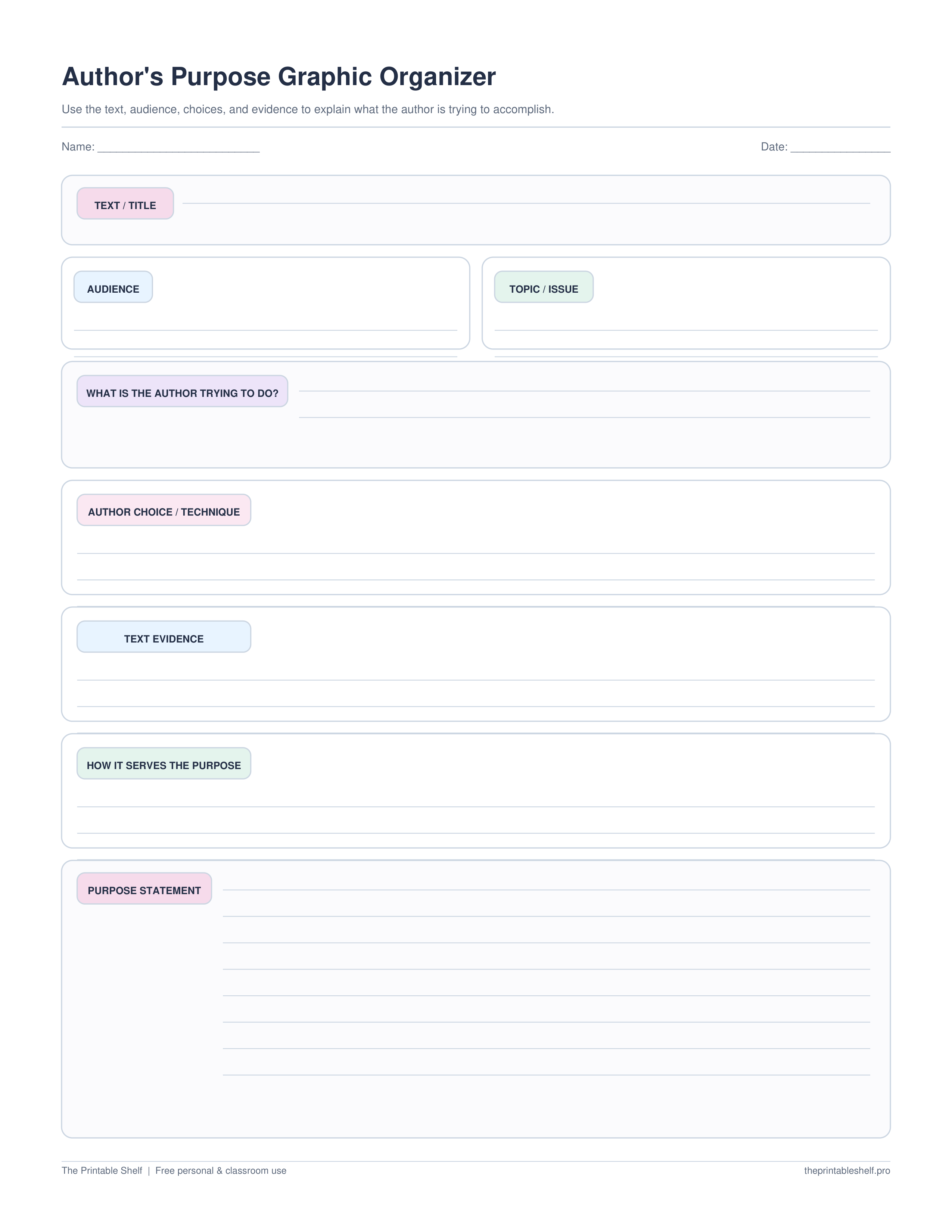
No sign-up required · personal/classroom use
What this printable is for
A reading organizer that goes beyond choosing one label from a PIE or PIEE acronym. It helps readers explain the author's goal in the specific text and connect that goal to audience, evidence, organization, examples, tone, or other deliberate choices.
A simple way to use it
Start with the text title or section, audience, and topic. Audience matters because the same topic can be handled differently for young readers, specialists, voters, customers, or a general audience. Use clues such as assumed background knowledge, vocabulary, examples, tone, and publication context when the intended audience is not stated directly.
Write what the author appears to be trying to accomplish in this specific text. Broad labels such as inform, explain, persuade, entertain, describe, or reflect can be useful starting categories, but they are not the finished answer. Make the purpose precise: explain why a process happens, persuade readers to change a policy, clarify a misconception, or create suspense around a decision.
Identify one author choice or technique that contributes to that purpose. This could be the selection of examples, the order of information, a comparison, a statistic, a personal anecdote, a definition, vivid description, a counterargument, or a repeated image. Record the actual text evidence that shows the choice rather than naming a technique with no example.
Explain how the evidence helps accomplish the purpose for the intended audience. A statistic may make a claim seem measurable, a definition may make technical material accessible, or a personal example may make an abstract issue concrete. The explanation is the bridge between finding a feature and analyzing why the author used it.
Finish with a purpose statement that combines the goal and the strongest evidence. If several purposes are present, identify the primary purpose for the passage or section you are analyzing and note a secondary purpose only when it meaningfully affects the text. Use the organizer to plan a paragraph rather than treating the category label as a complete response. In longer texts, repeat the analysis for a section when its local purpose differs from the purpose of the whole work, then explain how the section contributes to the larger goal.
Fill it online
Type directly into this organizer →
Your answers autosave only in this browser. Print or save the filled page as PDF, download a high-resolution PNG, or clear it and start again—no account required.
Customize instead
Need a different title, paper size, or orientation? →
Use the free Graphic Organizer Maker to build a custom Venn, KWL, Frayer, story map, T-chart, main-idea, sequence, or cause-and-effect page.
Also in a free pack
Download this organizer together with related pages when you want one reusable master PDF instead of separate files.
Choose the support level
Blank, guided, example, or fill online
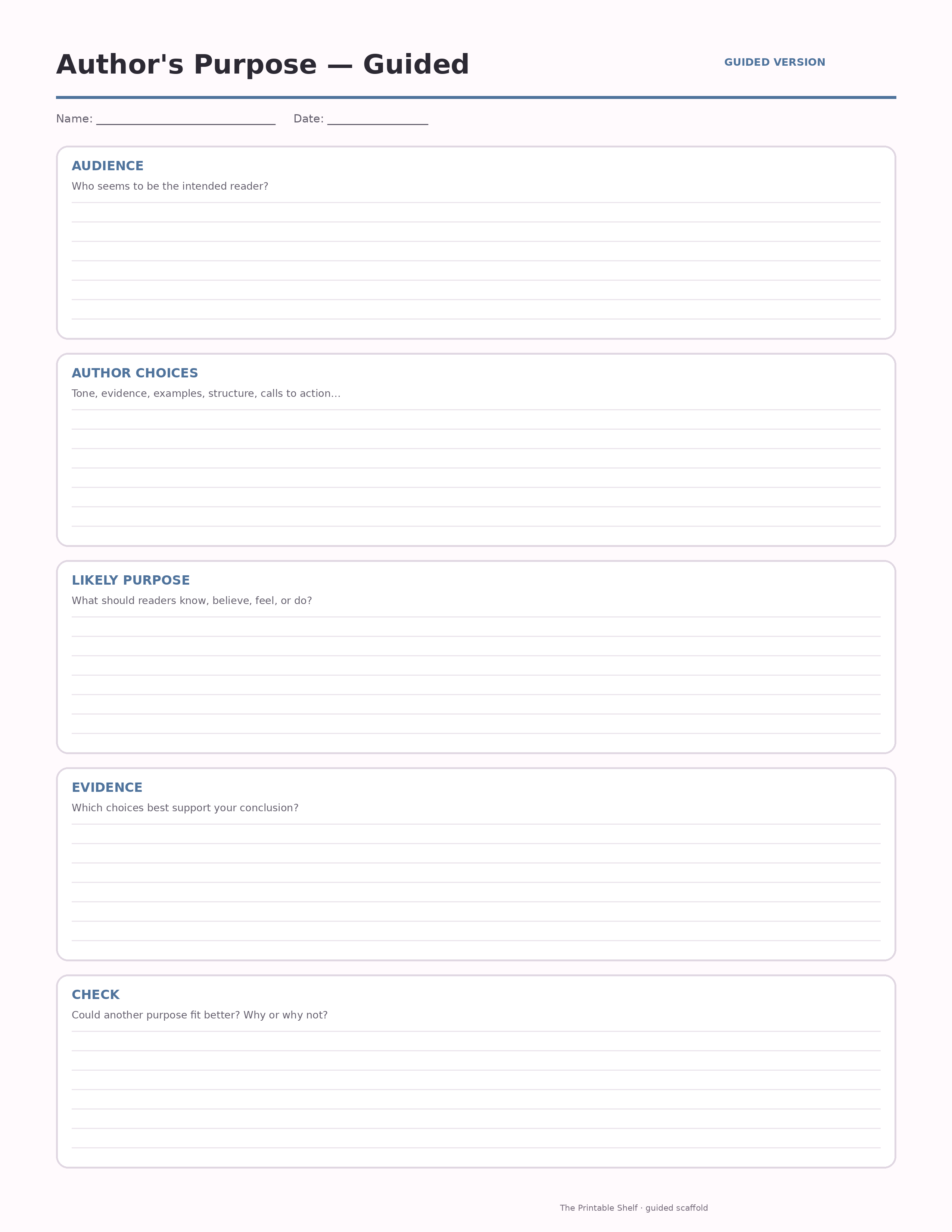
Use the blank page when students already know the routine. Choose the guided version when they need short prompts inside the sections. A completed example is available when this template benefits from modeling, and the online version lets students type before printing.
Blank
Independent use →
The standard printable with open writing space and no embedded hints. Download the Letter PDF.
Guided
Prompted scaffold
A scaffolded version with short prompts inside each section to help students know what kind of evidence or thinking belongs there.
Model
Completed example ↓
Use the finished sample to model the thinking before students work independently.
Online
Type before printing →
Autosave locally, print/save as PDF, or export the filled organizer as PNG.
Teaching set · 3 pages
Blank + guided + completed example in one PDF
Print the model first, practice with prompts, then move to the blank page without downloading three separate files.
Completed example
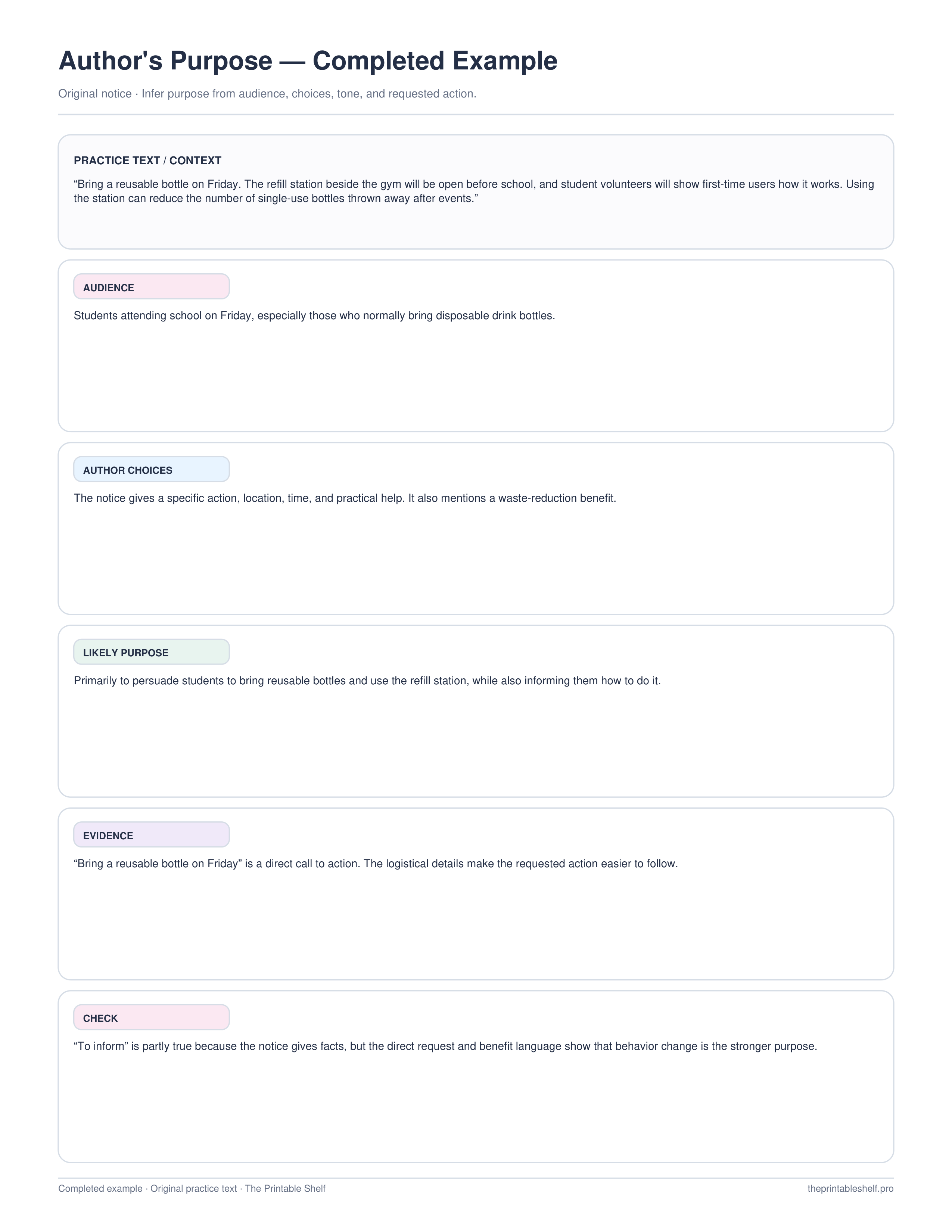
A completed example
See how audience, author choices, evidence, and a call to action support a conclusion about the author’s main purpose.
Good matches for this page
Three ways to use it
Move beyond PIE labels
Use a broad purpose category only as a starting point, then state the specific result the author seems to want.
Connect choice to purpose
Pair an author technique with actual text evidence and explain why that choice helps the intended audience.
Plan an analysis paragraph
Turn the final purpose statement into a claim and use the author-choice section as evidence and explanation.
Common mistakes to avoid
Stopping at 'to inform'
State what the author is trying to help the audience understand and how the text is designed to do that.
Naming a technique without evidence
Record the actual statistic, example, definition, comparison, or other text feature that shows the choice.
Ignoring audience
Use audience clues to explain why particular vocabulary, examples, tone, or evidence may have been selected.
Classroom fit
Suggested grades, use modes & standards
Suggested grade bands
These are practical use ranges, not hard limits. Text complexity and the amount of teacher modeling matter more than the worksheet alone.
Good fit for
Scaffold level: Standard.
Common Core crosswalk
- RI.6.6 · Determine an author’s point of view or purpose and how it is conveyed
- RI.7.6 · Determine author point of view or purpose and analyze contrasting viewpoints
- RI.8.6 · Determine author point of view or purpose and analyze conflicting evidence or viewpoints
These codes are a practical crosswalk for skills this organizer can support. They are not a claim that the worksheet alone fully teaches or assesses the standard.
Common questions
Is author's purpose always persuade, inform, or entertain?
Those labels can be useful starting points, but real texts often have more specific or overlapping purposes. A stronger answer states what the author is trying to accomplish in the particular text.
Why include the audience?
Audience helps explain why an author chooses certain vocabulary, evidence, examples, tone, or organization.
What counts as an author choice?
Examples include organization, statistics, definitions, anecdotes, comparisons, tone, description, counterarguments, and the selection or omission of evidence.
Keep organizing
You might also like
Free printable
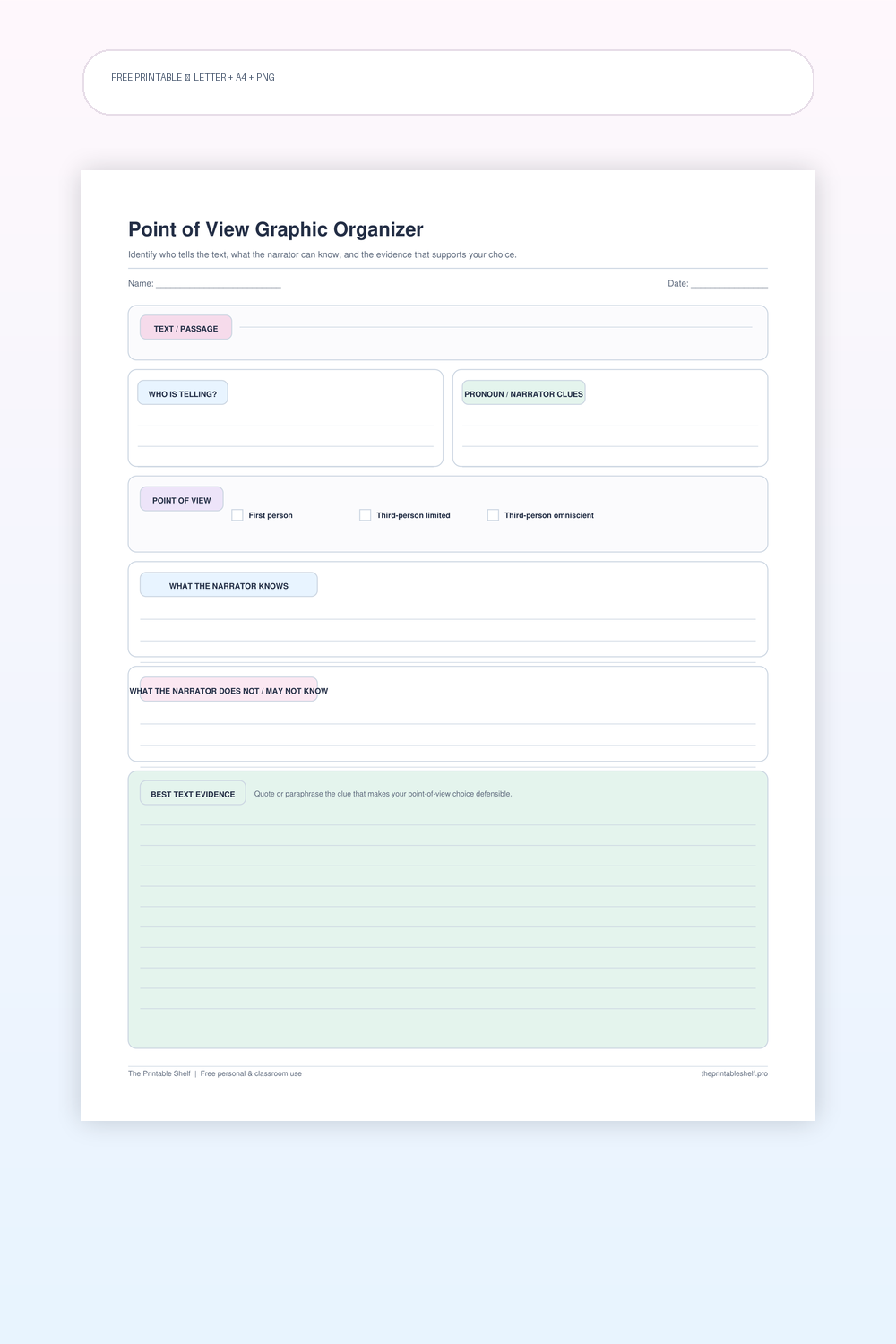
Point of View Graphic Organizer Printable
A reading organizer that treats point of view as more than spotting pronouns. Readers first identify the narrator and clues, then consider access to characters' thoughts and information before choosing a point-of-view category. A final evidence box requires a defensible reason for the choice.
Free printable
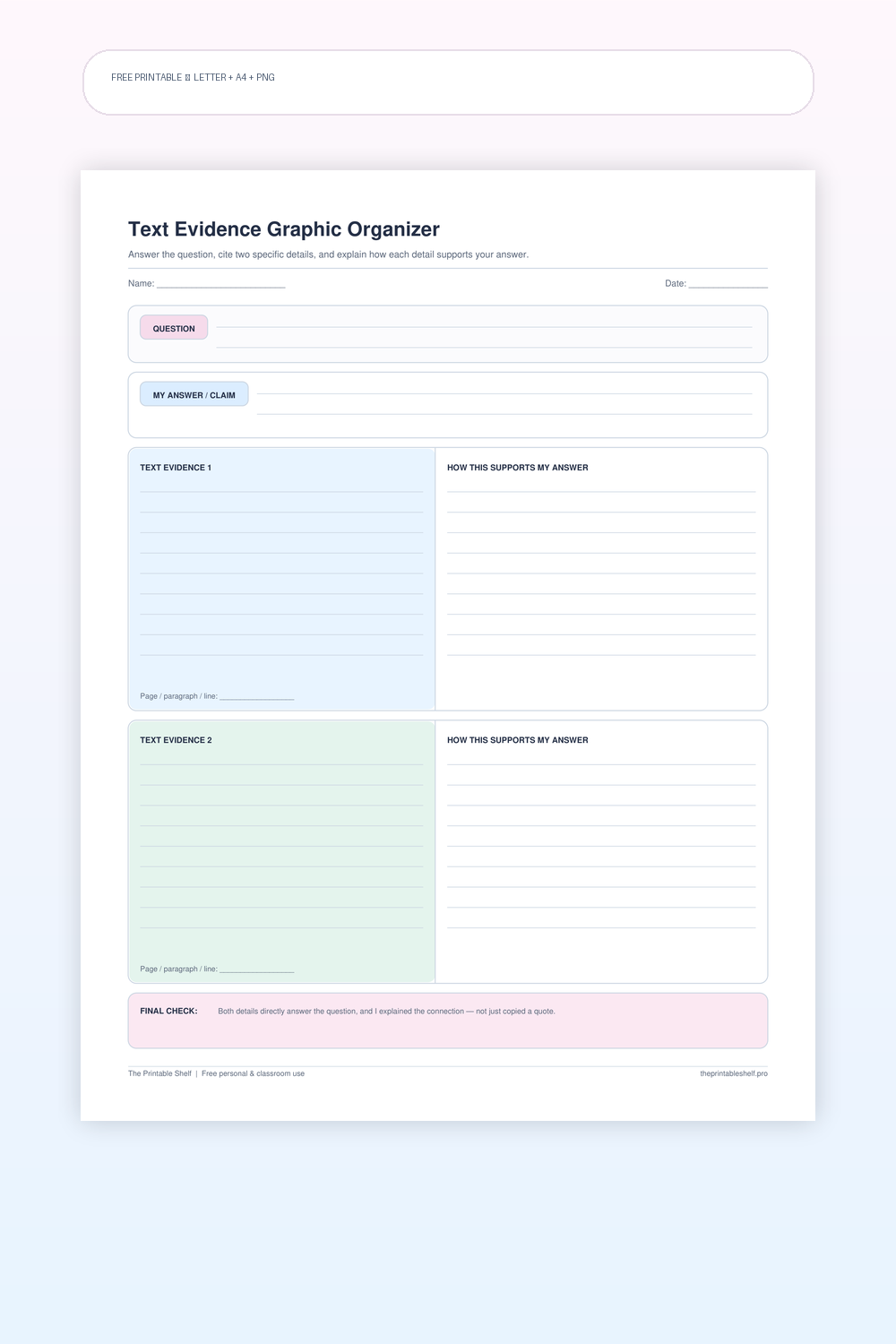
Text Evidence Graphic Organizer
A compact evidence-to-explanation organizer for reading responses and source-based writing. The page deliberately separates evidence from the explanation of evidence. That separation helps expose a common gap: a learner may copy a strong quotation or detail but never show why it supports the point being made. The organizer can be used with direct quotations, paraphrased details, page or paragraph references, and other text-specific evidence allowed by the assignment.
Free printable
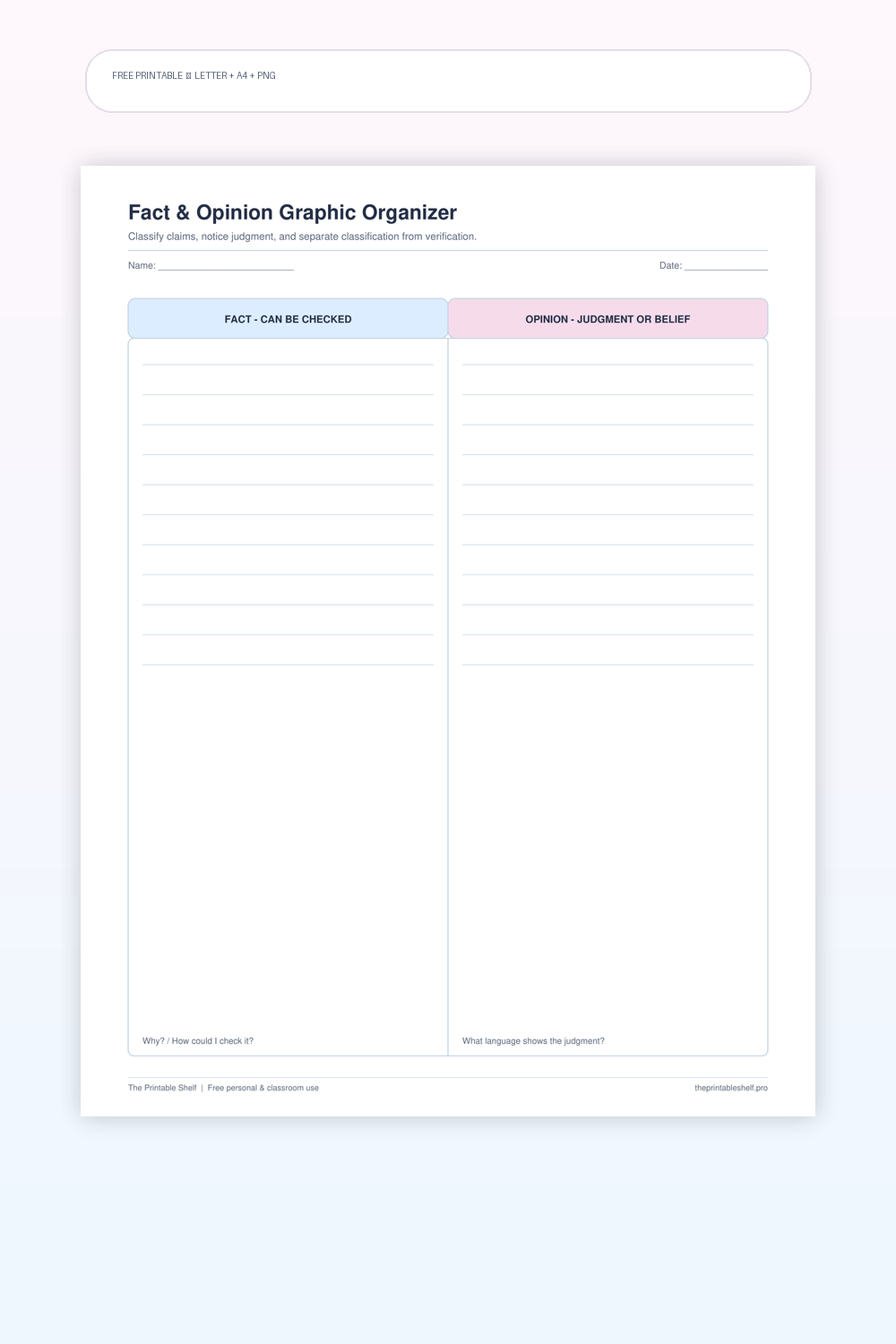
Fact and Opinion Graphic Organizer
A two-column organizer that goes beyond the shortcut ‘facts are true and opinions are false.’ The layout asks learners to classify statements and think about how a factual claim could be verified or what language signals a judgment. That makes the printable useful for real texts where opinions may contain facts and factual claims still need checking.