Work & Study · Free printable
Free Fact and Opinion Graphic Organizer
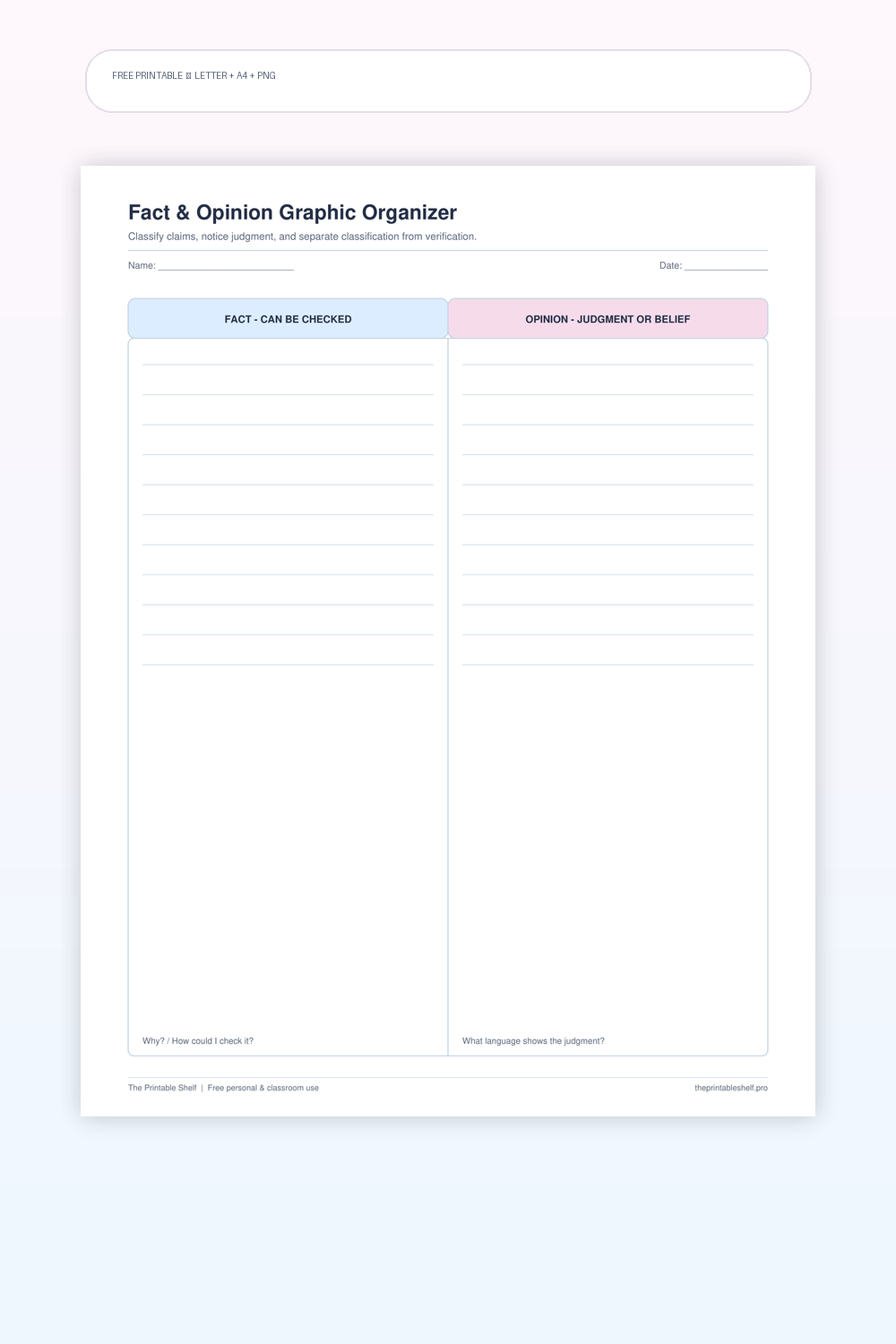
This fact and opinion organizer helps learners sort statements into two columns and explain why each belongs there. Facts should be verifiable with reliable evidence; opinions express a judgment, preference, or belief. The page is useful for reading comprehension, media literacy, discussion prep, and writing activities where students need to distinguish evidence from viewpoint.
Edited by Tessa Vaughn · Planning & Organization Editor
Free download
Choose your file size
Print at 100% / Actual Size for the cleanest margins. Pick the paper size your printer normally uses.
Share to Google Classroom ↗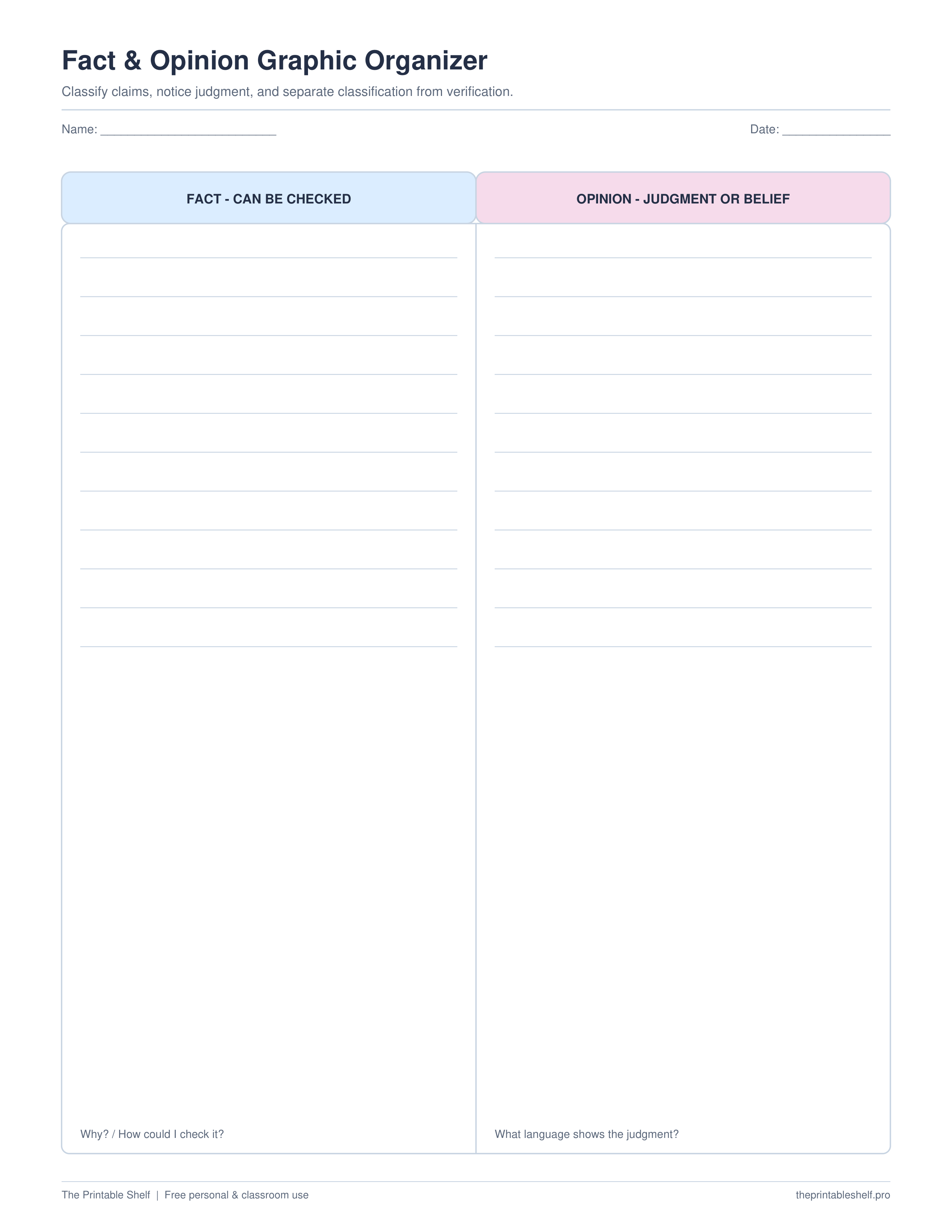
No sign-up required · personal/classroom use
More useful layouts
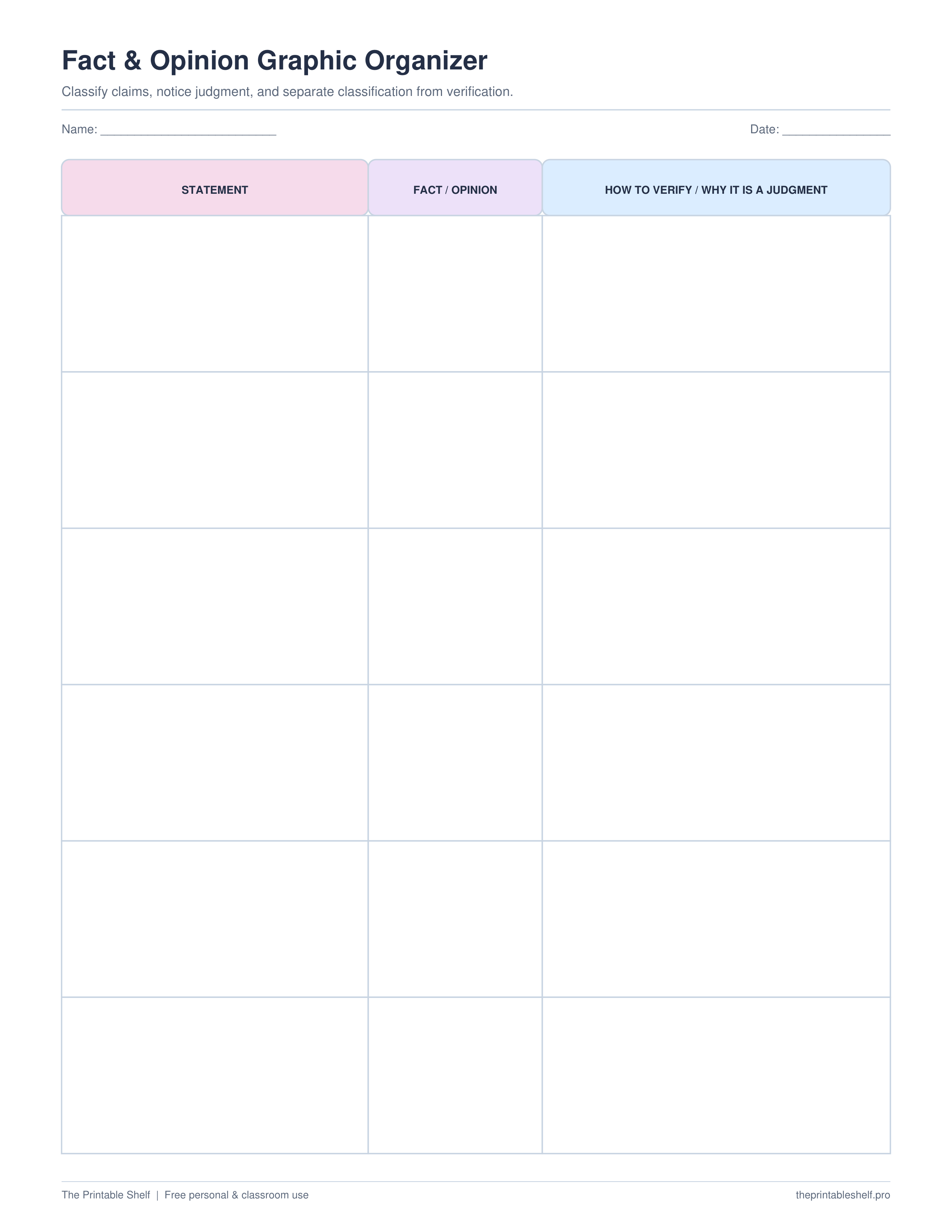
Verify-it table
Adds a third column for how a factual claim could be checked or why a statement is judgment.
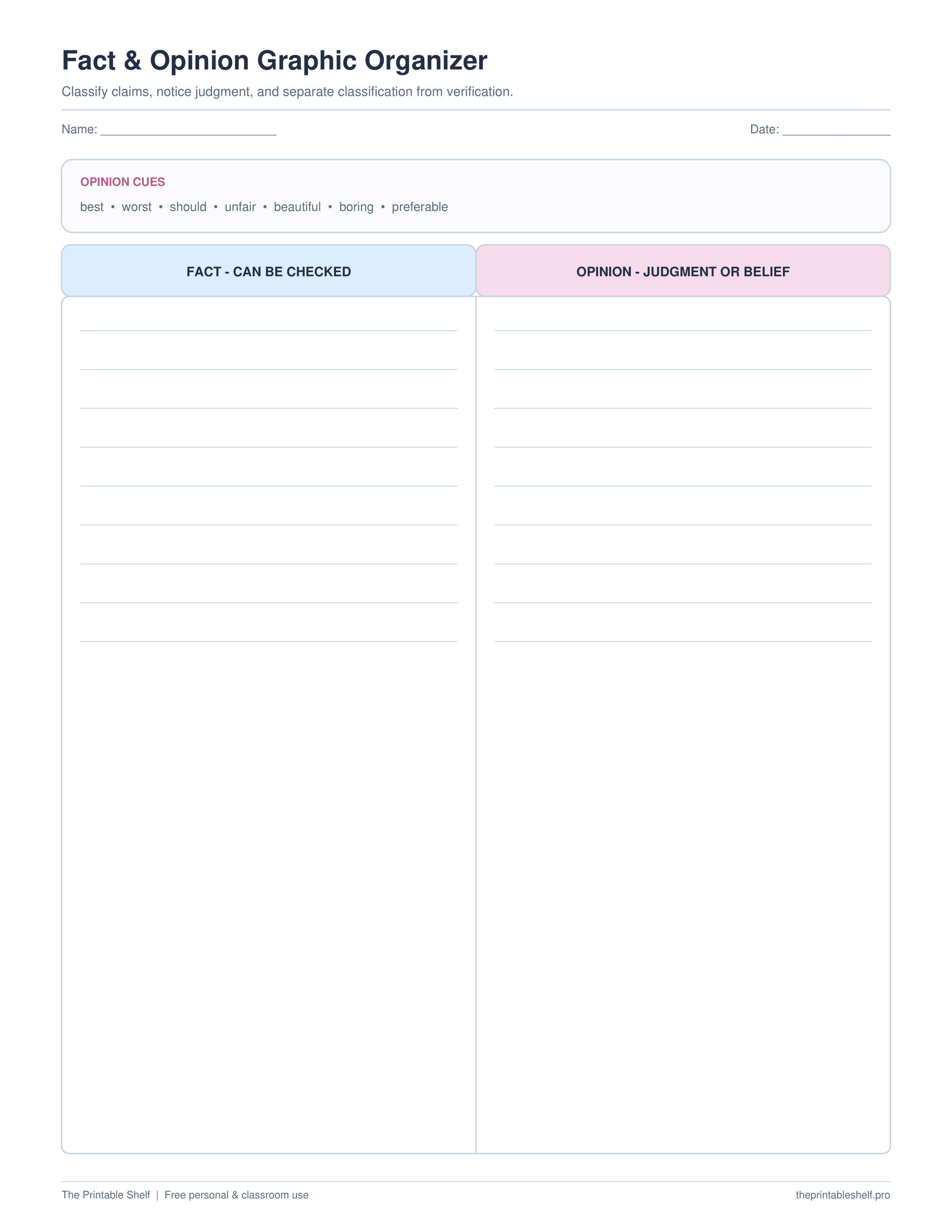
Opinion cue version
Adds a compact cue strip for common judgment words while keeping two roomy columns.
What this page helps with
A two-column organizer that goes beyond the shortcut ‘facts are true and opinions are false.’ The layout asks learners to classify statements and think about how a factual claim could be verified or what language signals a judgment. That makes the printable useful for real texts where opinions may contain facts and factual claims still need checking.
How to use it
Choose a short text, article, advertisement, review, or set of statements and write the source at the top. Read one statement at a time. Before sorting it, ask whether the statement could be checked against evidence outside the speaker’s personal preference. If it can be verified—such as a date, measurement, documented event, or observable feature—place it in the Fact column, even if you have not personally verified it yet.
Use the Opinion column for judgments, preferences, recommendations, and value statements. Words such as best, worst, beautiful, boring, should, or unfair often signal an opinion, but do not rely on signal words alone. ‘The movie is two hours long’ is a factual claim; ‘the movie is too long’ is an opinion because ‘too long’ depends on a judgment. Write enough of the original statement to preserve that distinction.
Beside factual claims, add a short note about how you could check them. You might use the text itself, a map, a data table, an official record, or another reliable source. This step helps learners understand that a sentence does not become a fact just because it sounds confident. A claim can be intended as factual and still turn out to be inaccurate, so classification and verification are related but different tasks.
For opinions, identify the reason or perspective behind the judgment when the text provides one. An opinion supported by strong evidence is still an opinion; the evidence simply makes the argument more convincing. For example, ‘This park is the best choice for families because it has shaded play areas and restrooms’ contains a judgment plus supporting facts. Record the opinion in the right column and underline the factual support in the source.
After sorting several statements, look for sentences that combine both types. Split them into parts if necessary. News analysis, reviews, persuasive writing, and everyday conversation often mix verifiable information with interpretation in a single sentence. Practicing that split is more useful than working only with obvious examples such as ‘Dogs have four legs’ versus ‘Dogs are the best pets.’
For younger learners, begin with short, concrete statements and ask ‘Can we check this?’ before introducing more nuanced examples. Older students can add a third mark for ‘needs verification’ when a factual claim cannot be confirmed from the material they have. The goal is not to make students suspicious of every sentence; it is to help them notice the difference between what can be evidenced and what reflects a point of view.
Customize instead
Need a different title, paper size, or orientation? →
Use the free Graphic Organizer Maker to build a custom Venn, KWL, Frayer, story map, T-chart, main-idea, sequence, or cause-and-effect page.
Also in a free pack
Download this organizer together with related pages when you want one reusable master PDF instead of separate files.
Good matches for this page
Three ways to use it
Reading articles
Sort statements from a passage, then note which factual claims can be verified directly and which would need another source.
Reviews & advertising
Separate product or experience claims from words that express preference, quality judgments, or recommendations.
Persuasive writing
Highlight the writer’s opinion and then identify the factual details used to support that position.
Common mistakes to avoid
Defining fact as ‘a sentence I agree with’
Ask whether the statement can be checked with evidence, not whether it sounds believable.
Calling every unsupported claim an opinion
A checkable claim can still be factual in form even when it has not yet been verified.
Ignoring mixed sentences
Split a sentence when it contains both a verifiable detail and a judgment about that detail.
Included layout options
Sort + explain
Classify statements and justify the decision
Layout: Fact / opinion columns with a short why field
How can I verify it?
Build media-literacy habits around factual claims
Layout: Adds verification source or method beside fact entries
Signal words
Support younger learners noticing judgment language
Layout: Small cue box for words that signal preference or belief
Classroom fit
Suggested grades, use modes & standards
Suggested grade bands
These are practical use ranges, not hard limits. Text complexity and the amount of teacher modeling matter more than the worksheet alone.
Good fit for
Scaffold level: Beginner.
Common Core crosswalk
No narrow standards code is listed for this general-purpose template. Use it where the thinking task fits your local curriculum.
Common questions
Is a fact always true?
A factual claim is the kind of statement that can be checked with evidence. A person can make an incorrect factual claim, so important facts still need verification.
Can an opinion include facts?
Yes. A writer can support an opinion with facts, examples, or data. The supporting evidence does not turn the judgment itself into a fact.
What words usually signal an opinion?
Words such as best, worst, better, unfair, beautiful, boring, should, and preferable often signal judgment, but the meaning of the whole sentence matters more than one keyword.
Helpful guides
See where this organizer fits, when a different layout works better, and how to turn the completed page into a useful next step.

Free Reading Comprehension Graphic Organizers by Reading Skill
Free reading comprehension graphic organizers for story elements, main idea, sequence, cause and effect, comparison, vocabulary, and prior knowledge.
Read guide →
How to Use Graphic Organizers Effectively (Without Turning Them Into Busywork)
Learn how to choose, model, scaffold, and reuse graphic organizers so students think with them instead of simply filling in boxes.
Read guide →Keep organizing
You might also like
Free printable
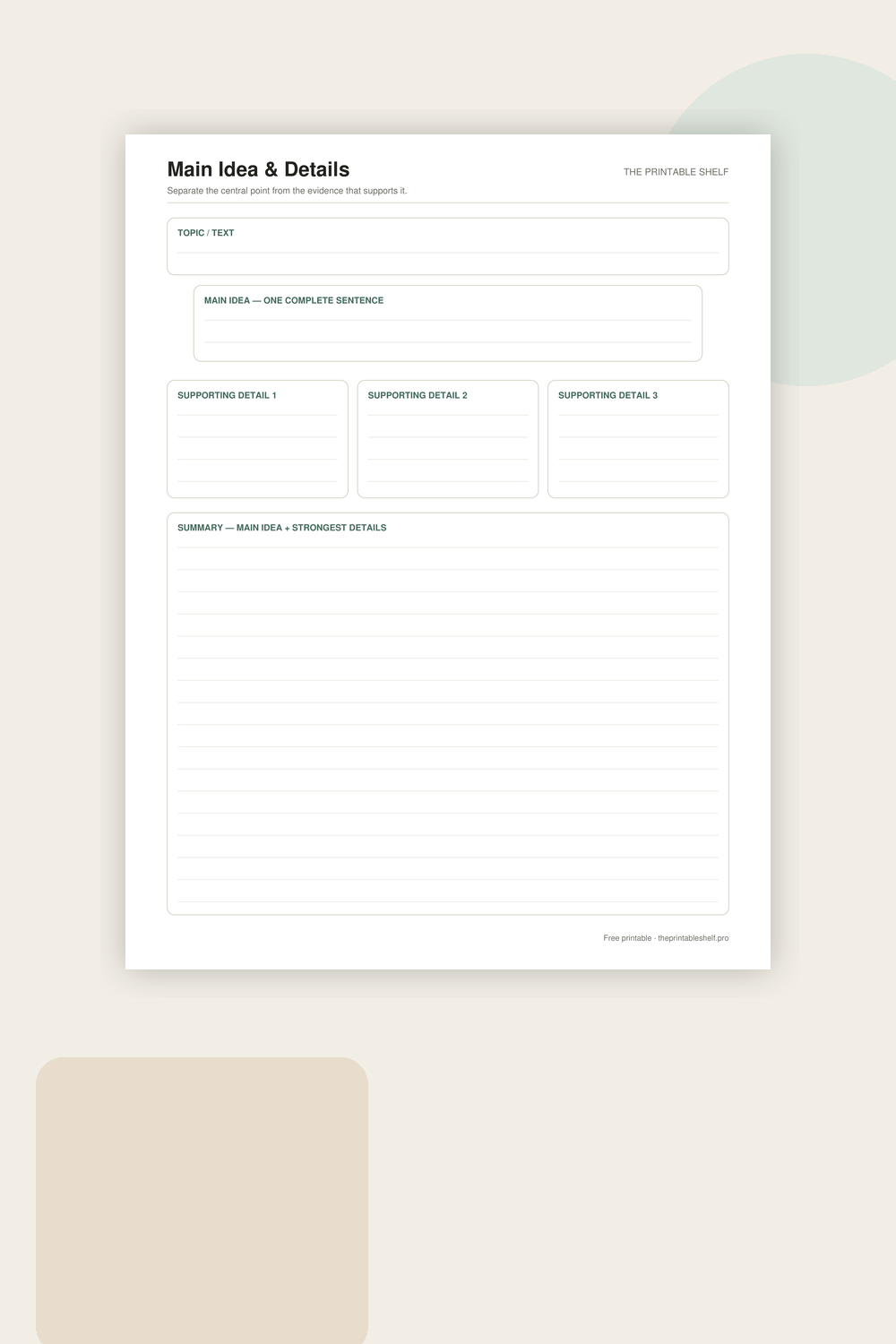
Main Idea and Details Graphic Organizer PDF
A reading and note-taking organizer built around one central idea and three pieces of support. The extra topic box helps learners distinguish a broad subject from the author’s actual main point, while the final summary asks them to recombine the important information in their own words.
Free printable
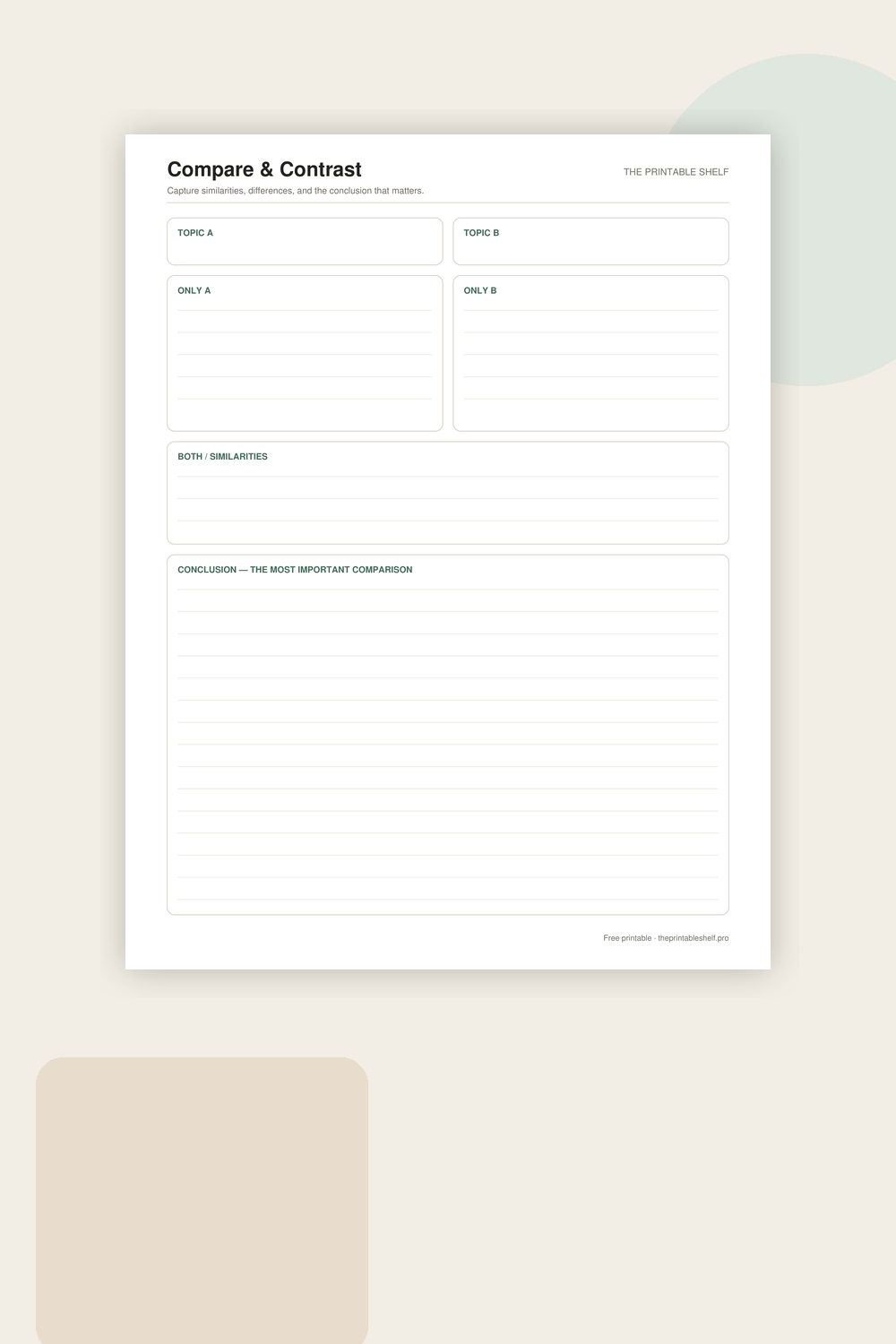
Compare and Contrast Graphic Organizer
A structured alternative to a Venn diagram for learners who need more writing space. Two difference boxes sit side by side, a full-width similarities area keeps shared traits together, and the final conclusion section turns the collected notes into an actual comparison rather than stopping at a list.
Free printable
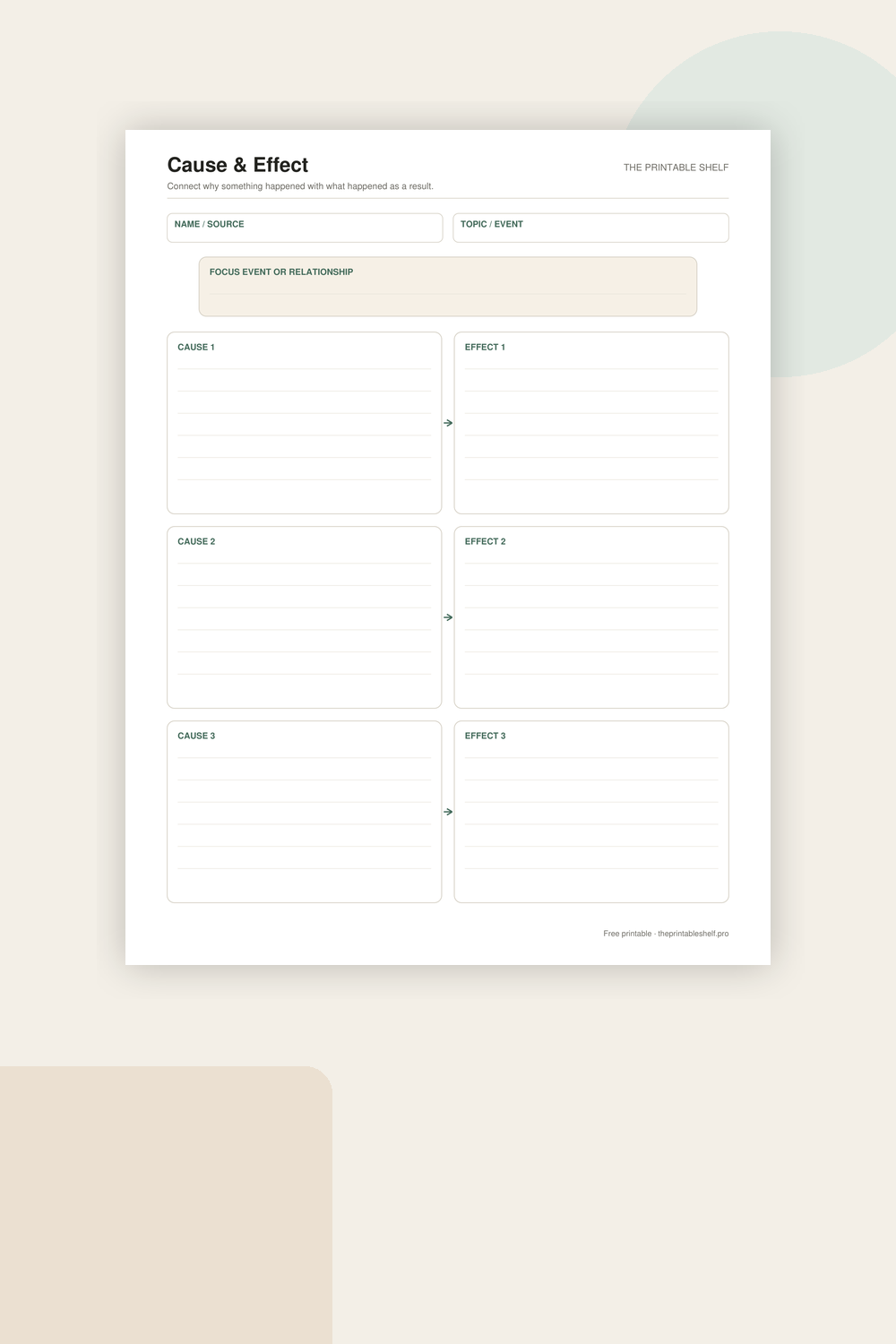
Cause and Effect Graphic Organizer
A one-page organizer for examining causal relationships instead of simply listing events. Each cause is visually connected to its effect, and the focus box at the top gives the page one clear subject so students can analyze several relationships without losing track of the larger event, text, or concept.