Work & Study · Free printable
Free Problem and Solution Graphic Organizer
This problem and solution organizer helps readers identify the central problem, record evidence about what makes it important, and explain how it is solved. It can also be used before writing to plan a problem, attempted responses, and a believable solution. The one-page format keeps the relationship between problem and solution visible.
Edited by Tessa Vaughn · Planning & Organization Editor
Free download
Choose your file size
Print at 100% / Actual Size for the cleanest margins. Pick the paper size your printer normally uses.
Share to Google Classroom ↗No sign-up required · personal/classroom use
More useful layouts
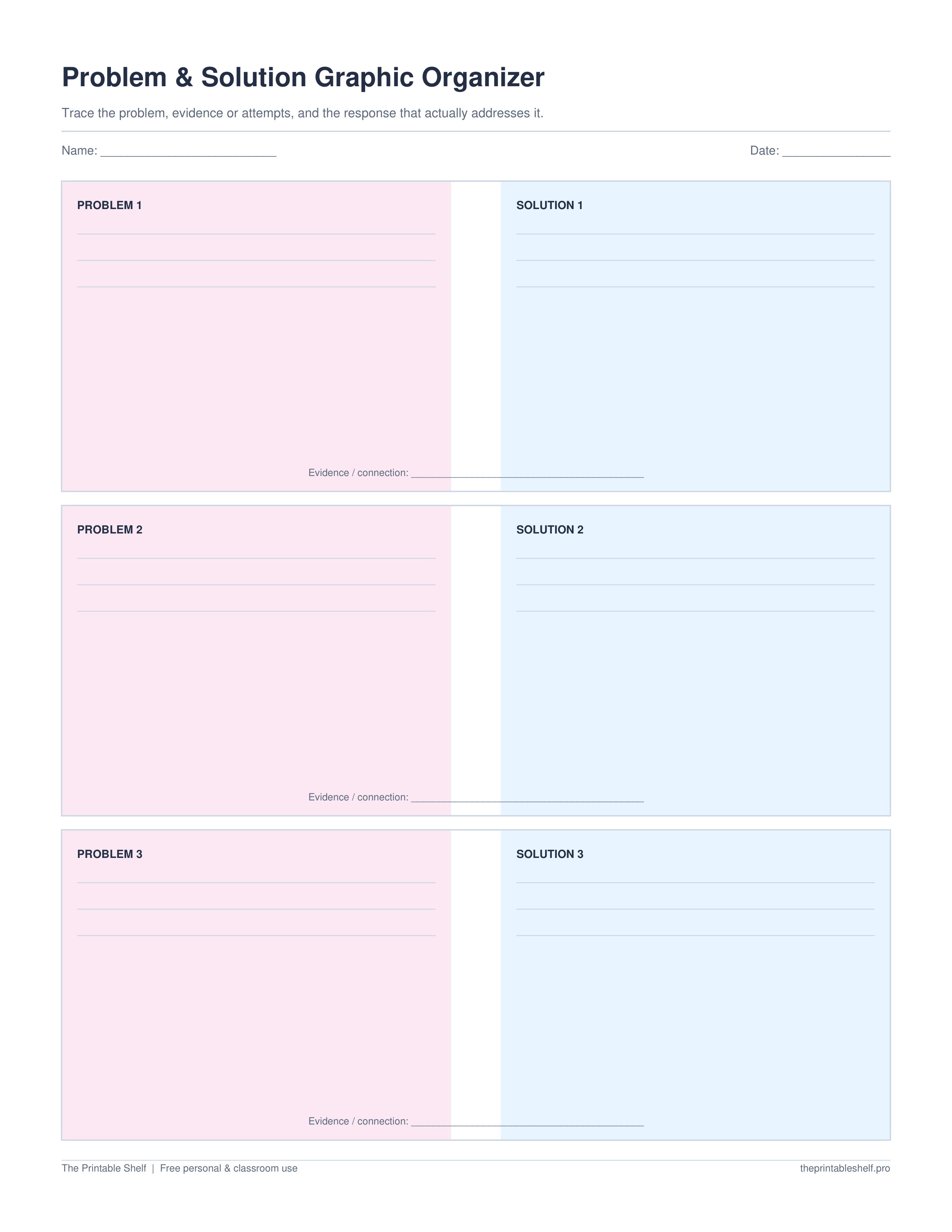
3 problem–solution pairs
Three repeated problem-to-solution rows for texts or units with several smaller problems.
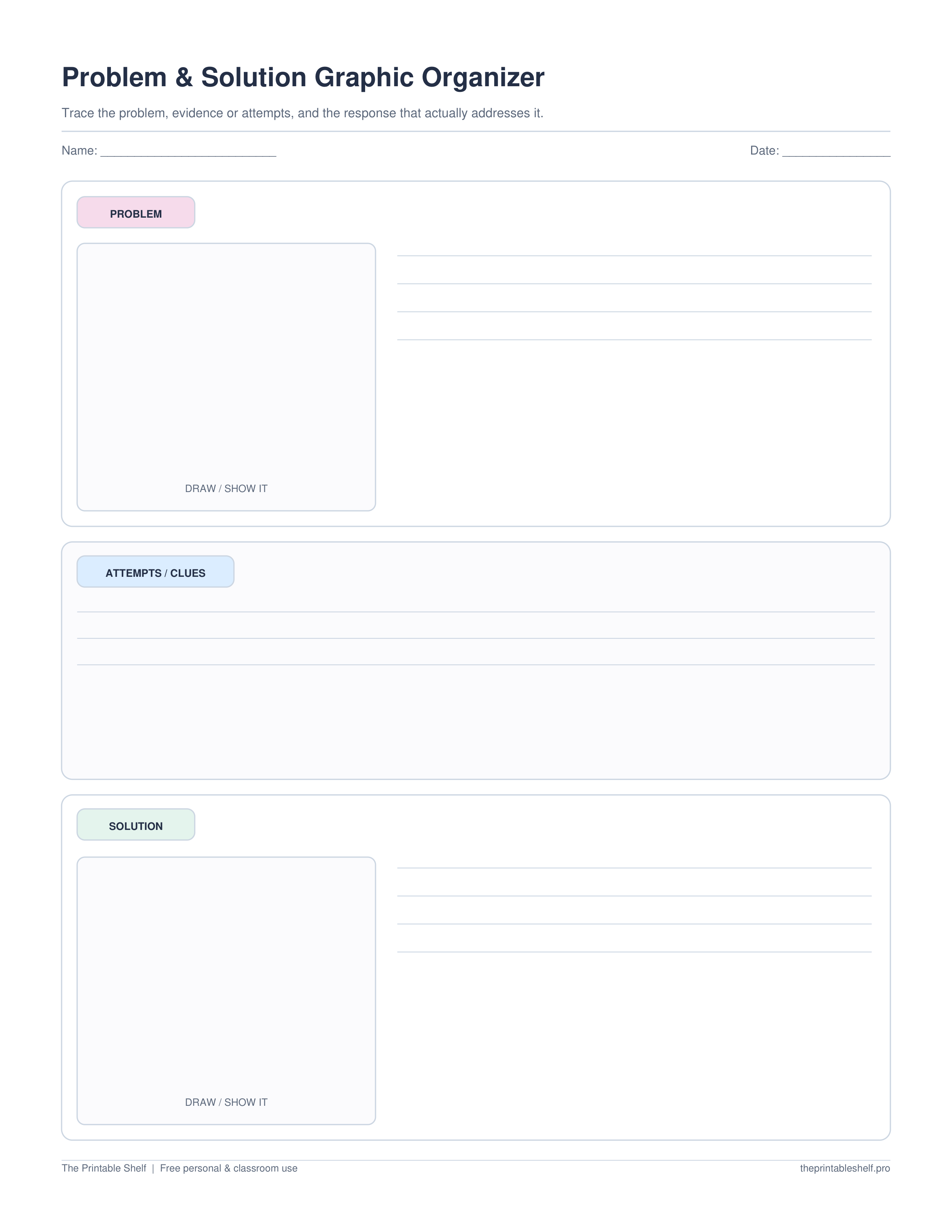
Draw + write
Large problem and solution sketch areas plus short writing prompts and an attempts/clues section.
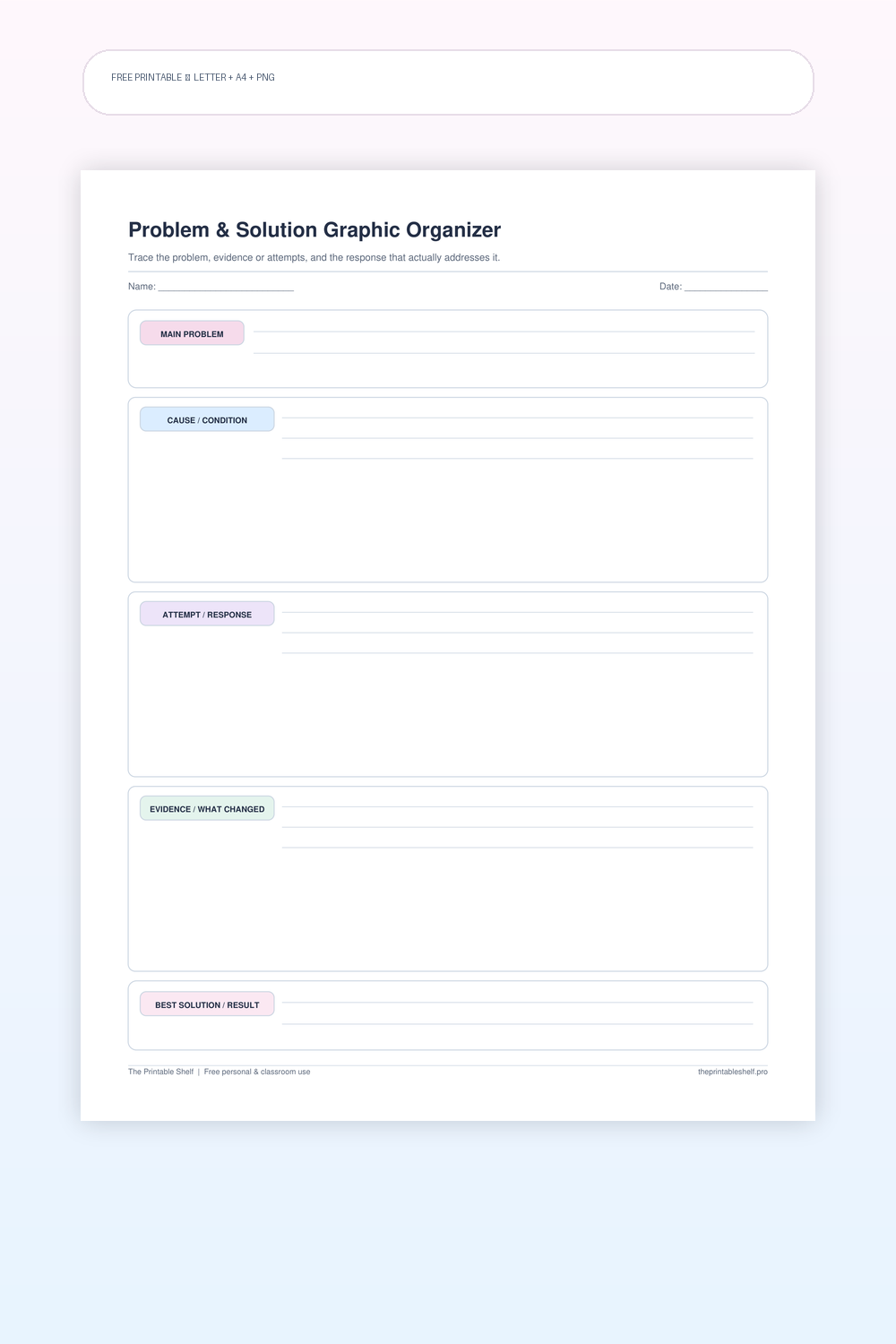
What this page helps with
A one-page reading and prewriting organizer built around more than two empty boxes. The page separates the central problem from clues or attempts in the middle and the final solution at the bottom, so learners can show how a solution develops rather than jumping straight from ‘problem’ to ‘solution.’
Putting it to work
Start by naming the text, story, article, or writing topic. Then write the main problem in one complete sentence. A useful problem statement names who or what is affected and what is getting in the way. ‘The character has a problem’ is too vague; ‘Maya misses the bus and has no other ride to school’ gives you something specific to trace through the rest of the organizer.
Before writing the solution, collect the important evidence in the middle of the page. In fiction, this can include attempts the character makes, obstacles that make the problem harder, or information that changes the character’s plan. In nonfiction, record the conditions that created the problem and the responses described by the author. This prevents the organizer from becoming a two-answer worksheet that skips the reasoning between the beginning and the end.
Write the solution only after you can explain how it addresses the original problem. Ask two questions: What changed? And why does that change solve, reduce, or respond to the problem? If the text has several attempted solutions, note them separately and mark the one that actually works. If the ending does not fully solve the problem, say that clearly instead of forcing a neat answer the text does not support.
For writing practice, reverse the process. Plan the problem first, brainstorm plausible responses, then choose a solution that grows out of what the character or writer already has available. A solution that appears suddenly without setup often makes a story feel weak. The organizer is useful here because the middle evidence boxes can become failed attempts, discoveries, or turning points that make the final solution feel earned.
When reviewing the finished page, draw a quick line from the solution back to the problem statement and read both aloud. They should answer each other directly. If they do not, either the problem was stated too broadly or the solution describes an unrelated event. For younger learners, allow short phrases or drawings in the middle boxes. For older students, add a page, paragraph, or other source locator beside important evidence when the task benefits from text verification or formal citation.
If the source contains several smaller problems, use the organizer to rank them before choosing the central one. Ask which problem drives the most important events or which problem the author spends the most time explaining. Keeping one clear focus on each sheet makes later comparison easier: a second copy can track a secondary problem, and the two completed pages can then be compared without crowding the original organizer.
Customize instead
Need a different title, paper size, or orientation? →
Use the free Graphic Organizer Maker to build a custom Venn, KWL, Frayer, story map, T-chart, main-idea, sequence, or cause-and-effect page.
Good matches for this page
Three ways to use it
Reading fiction
Identify the story problem, record the character’s attempts or obstacles, then explain how the ending resolves—or fails to resolve—the original problem.
Reading nonfiction
Use the organizer when a passage describes a problem, evidence about its effects, and one or more responses. This works well for science, social studies, and current-events reading.
Planning a story
Use the middle section for failed attempts, discoveries, or turning points so the final solution follows naturally from the story instead of appearing out of nowhere.
Common mistakes to avoid
Writing a topic instead of a problem
State what is wrong, difficult, missing, or in conflict—not just the subject of the text.
Jumping straight to the ending
Record the evidence or attempts that connect the original problem to the eventual solution.
Forcing a perfect solution
If the text leaves the problem partly unresolved, describe the partial response accurately.
Included layout options
Single problem deep-dive
Analyze one central problem and the response that addresses it
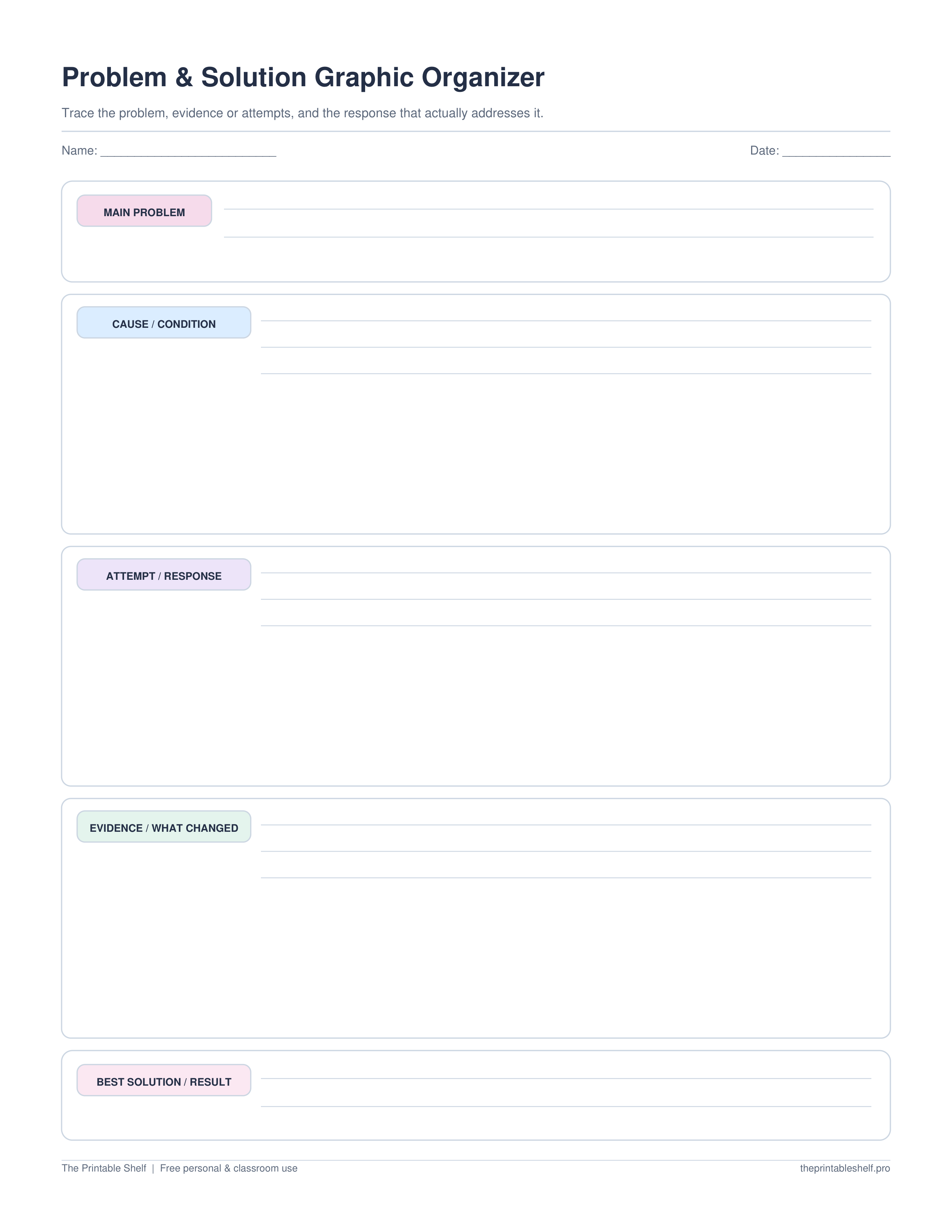
Layout: Problem, cause/condition, attempt, evidence, and best solution/result
Problem / solution pairs
Track several smaller problems without crowding one analysis
Layout: Three repeated problem-to-solution rows with a connection/evidence line
Draw + write
Support younger learners and visual retells
Layout: Large sketch spaces for the problem and solution plus shorter writing prompts
Classroom fit
Suggested grades, use modes & standards
Suggested grade bands
These are practical use ranges, not hard limits. Text complexity and the amount of teacher modeling matter more than the worksheet alone.
Good fit for
Scaffold level: Standard.
Common Core crosswalk
No narrow standards code is listed for this general-purpose template. Use it where the thinking task fits your local curriculum.
Common questions
Can I use this organizer with both fiction and nonfiction?
Yes. In fiction, track the story problem, attempts, and resolution. In nonfiction, use the same structure to identify a real-world problem, evidence, responses, and the solution or proposed solution.
What if the story has more than one problem?
Choose the problem most important to the text or print a second sheet. Mixing several unrelated problems on one page usually makes the problem-solution relationship harder to see.
What if the problem is not completely solved?
Write what changed and note that the problem remains partly unresolved. Do not invent a complete solution simply because the organizer has a box labeled Solution.
Helpful guides
See where this organizer fits, when a different layout works better, and how to turn the completed page into a useful next step.

Keep organizing
You might also like
Free printable
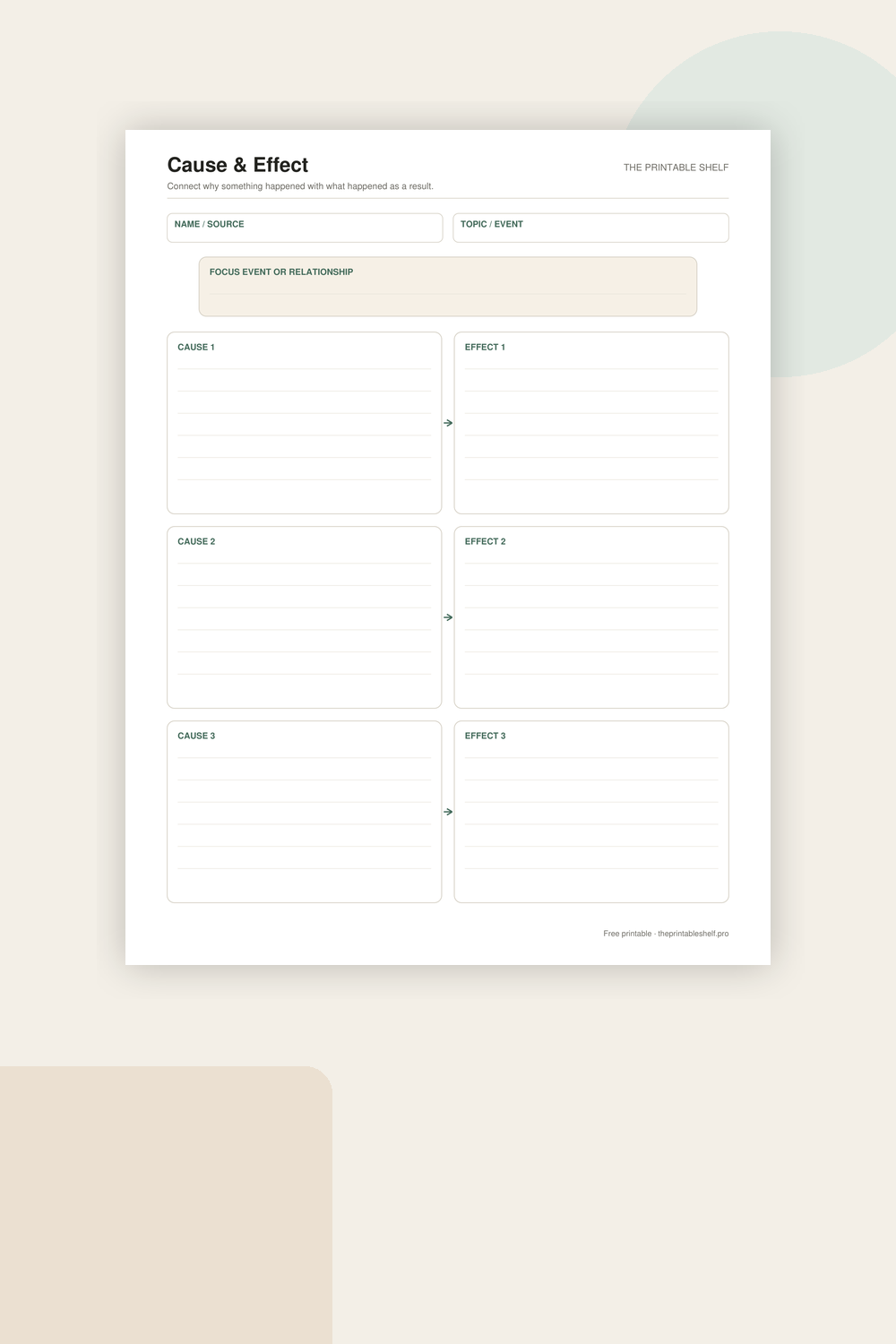
Cause and Effect Graphic Organizer
A one-page organizer for examining causal relationships instead of simply listing events. Each cause is visually connected to its effect, and the focus box at the top gives the page one clear subject so students can analyze several relationships without losing track of the larger event, text, or concept.
Free printable
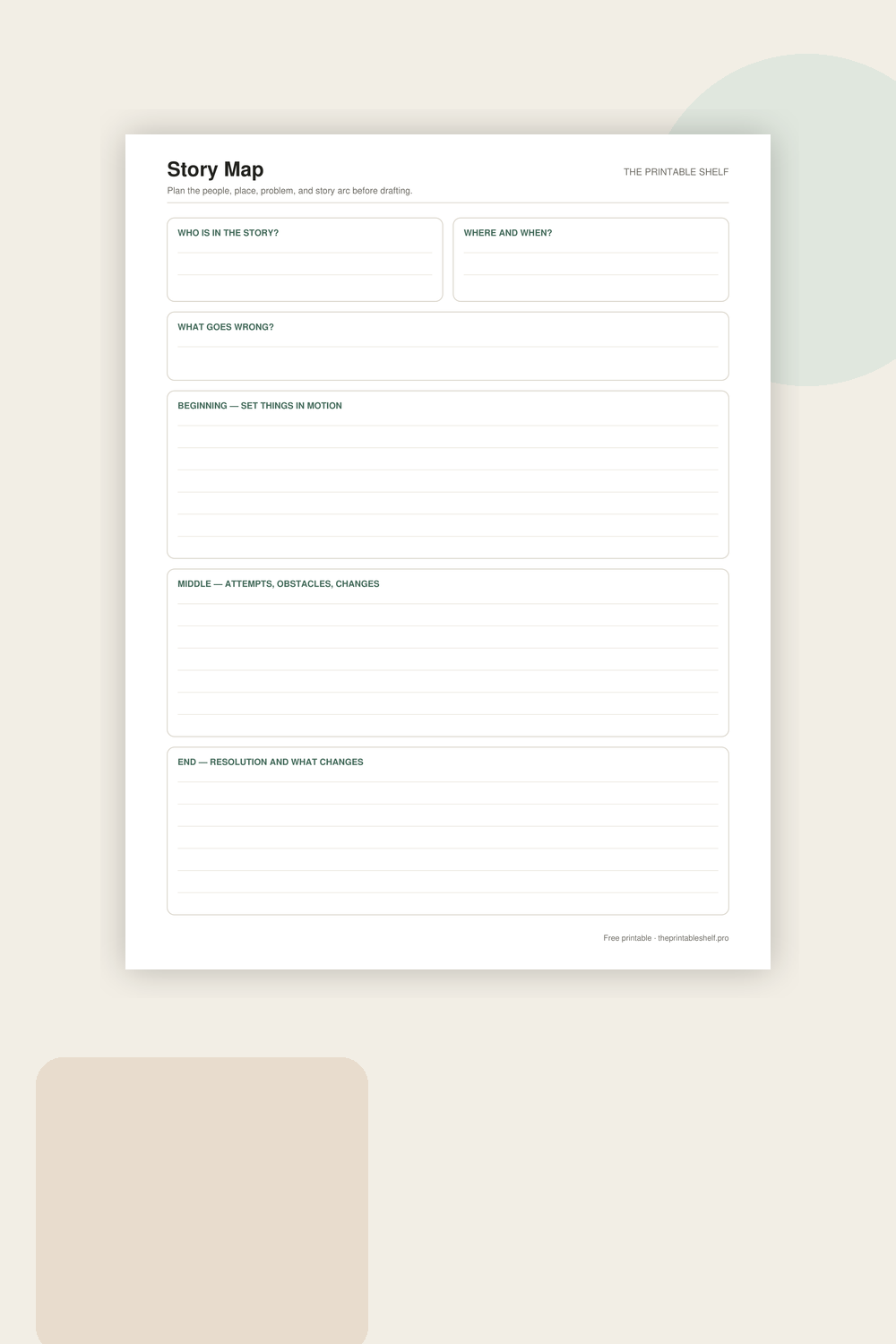
Printable Story Map Template
A one-page story organizer that separates the pieces students often mix together. Characters and setting establish who and where, the problem gives the story something to resolve, and three larger boxes organize the sequence into beginning, middle, and end. It works for reading response or prewriting.
Free printable
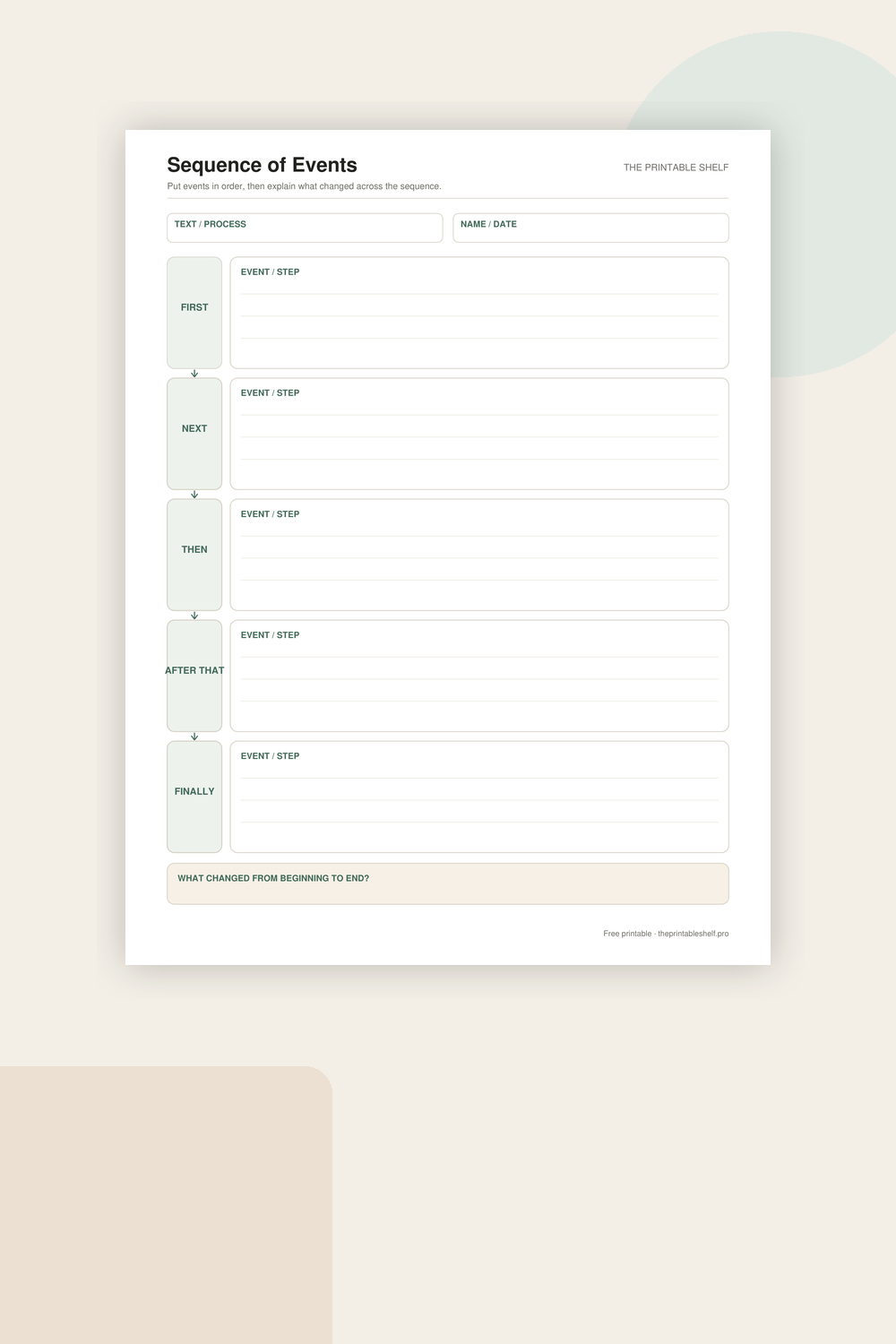
Sequence of Events Graphic Organizer
A vertical sequence chain that makes order visible without squeezing each event into tiny boxes. Five linked writing areas support short event summaries or process steps, and a final reflection box pushes the learner to notice the overall change from beginning to end rather than merely copying chronology.