Work & Study · Free printable
Free Reading Prediction Graphic Organizer
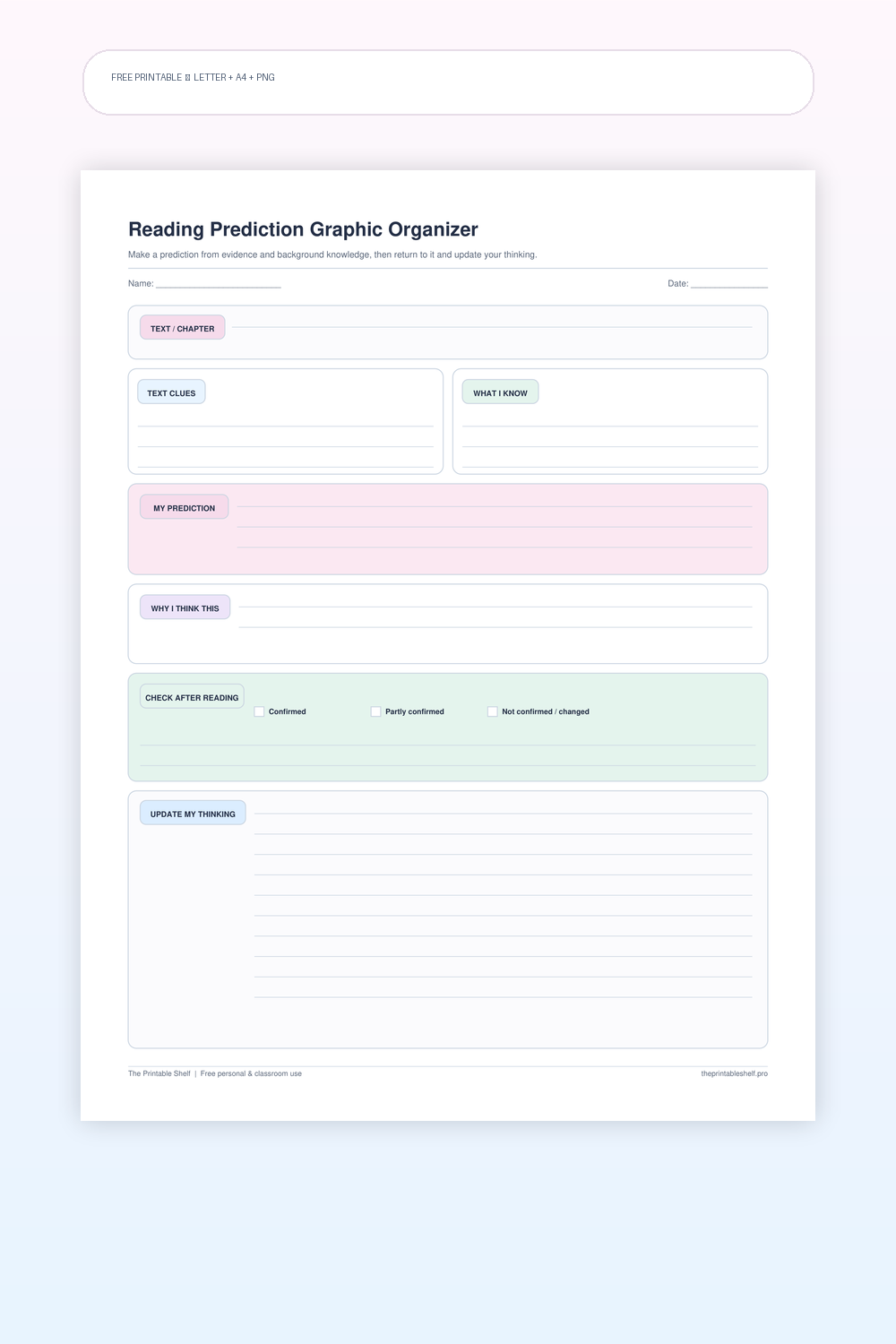
This free prediction graphic organizer combines text clues with relevant background knowledge, asks readers to state why a prediction is reasonable, and includes a check-after-reading section so predictions can be confirmed, partly confirmed, or revised. The page emphasizes evidence and revision rather than guessing what happens next.
Edited by Tessa Vaughn · Planning & Organization Editor
Free download
Choose your file size
Print at 100% / Actual Size for the cleanest margins. Pick the paper size your printer normally uses.
Share to Google Classroom ↗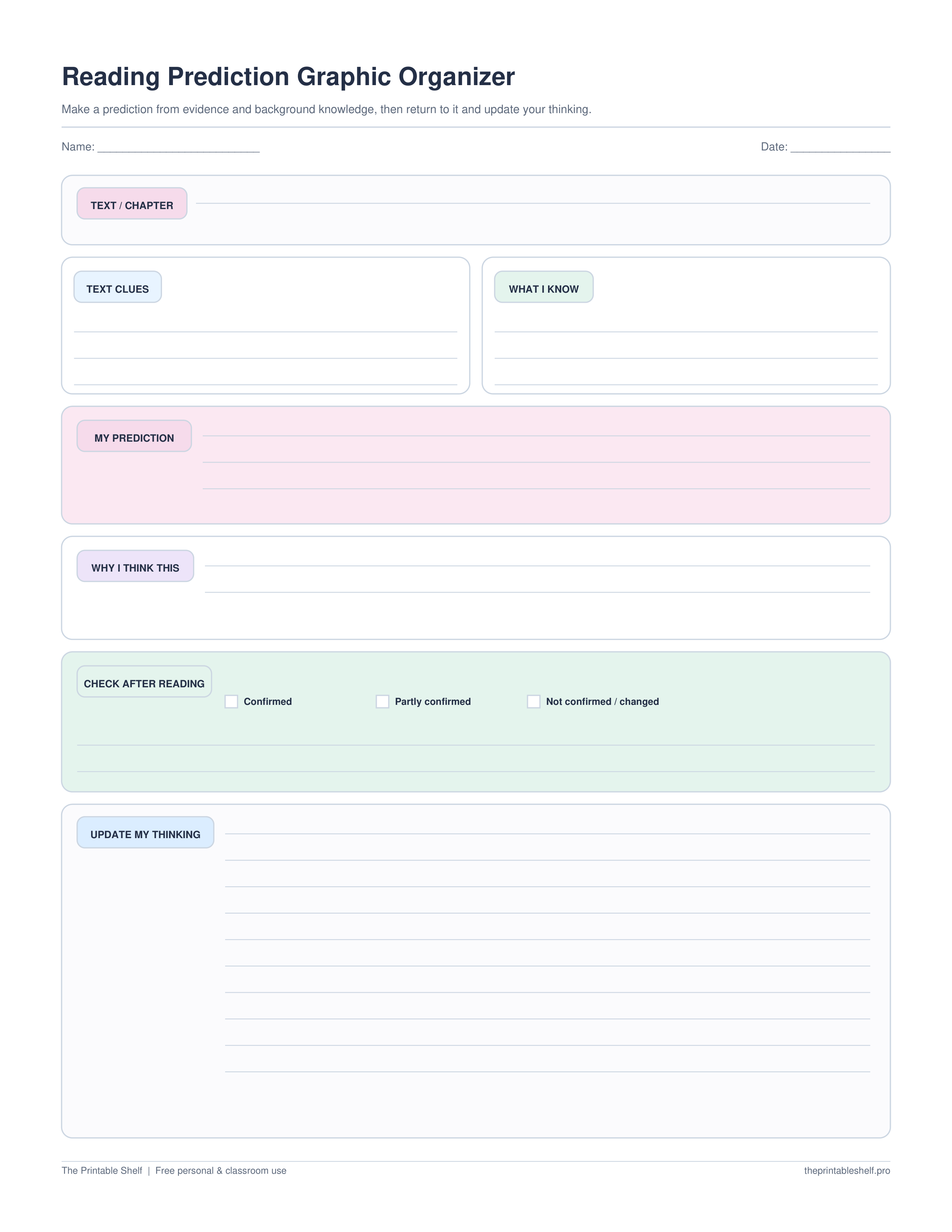
No sign-up required · personal/classroom use
What is on the page
A before-and-during-reading organizer that treats prediction as evidence-based thinking rather than guessing. The page preserves the original prediction and then asks the learner to return to it after reading, which makes revision and metacognition part of the activity.
Putting it to work
Before reading the next section, collect clues from the title, headings, illustrations, previous events, character goals, or information already established in the text. Use the text-clue box for details that come from the source itself. Avoid predicting from a single decorative image when the text provides stronger evidence.
Add only background knowledge that is relevant to the clue. In fiction, this may involve what you know about a character's goal or how people often respond to a situation. In nonfiction, it may involve prior knowledge about a process or topic. Keep the background knowledge separate from the text evidence so you can see what comes from the source and what comes from you.
Write a prediction that is specific enough to check later. 'Something will happen' cannot be evaluated. A useful prediction states an event, explanation, result, or idea you expect and may include a condition such as 'because the character has already...' or 'if the pattern continues...'.
Use the reasoning box to connect the prediction to the clues. This prevents the activity from becoming a guessing game. If two predictions seem possible, choose the one that best uses the available evidence or write both and state what additional information would distinguish them.
After reading, mark whether the prediction was confirmed, partly confirmed, or not confirmed. Then update your thinking. An incorrect prediction is useful if the learner can explain which new detail changed the interpretation. The goal is not to be right in advance; it is to make, test, and revise a reasonable model of the text. Ask the reader to name the exact clue that changed the prediction so revision becomes evidence of comprehension rather than a simple right-or-wrong score. For longer reading, make a second prediction after the first checkpoint and compare how the evidence base becomes more precise as the text develops.
Customize instead
Need a different title, paper size, or orientation? →
Use the free Graphic Organizer Maker to build a custom Venn, KWL, Frayer, story map, T-chart, main-idea, sequence, or cause-and-effect page.
Also in a free pack
Download this organizer together with related pages when you want one reusable master PDF instead of separate files.
Where it fits best
Ways to use it
Make predictions from evidence
Separate source clues from background knowledge and connect both to a specific expectation.
Check thinking after reading
Preserve the original prediction, then mark what the text confirmed or changed instead of erasing the first idea.
Discuss competing predictions
Compare which prediction uses the available evidence more convincingly and identify what new information would settle the question.
Where learners go wrong
Writing a random guess
Require at least one text clue and a reason the clue makes the prediction plausible.
Making a prediction too vague to check
State a specific event, result, explanation, or next idea that can later be evaluated.
Treating an incorrect prediction as failure
Use the update section to identify which new evidence changed the reader's thinking.
Classroom fit
Grade fit and standards crosswalk
Suggested grade bands
These are practical use ranges, not hard limits. Text complexity and the amount of teacher modeling matter more than the worksheet alone.
Good fit for
Scaffold level: Beginner.
Common Core crosswalk
No narrow standards code is listed for this general-purpose template. Use it where the thinking task fits your local curriculum.
Frequently asked questions
What makes a good reading prediction?
A useful prediction is specific enough to check and is supported by text clues plus relevant background knowledge.
Is a wrong prediction a mistake?
Not necessarily. Revising a reasonable prediction after new evidence appears is part of active comprehension and monitoring.
Can I use predictions with nonfiction?
Yes. Readers can predict what information, explanation, result, or next stage a nonfiction text may present, then test that expectation while reading.
Keep organizing
You might also like
Free printable
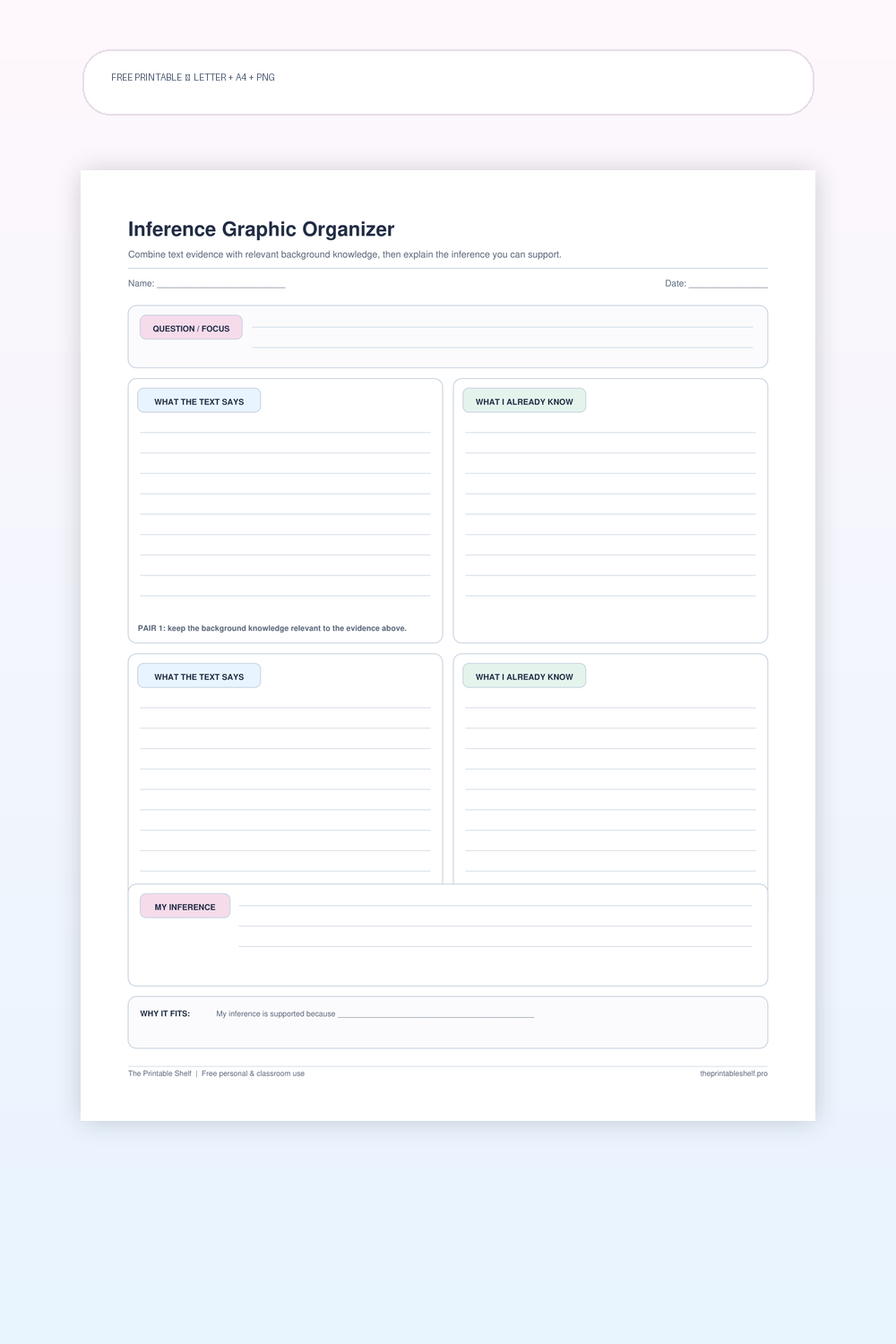
Inference Graphic Organizer
A reading-comprehension scaffold for conclusions that are implied rather than stated directly. The layout separates what the text actually provides from what the reader already knows, then asks for an inference supported by both. That distinction matters because an inference is not a guess or personal opinion; it should be a conclusion that remains accountable to textual clues and can be revised when new information changes the evidence.
Free printable
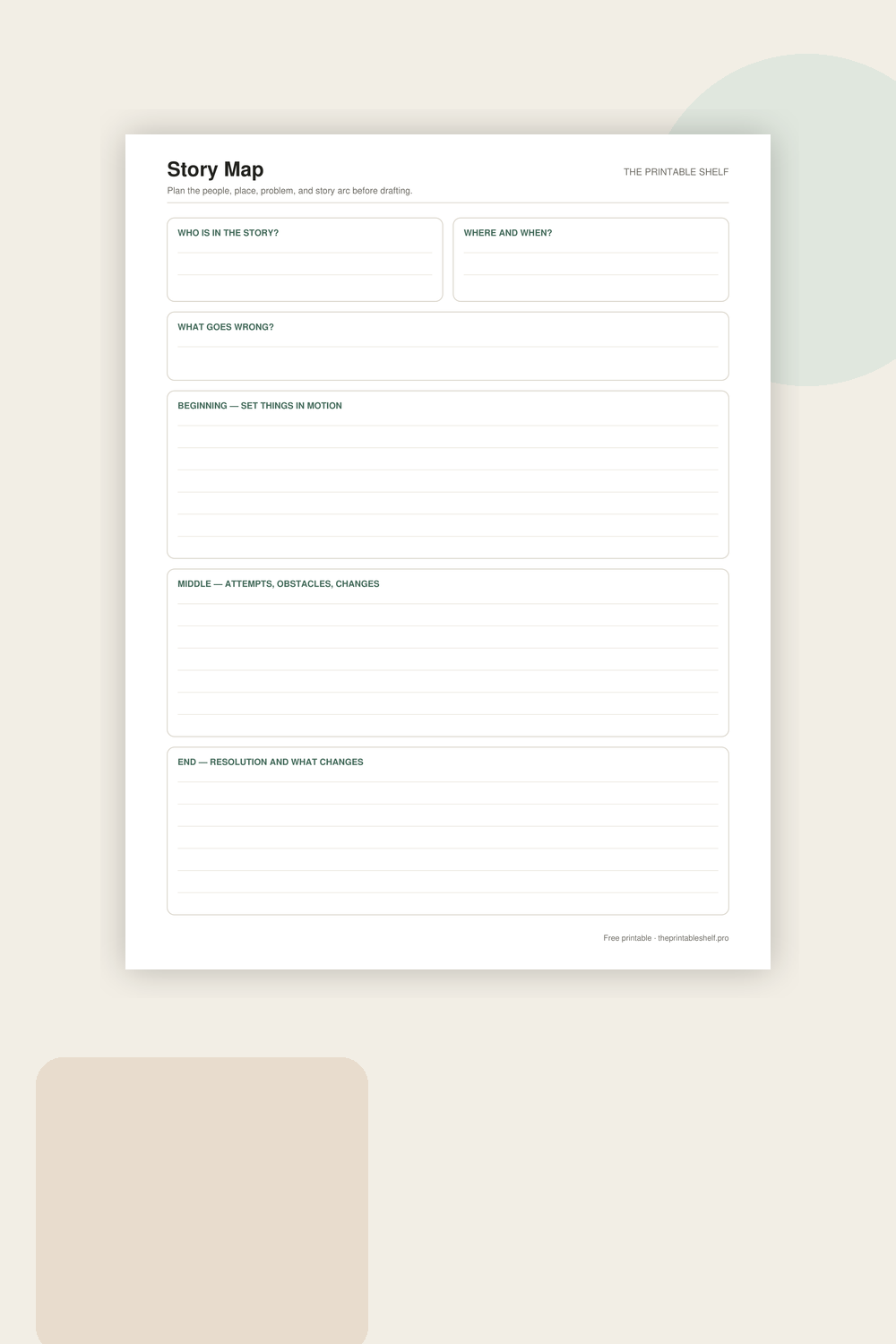
Printable Story Map Template
A one-page story organizer that separates the pieces students often mix together. Characters and setting establish who and where, the problem gives the story something to resolve, and three larger boxes organize the sequence into beginning, middle, and end. It works for reading response or prewriting.
Free printable
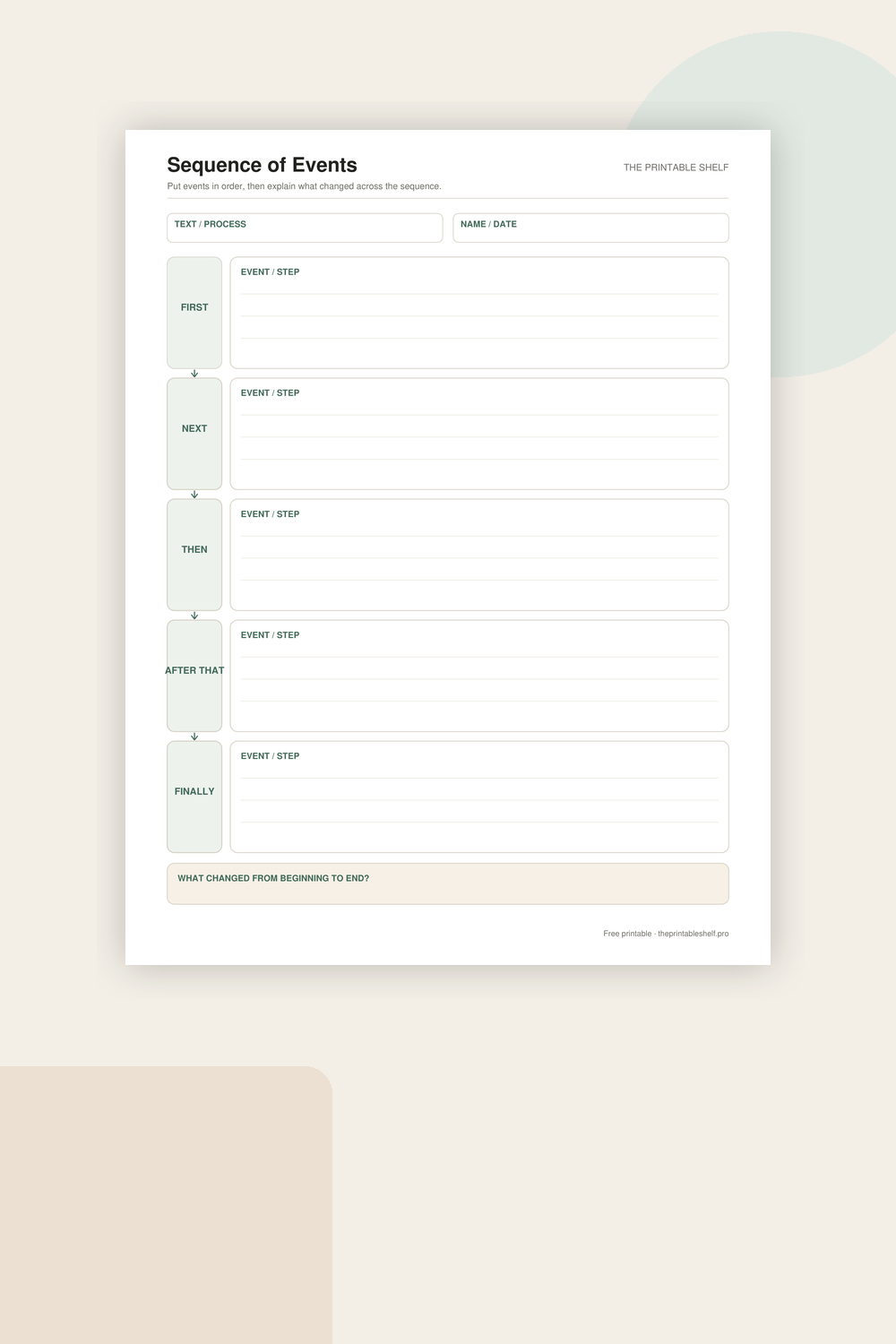
Sequence of Events Graphic Organizer
A vertical sequence chain that makes order visible without squeezing each event into tiny boxes. Five linked writing areas support short event summaries or process steps, and a final reflection box pushes the learner to notice the overall change from beginning to end rather than merely copying chronology.