Work & Study · Free printable
Free How-To Writing Graphic Organizer
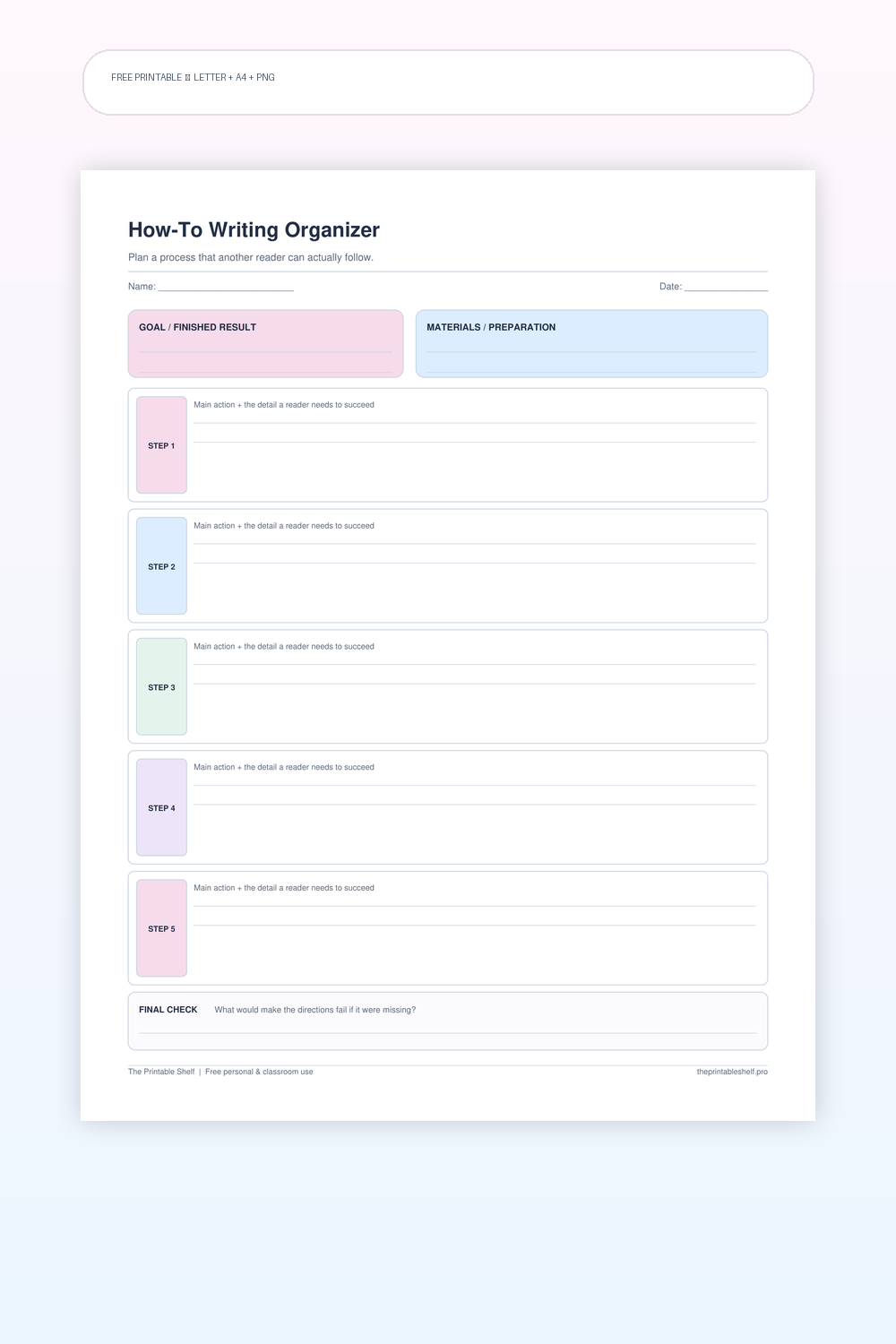
This how-to writing organizer helps a writer plan a process before drafting: name the goal, list needed materials or preparation, put the steps in a workable order, and add the details a reader would need to succeed. It is designed for procedural and informational writing where missing, vague, or out-of-order steps can make the instructions fail.
Edited by Tessa Vaughn · Planning & Organization Editor
Free download
Choose your file size
Print at 100% / Actual Size for the cleanest margins. Pick the paper size your printer normally uses.
Share to Google Classroom ↗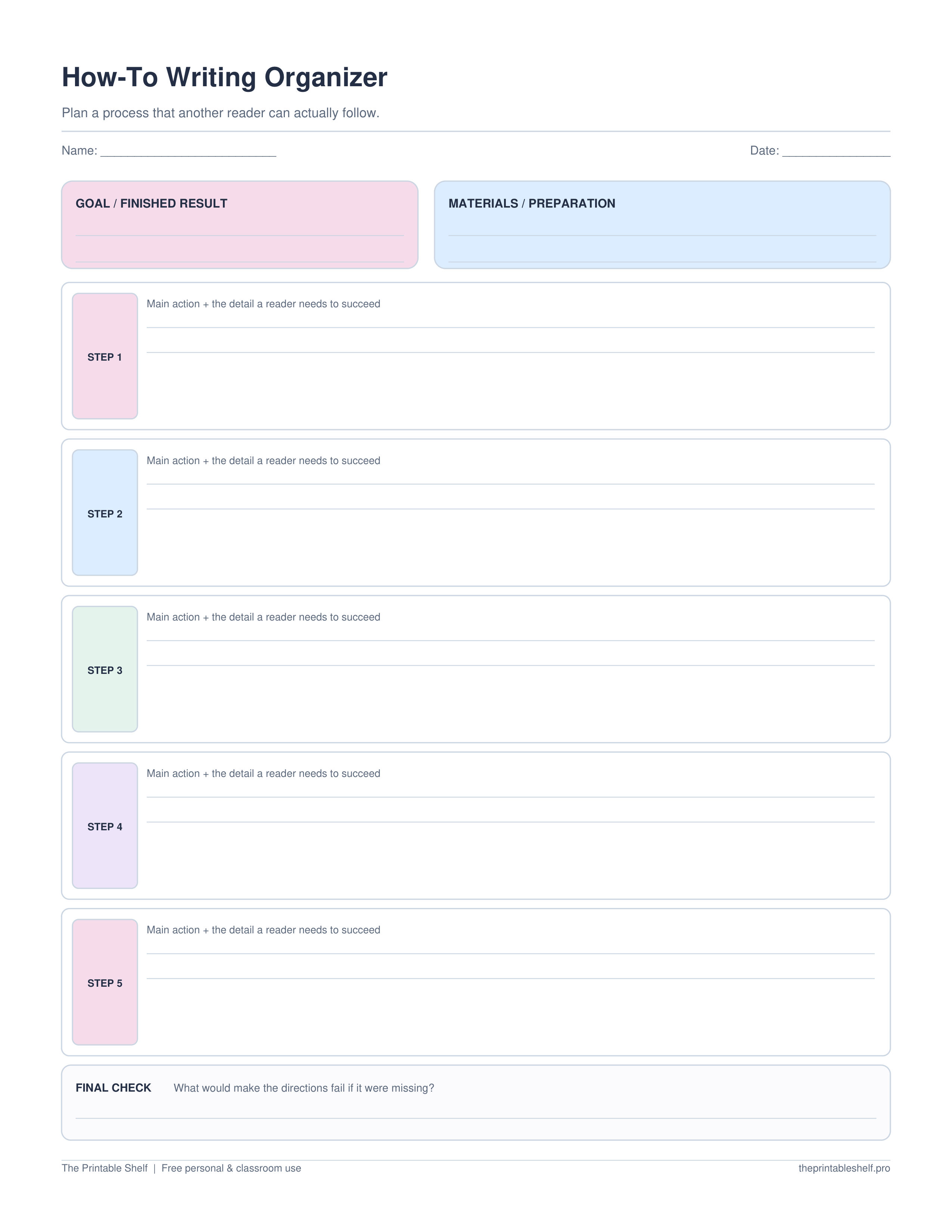
No sign-up required · personal/classroom use
More useful layouts
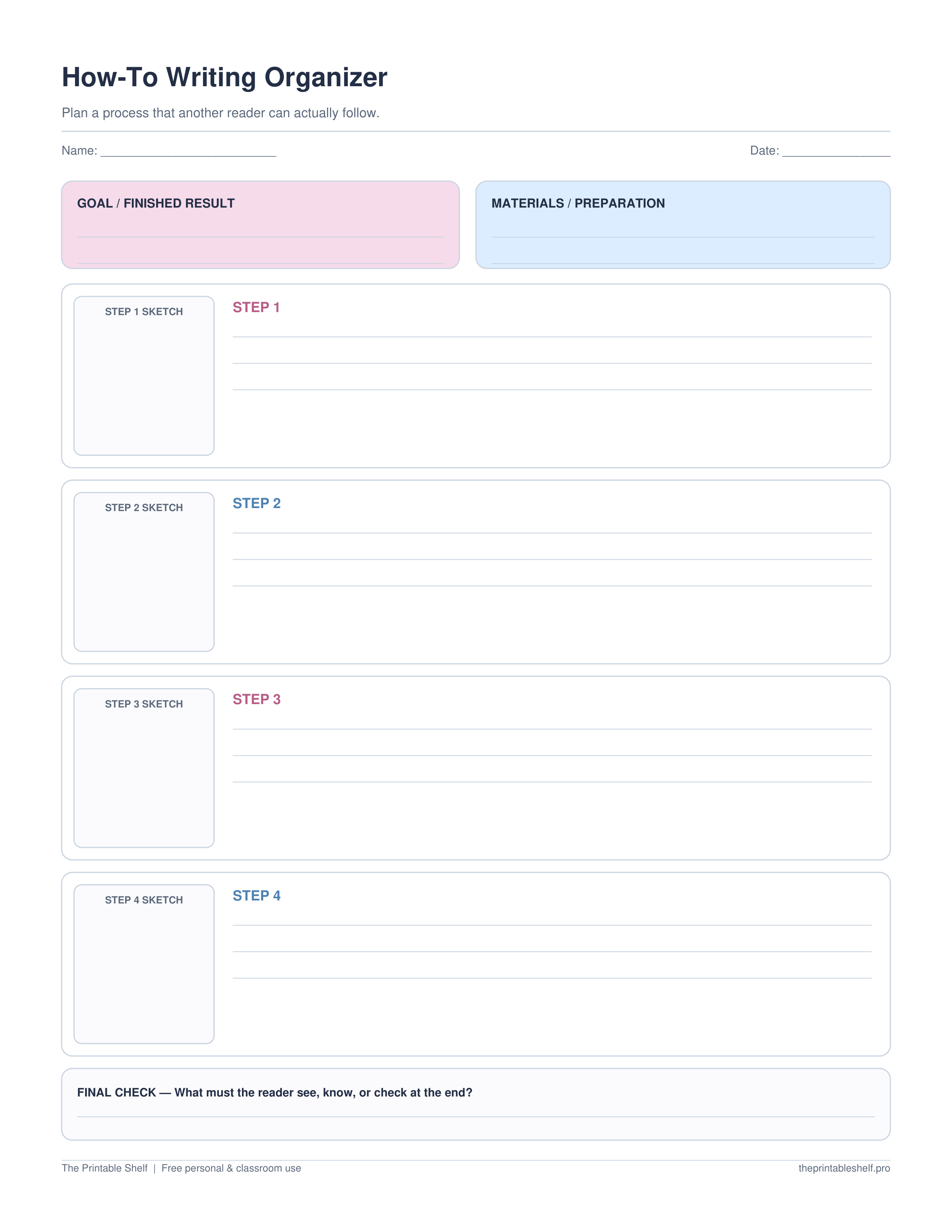
Draw + write steps
Four larger step rows pair a sketch box with short writing lines for younger writers and visual procedures.
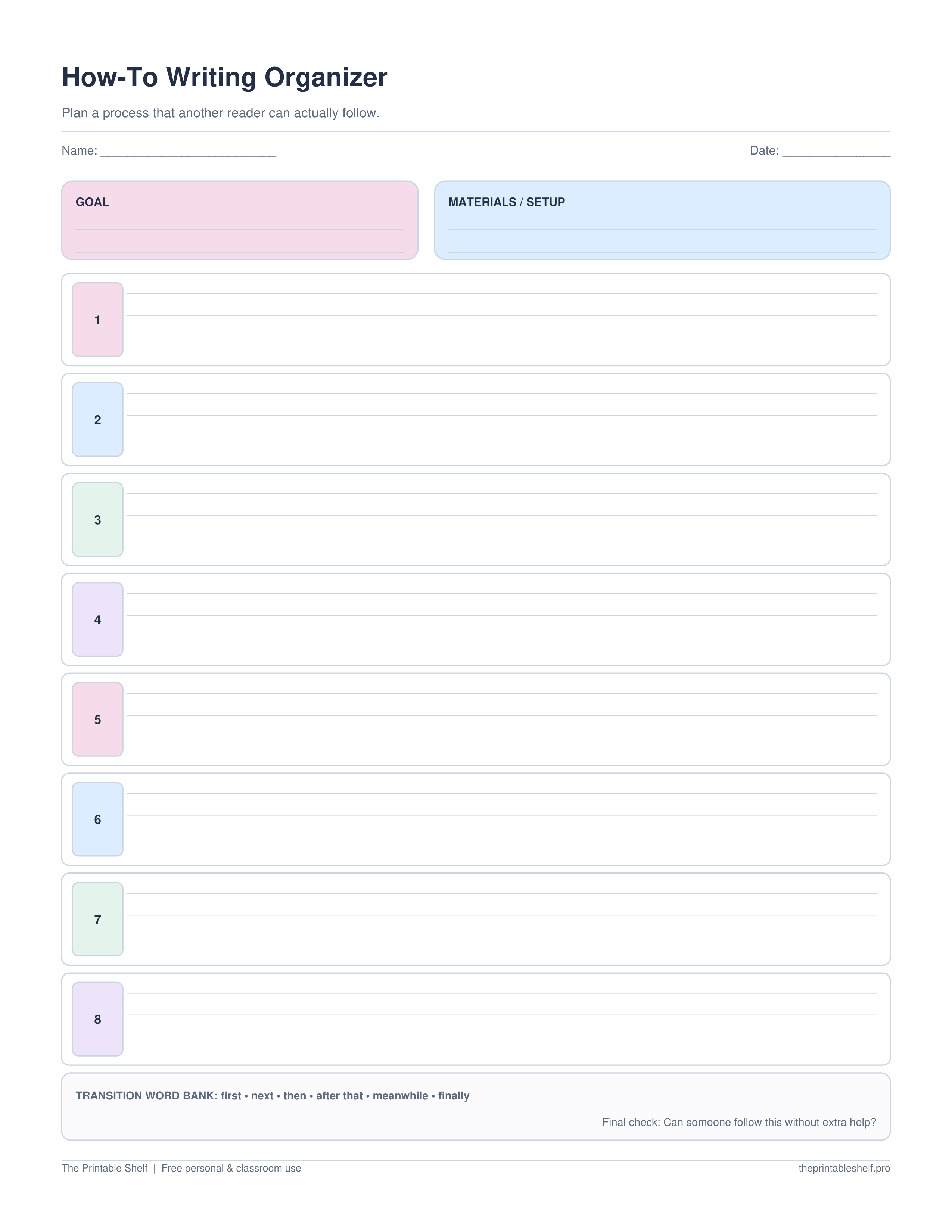
8-step compact
Eight numbered rows, a transition-word bank, materials space, and a final reader check for longer procedures.
What this printable is for
A one-page procedural-writing planner built around the reader’s task rather than a generic sequence alone. It combines a clear outcome, preparation or materials, numbered steps, transition words, and a final check for hidden assumptions. That makes it useful for recipes, classroom procedures, simple experiments, crafts, game instructions, and any explanation of how to complete a repeatable process.
Using it in class or at home
Start with the outcome: write exactly what the reader should be able to do when the directions are finished. “Make a paper airplane that can glide across the room” gives the writer a clearer target than “paper airplanes.” Then list the materials, tools, ingredients, files, or setup needed before Step 1. If the process requires preparation such as preheating, logging in, or measuring something first, include that here rather than hiding it later.
Brainstorm the actions in rough order without worrying about polished sentences. Use one main action per step. If a box contains several verbs joined by “and,” ask whether the reader could reasonably complete them as one action or whether they should be separated. Good procedural writing makes the sequence easy to execute. A step such as “Prepare everything” is usually too broad; “Measure 1 cup of water” gives the reader something observable to do.
Test the order by acting it out mentally or physically. Look for dependencies: a reader cannot attach a part that has not been cut, save a document that has not been created, or pour a mixture into a pan that has not been prepared. Number the steps only after the order works. Add transition words such as first, next, after that, meanwhile, or finally where they clarify the sequence, but do not force a transition onto every sentence.
Add the details that prevent failure. Measurements, time, location, direction, settings, safety limits, visual cues, and decision points often matter more than extra adjectives. Compare “cook until done” with “cook until the center is no longer wet, about 12 minutes.” The second gives the reader a checkable condition. For school procedures, include what to do when something goes wrong if that branch is likely enough to matter.
Use the final-check area to find assumptions the writer knows but the reader may not. Pretend the reader has the required background but has never completed this exact task. Could they tell which button to press, which side faces up, when to stop, or what the finished result should look like? Add only the missing details that affect success. The goal is complete instructions, not a bloated explanation of obvious actions.
Before drafting, have another person follow the organizer or read the steps without extra verbal help. Mark any point where they hesitate, ask a question, or do something different from what you intended. Revise that step before turning the plan into paragraphs. For a process with more than five major stages, use this sheet for the main phases and a second sequence page for substeps rather than shrinking the writing until it is unusable.
Customize instead
Need a different title, paper size, or orientation? →
Use the free Graphic Organizer Maker to build a custom Venn, KWL, Frayer, story map, T-chart, main-idea, sequence, or cause-and-effect page.
Also in a free pack
Download this organizer together with related pages when you want one reusable master PDF instead of separate files.
Good matches for this page
Three ways to use it
Procedural writing
Plan the outcome, materials, ordered actions, and reader-facing details before turning the steps into an informational paragraph or article.
Hands-on demonstrations
Use the organizer to test whether a craft, experiment, recipe, or classroom routine can actually be followed without extra spoken instructions.
Revision test
Give the planned steps to a partner and note every hesitation or missing assumption before polishing the final directions.
Common mistakes to avoid
Starting with a vague outcome
State what the finished result should be so every step can be checked against that goal.
Combining too many actions in one step
Keep one main action per step and separate actions when the reader could reasonably pause between them.
Leaving out details the writer takes for granted
Add measurements, timing, settings, orientation, or stop conditions wherever they affect whether the process succeeds.
Included layout options
5-step guided
Standard elementary and short-process planning
Layout: Goal, materials, five numbered steps, final check
Draw + write
Support younger writers and visual procedures
Layout: Each step splits into a small sketch box and short writing lines
8-step compact
Plan longer but still simple procedures
Layout: Eight smaller numbered rows with materials box reduced
Classroom fit
Suggested grades, use modes & standards
Suggested grade bands
These are practical use ranges, not hard limits. Text complexity and the amount of teacher modeling matter more than the worksheet alone.
Good fit for
Scaffold level: Standard.
Common Core crosswalk
No narrow standards code is listed for this general-purpose template. Use it where the thinking task fits your local curriculum.
Common questions
What should a how-to writing organizer include?
Include the goal, materials or preparation, steps in order, important details such as measurements or timing, and a final check that helps the reader know the process worked.
How is this different from a sequence of events organizer?
A sequence organizer records what happened in order. A how-to organizer is written for a reader who must perform the process successfully, so it needs action details and preparation information.
Can I use this for recipes or science procedures?
Yes. It works for any repeatable process as long as the steps, materials, quantities, timing, and safety information fit the scope of the page.
Helpful guides
See where this organizer fits, when a different layout works better, and how to turn the completed page into a useful next step.
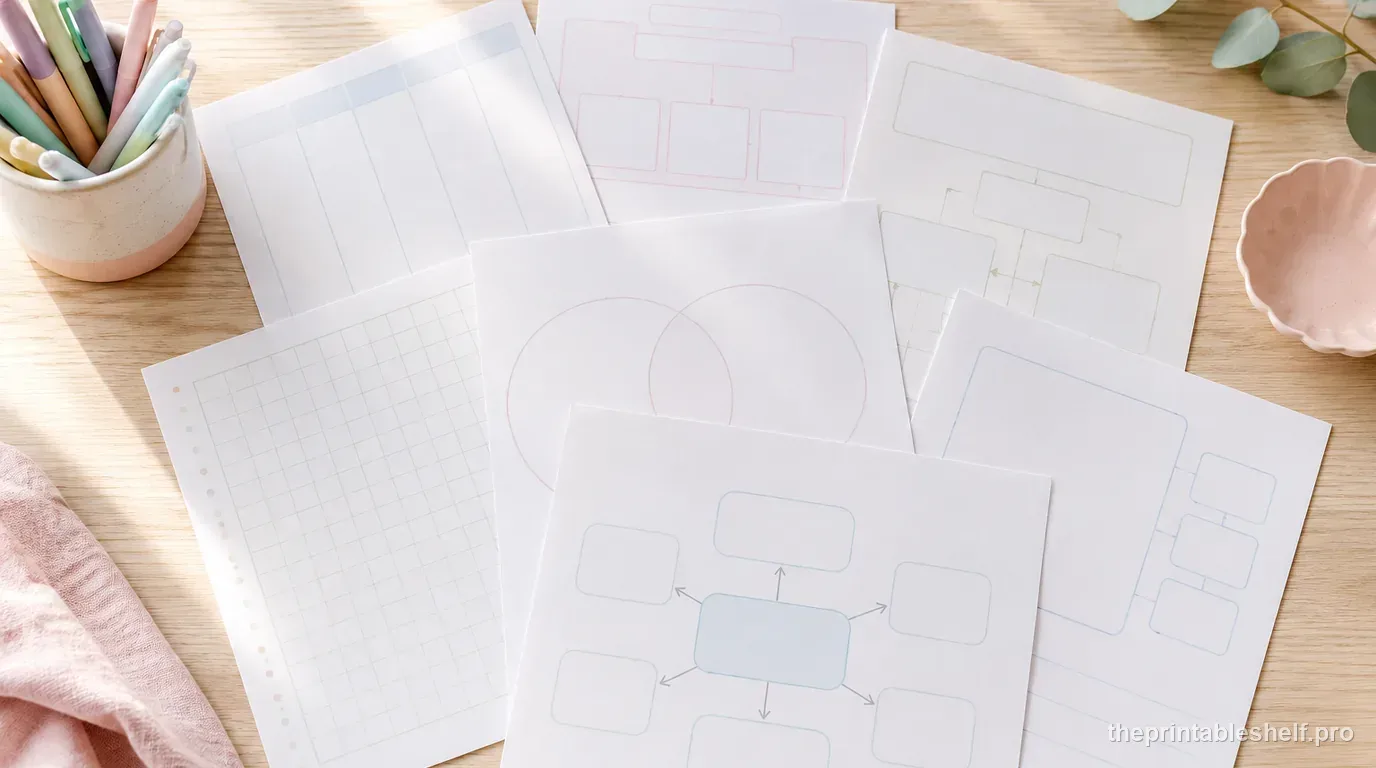
10 Free Graphic Organizers for Reading, Writing, and Studying
Download 10 free graphic organizers for reading, writing, comparison, vocabulary, sequencing, and study. Includes a guide to choosing the right one.
Read guide →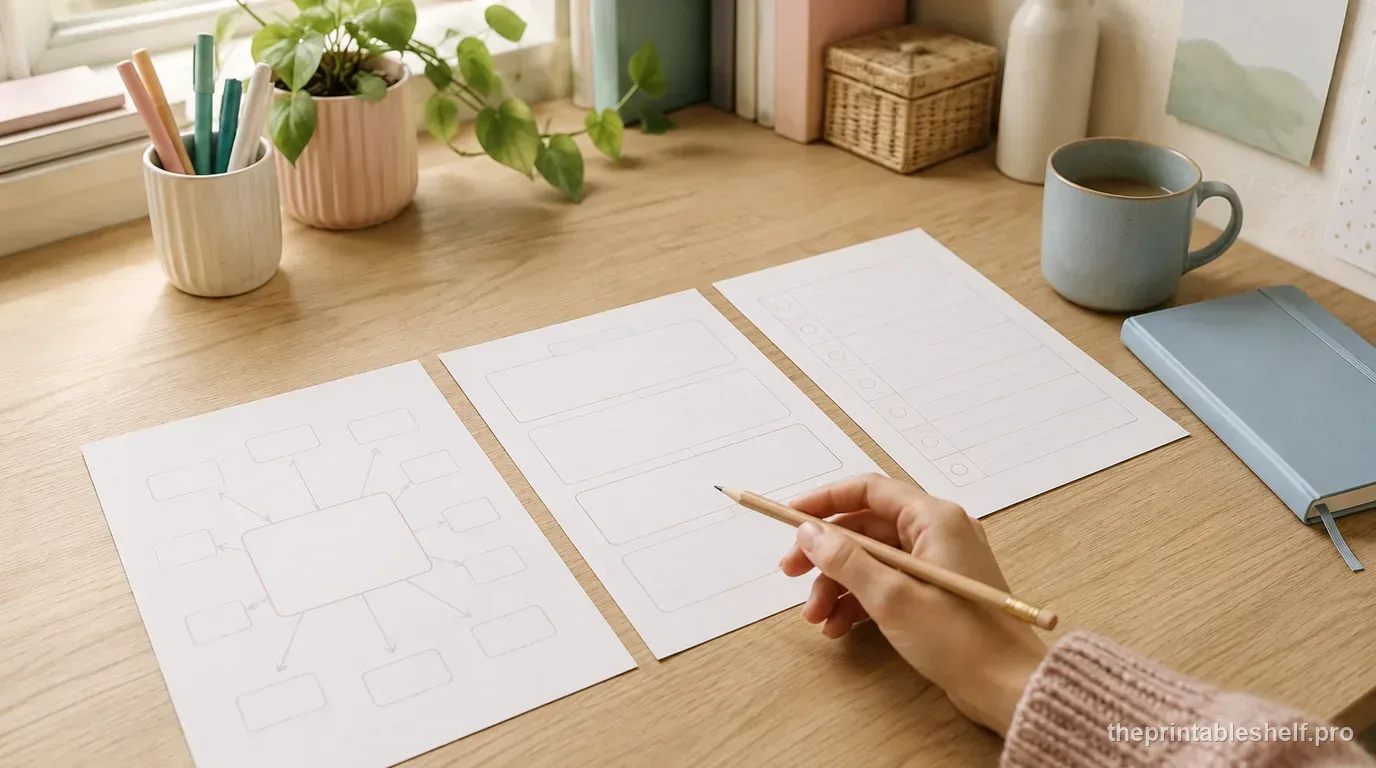
Free Writing Graphic Organizers: Which One to Use and When
Use free writing graphic organizers to plan ideas, structure paragraphs, compare evidence, sequence steps, and organize explanations before drafting.
Read guide →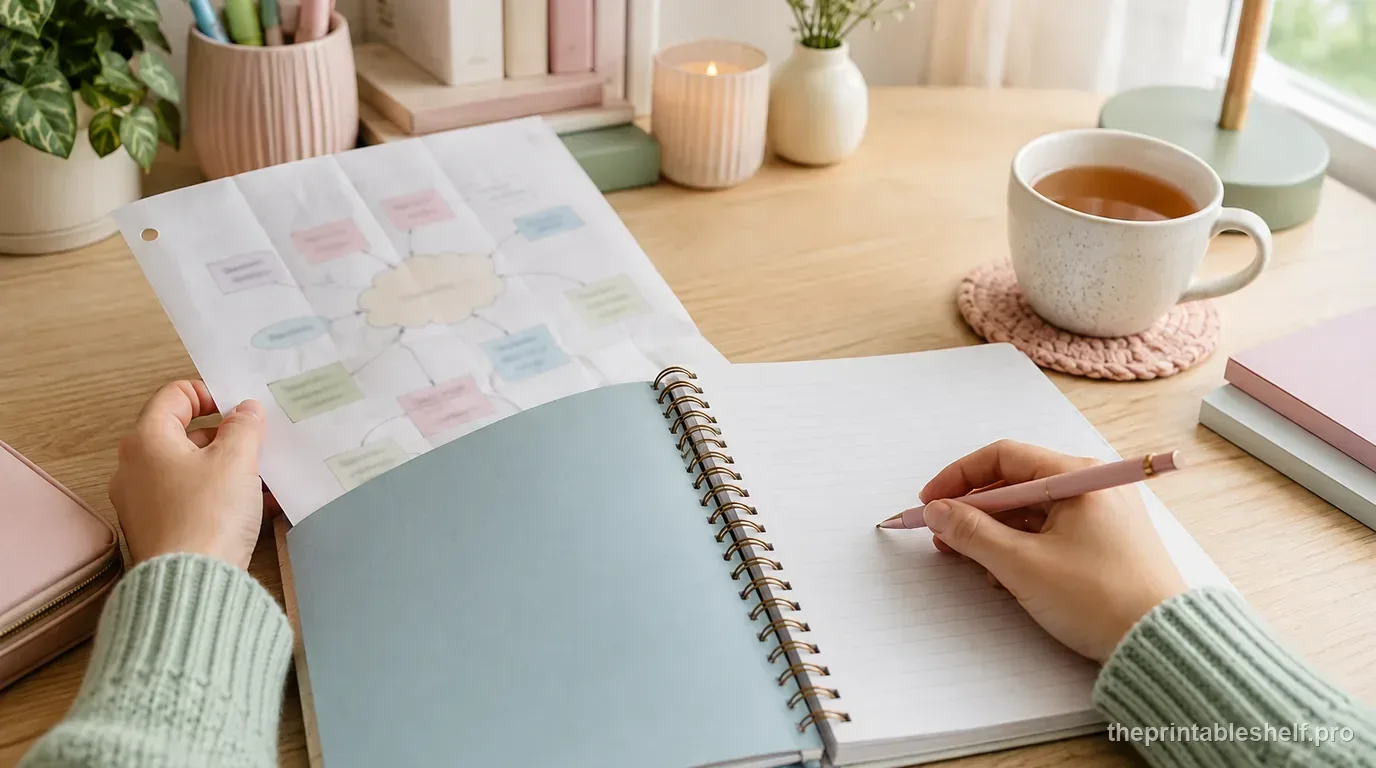
How to Use Graphic Organizers Effectively (Without Turning Them Into Busywork)
Learn how to choose, model, scaffold, and reuse graphic organizers so students think with them instead of simply filling in boxes.
Read guide →Keep organizing
You might also like
Free printable
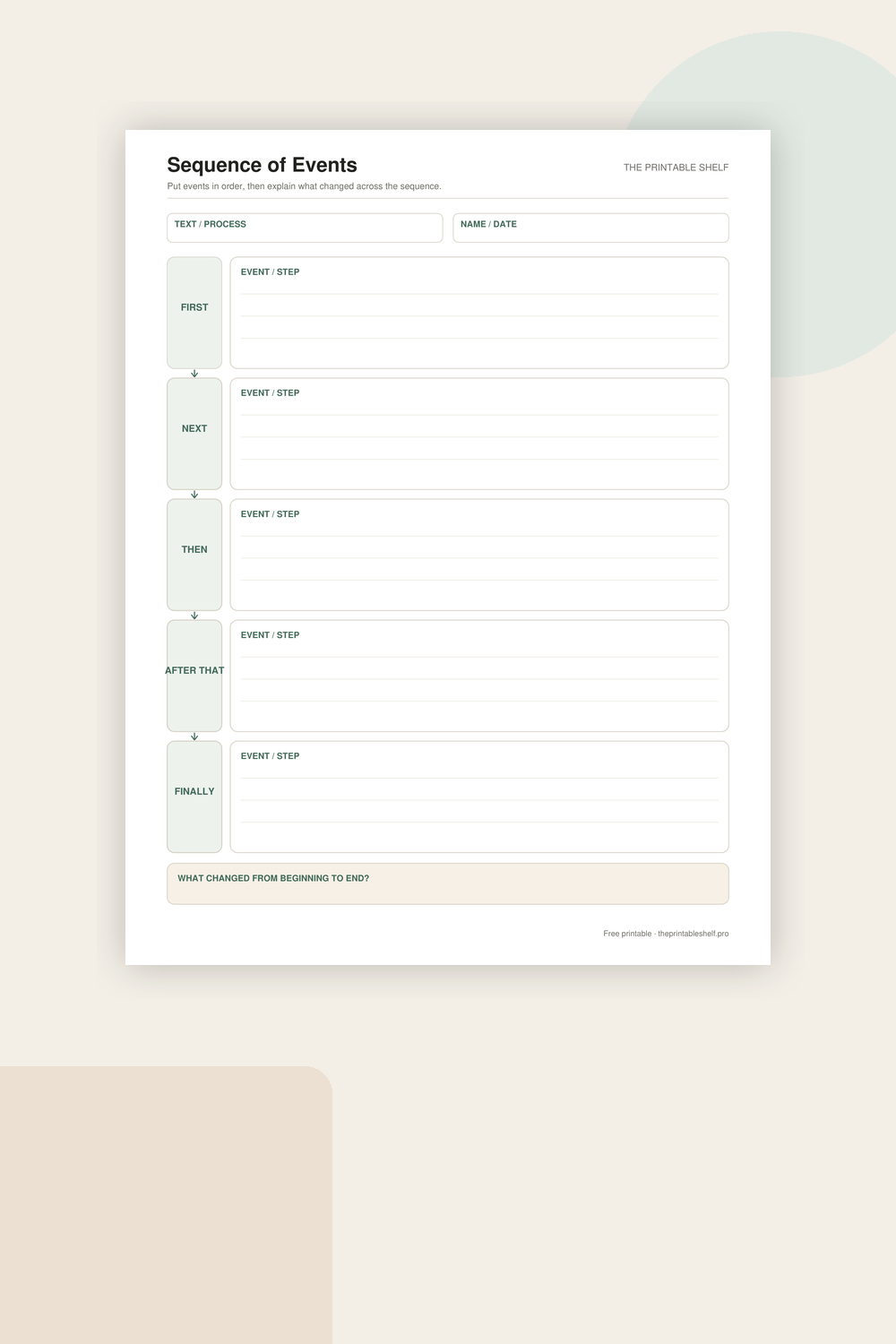
Sequence of Events Graphic Organizer
A vertical sequence chain that makes order visible without squeezing each event into tiny boxes. Five linked writing areas support short event summaries or process steps, and a final reflection box pushes the learner to notice the overall change from beginning to end rather than merely copying chronology.
Free printable
Paragraph Writing Graphic Organizer
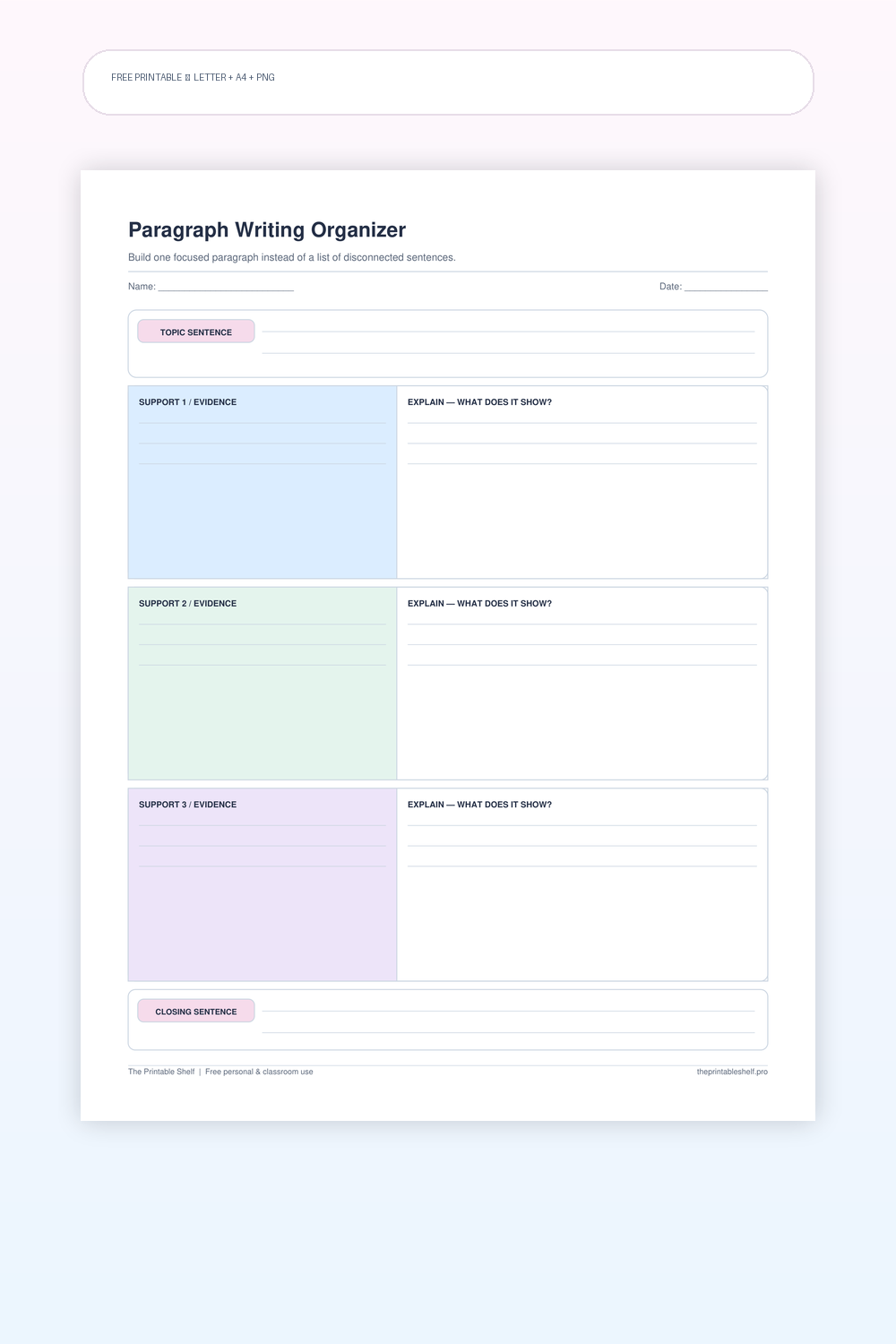
A structured single-paragraph planner that separates the job of each sentence group: establish the controlling idea, support it with relevant points, explain those points, and close without introducing a new topic. The layout borrows the clarity of a hamburger-style organizer but avoids treating paragraph writing as a rigid five-sentence formula when a supporting idea needs more than one sentence.
Free printable
Narrative Writing Graphic Organizer
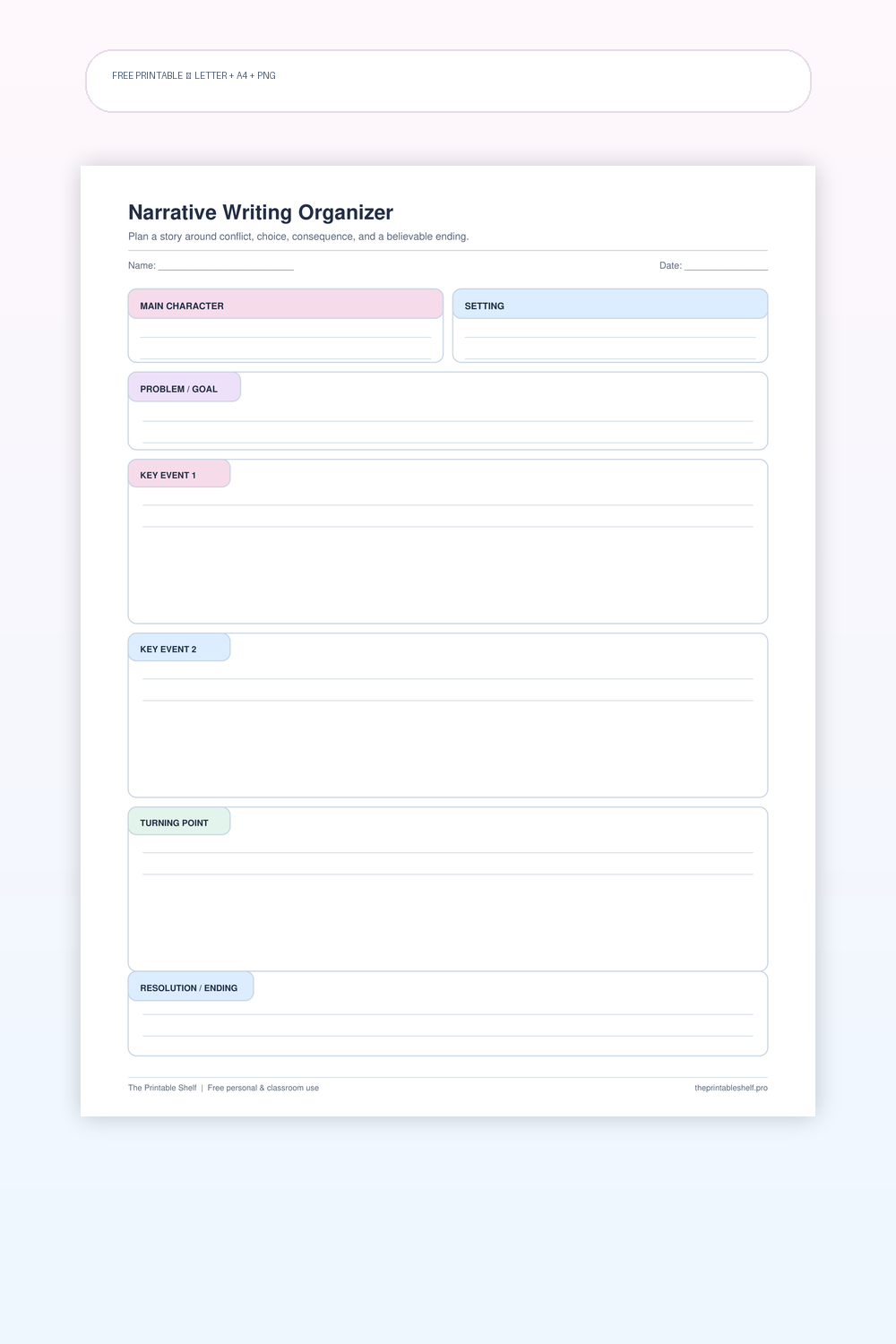
A one-page story-planning sheet for narrative and creative writing. It combines core story elements with a simple event path, giving writers more support than a blank beginning-middle-end page without turning the plan into a complicated plot diagram. The purpose is to make cause, choice, and consequence visible before the first draft begins.